Most money problems do not begin with the wrong product. They begin with one large, undefined pool of money.
The same savings account is expected to handle next month's medical bill, next year's school fee, a future house down payment, retirement planning, and sometimes a higher-return opportunity. That is too much work for one pool of money.
A bucket strategy for Indian investors solves the organisation problem first. It separates money by time horizon, liquidity need, purpose, and risk. The aim is not to find one perfect option. The aim is to make sure each rupee has a job.
For IndiaP2P lenders, this distinction matters even more. IndiaP2P enables lenders to target up to 18% p.a. indicative returns through P2P lending, but those returns depend on borrower repayments. P2P lending is not a bank deposit, not a capital-protected product, and not suitable for emergency money.
The useful question is therefore not: "Where should I put all my money?"
It is: "Which money can take which risk, over which time horizon?"
What is a Bucket Strategy in Financial Planning?
A bucket strategy is a way to divide money into separate groups, or buckets, based on when the money may be needed and what risk it can take.
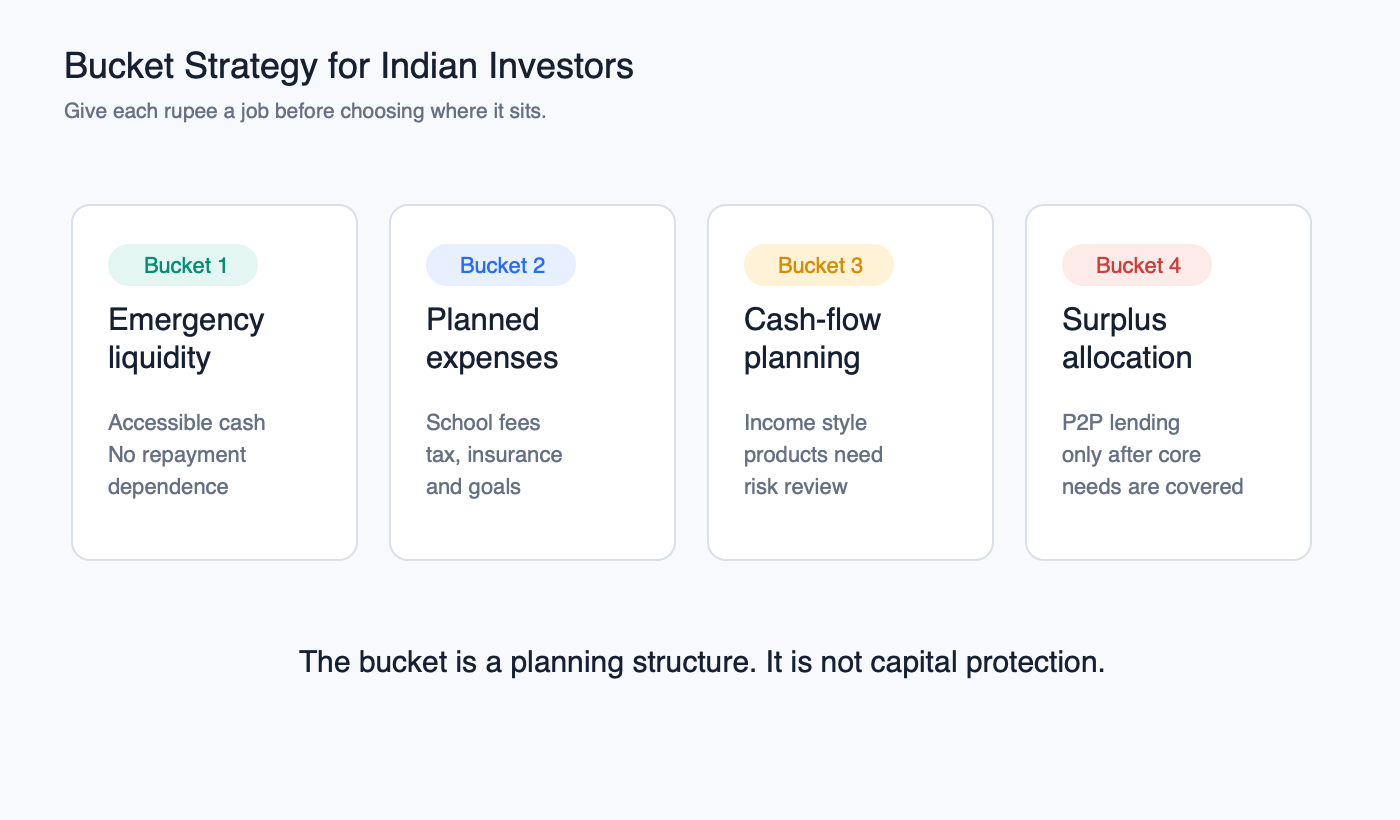
One bucket may hold emergency liquidity. Another may hold money for known expenses in the next one to three years. A third may support medium-term cash-flow planning. A fourth may hold long-term or surplus allocation where the user can tolerate more uncertainty.
The framework is simple. The discipline is harder.
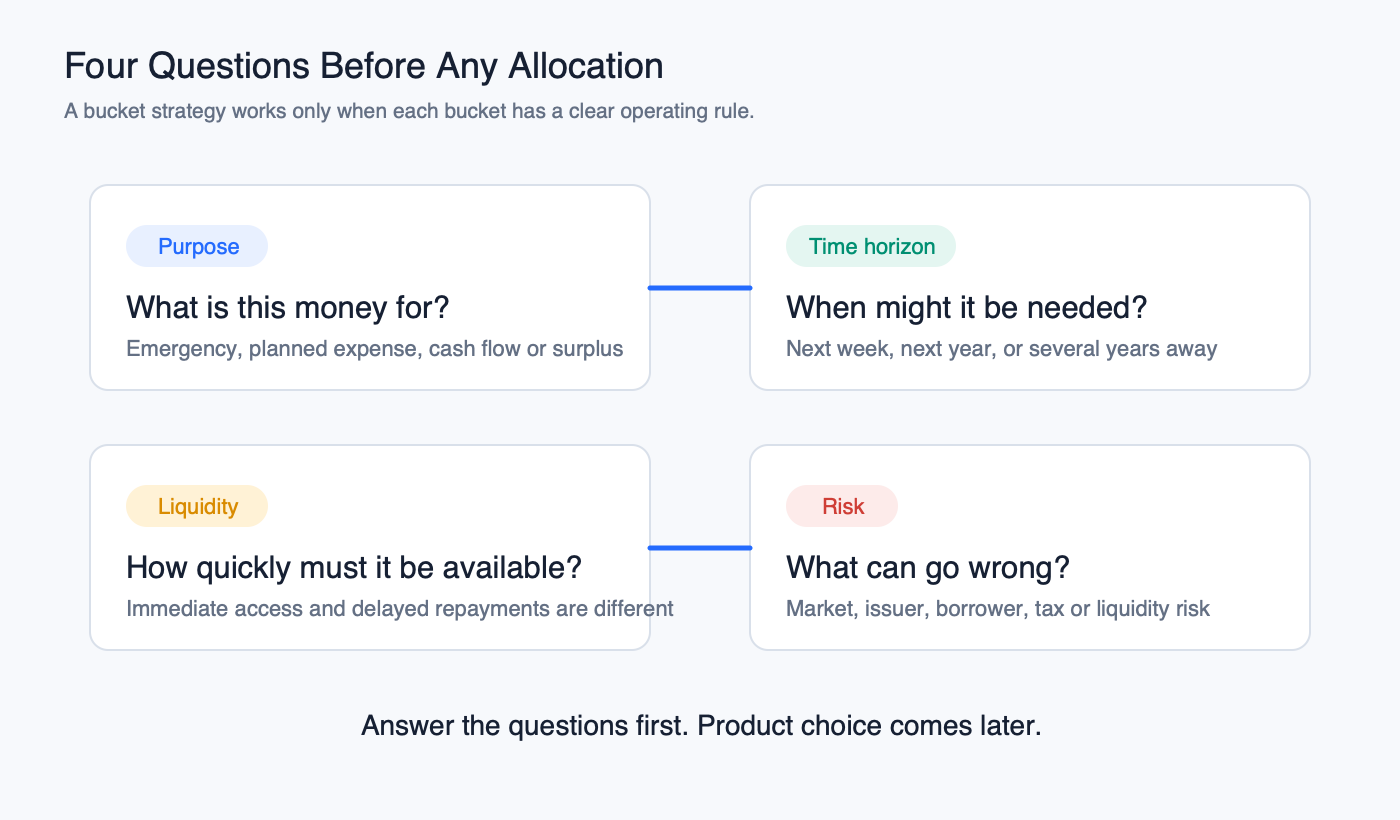
Each bucket should answer four questions:
Question | Why it matters |
|---|---|
What is this money for? | A school fee, emergency reserve, retirement goal, or surplus allocation cannot be treated the same way. |
When might it be needed? | Money needed soon should usually carry less timing risk. |
How liquid should it be? | Some money must be available quickly; some can wait for maturity or repayment. |
What can go wrong? | Every bucket has a risk engine: market movement, issuer risk, borrower default risk, inflation, tax, or liquidity. |
Bucket Strategy vs Asset Allocation
Bucket strategy and asset allocation are related, but not identical.
Asset allocation asks how money is spread across categories such as cash, fixed income, equity, gold, or alternative lending. A bucket strategy asks what each portion of money is meant to do.
For example, two people may both hold cash, fixed-income products, equity funds, and P2P lending exposure. Their bucket strategy can still differ if one person needs near-term liquidity and the other has stable income, fewer liabilities, and more surplus.
This is why buckets should not become decorative labels. They should change behaviour. If a bucket is meant for emergencies, it should not chase higher returns. If a bucket is meant for long-term growth, it should not be interrupted for a discretionary short-term purchase.
How a Bucket Strategy for Indian Investors Work
There is no single correct number of buckets. Three is common. Four can be more practical for Indian households because it separates emergency money from planned expenses and keeps higher-risk surplus allocation clearly marked.
Bucket 1: Emergency Liquidity
This bucket is for money that may be needed without notice.
It may cover medical expenses, job loss, urgent travel, temporary income gaps, or family obligations. The focus is access and stability, not return maximisation.
This bucket is not the place for P2P lending. It is also not the place for any product where exit depends on market conditions, borrower repayment, lock-in rules, or platform terms.
The size of this bucket depends on income stability, dependents, health needs, existing insurance, and household obligations. A salaried household with two incomes may need a different buffer from a freelancer, business owner, or retiree.
Bucket 2: Planned Expenses in the Next 1-3 Years
This bucket is for expenses that are visible but not immediate.
Examples include annual school fees, insurance premiums, tax payments, a home renovation, a vehicle purchase, a wedding expense, or a planned down payment.
The job of this bucket is timing discipline. If the expense is likely within the next one to three years, the money should not be placed where a market fall, borrower delay, or exit constraint can disturb the plan.
The important principle: planned money should remain boring. A bucket strategy fails when near-term money is quietly moved into higher-risk products because the headline return looks attractive.
Bucket 3: Medium-Term Cash Flow and Income Planning
This bucket is for money that does not need same-day access but still needs some cash-flow visibility.
Depending on the person, this may include fixed deposits, debt-oriented products, bonds, annuities, or other income-style options. Each has different risk, tax treatment, liquidity, and suitability. A bucket strategy does not rank them. It simply forces the investor to ask what role each option is playing.
This is also where some people begin evaluating P2P lending as a cash-flow layer, provided the emergency and planned-expense buckets are already handled.
Bucket 4: Long-term Growth and Surplus Allocation
This bucket is for money that can stay allocated for longer.
It may include long-term growth assets, retirement planning, wealth transfer goals, or surplus capital that is not tied to essential expenses. The key is that this bucket can tolerate more movement, delay, or uncertainty than the first two buckets.
For a P2P lender, this is the more appropriate zone to evaluate P2P lending. Even then, the sizing should be measured. P2P lending involves borrower repayment risk, so it should not carry money that the household cannot afford to see delayed or impaired.
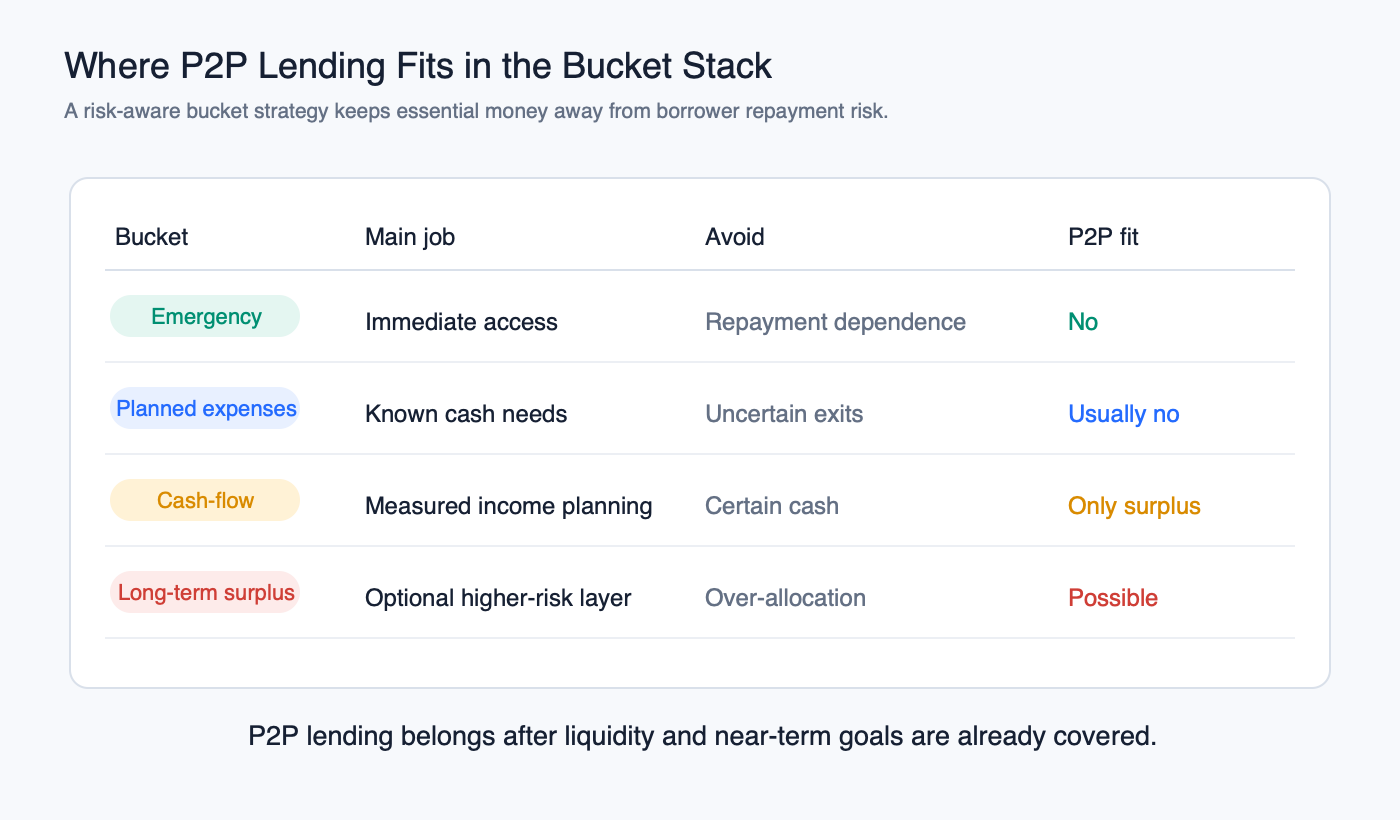
Bucket | Time horizon | Main job | What to avoid | Where P2P lending fits |
|---|---|---|---|---|
Emergency liquidity | Immediate to 12 months | Access and resilience | Chasing returns, lock-ins, repayment dependence | Does not fit |
Planned expenses | 1-3 years | Known cash needs | Volatility, uncertain exits, borrower repayment dependence | Usually does not fit |
Medium-term cash flow | 3-5 years, depending on need | Cash-flow visibility and measured risk | Treating scheduled income as certain | May fit only for surplus money |
Long-term and surplus | 5+ years or flexible | Growth, opportunity, higher risk capacity | Over-allocation and poor monitoring | May fit as a measured lending bucket |
Where P2P Lending Can Fit in a Bucket Strategy
P2P lending connects lenders with borrowers through an online platform. IndiaP2P is registered with the Reserve Bank of India as an NBFC-P2P. Under the RBI's NBFC-P2P framework, a platform acts as an intermediary for loan facilitation; it does not act as a deposit-taker or guarantor of borrower repayment.
On IndiaP2P, lenders may target up to 18% p.a. indicative returns. That number should always be read beside the risk: borrower repayments may be delayed, partly received, or not received. There is no guarantee of principal or interest.
This makes P2P lending very different from an emergency bucket. The cash flow may be monthly, but it is still borrower-linked. A repayment schedule is an expectation, not a promise.
IndiaP2P's Monthly Income Plan Plus can be reviewed as a borrower-linked monthly repayment structure. Before lending, a user should understand the P2P lending repayment process, including what happens after funds are matched, how EMIs are tracked, and how delayed repayments are handled.
Why P2P Lending is not the Emergency Bucket
Emergency money needs high certainty of access. P2P lending does not offer that kind of certainty.
The lender's cash flow depends on borrowers making repayments as scheduled. Even when loans are diversified across borrowers, some repayments can be delayed. If emergency money is placed into P2P lending, the household may be forced to depend on cash that has not arrived yet.
That is the wrong order of risk.
Build the emergency bucket first. Then evaluate whether surplus money can be lent through a P2P platform.
How Borrower Repayments Create Expected Cash Flow
In P2P lending, cash flow usually comes from borrower repayments. These repayments may include principal and interest, depending on the loan structure.
The clean way to manage this inside a bucket strategy is to separate three numbers:
Number | Meaning | How to use it |
|---|---|---|
Scheduled repayment | What the repayment timetable expects | Useful for planning |
Received repayment | What has actually arrived | Better base for decisions |
Delayed repayment | What has not arrived as expected | Risk signal to monitor |
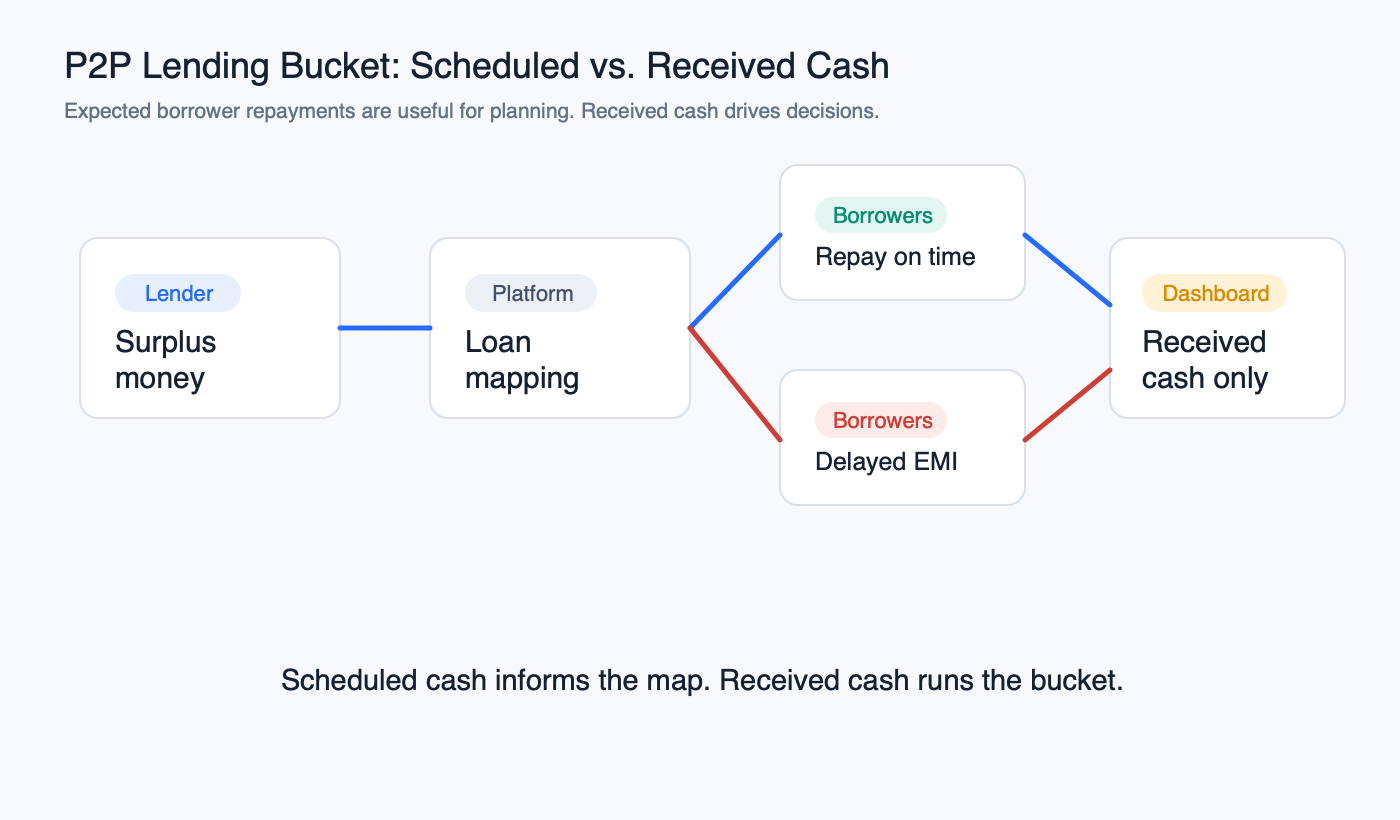
A lender should not plan essential expenses around scheduled repayments. The more practical rule is: use received cash for action, and use delayed cash as a monitoring signal.
A Practical Bucket Strategy Example for an Indian Household
Consider a household with monthly income, predictable annual expenses, and some surplus after insurance, essential savings, and loan EMIs.
This is not a recommended allocation. It is only an illustration of how the decision process can work.
Money type | Possible bucket | Decision logic |
|---|---|---|
Three to six months of essential expenses | Emergency liquidity | Keep accessible; do not depend on borrower repayments or market exits. |
School fees due in nine months | Planned expenses | Prioritise timing and low volatility over return. |
Annual insurance and tax payments | Planned expenses | Keep maturity or withdrawal dates aligned to the expense. |
Money not needed for 3-5 years | Medium-term planning | Evaluate risk, tax, liquidity, and cash-flow needs. |
Surplus after core goals are covered | Long-term or surplus bucket | Can evaluate P2P lending if borrower repayment risk is understood. |
Now assume the household is evaluating a small P2P lending bucket. The better question is not "How much return can this earn?" The better question is:
"If some borrower repayments are delayed, will the rest of my financial plan still work?"
If the answer is no, the amount does not belong in P2P lending. If the answer is yes, the lender can then review borrower spread, tenure, expected repayments, delayed repayment reporting, and exposure limits.
The bucket strategy creates this pause. It prevents a return number from doing all the thinking.
Common Mistakes When Using a Bucket Strategy
The first mistake is treating buckets as protection. A bucket is a label and a process. It does not remove market risk, issuer risk, borrower default risk, liquidity risk, tax impact, or inflation.
The second mistake is putting emergency money into products that depend on someone else's repayment schedule. If the money must be available quickly, it should not sit in a bucket that requires borrower repayment to arrive on time.
The third mistake is comparing only headline return. A bank deposit rate, bond yield, mutual fund return, annuity payout, and P2P indicative return do not come from the same risk engine.
The fourth mistake is treating scheduled cash flow as certain cash flow. This is especially relevant for P2P lending. The useful operating number is received repayment, not only scheduled repayment.
The fifth mistake is confusing date spread with diversification. A product can be spread across dates but still concentrated in one issuer, one borrower type, one platform, or one risk factor.
The sixth mistake is re-lending every repayment automatically without revisiting the household's cash needs. A repayment should trigger a decision: withdraw, hold, or consider fresh lending after review.
How to Decide Whether P2P Lending Belongs in Your Bucket Strategy
P2P lending may be considered only after the first two buckets are stable.
Before lending, ask:
Are emergency expenses covered outside P2P lending?
Are near-term planned expenses covered outside P2P lending?
Can I tolerate delayed or lower-than-expected cash flow?
Do I understand that borrower default can affect principal and interest?
Is the amount spread across enough borrowers to reduce concentration risk?
Do I understand the exposure caps under the RBI NBFC-P2P framework?
Can I track repayments instead of ignoring the dashboard?
Am I using surplus money, not money needed for essentials?
RBI caps total exposure across all P2P platforms at ₹50 lakh per lender and exposure to a single borrower at ₹50,000. A lender should also note that RBI registration of an NBFC-P2P platform is a regulatory status. It is not an RBI assurance of repayment or returns.
If you are new to the category, start with IndiaP2P's first-time lender guide and then review how to choose P2P lending tenure before deciding whether P2P lending fits your surplus bucket.
Conclusion: Buckets Organise Decisions; They Do Not Remove Risk
A bucket strategy helps Indian investors organise money by purpose, time horizon, liquidity, and risk.
That organisation is useful. It can stop emergency money from chasing returns. It can separate planned expenses from long-term goals. It can also show where P2P lending may fit: not as a substitute for liquidity, but as a measured surplus lending bucket for people who understand borrower repayment risk.
The right question is not "which bucket earns the most?"
The right question is: "Which money can take which risk, for how long, and with what monitoring?"