P2P lending for NRIs in India is not a topic to approach through return numbers alone. It sits at the intersection of RBI's NBFC-P2P framework, FEMA rules for resident and non-resident transactions, bank-account routing, tax treatment, and borrower repayment risk.
That makes the first question very simple:
Can an NRI lend through an Indian peer-to-peer lending platform at all?
The answer should not be assumed from a generic registration page, a high-return claim, or an old article. NRIs should first confirm their eligibility, permitted account route, repatriation treatment, tax position, and the current policy of the relevant RBI-registered NBFC-P2P platform.
Only after that does the lending decision begin.
IndiaP2P is registered with the Reserve Bank of India as an NBFC-P2P. That is a regulatory fact, not an RBI endorsement of returns or repayment. P2P lending is not a deposit product. Principal is not protected. Returns are not guaranteed. Borrowers may delay, partly repay, or default.
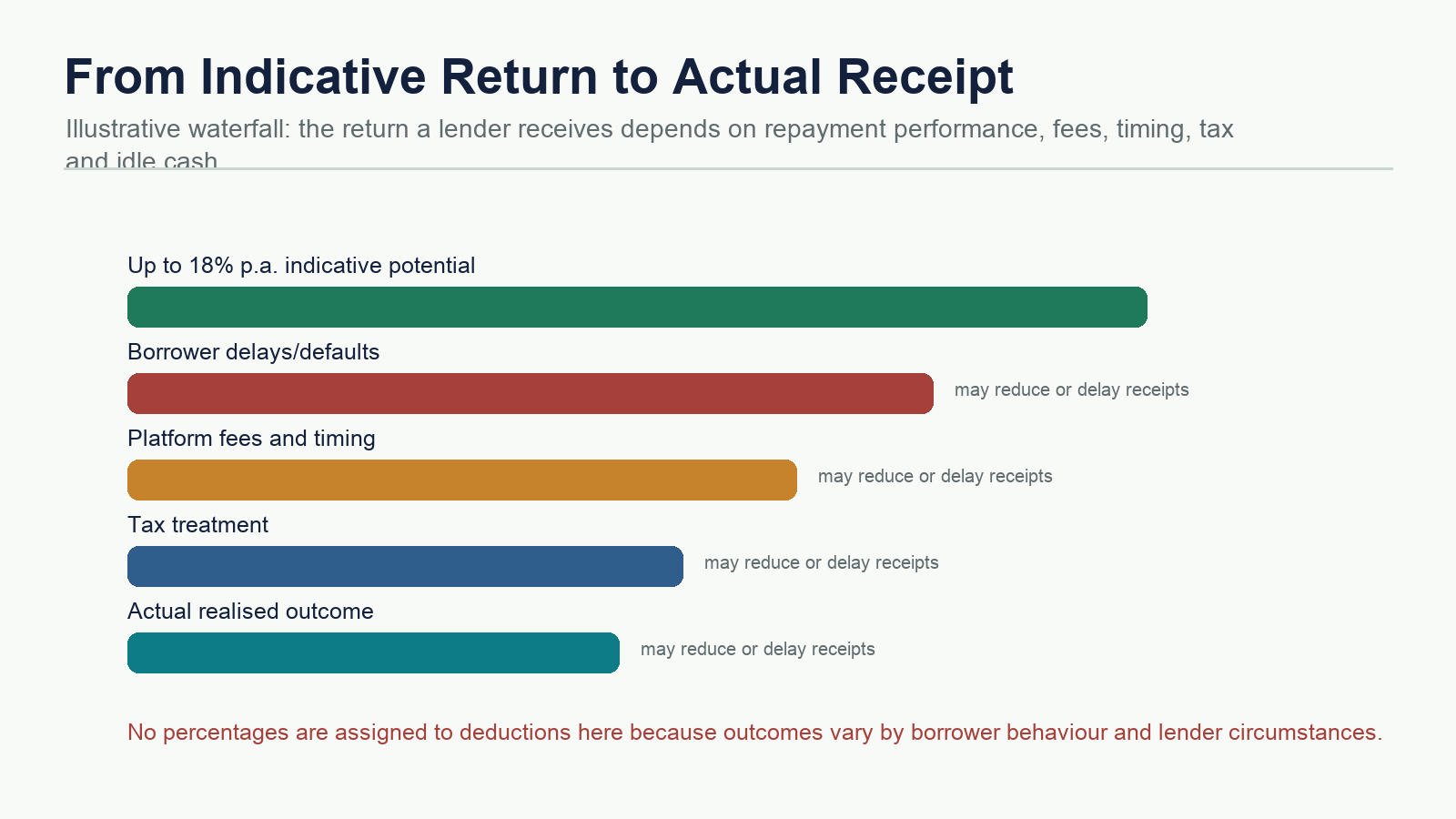
Where IndiaP2P refers to indicative return potential of up to 18% p.a., it should be read with that risk context: actual receipts depend on borrower repayment performance, fees, timing, defaults, tax treatment, platform terms, and whether the person is eligible to lend in the first place.
This guide explains the checks an NRI should complete before considering P2P lending in India.
Can NRIs Do P2P Lending in India? Start With Eligibility
For NRIs, P2P lending begins with eligibility, not product selection.
Indian P2P lending platforms operate under the Reserve Bank of India's NBFC-P2P framework. Under that framework, the platform facilitates lending between participants. It is not a bank, not a deposit-taker, and not a guarantor.
The RBI Master Directions for NBFC-P2P platforms also state that an NBFC-P2P must not permit international flow of funds and must ensure adherence to legal requirements applicable to participants. That matters for NRIs because a non-resident's money movement, account usage, and permitted rupee transactions are governed by FEMA and RBI directions.
So the practical answer is:
An NRI should not assume they can lend through an Indian P2P platform until the platform and the NRI's advisor confirm that the proposed lending route is permitted.
This is especially important because online pages may use broad words like "NRI registration," "P2P for NRIs," or "lend from abroad." Those phrases do not settle the legal and operational question. The actual answer depends on the person's current residential status, account route, source of funds, repayment destination, tax treatment, and the platform's own eligibility policy.
NRI P2P Lending India FEMA Checks Before You Lend
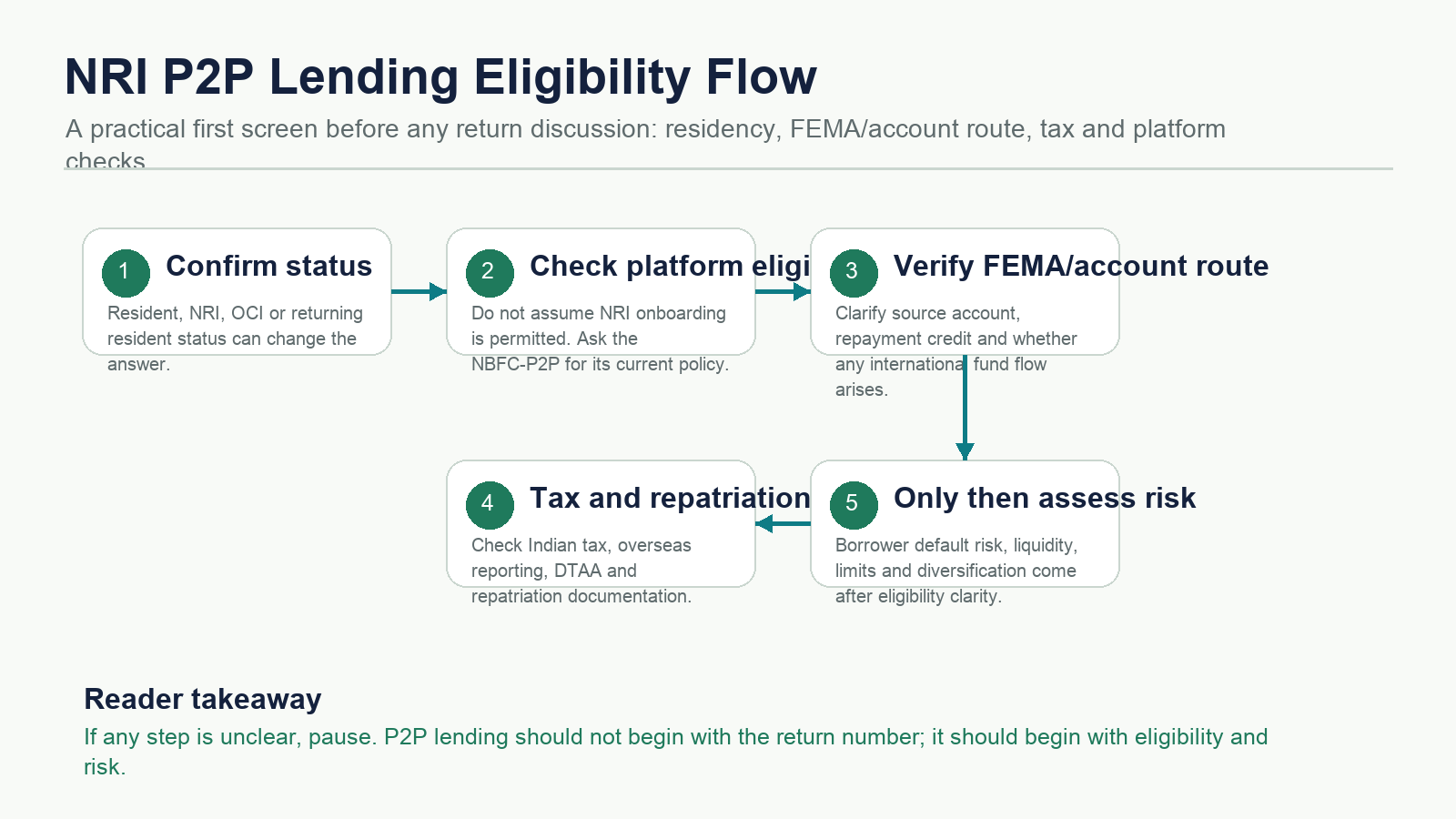
FEMA is the reason this topic needs care.
The relevant questions are not only "Is P2P lending legal in India?" or "Is the platform registered with RBI?" Those are necessary checks, but not sufficient for an NRI.
An NRI should ask:
FEMA / eligibility check | Why it matters |
|---|---|
What is my current residential status under FEMA? | A person resident in India and a person resident outside India are treated differently. |
Does the platform currently allow NRIs or OCIs as lenders? | Platform policy may be narrower than general P2P rules. |
Which account can be used to lend, if permitted? | NRE, NRO, FCNR and resident accounts have different rules. |
Where will repayments be credited? | Principal and interest routing may affect tax and repatriation treatment. |
Does any international flow of funds arise? | RBI's NBFC-P2P framework restricts international fund flow through P2P platforms. |
Is the proposed route documented by the platform and advisor? | Verbal comfort is not enough for a regulated financial transaction. |
RBI's Master Direction on INR borrowing and lending transactions between persons resident in India and NRIs/PIOs is a separate framework from the NBFC-P2P directions. It should be reviewed with a qualified professional before any NRI treats P2P lending as permissible.
This article is educational. It is not legal or tax advice.
NRE, NRO and FCNR Account Questions for P2P Lending
The account route is not a back-office detail. It is central to whether an NRI can participate and how cash flows are treated.
Before lending through any NBFC-P2P platform, an NRI should clarify the following with the platform, the bank, and a qualified tax/FEMA advisor:
Account question | What to clarify |
|---|---|
Can funds come from an NRE account? | Whether the platform permits it and whether the route creates a prohibited flow. |
Can funds come from an NRO account? | Whether lending and repayments are permitted through NRO under the current structure. |
Can FCNR funds be used? | Whether conversion, account movement or FEMA treatment creates restrictions. |
Where are borrower repayments credited? | Whether principal and interest go to NRO, resident account, or another permitted account. |
Can repayments be repatriated? | Repatriation is a separate question and may require tax documentation. |
What tax documents are generated? | Interest receipts, TDS treatment, ITR reporting, and overseas reporting may apply. |
If the platform cannot answer these questions clearly, the safer response is to pause.
NRI P2P Lending India FEMA Scenarios to Discuss With an Advisor
NRI status is not one single situation. Two people who both describe themselves as NRIs may have very different facts.
One may have recently moved abroad but still hold Indian income and an NRO account. Another may have lived overseas for ten years, file taxes in another country, and use India only for family remittances. A third may be returning to India during the year. A fourth may be an OCI with Indian assets but no current Indian salary or business income.
Each case can change the answer.
That is why an NRI should avoid generic statements such as "NRIs can lend in India" or "NRIs cannot lend in India" without checking the facts. The safer practical question is more specific:
"Given my residential status, bank account, source of funds, repayment destination, tax residency and the platform's current policy, am I permitted to lend through this NBFC-P2P platform?"
Here are the scenarios worth discussing before any lending decision.
NRI situation | Practical question to ask |
|---|---|
NRI living abroad with NRE and NRO accounts | Which account, if any, can be used without creating an impermissible fund flow? |
NRI with existing Indian income credited to NRO | Can NRO balances be used for this purpose under current rules and platform policy? |
NRI planning to return to India | Should the person wait until residential status is clear? |
Resident who later becomes an NRI | What happens to existing lending exposure after status changes? |
OCI with Indian bank accounts | Does the platform treat OCI eligibility differently from NRI eligibility? |
NRI with overseas tax residency | What reporting is needed outside India if interest is received in India? |
The important point is not to solve FEMA from a blog article. The point is to know which questions to take to the platform, bank and advisor.
Returning Resident P2P Lending Eligibility
Returning residents need special care because their status may change during the year.
A person may begin the year as non-resident and later become resident under FEMA or tax rules. Or the person may be physically present in India for a period but still have open NRE/NRO banking arrangements that need to be redesignated or reviewed with the bank.
For P2P lending, this creates practical questions:
Should the person wait until bank accounts are updated?
Should lending be considered only after residential status is clear?
What happens to repayments if the account type changes?
Does the platform require a fresh KYC or declaration?
Are previous overseas tax-reporting obligations still relevant?
A returning resident should not rely on last year's status. The platform's eligibility check should match the current facts.
Existing India Assets and NRO Account P2P Lending Questions
Many NRIs hold Indian assets through an NRO account. Rental income, dividends, pension, sale proceeds and other India-sourced receipts may sit there.
That does not automatically mean the money can be used for P2P lending.
Before using NRO funds, an NRI should clarify:
whether the platform permits NRO-funded lending;
whether the bank permits the transaction type;
whether repayments can be credited back to NRO;
whether interest receipts are treated as taxable income in India;
whether the funds can later be repatriated;
what tax forms or certifications may be required;
whether the platform's escrow flow creates any issue under its current policy.
This is where many broad NRI financial articles become too casual. "You have an NRO account" is not the same as "every rupee use is permitted for every regulated product."
For P2P lending, account permission, platform permission and FEMA treatment all need to align.
Peer-to-Peer Lending for NRIs: How the Model Works
Peer-to-peer lending connects lenders and borrowers through a digital platform. In India, a platform carrying on the business of peer-to-peer lending must be registered with RBI as an NBFC-P2P.
In a typical P2P flow:
A borrower applies for a loan.
The platform performs participant due diligence and borrower credit assessment.
The platform discloses relevant borrower, pricing, fee and risk information to prospective lenders.
Lenders choose whether to lend, subject to platform rules and RBI limits.
Loan agreements are executed.
Funds move through prescribed escrow accounts.
Borrowers repay principal and interest as per the loan schedule.
Lenders receive repayments if borrowers pay as agreed.
For NRIs, this model has one additional layer: the person must first be eligible to participate and must use a permitted fund route.
RBI-Registered NBFC-P2P Platform Role in P2P Lending
An RBI-registered NBFC-P2P platform is an intermediary. It provides loan facilitation services through an online medium or otherwise.
That does not mean the platform becomes the borrower. It does not mean RBI has approved the return. It does not mean the lender's principal is insured. It does not mean the platform can absorb borrower credit risk.
Under RBI's NBFC-P2P directions, the platform may undertake due diligence, borrower credit assessment, documentation, repayment assistance, and recovery support. It must also disclose its credit assessment methodology, grievance redressal mechanism, performance information, fees, and terms.
But if a borrower fails to repay, the loss of principal, interest, or both is borne by the lender.
That is the heart of P2P lending.
P2P Escrow Account Flow for Lenders and Borrowers
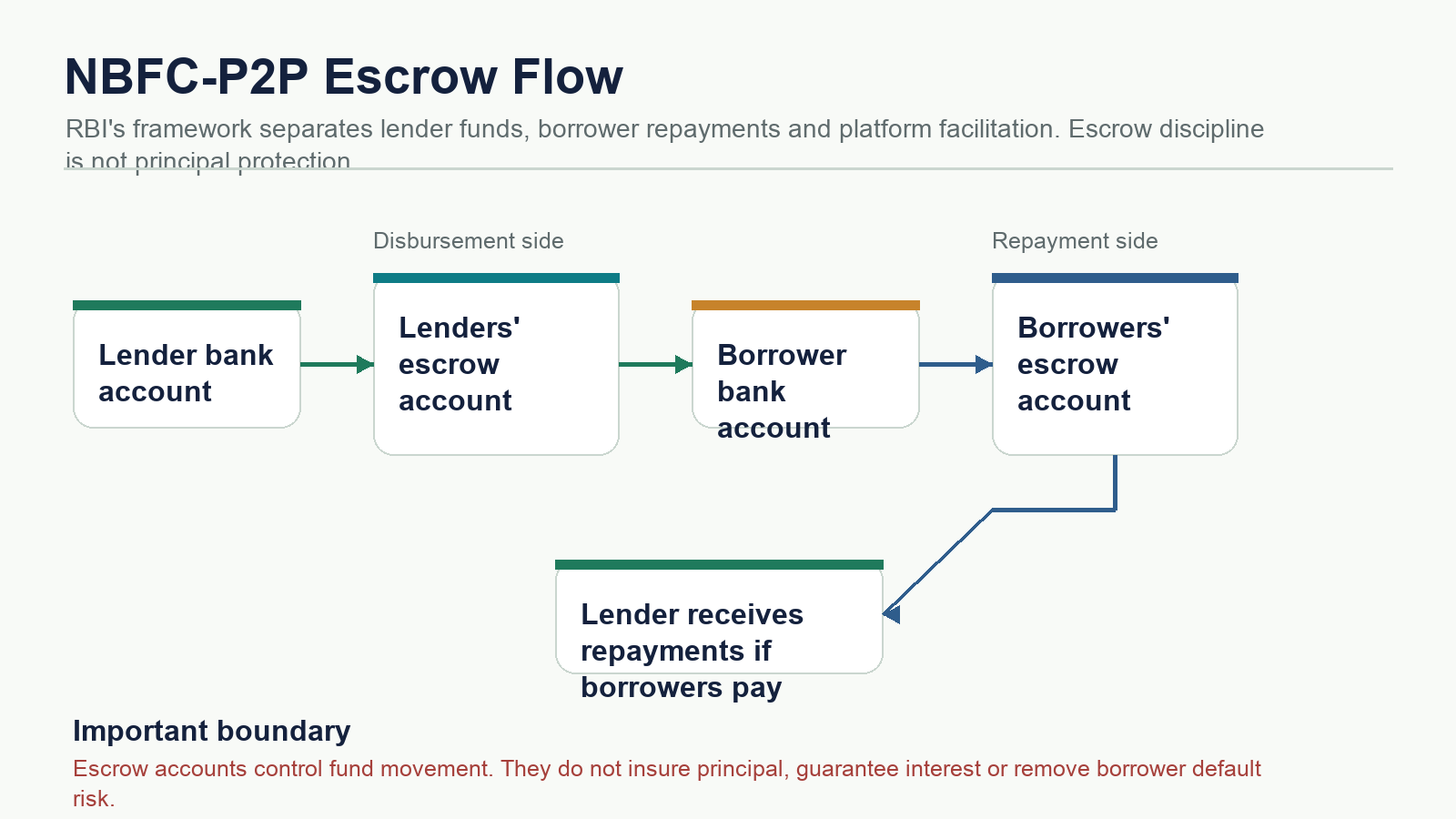
RBI's framework requires fund transfers between participants on a P2P platform to happen through escrow account mechanisms operated by a bank-promoted trustee.
At least two escrow accounts are maintained:
Escrow account | Purpose |
|---|---|
Lenders’ escrow account | Holds funds received from lenders pending disbursal to matched borrowers. |
Borrowers’ escrow account | Holds collections from borrowers before transfer to respective lenders. |
The lender's money moves from the lender's bank account to the lenders' escrow account and then to the specific borrower's bank account after matching, approval, and agreement execution. Borrower repayments move from the borrower's bank account to the borrowers' escrow account and then to the lender's bank account.
Cash transactions are not permitted. Funds in escrow accounts should not remain there beyond the period specified in the RBI framework.
Escrow improves fund-flow discipline. It does not protect principal.
RBI NBFC-P2P Rules for Lenders in India
The RBI NBFC-P2P framework is important because it defines the platform's boundary.
For lenders, the most relevant rules are:
RBI NBFC-P2P rule | What it means for a lender |
|---|---|
Platform acts as intermediary | The platform facilitates lending; it is not the borrower or guarantor. |
No credit enhancement or credit guarantee | The platform cannot arrange protection that makes repayment appear assured. |
Platform cannot assume credit risk | Borrower default risk remains with the lender. |
Lender consent is required | No loan should be disbursed unless matching, approval and agreements are complete. |
Fees must be disclosed upfront | Lenders should know fees before lending. |
Risk declaration is required | Lenders must understand that principal and interest are not assured. |
Escrow mechanism is mandatory | Funds move through prescribed escrow accounts, not casually through platform accounts. |
International flow of funds is not permitted | This is especially relevant for NRI eligibility and account-route checks. |
For an NRI, the final line is the one that cannot be skipped.
P2P Lending Exposure Limits India: Rs 50 Lakh and Rs 50,000
RBI sets exposure limits for P2P lending.
A lender's aggregate exposure across all P2P platforms must not exceed Rs 50 lakh. A single lender's exposure to the same borrower across all P2P platforms must not exceed Rs 50,000. P2P loan maturity must not exceed 36 months.
For lenders whose total exposure across P2P platforms exceeds Rs 10 lakh, IndiaP2P's existing RBI-limits explainer notes the need for a net-worth certificate from a practicing Chartered Accountant certifying minimum net worth of Rs 50 lakh.
For an NRI, exposure tracking can be harder if the person has multiple Indian financial relationships, older lending records, or accounts handled remotely. The lender should maintain a single record of:
total amount lent across all P2P platforms;
borrower-level exposure where available;
dates of lending;
scheduled maturity;
actual repayments received;
delayed or defaulted loans;
tax documents and annual statements.
The exposure cap is not a target. It is a limit.
How NRIs Should Read P2P Platform Disclosures
A P2P platform's disclosures are not paperwork to scroll past. For NRIs, they are the main source of practical truth before lending.
Read them in five layers.
First, read the eligibility layer. Look for who can become a lender, what residential status is required, what bank accounts are accepted, and whether the platform has a separate NRI policy. If the website is silent, ask before onboarding.
Second, read the regulatory layer. The platform should clearly identify the regulated entity and state that it is registered with RBI as an NBFC-P2P. It should not imply RBI endorsement, RBI approval of returns, or RBI support for repayment.
Third, read the risk layer. The disclosure should make clear that borrower default risk exists, principal is not protected, interest is not guaranteed, and the lender bears losses if borrowers do not repay. If a platform talks about return potential but buries risk language far below the page, treat that as a reason to slow down.
Fourth, read the fund-flow layer. The platform should explain how money moves from lender to escrow to borrower, and how borrower repayments return through escrow. For NRIs, this should lead to the next question: which bank account is permitted for those flows?
Fifth, read the reporting layer. NRIs may need annual statements, interest break-ups, TDS details, overdue summaries, and repayment histories for Indian and overseas tax records.
This is the difference between a return-led reading and a risk-led reading.
RBI-Registered NBFC-P2P Disclosures NRIs Should Look For
A serious P2P page should help the lender understand the regulated boundary.
Look for:
the legal name of the NBFC-P2P entity;
the brand name, if different;
RBI registration framing stated as a fact;
clear no-guarantee language;
borrower default risk disclosure;
exposure limits;
fee disclosure;
escrow flow explanation;
grievance redressal contact;
public performance disclosure, including overdue or NPA information where applicable;
credit assessment overview;
privacy and data-handling disclosure.
For IndiaP2P content, the correct framing is: IndiaP2P is registered with the Reserve Bank of India as an NBFC-P2P.
Avoid any interpretation that converts that into "RBI has approved the lending opportunity." It has not.
P2P Lending Red Flags for NRIs
NRIs should be cautious if they see:
guaranteed, fixed or assured return language;
claims that RBI has approved a return;
promises of instant liquidity from borrower loans;
unclear account-route instructions;
no explanation of borrower default risk;
return numbers presented without fees, tax and default context;
no mention of exposure limits;
no grievance contact;
pressure to lend before documents are reviewed;
unclear treatment if residential status changes.
The red flag is not only a false statement. It can also be an important missing statement.
If the page tells you the return but not the risk, ask why.
P2P Lending Not a Deposit: No Principal Protection
P2P lending is not a deposit.
This point matters for NRIs because Indian financial planning often begins with account and deposit questions: NRE deposit, NRO deposit, FCNR deposit, resident savings account, fixed deposit, remittance and repatriation.
P2P lending is different.
In a deposit, the bank or deposit-taking institution owes money to the depositor under a different legal and regulatory structure. In P2P lending, the lender is exposed to borrower loans facilitated by the NBFC-P2P platform.
That means:
the platform does not guarantee repayment;
RBI registration does not insure the lender;
escrow routing does not make the lending principal safe;
scheduled repayments are expected cash flows, not assured cash flows;
borrower default can reduce interest, principal, or both.
Do not use money needed for near-term family obligations, emergency liquidity, tax payments, property commitments, or repatriation deadlines.
P2P Lending Returns for NRIs: Read Up to 18% p.a. Carefully
Returns in P2P lending come from borrower repayments.
If a borrower pays on schedule, the lender may receive principal and interest as per the loan terms after platform processes and applicable charges. If the borrower pays late, the lender's cash flow is delayed. If the borrower defaults, the lender may lose interest, principal, or both.
IndiaP2P may enable eligible lenders to target indicative returns of up to 18% p.a. That number must be read carefully. It is not a promise, not a fixed payout, and not a standard outcome for every lender.
Actual receipts depend on:
whether the lender is eligible to lend;
borrower repayment behaviour;
delays and defaults;
fees and charges;
loan tenure;
tax treatment;
cash sitting idle between lending cycles;
platform terms;
the lender's diversification and exposure choices.
For NRIs, tax and repatriation questions can further change the realised outcome.
P2P Lending Returns Not Guaranteed: Borrower Repayment Risk
P2P lending returns are not guaranteed because borrower repayment is not guaranteed.
That is not a footnote. It is the main risk.
A borrower may:
pay on time;
pay after a delay;
make partial payments;
restructure or settle depending on recovery outcomes and platform processes;
default.
Each outcome affects the lender differently. A delayed EMI can interrupt monthly cash planning. A partial repayment can reduce expected interest. A default can affect principal recovery.
For an NRI, the operational burden can also be higher. The lender may be in a different time zone, may file taxes in more than one jurisdiction, and may need cleaner documentation for Indian and overseas reporting.
The return number should be the last line of the decision, not the first.
NRI Tax on P2P Lending Interest and Repatriation Questions
Tax treatment depends on individual circumstances and may change. NRIs should consult a qualified tax advisor before lending.
At a minimum, ask:
Tax / repatriation question | Why it matters |
|---|---|
Is P2P interest taxable in India for me? | Interest income may need to be reported in India. |
Is any TDS applied? | TDS treatment affects cash received and filing. |
Do I need to file an Indian ITR? | Filing depends on income, tax deducted, and individual circumstances. |
Does my country of residence tax this income? | Overseas reporting may apply. |
Can DTAA relief apply? | Double Taxation Avoidance Agreement treatment depends on facts and documents. |
Can repayments be repatriated? | Repatriation may require tax payment, Form 15CA/15CB, bank checks, or other documentation. |
What statements will the platform provide? | Annual statements, loan-level reports, interest break-up and default records may be needed. |
Do not treat pre-tax indicative return potential as the same thing as post-tax cash available overseas.
Borrower Default Risk in P2P Lending for NRIs
Borrower default risk is the possibility that a borrower does not repay as agreed.
This risk exists even when the borrower was assessed before loan listing. Credit assessment can reduce poor selection, but it cannot predict every job loss, health event, business disruption, fraud, cash-flow shock, or behavioural change.
Under the RBI NBFC-P2P framework, the platform cannot assume credit risk directly or indirectly. It cannot provide or arrange a credit guarantee. It cannot promote P2P lending as an assured-return product.
For a lender, this means losses are possible.
For an NRI, the risk review should include:
Am I able to monitor repayments remotely?
Do I understand what happens if a borrower is overdue?
How does the platform report delays, NPAs, recoveries and losses?
Will I receive enough documentation for tax filing?
Can I tolerate principal loss without affecting overseas or India-linked obligations?
Is this money genuinely surplus?
P2P Lending Diversification Across Borrowers
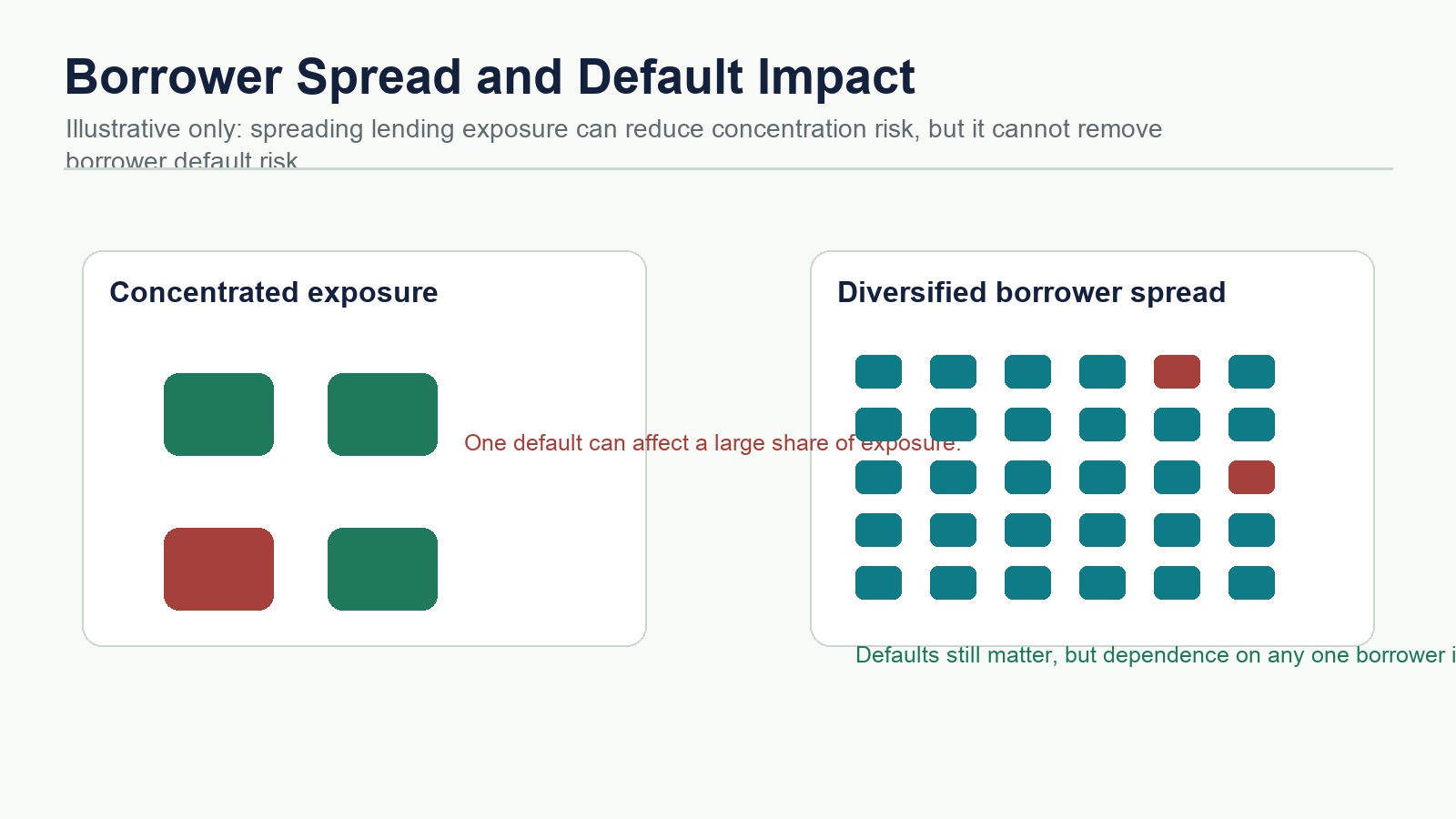
Diversification in P2P lending means spreading lending exposure across multiple borrowers instead of depending heavily on one borrower.
It can reduce concentration risk. It cannot remove borrower default risk.
For example, if a lender lends most of the amount to a small number of borrowers, one default can have a large impact. If the same amount is spread across many borrowers, one default may have a smaller proportional impact. But defaults can still occur, and multiple borrowers can be affected by the same economic shock.
Diversification should be read as a risk-control practice, not as protection.
Delayed P2P Repayments and Remote Monitoring for NRIs
Monthly repayments in P2P lending are useful only if they are understood correctly.
They are not salary. They are not rent. They are not deposit interest. They are borrower-linked cash flows.
An NRI should check:
how often repayment statements are updated;
how delays are shown in the dashboard;
how overdue ageing is reported;
what recovery process is followed;
what documents are available at year-end;
whether alerts work reliably for an overseas phone number or email;
how bank account changes are handled if residential status changes.
Remote access can make P2P lending convenient. It can also make complacency easier. A lender should have a review routine before lending, not after the first delay.
NRI Lender P2P Platform India Checklist
Before an NRI lends through any NBFC-P2P platform, the following checklist should be completed.
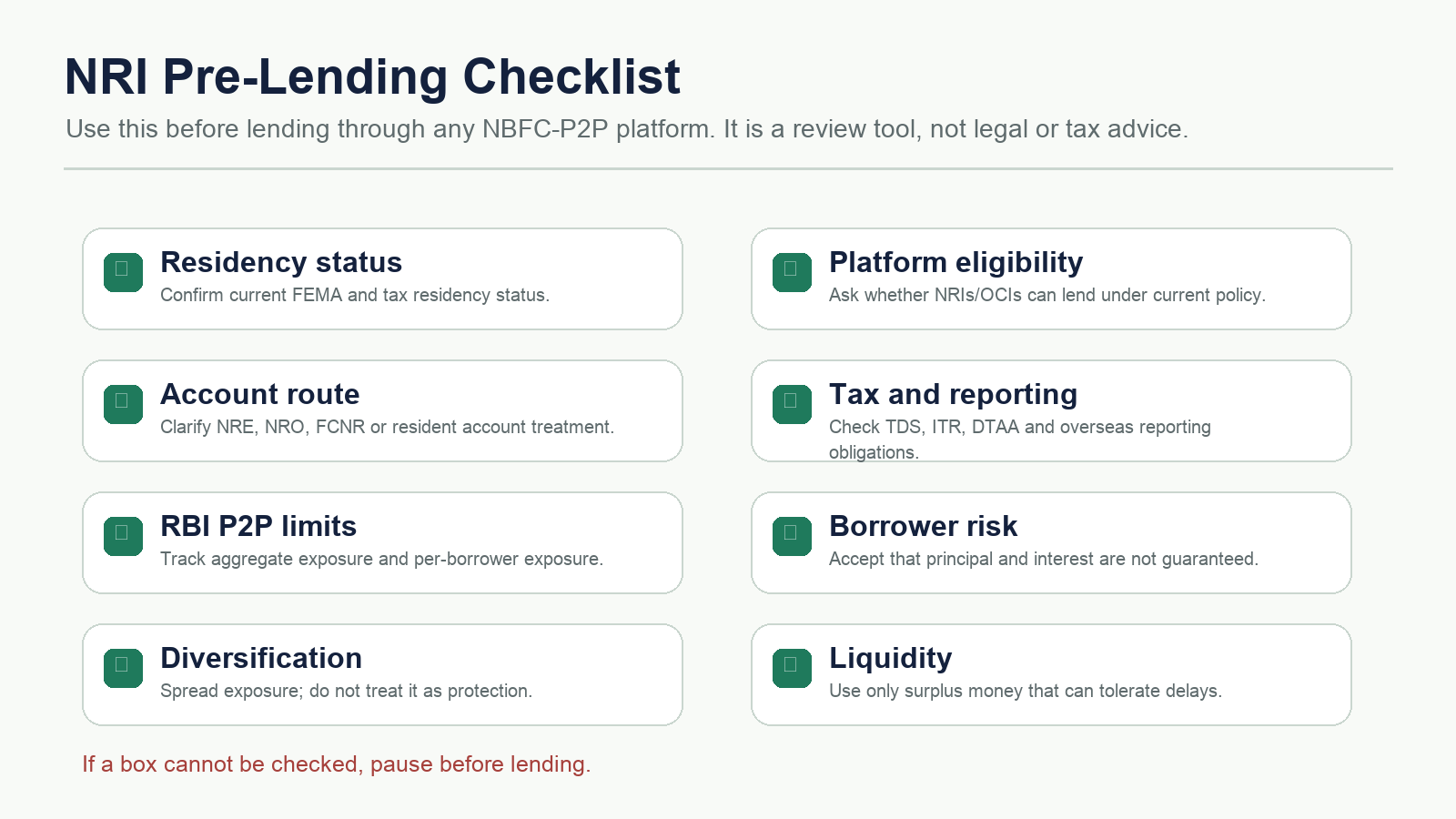
If any answer is unclear, pause.
P2P Lending KYC Documents for NRIs
Document requirements can change by platform policy, bank process, KYC rules, and the person's residential status.
An NRI may be asked for some combination of:
PAN;
passport;
overseas address proof;
Indian address proof, if applicable;
NRE/NRO/other bank account details, if permitted;
cancelled cheque or bank proof;
tax residency declaration;
FATCA/CRS declaration;
visa/residence permit;
recent photograph;
mobile/email verification;
additional declarations required by the platform.
Do not treat this list as a guarantee that onboarding will be allowed. Documents support eligibility. They do not create eligibility by themselves.
Questions to Ask Before Lending Through an NBFC-P2P Platform
Before lending, ask the platform:
Are NRIs currently eligible to lend through your platform?
What is the regulatory basis for that eligibility?
Which accounts can be used to transfer funds?
Which account receives repayments?
Does the flow involve any international movement of funds?
What declarations do I need to provide?
What tax documents will I receive?
How are borrower loans selected or matched?
What information is disclosed before lending?
How do I approve borrowers or loan mapping?
What fees apply?
What happens if a borrower delays or defaults?
How are recoveries pursued and reported?
How do I track exposure across borrowers and platforms?
What happens if my residential status changes later?
The quality of the answers is part of the due-diligence process.
NRI P2P Lending Record-Keeping and Documentation
Record-keeping is not exciting, but it is essential for NRIs.
Resident lenders may need repayment statements for tax filing and personal tracking. NRIs may need more: Indian tax records, overseas reporting support, bank repatriation paperwork, source-of-funds clarity, and a clean trail if residential status changes.
Before lending, create a simple folder structure:
eligibility confirmation from the platform;
KYC and account-route confirmation;
bank account details used for lending and repayments;
loan agreements or platform confirmations;
borrower allocation summary, if available;
fee schedule;
repayment statement;
overdue/default report, if any;
annual interest statement;
TDS documents, if any;
tax advisor notes;
repatriation documents, if funds are later remitted.
The goal is not to create a complicated archive. The goal is to avoid reconstructing the facts months later.
P2P Repayment Records for NRIs
Repayment records should separate expected cash flow from received cash flow.
Expected cash flow is the schedule. Received cash flow is what actually arrived. The difference between the two is where delays, partial repayments and defaults become visible.
Track:
Record | Why it matters |
|---|---|
Lending date | Establishes exposure start date. |
Borrower allocation | Helps monitor concentration. |
Loan tenure | Helps set liquidity expectation. |
Expected repayment date | Shows scheduled cash flow. |
Actual repayment date | Shows delay or timely receipt. |
Principal received | Separates capital recovery from interest. |
Interest received | Supports tax reporting. |
Fees deducted | Helps calculate realised outcome. |
Overdue status | Helps review borrower risk. |
Recovery updates | Helps document default outcomes. |
|For an NRI, clean repayment records can matter more than expected. A bank or advisor may later ask why money entered the account, whether tax was paid, and whether the amount can be transferred further.
Tax and Repatriation Documentation for P2P Lenders
Do not wait until year-end to ask for tax records.
Before lending, ask the platform what reports are available and when. Ask whether statements separate principal and interest. Ask whether TDS records are generated. Ask whether the annual summary is sufficient for an advisor to prepare an Indian tax filing.
Also ask the bank what documents may be needed if funds are later repatriated. Depending on the facts, repatriation may require tax payment evidence, Form 15CA/15CB, accountant certification, or other bank-specific checks.
The article cannot decide those requirements for every NRI. But the lender can prepare early by keeping documents organised from the first transaction.
Is P2P Lending for NRIs in India Suitable for You?
Suitability is not only about return potential.
For NRIs, P2P lending may be worth evaluating only if all of the following are true:
eligibility is clearly confirmed;
the account route is permitted and documented;
tax and repatriation treatment are understood;
funds are surplus and not needed for near-term obligations;
borrower default risk is acceptable;
principal loss would not disrupt family or financial commitments;
exposure is diversified across borrowers;
the lender can monitor repayments remotely;
the lender understands that up to 18% p.a. is indicative potential, not certainty.
If those conditions are not met, the safer answer is to wait.
When NRIs Should Pause Before P2P Lending
NRIs should pause before P2P lending if:
platform eligibility is unclear;
the account route is unclear;
the lender needs principal protection;
the money is needed for education, medical, property, tax or family commitments;
the lender cannot tolerate delayed repayments;
the lender has not reviewed FEMA and tax treatment;
the lending decision is driven mainly by the headline return number;
the lender cannot track exposure across P2P platforms;
the lender wants deposit-like certainty or easy withdrawal.
Pausing is not a missed opportunity. It is a good decision when the foundation is unclear.
When Eligible NRIs May Consider P2P Lending With Risk Controls
Eligible NRIs may consider P2P lending only after completing the eligibility, account, tax and risk checks.
Even then, the lending approach should be measured:
start with surplus money;
keep exposure within RBI limits;
avoid concentration in a few borrowers;
read borrower and platform disclosures;
understand fees before lending;
track expected versus received repayments;
keep tax documents organised;
do not re-lend automatically without reviewing risk;
treat indicative return potential as conditional.
P2P lending is a lending decision. It should feel documented, not impulsive.
Summary: P2P Lending for NRIs Needs Eligibility First, Returns Second
P2P lending for NRIs in India needs a different order of thinking.
The first question is not "How much can I earn?" It is "Am I eligible to lend through this platform, using this account route, under the applicable RBI and FEMA framework?"
After that come the standard P2P questions:
Is the platform registered with RBI as an NBFC-P2P?
Does the platform explain that it is only a facilitator?
Are borrower default risks clearly disclosed?
Are returns described as indicative and not guaranteed?
Are exposure limits respected?
Are escrow and repayment flows clear?
Is diversification used correctly, without implying protection?
Are tax and repatriation documents available?
IndiaP2P is registered with the Reserve Bank of India as an NBFC-P2P. Eligible lenders may evaluate indicative return potential of up to 18% p.a., subject to borrower repayment performance, delays, defaults, fees, tax treatment, platform terms, and other risks.
For NRIs, that sentence has one extra word at the front: eligible.
Confirm that first.