P2P lending myths usually start with a half-truth.
Yes, peer-to-peer lending in India operates under the RBI's NBFC-P2P framework. No, that does not mean RBI guarantees repayment. Yes, a platform may show up to 18% p.a. indicative returns. No, that does not mean every lender receives that outcome. Yes, escrow accounts matter. No, escrow does not protect principal from borrower default.
That is the point of this 2026 guide. The useful question is not whether P2P lending is good or bad in the abstract. The useful question is whether the lender understands what is regulated, what is still risky, what is only indicative, and what should never be treated like a deposit.
IndiaP2P, legally Trickle Flood Technologies Pvt Ltd, is registered with the Reserve Bank of India as an NBFC-P2P. That regulatory fact matters. It gives lenders a defined platform framework. It does not remove borrower default risk, does not protect principal, and does not make returns guaranteed.
P2P Lending Myths in India: The Short 2026 Answer
Here is the short version before the detail:
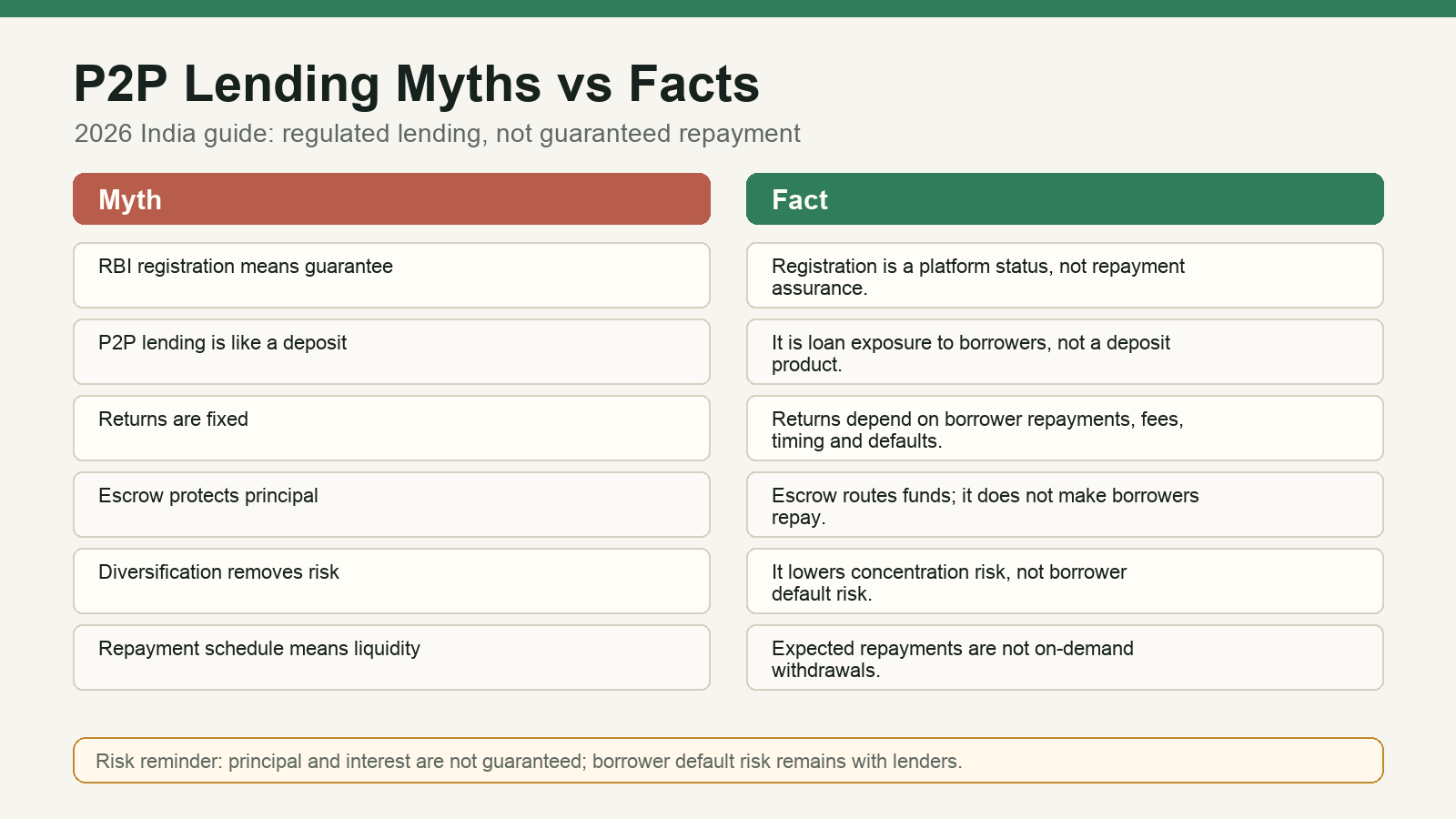
Myth | Fact for lenders in 2026 |
|---|---|
P2P lending is unregulated in India | P2P platforms are regulated by RBI under the NBFC-P2P framework. |
RBI registration means repayment is guaranteed | RBI registration is a platform regulatory status, not a repayment assurance. |
P2P lending is like a deposit | P2P lending is not a deposit product. Principal is exposed to borrower repayment risk. |
Returns are fixed | P2P lending returns are indicative and depend on borrower repayments, fees, timing, tax and defaults. |
Escrow protects the lender from default | Escrow controls fund flow. It does not make borrowers repay. |
Diversification removes risk | Diversification can reduce concentration risk, but borrower defaults can still happen. |
Scheduled repayments mean instant liquidity | Expected repayments are not on-demand withdrawals. Cash flow depends on borrowers paying as scheduled. |
The best way to read P2P lending is as regulated loan facilitation. A lender lends to borrowers through a platform process. The lender's outcome depends on actual borrower repayment.
If you want the full regulatory background, IndiaP2P's guide to RBI P2P lending guidelines 2026 explains the framework in detail.
RBI Registered P2P Lending Platform: What Registration Does and Does Not Mean
An RBI registered P2P lending platform is a platform that has permission to operate as an NBFC-P2P. In plain language, it facilitates lending between lenders and borrowers through an online platform.
The RBI framework defines a peer-to-peer lending platform as an intermediary providing loan facilitation services. That word, intermediary, is important. The platform supports onboarding, borrower assessment, documentation, fund routing, servicing, reporting and recovery support. It does not become the borrower. It does not accept deposits. It does not lend on its own balance sheet through the P2P marketplace.
NBFC-P2P Regulations in India Do Not Guarantee Repayment
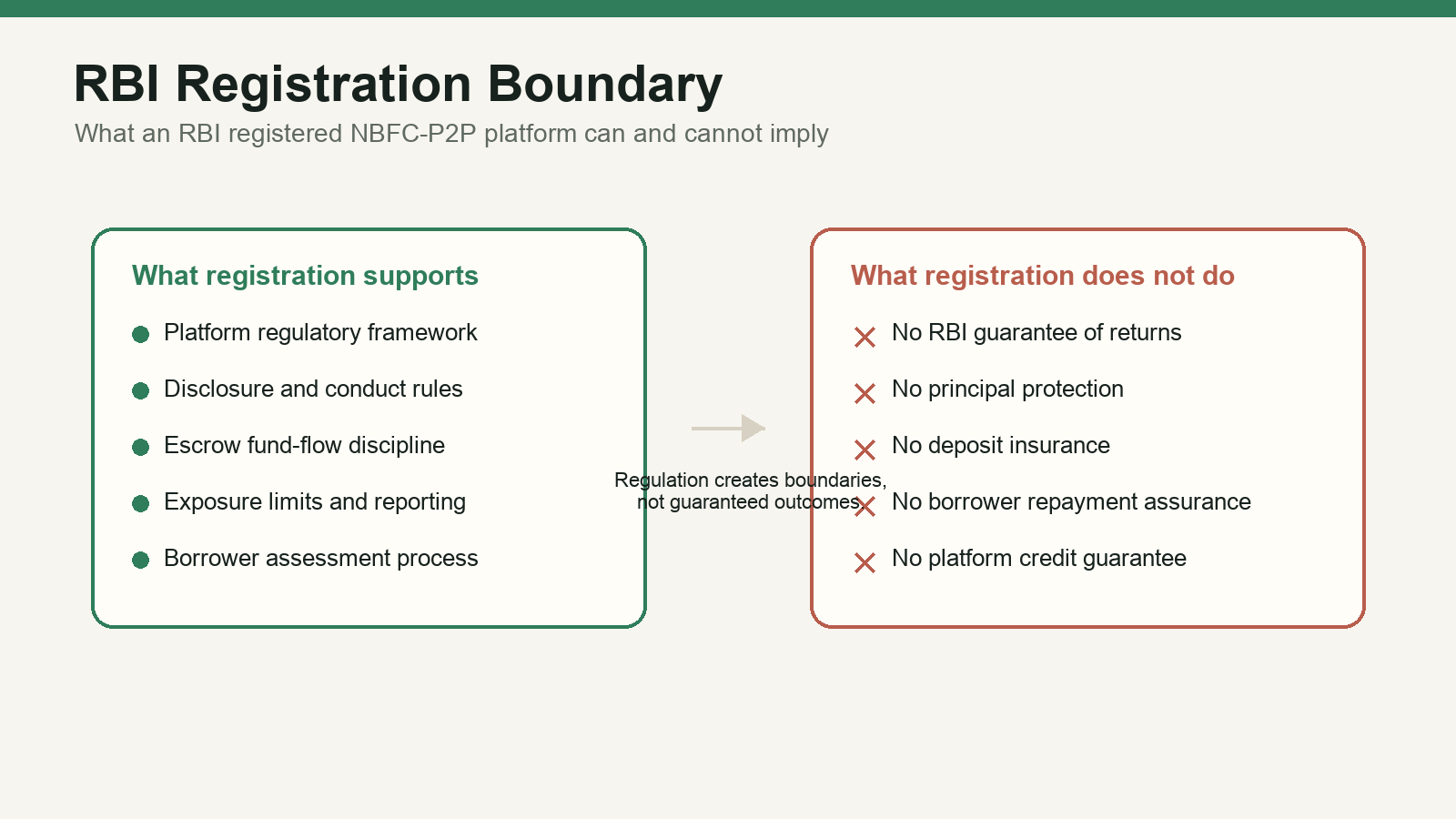
NBFC-P2P regulations in India create operating boundaries. They require registration, disclosure, fund-flow rules, exposure limits, borrower assessment, agreements, grievance processes and reporting.
They do not make every borrower repay on schedule.
Under the RBI Master Direction for NBFC-P2P platforms, an NBFC-P2P must not provide or arrange credit enhancement or credit guarantee. It must not assume credit risk directly or indirectly. If there is loss of principal or interest on funds lent through the platform, that loss is borne by lenders.
This is why RBI registration should be treated as the beginning of due diligence, not the end of it.
RBI Does Not Guarantee P2P Lending Returns or Principal
One of the most persistent P2P lending myths is that an RBI registered platform means RBI stands behind the lender's return.
That is not correct.
RBI registration means the platform sits inside a regulated category. It does not mean RBI approves the return number, selects the borrowers, guarantees repayment, or protects principal. A lender still needs to understand borrower default risk, diversification, tenure, liquidity, fees, tax treatment and platform terms.
For a deeper registration-specific explanation, read IndiaP2P's guide to what RBI registration means for P2P lenders.
P2P Lending Is Not a Deposit Product
P2P lending is not a deposit product. This is the single most important fact behind many other myths.
In a deposit, the depositor places money with a bank or eligible deposit-taking institution. In P2P lending, a lender lends to borrower loans through an NBFC-P2P platform. The repayment source is borrower repayment, not a deposit obligation of the platform.
Question | Bank deposit | P2P lending through an NBFC-P2P platform |
|---|---|---|
What is the relationship? | Deposit placed with a bank | Loan exposure to borrowers through a platform |
Who drives repayment? | Bank deposit terms | Borrower repayment behavior |
Is principal protected? | Eligible bank deposits may have DICGC cover within limits | No principal protection |
Is the platform a deposit-taker? | Bank accepts deposits | NBFC-P2P must not raise deposits |
What is the main risk? | Bank/deposit-related risk beyond applicable protection | Borrower default, delay, concentration, liquidity and platform and process risk |
This does not make one product universally better or worse than the other. It means they should not be compared only by headline percentage.
P2P Lending vs Fixed Deposit: Why the Risk Engine Is Different
P2P lending vs fixed deposit comparisons often become misleading when the comparison starts and ends with the return number.
A bank fixed deposit and P2P lending have different legal structures, repayment sources, liquidity rules and risk bearers. In P2P lending, the lender is exposed to borrower repayment behaviour. If borrowers delay or default, the lender's cash flow and final outcome can change.
For the full boundary, read P2P lending vs fixed deposit: why P2P is not a deposit.
P2P Lending Returns Are Not Fixed or Guaranteed
Another common myth is that P2P lending returns are fixed.
They are not.
Returns in P2P lending depend on actual borrower repayments. A displayed or target return may assume that borrowers repay as scheduled, cash is deployed efficiently, fees apply as expected, tax is handled correctly, and defaults do not materially change the cash-flow pattern. Real outcomes can differ.
This is why responsible P2P lending content should never present a return number in isolation.
Up to 18% p.a. Indicative Returns: What the Phrase Means
IndiaP2P may refer to up to 18% p.a. indicative returns for eligible lenders. That phrase has three important parts.
Up to means the number is an upper-end potential, not a standard outcome for every lender.
Indicative means the return is not a promise. It depends on borrower repayments, defaults, delays, fees, timing, tax treatment and platform terms.
p.a. means annualized. It does not mean the same amount is received every month, and it does not convert expected repayment schedules into guaranteed income.
Eligible lenders who understand these risks can review IndiaP2P's Monthly Income Plan Plus after reading the product terms and risk disclosure.
P2P Lending Return Calculation Depends on Actual Borrower Repayments
P2P lending return calculation begins with cash flows: the amount lent, the borrower EMIs received, the interest component, principal returned, fees, tax, delayed repayments, defaults, recoveries and idle cash.
The key distinction is scheduled versus received cash. A repayment schedule is an expectation. Received repayment is what has actually arrived. The lender's final outcome depends on the second, not just the first.
IndiaP2P's P2P lending returns calculation guide explains this return waterfall in more detail.
Borrower Default Risk in P2P Lending Is Real
Borrower default risk in P2P lending is not fine print. It is the central risk.
When a lender lends through a P2P platform, borrowers are expected to repay principal and interest according to the loan schedule. Some borrowers may repay on time. Some may delay. Some may partially repay. Some may default. In those cases, interest received can be lower, cash flow can be delayed, and principal recovery can be affected.

This is also why the language around borrower assessment must stay precise. A platform may assess borrowers using credit data, policy filters and repayment signals. That helps make lending more reviewable. It does not guarantee repayment.
For a risk-reading framework, see P2P lending risk disclosure: how to read it before you lend.
P2P Lending Risk Is Reduced by Screening, Not Removed
Borrower screening can reduce unsuitable borrower selection. It can help classify risk. It can support better disclosure and monitoring.
But screening happens before future repayment behaviour is known. Income can change. Obligations can rise. A borrower can miss payments. Recovery can take time and may not be complete.
That is the right mental model: underwriting is a process, not a guarantee.
P2P Lending Diversification Lowers Concentration Risk, Not Default Risk
Diversification is another half-truth that creates a myth.
It is true that spreading lending across many borrowers can reduce dependence on a single borrower. If one borrower delays, the lender is not relying on one loan for the entire outcome.
It is not true that diversification removes borrower default risk. If multiple borrowers delay or default, diversification cannot make those repayments appear. It can change the impact of any one borrower, but it cannot remove the underlying risk that borrowers may not repay.
Lender Diversification Across Borrowers: A Simple Default-Impact Example
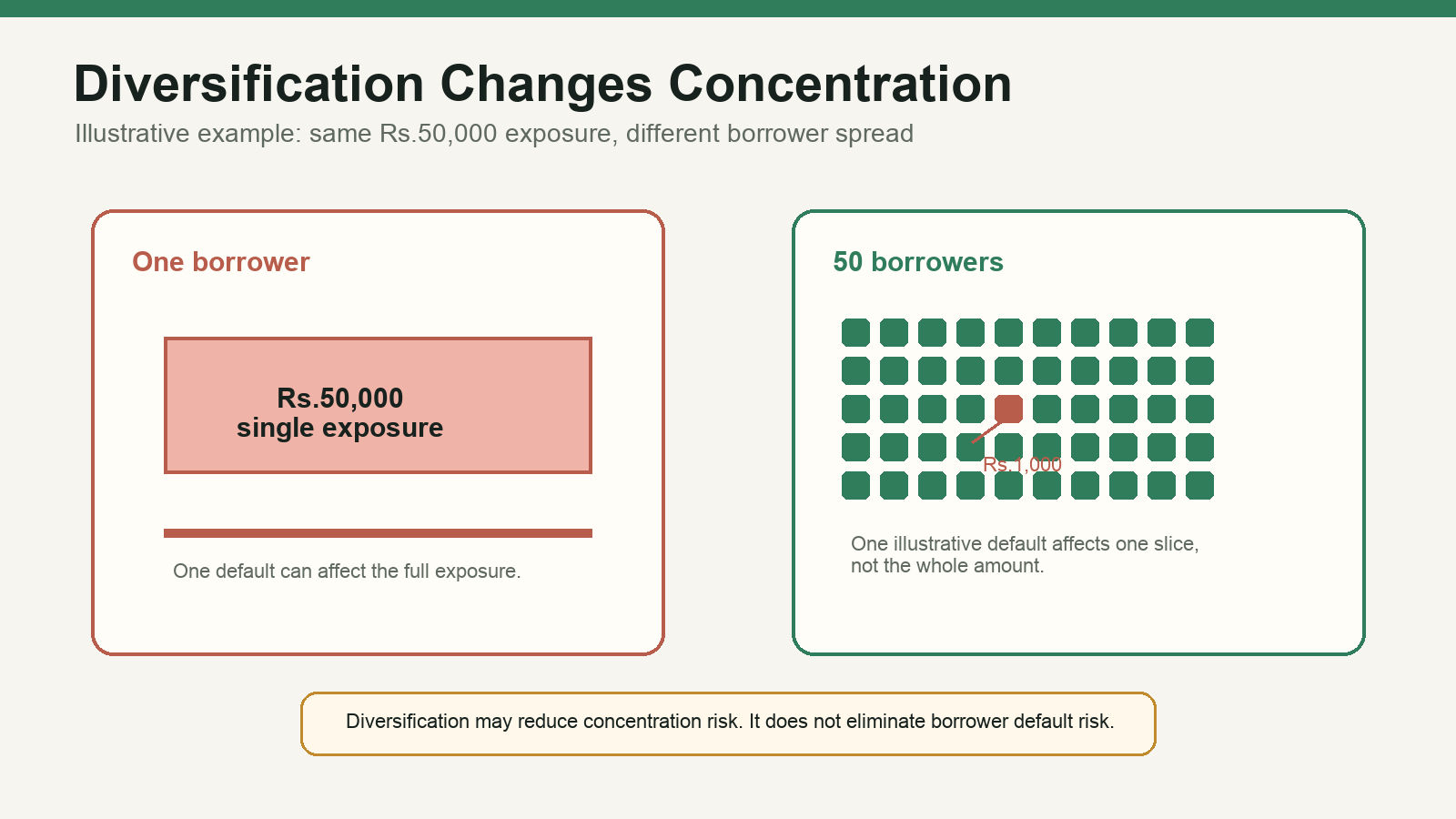
Consider an illustrative example.
If a lender places Rs.50,000 with one borrower and that borrower defaults, the entire Rs.50,000 exposure is affected.
If the same Rs.50,000 is spread equally across 50 borrowers, one default affects Rs.1,000 of principal exposure before recovery outcomes, fees, timing and interest effects. The loss is still real. The concentration is lower.
That is the correct way to read lender diversification: it helps manage concentration risk. It does not create principal protection.
P2P Lending Escrow Account Rules Protect Fund Flow, Not Principal
P2P lending escrow account rules are often misunderstood.
Escrow accounts are part of the fund-flow mechanism. Under RBI's NBFC-P2P framework, fund transfers between participants must happen through escrow account mechanisms operated by a bank-promoted trustee. There must be at least two escrow accounts: one for funds received from lenders and pending disbursal, and one for borrower collections pending transfer to lenders.
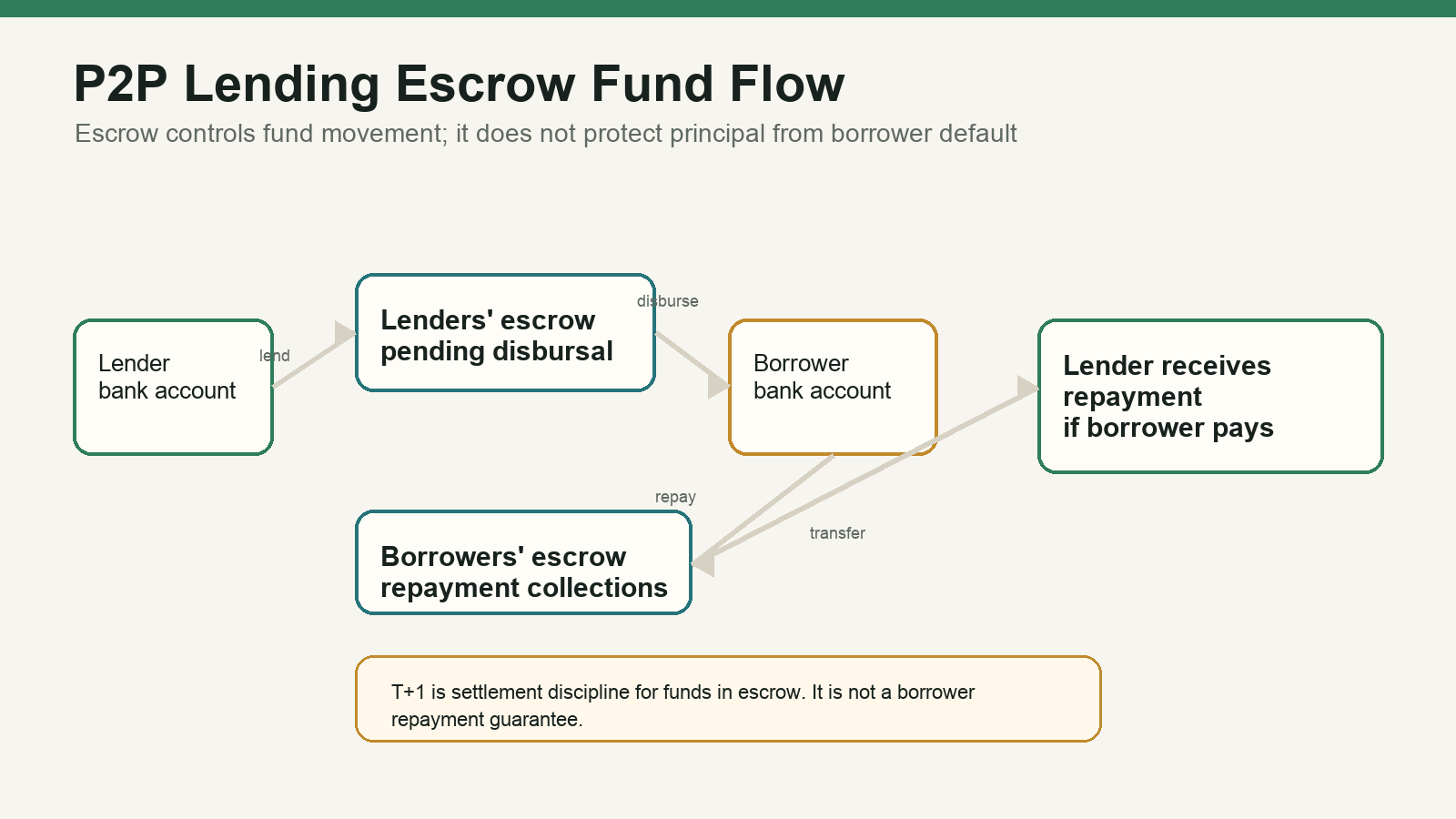
Escrow matters because it creates process discipline. It helps keep participant money separate from the platform's own operating money and creates a clearer trail for disbursal and repayment.
But escrow is not borrower-default insurance.
If a borrower does not repay, the borrower repayment collection does not appear simply because escrow exists. Escrow controls the route of money that is received. It does not create money that has not been paid.
Escrow Mechanism in P2P Lending: What T+1 Actually Means
The T+1 rule means funds received into the relevant P2P escrow account should not remain there beyond the next bank working day, as required under the RBI framework.
That is a settlement discipline after money reaches escrow. It is not a promise that a borrower will pay an EMI on time. A lender should not confuse faster fund movement with guaranteed borrower repayment.
For a focused explanation, read IndiaP2P's guide to escrow accounts in P2P lending.
P2P Lending Liquidity Myth: Scheduled Repayments Are Not On-Demand Withdrawal
P2P lending can create expected repayment flows when borrowers pay EMIs on schedule. That does not make it on-demand liquidity.
Money lent through P2P lending is linked to borrower loan tenure and repayment behaviour. If the lender needs money for rent, medical costs, school fees, payroll, tax payments or emergency reserves, that money should not be treated as instantly available through scheduled P2P repayments.
This is why liquidity planning should come before lending. A repayment calendar is useful, but it is still dependent on actual borrower repayment.
IndiaP2P's guide to monthly income from P2P lending explains the difference between cash-flow planning and return expectation.
Is P2P Lending Safe in India? A Better Question for 2026
The question is P2P lending safe in India? is understandable, but it is too broad.
A better 2026 question is: Which risks are controlled by the RBI framework, which risks remain with the lender, and am I comfortable with those risks?
Use this checklist before lending:
Check | Why it matters |
|---|---|
Is the platform registered as an NBFC-P2P? | Confirms the platform is inside the RBI P2P framework. |
Do I understand P2P lending is not a deposit? | Prevents deposit-like assumptions. |
Have I read the no-guarantee disclosure? | Confirms principal and interest are not assured. |
Is my exposure diversified across borrowers? | Reduces dependence on one borrower. |
Do I understand the lender exposure caps? | Keeps lending within RBI limits. |
Can I tolerate delayed repayments? | Tests liquidity fit. |
Have I considered fees and tax? | Helps estimate the realised outcome, not just the displayed return. |
Am I using surplus money, not emergency money? | Reduces the chance of needing an early exit. |
Peer-to-Peer Lending Checklist Before you Lend
A lender should be able to say yes to these statements:
I understand that borrower default risk remains with me.
I understand that RBI registration is not RBI repayment assurance.
I understand that escrow controls fund flow, not borrower credit risk.
I understand that diversification can reduce concentration risk, not eliminate default risk.
I understand that up to 18% p.a. indicative returns are not guaranteed.
I understand the RBI exposure limits before deciding how much to lend.
For the limits specifically, see IndiaP2P's guide to RBI P2P lender exposure limits.
Final Myth-Fact Summary for P2P Lenders in India
The most useful way to understand P2P lending myths is to replace certainty with structure.
P2P lending in India is regulated, but not guaranteed. IndiaP2P is registered with RBI as an NBFC-P2P, but RBI registration is not an endorsement of returns or repayment. P2P lending is not a deposit, principal is not protected, and returns depend on borrower repayments.
That does not make the category impossible to evaluate. It means lenders should evaluate it with the right questions: borrower risk, diversification, escrow mechanics, return calculation, liquidity needs, fees, tax and exposure limits.
Eligible lenders who understand these risks can review IndiaP2P's Monthly Income Plan Plus after reading the product terms and risk disclosure.