When people ask what happens when a borrower defaults on P2P lending, they are usually asking a practical question: does the platform repay the lender, does recovery begin, and can principal be lost?
The short answer is direct. If a borrower defaults, the lender's expected repayments may be delayed, partly recovered, or not recovered in full. The platform may support reminders, repayment follow-up, collections, status reporting, and legal-process facilitation where permitted. But the platform cannot guarantee recovery, principal, or interest.
That distinction is the core of P2P lending. IndiaP2P, legally Trickle Flood Technologies Pvt Ltd, is registered with the Reserve Bank of India as an NBFC-P2P. That registration places the platform inside RBI's peer-to-peer lending framework. It does not mean RBI guarantees repayment or approves a return outcome.
This article explains what default means, how recovery usually proceeds, what RBI rules say, how delayed repayments affect cash flow, and what lenders should check before lending more.
For the broader post-lending lifecycle, see IndiaP2P's guide to the P2P lending repayment process after you lend.
P2P Lending Default Risk: What Borrower Default Actually Means
P2P lending default risk is the possibility that a borrower does not repay as scheduled.
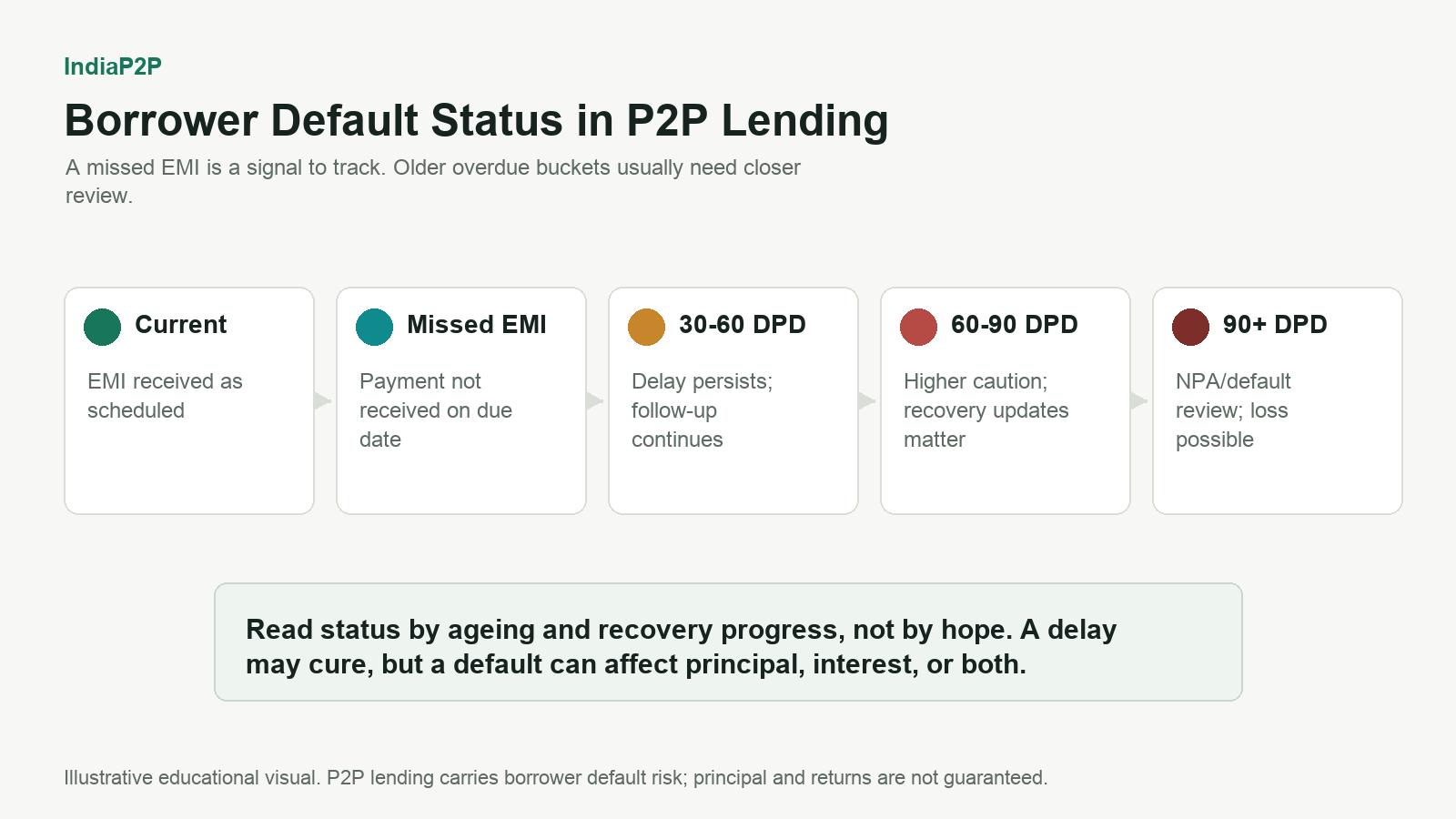
The word "default" should not be used loosely. A borrower who is one day late is not the same as a borrower whose repayment has remained overdue for months. A useful lender dashboard should help separate a fresh delay from a deeper repayment problem.
In practical terms, there are three stages to watch.
Status | What it usually means | What the lender should do |
|---|---|---|
Missed EMI | A scheduled repayment has not arrived on the due date | Track status, do not count it as received cash |
Overdue repayment | The delay continues beyond the due date | Review ageing, borrower spread, and recovery updates |
Default / NPA review | Repayment remains unresolved for a longer period, often 90+ days for NPA reporting | Consider possible principal and interest impact |
The exact operational labels may differ by platform. The economic point is the same: the lender's outcome depends on borrower repayment performance.
IndiaP2P's article on P2P lending risks and returns explains why lenders should read any return number together with borrower default risk, delayed EMI risk, liquidity risk, and principal exposure.
Borrower Misses EMI in P2P Lending: Delay Is the First Signal
When a borrower misses an EMI in P2P lending, the expected repayment does not become available to the lender on schedule.
That may be temporary. A borrower may cure the delay after a reminder, a mandate retry, a salary credit, or a cash-flow correction. But the lender should still treat the missed EMI as a signal. Scheduled cash is not the same as received cash.
The right habit is simple: track the delay, wait for the dashboard update, and avoid making fresh lending decisions using money that has not been received.
Overdue Ageing in P2P Lending: Why 30, 60 and 90 Days Matter
Overdue ageing in P2P lending shows how long a repayment has remained unpaid.
A repayment delayed by a few days may need monitoring. A repayment overdue by 30 or 60 days needs closer review. A repayment overdue by 90 days or more may enter non-performing asset reporting, depending on the applicable platform and regulatory disclosure treatment.
Ageing matters because time changes the meaning of a delay. The older the overdue amount, the more carefully the lender should read recovery updates, borrower spread, and possible principal or interest impact.
P2P Lending Recovery Process After a Borrower Default
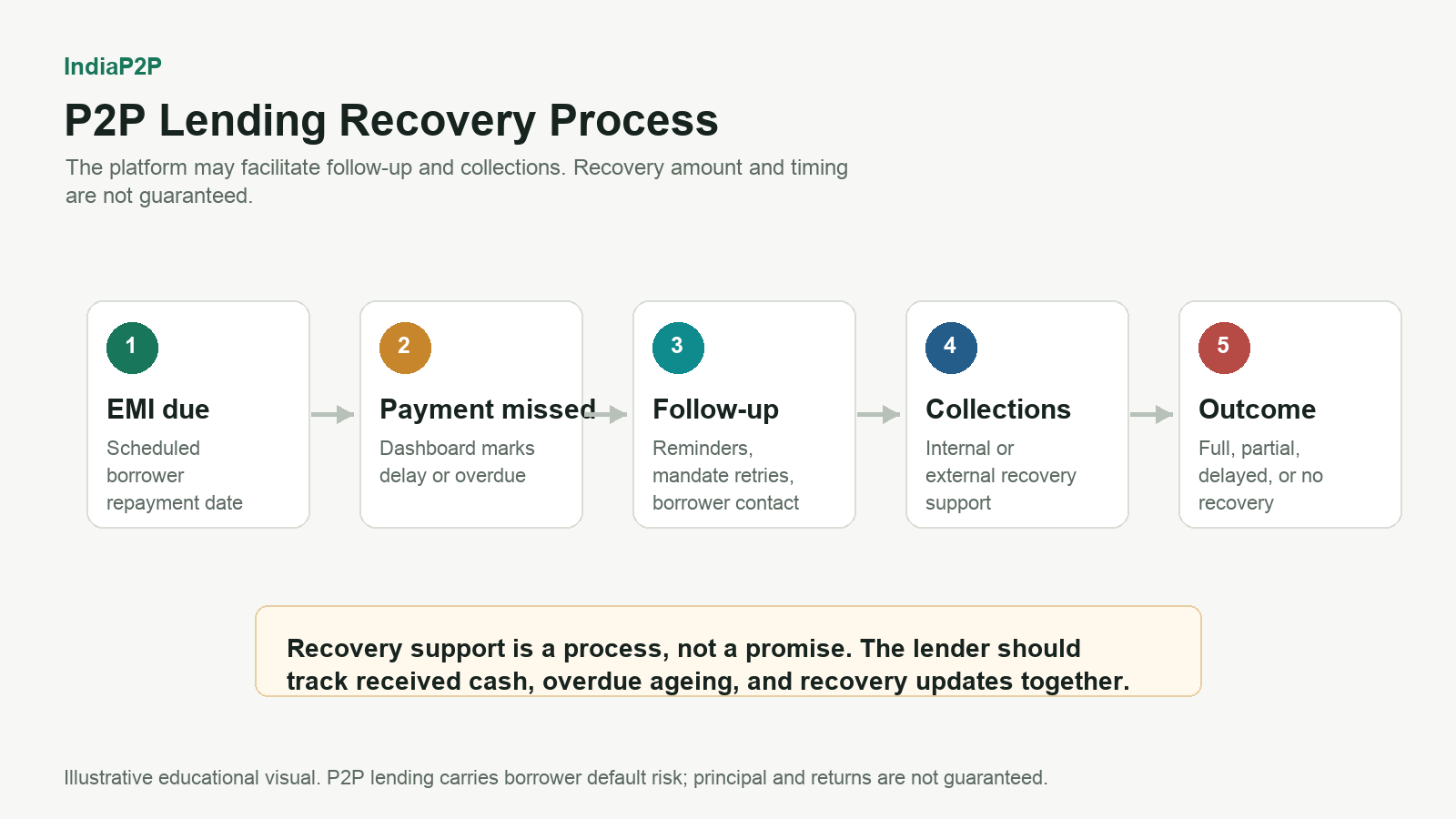
The P2P lending recovery process begins when a repayment is missed or remains overdue.
The first step is usually communication. The platform may send reminders, notify the borrower, retry an electronic mandate where applicable, or contact the borrower to understand the reason for delay. If the borrower cures the overdue amount, the repayment can be reflected as received and routed through the permitted account flow.
If the delay continues, the matter may move into deeper collections follow-up. The platform may use an internal team or a permitted external collection agency. It may facilitate borrower communication, collection attempts, recovery updates, and legal notices or legal-process support where applicable.
The important phrase is "may facilitate." Recovery is not the same as repayment assurance.
A borrower may repay fully after follow-up. A borrower may repay partly. A borrower may take longer than expected. A borrower may not repay enough to cover principal and interest. The lender should therefore read recovery as an uncertain process, not as a promise.
P2P Lending Collections Process: What the Platform Can Facilitate
The P2P lending collections process is part of servicing after a borrower delay.
A platform can help by keeping repayment records, contacting borrowers, sending reminders, coordinating collection follow-up, recording recovery attempts, and updating lender-facing status. It can also use data from repayment behaviour to improve future credit assessment and monitoring.
IndiaP2P's guide to the IndiaP2P borrower selection credit process explains the pre-lending side of this work: borrower review, risk classification, repayment monitoring, and the limits of credit assessment.
But collections cannot remove borrower risk. A structured recovery process is useful because it creates follow-up discipline. It is not useful if a lender treats it as principal protection.
P2P Lending Not Guaranteed: What Recovery Support Cannot Promise
P2P lending is not guaranteed.
That sentence should sit beside every default discussion. Recovery support cannot promise that every missed EMI will be collected. It cannot promise that principal will be recovered in full. It cannot promise a fixed recovery timeline.
This is not a weakness of one platform. It is the nature of lending to borrowers through an NBFC-P2P framework. Borrowers may face income loss, business stress, health expenses, household shocks, or repayment indiscipline. A borrower who looked acceptable at approval can still default later.
The lender should therefore read every recovery update through three questions: what amount was due, what amount was actually received, and what remains at risk?
RBI NBFC-P2P Default Rules: Who Bears Principal and Interest Loss?
RBI NBFC-P2P default rules make the responsibility clear.
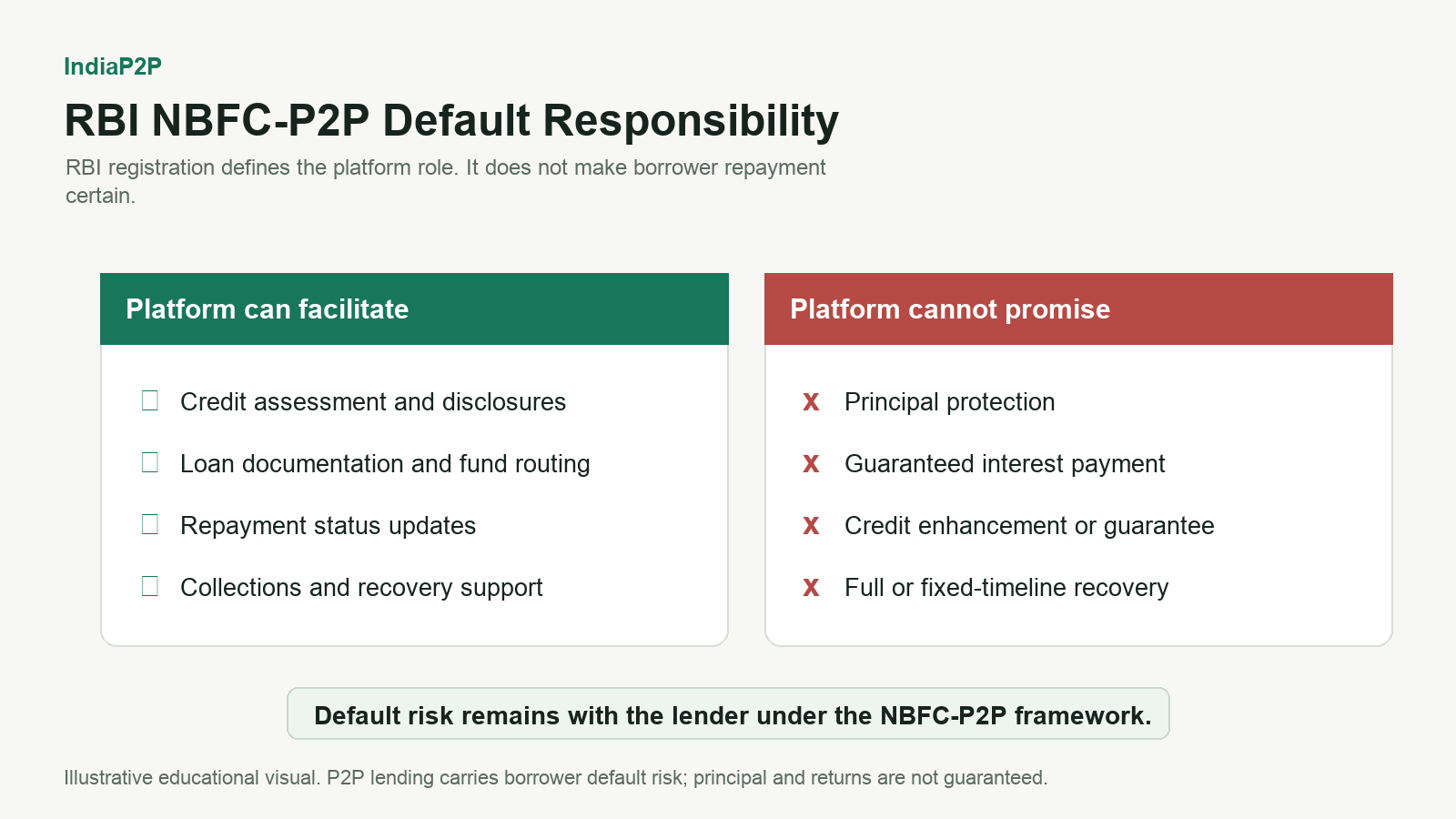
Under the RBI framework, an NBFC-P2P platform acts as an intermediary. It facilitates lending between lenders and borrowers. It must not act as a deposit-taker, must not lend on its own through the platform, and must not provide credit enhancement or credit guarantee.
The RBI Master Direction requires an explicit lender declaration that the lender understands the risks of the lending transaction and that the P2P platform does not assure return of principal or payment of interest. The declaration must also recognize the likelihood of loss of the entire principal in case of borrower default. See the RBI Master Direction for NBFC-P2P platforms.
RBI's August 16, 2024 update further clarified that an NBFC-P2P shall not assume credit risk, directly or indirectly. If there is loss of principal, interest, or both on funds lent through the platform, that loss is borne by the lender. See the RBI notification dated August 16, 2024.
RBI framework point | What lenders should read from it |
|---|---|
Platform is an intermediary | It facilitates the process; it is not the borrower |
No credit guarantee | The platform cannot promise repayment if the borrower defaults |
No credit risk assumption | Principal or interest loss, if any, remains with the lender |
Disclosure requirement | Risk should be visible before lending, not discovered after default |
P2P Lending NPA Disclosure: What Lenders Should Read Monthly
P2P lending NPA disclosure helps lenders see platform-level repayment performance.
The RBI framework requires NBFC-P2P platforms to disclose platform-level performance, including non-performing assets and losses borne by lenders where applicable. This is not a prediction of what will happen to one lender's amount, but it is useful context.
A lender should read NPA disclosure together with borrower spread, overdue ageing, recovery updates, loan tenure, and exposure limits.
For regulatory exposure boundaries, read IndiaP2P's guide to RBI P2P lender exposure limits.
Delayed Repayments in P2P Lending: Impact on Cash Flow and Returns
Delayed repayments in P2P lending affect the lender in two ways: timing and amount.
Timing comes first. If an EMI was expected this month but has not been received, the lender's available balance is lower than the schedule suggested. The lender should not withdraw, spend, or lend again based on an expected repayment that has not arrived.
Amount comes next. If a delay becomes prolonged or turns into default, the final received amount may be lower than expected. Interest may be delayed. Principal recovery may be partial. In some cases, principal and interest may both be affected.
This is why return language needs discipline. IndiaP2P may refer to up to 18% p.a. indicative returns for eligible lenders, but that figure depends on borrower repayments, delays, defaults, fees, timing, tax treatment, and platform terms. It is not a guaranteed outcome for every lender.
Dashboard line | How to read it |
|---|---|
Scheduled repayment | What should have arrived under the EMI schedule |
Received repayment | What has actually been received |
Delayed amount | What remains unpaid after the due date |
Recovery received | What comes back after follow-up |
Net received cash | The amount available after actual repayment and applicable platform treatment |
For cash-flow planning, see IndiaP2P's guide to monthly income from P2P lending cash flow.
P2P Lending Principal Loss: When Default Affects the Lender Outcome
P2P lending principal loss becomes possible when recovery is incomplete.
This does not mean every delay causes loss. It means the lender should not assume principal is protected. A borrower default may affect interest, principal, or both. The final effect depends on borrower repayment, recovery outcome, loan terms, timing, and platform process.
For a lender, this is the line that matters most: recovery support can help pursue missed payments, but it cannot convert borrower credit risk into a guaranteed payout.
That is why the amount lent through P2P should be money the lender can keep exposed through the loan tenure, including the possibility of delay or lower-than-expected recovery.
P2P Lending Diversification Default Impact: One Borrower vs Many Borrowers
P2P lending diversification default impact is best understood through concentration.
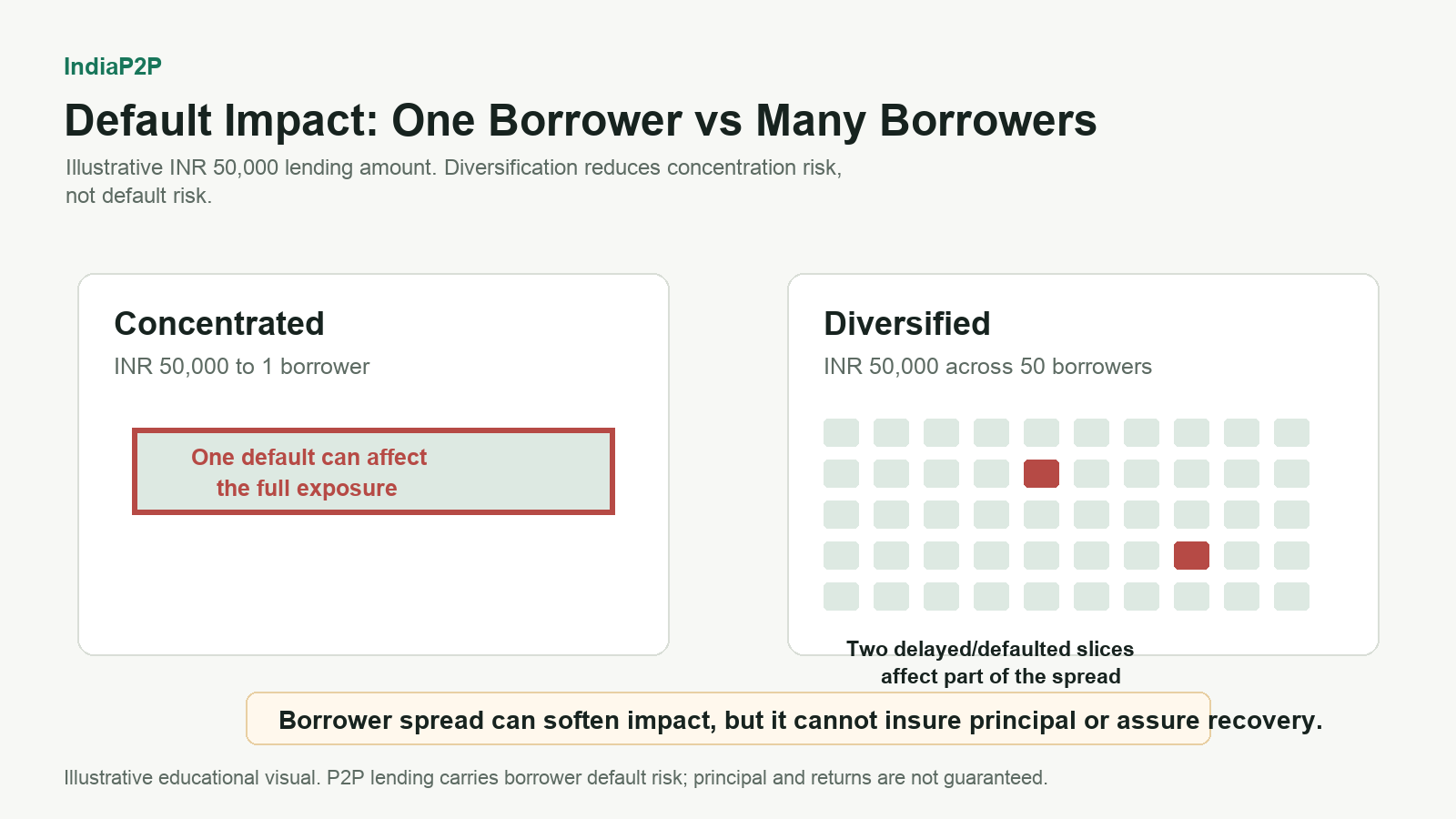
Assume a lender has INR 50,000 exposed to one borrower. If that borrower defaults and recovery is incomplete, the lender's whole amount is affected by one borrower outcome.
Now assume the same INR 50,000 is spread across 50 borrowers at INR 1,000 each. If one borrower delays repayment, the lender still needs to track and recover that amount, but the delay affects a smaller slice of the total lending spread. If two borrowers delay, the effect grows, but it is still different from having one borrower carry the full amount.
This example is illustrative. It is not a recommendation for a specific borrower count or allocation. It simply shows why lender diversification matters.
The compliance boundary is equally important: diversification reduces concentration risk. It does not eliminate borrower default risk. It does not insure principal. It does not guarantee recovery. A wider borrower spread can still face stress if several borrowers delay at the same time.
Lender Diversification and Concentration Risk After Borrower Default
Lender diversification and concentration risk should be reviewed after any default.
Ask how many borrowers are active, what the largest borrower exposure is, whether overdue amounts are concentrated in one borrower group, and whether a particular tenure or risk category is showing stress.
IndiaP2P's guide on how to read a P2P loan portfolio before lending explains how to review borrower spread, tenure, EMIs, delays, and net receipts before adding more money.
The aim is not to eliminate all risk. That is not possible. The aim is to avoid making one borrower, one repayment date, or one assumption too important.
Lender Dashboard Repayment Status: What to Check After a Default
Lender dashboard repayment status is where default becomes visible.
After a missed EMI or borrower default, do not look only at the return figure. Look at the repayment pattern.
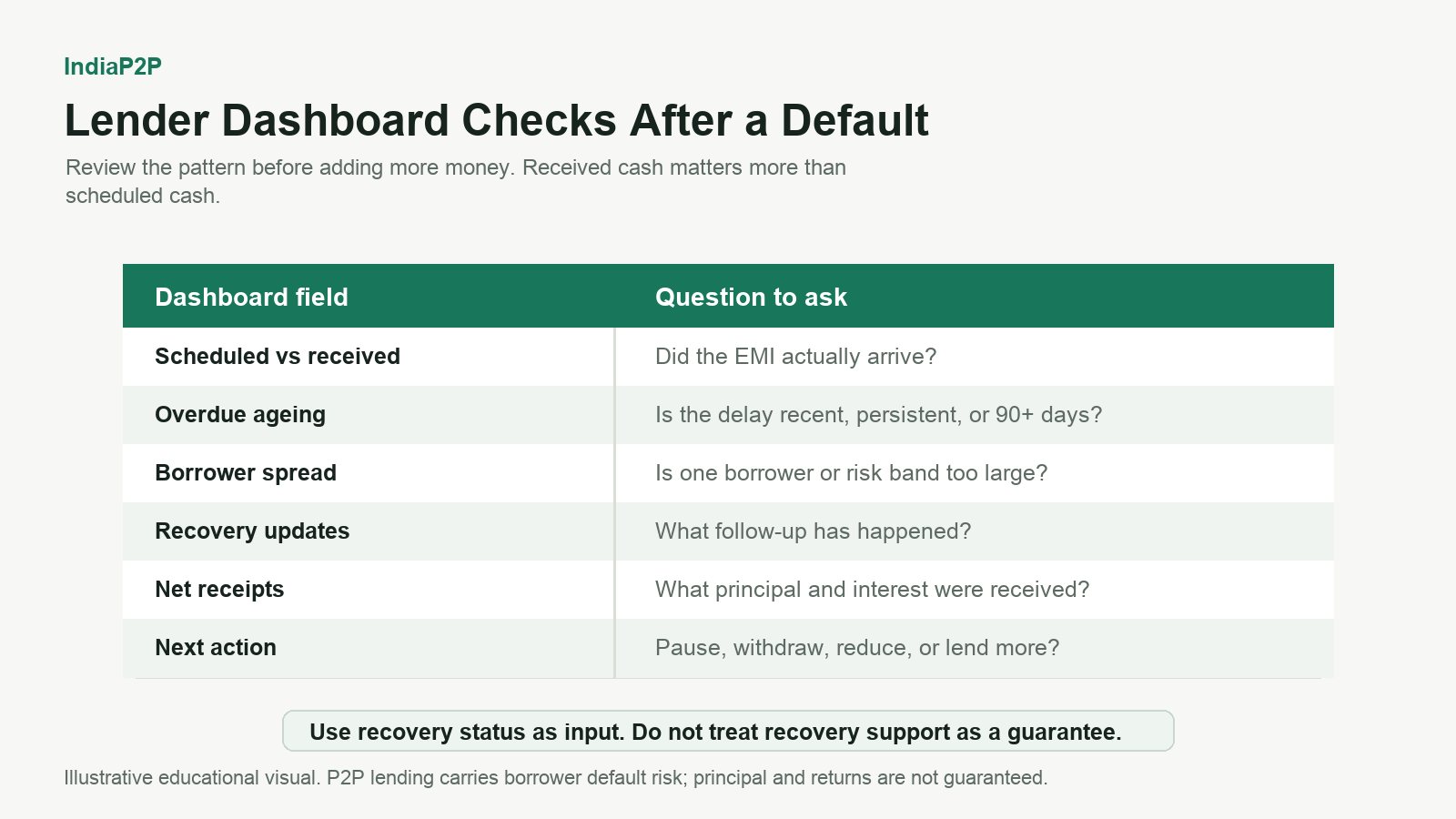
Use this checklist:
Field | Question |
|---|---|
Scheduled vs received repayment | Did the money actually arrive? |
Overdue ageing | Is the delay fresh, persistent, or 90+ days? |
Recovery updates | What follow-up has been attempted? |
Borrower spread | Is exposure concentrated in one borrower or group? |
Principal received | How much principal has actually come back? |
Interest received | How much interest has actually come back? |
Available balance | What cash is available for withdrawal or fresh lending? |
Exposure limits | Does the lending amount remain within RBI limits? |
Escrow is also worth understanding. Escrow supports regulated fund movement and separation of participant funds. It does not protect principal from borrower default. Read IndiaP2P's guide to the escrow account in P2P lending for the fund-flow mechanics.
What Lenders Should Do Before Lending More After a Borrower Default
Before lending more after a borrower default, slow the decision down.
First, separate one borrower event from a pattern. A single delay may cure. Several unresolved delays across borrower groups may call for a different response.
Second, use received cash only. Do not re-lend expected repayments that have not arrived.
Third, review borrower spread. If exposure is concentrated, reduce dependence on any one borrower before increasing the total amount lent.
Fourth, check tenure and liquidity. Money needed for near-term expenses should not depend on borrowers repaying exactly on schedule.
Fifth, read recovery updates without turning them into certainty. A recovery process may improve outcomes. It does not assure outcomes.
Eligible lenders may review Monthly Income Plan Plus after reading the borrower-risk and no-guarantee disclosures. IndiaP2P may enable eligible lenders to target up to 18% p.a. indicative returns, but actual outcomes depend on borrower repayments, delays, defaults, fees, timing, tax treatment, and platform terms.
Summary: Borrower Default in P2P Lending Is a Risk to Manage, Not Ignore
Borrower default in P2P lending is not a remote footnote. It is one of the main risks lenders accept.
If a borrower defaults, the platform may support recovery and update repayment status, but it cannot guarantee principal, interest, or recovery. RBI registration creates a regulatory framework for platform conduct. It does not make borrower repayment certain.
The better lending habit is practical: read scheduled and received repayments separately, track overdue ageing, review recovery updates, understand NPA disclosures, diversify across borrowers, and lend only amounts that can tolerate delay or loss.
That is the clear answer to what happens when a borrower defaults on P2P lending: a process begins, recovery may be attempted, and the lender's actual outcome depends on borrower repayment and recovery performance.