The right P2P lending ticket size is not simply the highest amount a platform allows you to lend. It is the amount that fits your liquidity needs, risk comfort, borrower spread and ability to review repayments over time.
That distinction matters. In P2P lending, you are lending to borrowers through a platform registered with the Reserve Bank of India as an NBFC-P2P. The platform facilitates borrower access, documentation, fund flow and repayment routing. It does not make the lending amount a deposit, does not protect principal and does not guarantee interest.
IndiaP2P enables eligible lenders to target up to 18% p.a. indicative returns through borrower repayments, subject to borrower repayment performance, delays, defaults, fees, tax treatment and platform terms. The return figure should never be read away from the risk. The better sizing question is therefore not "how much can I put in?" It is "what ticket size can I lend while staying diversified, liquid enough and emotionally comfortable if some repayments are delayed?"
This guide explains ticket size at three levels: the starting amount, the total amount you lend and the amount that reaches each borrower.
Minimum Amount For P2P Lending India: Start Amount vs Right Amount
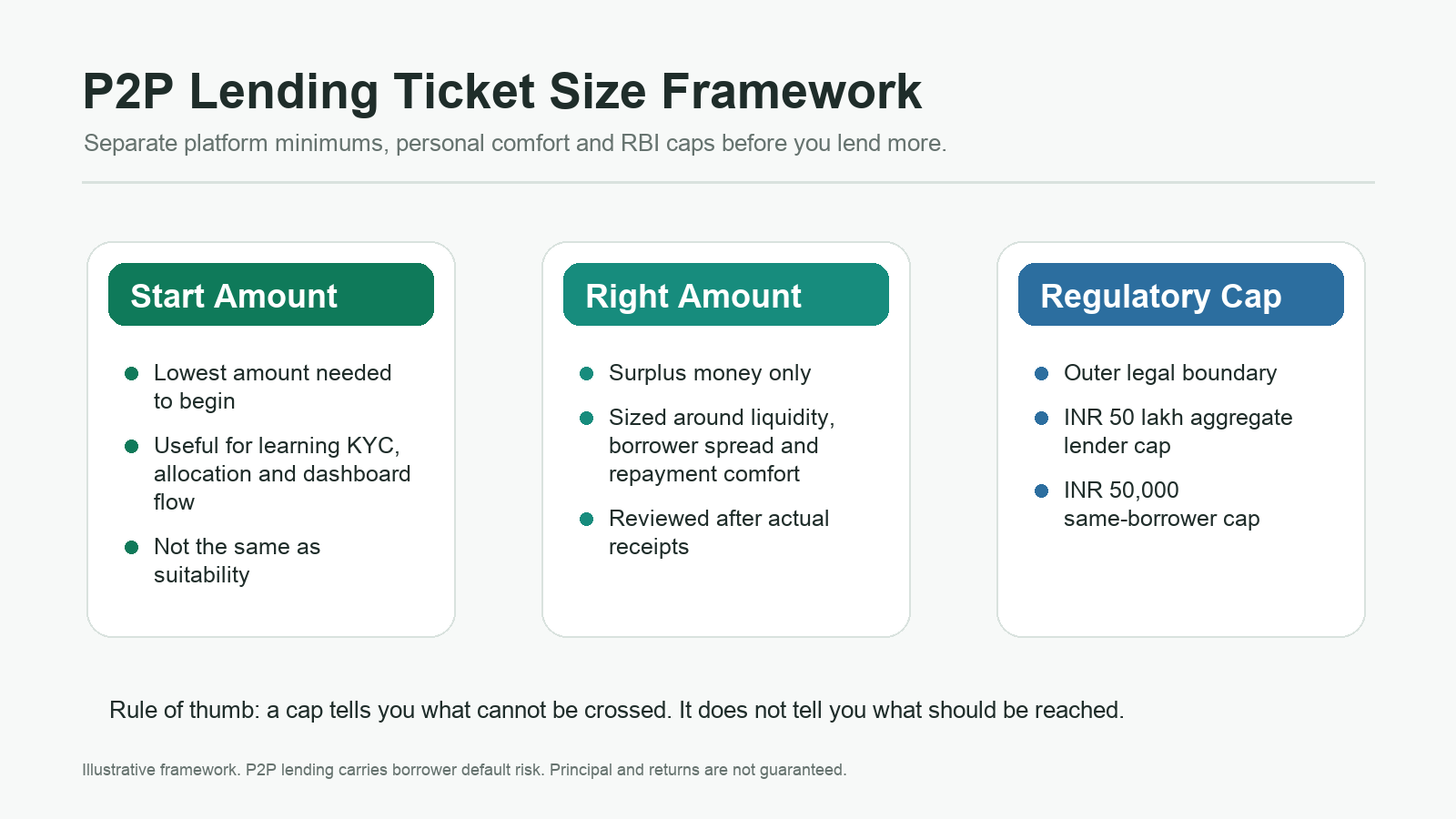
The minimum amount for P2P lending in India depends on the platform and the plan. On IndiaP2P, lenders can begin with a relatively small amount, but the minimum amount should not be confused with the right amount for your situation.
A platform minimum answers only one question: "What is the lowest amount required to begin?" A personal ticket size answers a better question: "How much surplus money can I lend without disturbing emergency funds, planned expenses or household cash flow?"
For a first-time lender, a smaller starting ticket can be useful because it lets you observe the mechanics before increasing exposure. You can see how borrower allocation works, how expected repayments are shown, how actual receipts arrive, what happens when payments are delayed and how clearly the dashboard explains overdue status.
That first ticket size should feel educational, not stressful. If you check the dashboard daily because the amount feels too large, the ticket may be too high. If a delayed repayment would force you to change a household expense, the ticket is too high. If the amount came from borrowed money, it should not be used for P2P lending at all.
The right start amount also depends on diversification. A very small lending amount may teach the process, but it may not always create enough borrower spread to show the full behaviour of a diversified lending pool. A larger amount may allow more spread, but it also increases the amount exposed to borrower repayment risk. That is why the decision should move in stages: start, observe, review and then decide whether to increase.
How Much To Lend In P2P Lending Without Stretching Liquidity
Before choosing how much to lend in P2P lending, remove the money that should not be lent.
Do not use your emergency fund. Emergency money should be available when you need it, not when borrowers repay. P2P lending runs through borrower loan tenures and repayment schedules. Even if repayments are expected monthly, actual receipts depend on borrowers paying as scheduled.
Do not use money needed for near-term goals. If school fees, rent, medical costs, travel, tax payments or business expenses are due within the next few months, that money should remain liquid. A repayment dashboard is a planning tool, not an assurance that cash will arrive on a particular day.
Do not lend borrowed money. If you use credit card debt, a personal loan or any other liability to fund P2P lending, you create a mismatch. Your own repayment obligation remains fixed even if borrower repayments are delayed.
Do not lend money that you cannot leave through a full repayment cycle. P2P lending is not designed for instant liquidity. RBI's framework treats NBFC-P2P platforms as intermediaries that facilitate loans between participants, not as deposit-taking institutions. That means your ticket size must be selected with loan tenure and repayment uncertainty in mind.
A useful personal rule is to define the purpose of the money first:
Money Purpose | Should it go into P2P lending? | Why |
|---|---|---|
Emergency fund | No | Needs immediate access |
Expense due in 3-6 months | Usually no | Repayments may not match the date |
Borrowed money | No | Creates liability mismatch |
Surplus money you can review patiently | Possible | Still subject to borrower risk |
Money being tested for a new lending habit | Possible, if small | Good for learning the process |
This is not personal financial advice. It is a discipline for avoiding the most common ticket-size error: lending an amount that looks attractive on a return screen but feels uncomfortable when repayments vary.
P2P Lending Per Borrower Exposure: Why One Loan Should Not Dominate
P2P lending per borrower exposure is the part of your total ticket size that reaches one borrower. It is one of the most important sizing decisions because concentration risk usually shows up at the borrower level.
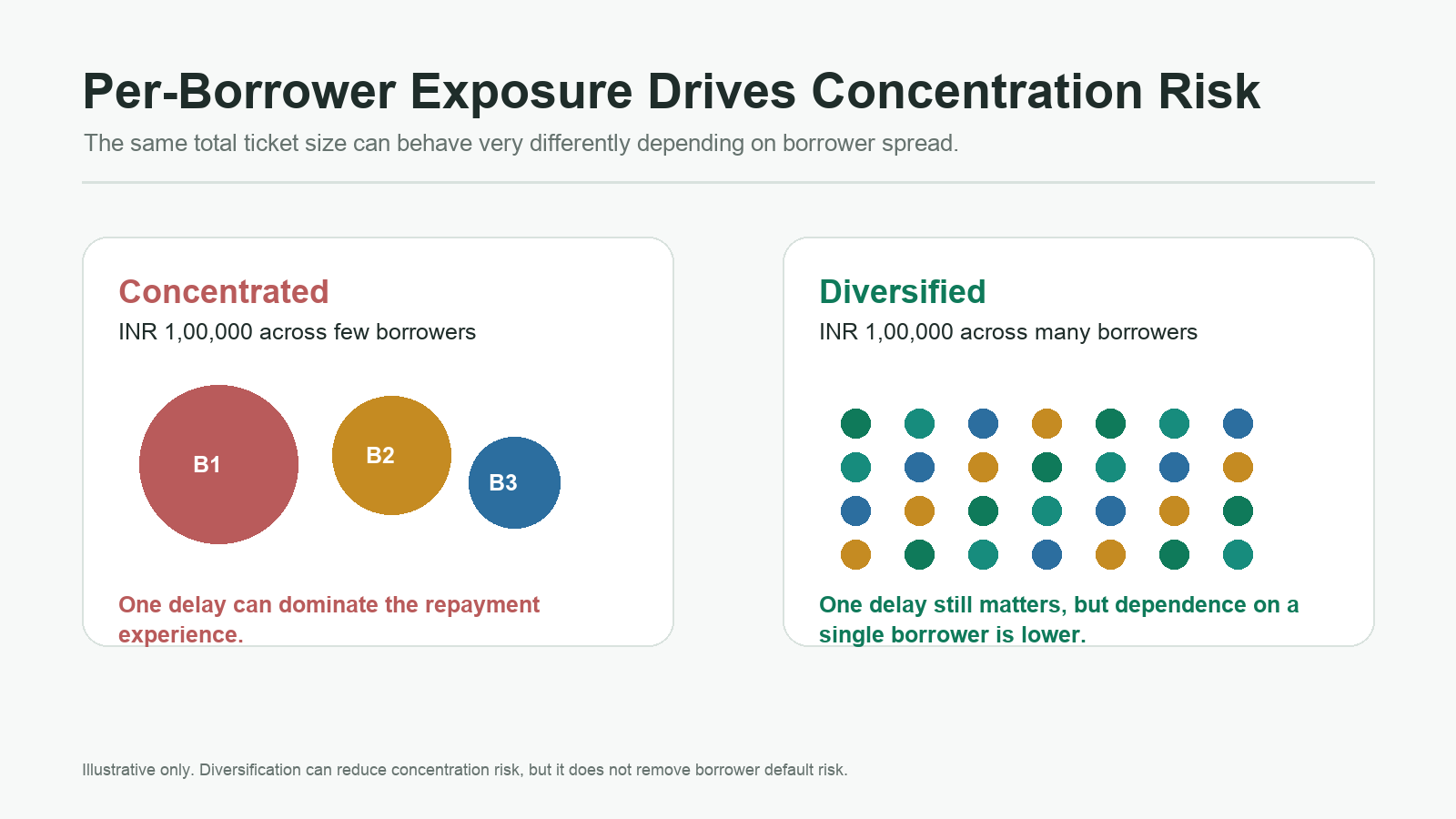
Consider two lenders who each lend INR 1,00,000.
The first lender has too much of the amount linked to a small number of borrowers. If one borrower delays, the effect is visible and emotionally stressful. If a borrower defaults, the loss can materially affect the overall outcome.
The second lender has the same total amount spread across many borrower exposures. One delay can still hurt. One default can still reduce returns or principal. But the experience is less dependent on one borrower doing everything right.
That is the point of small ticket P2P lending. It does not remove borrower default risk. It reduces dependence on one borrower, one repayment date or one small cluster of loans.
Small Ticket P2P Lending And Concentration Risk
Small ticket P2P lending means breaking the total lending amount into smaller borrower exposures instead of allowing a large share to sit with one borrower.
For example, INR 50,000 lent to one borrower behaves very differently from INR 50,000 spread across many borrower exposures. The total lending amount is the same, but the risk shape is not. In the first case, the borrower outcome can dominate the result. In the second case, the lender is still exposed to borrower default risk, but a single delay is less likely to define the entire experience.
This does not mean every lender must use the same borrower-level amount. Platform design, available loans, plan structure, borrower matching, regulations and your own risk comfort all matter. The principle is simpler: avoid a borrower-level ticket that is large enough to make one repayment delay feel like the whole plan has failed.
The RBI per-borrower exposure cap should be treated as a hard outer boundary, not as a comfort target. Your own borrower-level limit may be much lower.
Borrower Default Risk In P2P Lending Ticket Size Decisions
Borrower default risk in P2P lending means a borrower may pay late, pay partly, miss repayments or fail to repay principal and interest. Ticket size should be chosen with that possibility already built into the decision.
This is where a return-led approach can mislead. If a lender begins with the highest displayed return and then chooses the largest possible ticket size, risk is treated as an afterthought. A better sequence is:
Decide how much money can tolerate repayment delays.
Check how much of that amount could reach each borrower.
Review whether the spread is wide enough.
Understand the repayment schedule and tenure.
Increase only after actual repayment behaviour is visible.
IndiaP2P's up to 18% p.a. indicative return potential must be understood inside this risk frame. Actual receipts depend on borrower repayments, fees, tax treatment, timing, defaults and the lending spread selected. Principal is not protected, and returns are not guaranteed.
RBI NBFC-P2P Lending Limits: Caps Are Not Recommendations
RBI NBFC-P2P lending limits are important, but they are not personal ticket-size recommendations.
Under RBI's Master Directions for NBFC-P2P platforms, the aggregate exposure of a lender to all borrowers across all P2P platforms is capped at INR 50 lakh, provided the amount lent is consistent with the lender's net worth. If a lender lends more than INR 10 lakh across P2P platforms, the lender must provide a certificate from a practising Chartered Accountant certifying minimum net worth of INR 50 lakh.
RBI also caps exposure from a single lender to the same borrower, across all P2P platforms, at INR 50,000. The maturity of loans cannot exceed 36 months.
These numbers define the regulatory boundary. They do not mean INR 50 lakh is the right amount for you. They do not mean INR 50,000 is a sensible per-borrower ticket. They do not mean a 36-month loan is suitable for your liquidity needs.
RBI's framework also makes the role of the NBFC-P2P clear. The platform acts as an intermediary. It does not raise deposits. It does not lend on its own. It does not provide credit enhancement or credit guarantee. If there is a loss of principal or interest on funds lent to borrowers, that loss is borne by the lender.
That is why the ticket-size decision should sit below the regulatory cap and inside your personal risk capacity. A cap tells you what cannot be crossed. It does not tell you what should be reached.
For a deeper regulatory explanation, read IndiaP2P's guide to RBI P2P lending exposure limits.
P2P Lending Diversification By Ticket Size: INR 10,000 To INR 5 Lakh Examples
P2P lending diversification should be planned before money is lent, not after the first delay appears.
The table below is illustrative. It is not a recommendation, and it is not based on live borrower availability. It shows how the review process should change as the total ticket size increases.
Total P2P lending ticket | Main purpose | What to review first | Ticket-size caution |
|---|---|---|---|
INR 10,000 | Learning the platform | KYC, allocation, dashboard, repayment display | Do not judge long-term suitability from one short observation. |
INR 25,000 | Testing borrower spread | Number of borrower exposures, tenure, expected receipts | Keep emergency money outside the plan. |
INR 50,000 | Building repayment familiarity | Scheduled vs received repayments, overdue visibility | Avoid one borrower dominating the amount. |
INR 1,00,000 | More meaningful spread | Borrower count, tenure mix, delay pattern, fees, tax | Increase only after reviewing actual receipts. |
INR 5,00,000 | Larger monitored allocation | Exposure across borrowers, repayment ageing, liquidity buffer | Needs stronger review discipline and emotional comfort. |
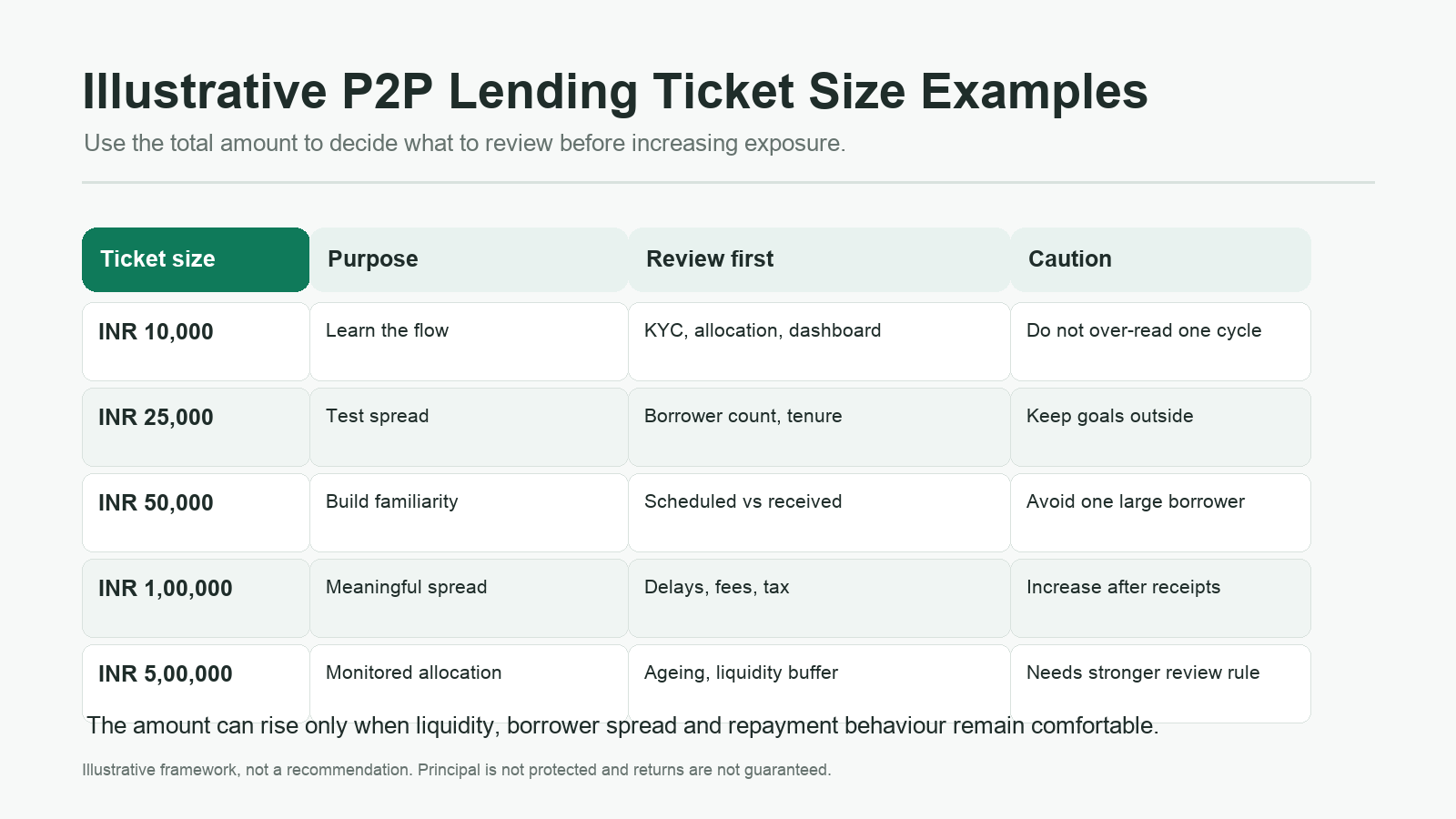
The larger the ticket size, the more important the review habit becomes. A small ticket can be used to learn. A larger ticket needs a written rule.
For example:
I will not use emergency money.
I will not increase lending only because the displayed return is attractive.
I will check borrower spread before increasing the total amount.
I will review scheduled repayments against actual receipts.
I will pause fresh lending if delays rise beyond my comfort.
I will decide whether repayments should be withdrawn, held or lent again before they arrive.
This rule matters because P2P lending can feel deceptively simple at the start. The dashboard may show expected repayments and indicative returns. But the real test is how the lending amount behaves across months, borrower types and repayment cycles.
P2P Lending For Beginners India: A First Ticket Size Framework
P2P lending for beginners in India should start with learning, not maximising.
A beginner's first ticket size should answer four questions:
Can I afford a delay without changing my household budget?
Do I understand that borrower default can reduce principal and interest?
Can the amount be spread enough to avoid obvious concentration?
Am I willing to review repayments before increasing the amount?
If the answer to any of these is no, the ticket size should be reduced or postponed.
The first lending cycle is useful because it turns abstract risk into visible behaviour. You can see the difference between expected and actual repayment, understand whether reporting is clear, check how borrower spread is presented and decide whether the product suits your temperament.
For beginners, the goal is not to reach the largest amount quickly. The goal is to learn whether P2P lending fits the money purpose.
For the onboarding sequence, read how to start P2P lending in India on IndiaP2P.
P2P Lending Portfolio Allocation vs Ticket Size
P2P lending portfolio allocation and ticket size are related, but they are not the same thing.
Allocation asks: "What share of my surplus financial assets should go toward P2P lending?"
Ticket size asks: "What actual rupee amount should I lend now, and how should that amount be spread across borrowers?"
The allocation question belongs to your broader financial plan. The ticket-size question belongs to execution. A lender can make a good allocation decision but still create avoidable risk by concentrating the amount among too few borrowers. A lender can also choose a small starting ticket but still make a poor decision if the money was needed for an upcoming expense.
If you are still deciding the overall share of your surplus money, read IndiaP2P's guide on P2P lending portfolio allocation. Use this ticket-size guide after that, when you are deciding how to start, spread and review the actual amount.
Escrow Account And Repayment Schedule Checks Before Increasing Ticket Size
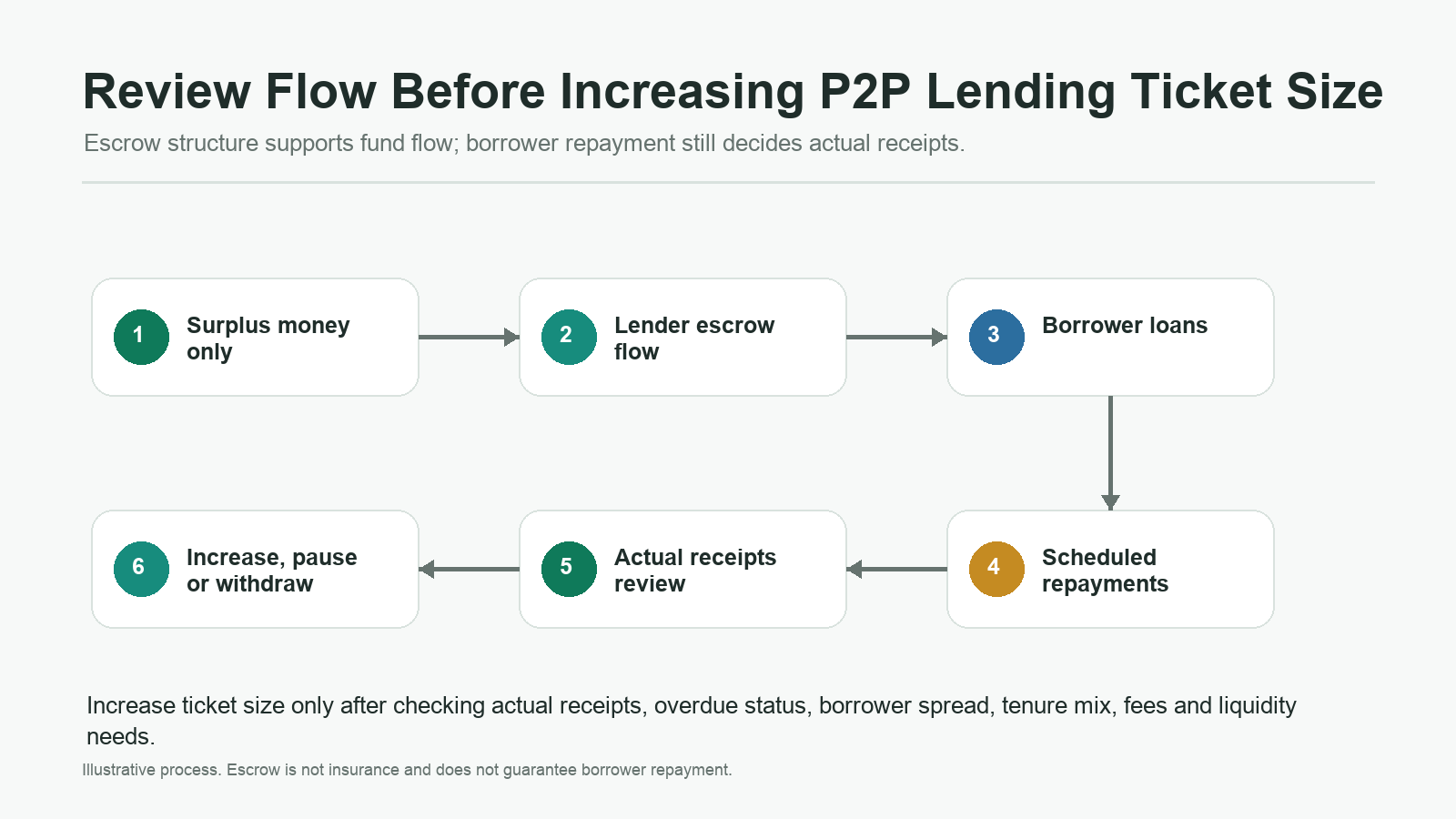
An escrow account in P2P lending helps route funds in the manner prescribed under the NBFC-P2P framework. It is part of the operational structure, not a guarantee.
In a simplified flow, lender funds move through a lender escrow account before disbursal to borrowers after the required matching and documentation. Borrower repayments move through a borrower escrow account before being routed to lenders. The platform facilitates this process, but the source of repayment remains the borrower.
That distinction should shape your ticket size. Escrow structure can help with fund-flow discipline. It does not mean money is insured. It does not mean a borrower will pay. It does not mean a delayed repayment becomes payable by the platform.
Before increasing your ticket size, review:
Check | Why it matters |
|---|---|
Scheduled repayments | Shows what was expected |
Actual receipts | Shows what borrowers paid |
Overdue status | Shows delays that need attention |
Borrower spread | Shows concentration risk |
Tenure mix | Shows how long exposure may remain |
Fees and tax | Affects net outcome |
Withdrawal or re-lending rule | Prevents impulsive decisions |
For more detail on fund flow, read IndiaP2P's guide to the escrow account in P2P lending.
How To Start P2P Lending India With A Review Rule
If you are deciding how to start P2P lending in India, build the review rule before choosing the amount.
A simple review rule can look like this:
Start only with surplus money.
Keep emergency funds and near-term expenses outside P2P lending.
Check the platform's RBI NBFC-P2P registration and disclosures.
Understand borrower default risk before looking at returns.
Choose a first ticket size small enough to observe calmly.
Review borrower spread, tenure and repayment schedule.
Increase only after actual repayments and delays are visible.
This keeps the decision grounded. IndiaP2P enables eligible lenders to target up to 18% p.a. indicative returns, but the figure must sit beside the risk: borrower repayments may be delayed or missed, principal is not protected, and returns are not guaranteed.
If the review rule feels too demanding, that itself is useful information. P2P lending requires monitoring. It is not a set-and-forget deposit.
After you decide what ticket size fits your risk and liquidity needs, you can explore IndiaP2P Monthly Income Plan+ and review whether its repayment structure matches your purpose.
P2P Lending Minimum Amount Mistakes To Avoid Before You Lend More
The P2P lending minimum amount can make the product feel easy to start, but ease of starting should not become ease of scaling. Most ticket-size mistakes happen when a lender treats the first successful step as proof that a larger amount will behave the same way.
The first mistake is reading the platform minimum as a recommendation. A low starting amount can be helpful because it reduces the pressure of learning. But it does not say anything about how much of your money should be exposed to borrower repayment risk. Your own liquidity, income stability, family obligations and tolerance for delayed repayments matter more than the platform's entry point.
The second mistake is increasing the ticket size before enough repayment data is visible. A dashboard can show expected receipts from day one, but expected receipts are not the same as received cash. A lender should see how the first repayment cycle behaves, how delays are reported and how easy it is to understand borrower spread before increasing the amount.
The third mistake is ignoring taxes, fees and idle cash. A return figure can look clear at the start, but the realised outcome depends on what borrowers actually repay, when they repay, what fees apply, whether any cash sits idle and how interest is taxed. Ticket size should therefore be reviewed on net experience, not only on a displayed rate.
The fourth mistake is treating diversification as a checkbox. A lender may see that the amount is spread, but still needs to ask: spread across how many borrowers, what borrower types, what tenures and what repayment dates? If the spread is too narrow, the total ticket size may be larger than the lender realises in practical risk terms.
The fifth mistake is increasing the amount because the first few repayments arrived on time. Timely early repayments are encouraging, but they do not eliminate borrower default risk. The better habit is to increase only when the money purpose, borrower spread, repayment visibility and liquidity buffer all remain comfortable.
How Much To Lend In P2P Lending: Increase, Pause Or Reduce
Once the first ticket is live, the next decision is not always "increase." Sometimes the right decision is to hold the amount steady. Sometimes it is to pause fresh lending. Sometimes it is to reduce future exposure by withdrawing repayments instead of lending them again.
Increase only when three conditions are true. First, the original ticket size came from surplus money and your liquidity needs have not changed. Second, borrower spread and repayment reporting are clear enough for you to understand what is happening. Third, actual receipts are broadly within your risk comfort, after accounting for delays, fees and tax.
Pause when you need more information. For example, if several repayments are delayed, if you do not understand the ageing of overdue loans, if a near-term expense has appeared or if the amount already feels emotionally large, pausing fresh lending can be more disciplined than adding more money.
Reduce future exposure when the product no longer fits the money purpose. You may not be able to instantly exit existing borrower loans, but you can decide what to do with repayments as they arrive. Withdrawing received repayments can gradually lower exposure. Holding cash before fresh lending can create a review buffer. Lending repayments again can continue exposure, but it should be a conscious decision rather than a default habit.
This increase-pause-reduce rule keeps ticket size connected to real behaviour. It also prevents return-chasing. IndiaP2P's up to 18% p.a. indicative return potential should be considered only with borrower repayment risk beside it. The figure is not a fixed outcome, and principal is not protected.
P2P Lending Repayment Schedule: A 30-60-90 Day Review Cadence
A P2P lending repayment schedule becomes useful only when the lender compares it with actual receipts. A simple 30-60-90 day review cadence can make the ticket-size decision more grounded.
In the first 30 days, review setup and clarity. Check whether your account, KYC, bank details, lender agreements, allocation details and dashboard views are understandable. Confirm whether you can see the expected repayment schedule, borrower spread, tenure and fees. At this stage, the main question is operational: do you understand where the money went and what is expected to happen next?
By 60 days, review repayment visibility. Look at scheduled repayments versus actual receipts. If repayments are delayed, check whether the dashboard explains overdue status and ageing clearly. Do not make a bigger ticket-size decision only because one receipt arrived. Look for whether the reporting gives you enough confidence to monitor both normal and delayed behaviour.
By 90 days, review comfort and next action. Ask whether the ticket size still feels appropriate. Has your liquidity need changed? Are you comfortable with the number of borrower exposures? Do you understand the tenure mix? Are you willing to keep the same amount exposed through the next repayment cycle? Would a borrower delay affect your household decisions?
After this review, choose one action: keep the ticket size unchanged, increase modestly, pause fresh lending or withdraw repayments as they arrive. The point is not to follow a rigid calendar forever. The point is to avoid increasing ticket size before the lending experience has produced enough information.
Conclusion: Keep P2P Lending Ticket Size Measured, Spread, Reviewed
A good P2P lending ticket size is measured, spread and reviewed.
Measured means it comes from surplus money, not emergency funds, near-term expenses or borrowed money.
Spread means the amount is not overly dependent on one borrower or a small group of borrowers. Diversification does not remove default risk, but it can reduce concentration risk.
Reviewed means the lender checks scheduled repayments, actual receipts, delays, borrower spread, tenure and liquidity needs before increasing the amount.
The RBI framework gives outer limits. Platform minimums give starting points. Neither replaces lender judgment. The right ticket size is the amount you can lend with a clear view of borrower risk, no expectation that returns are assured and enough patience to review the full repayment cycle.