IndiaP2P enables eligible lenders to target up to 18% p.a. indicative returns through P2P lending, subject to borrower repayment performance, fees, platform terms and default risk. That return potential should not be read as a fixed outcome. P2P lending is not a deposit product. Principal is not protected, and returns are not guaranteed.
That distinction becomes especially important when people talk about compounding.
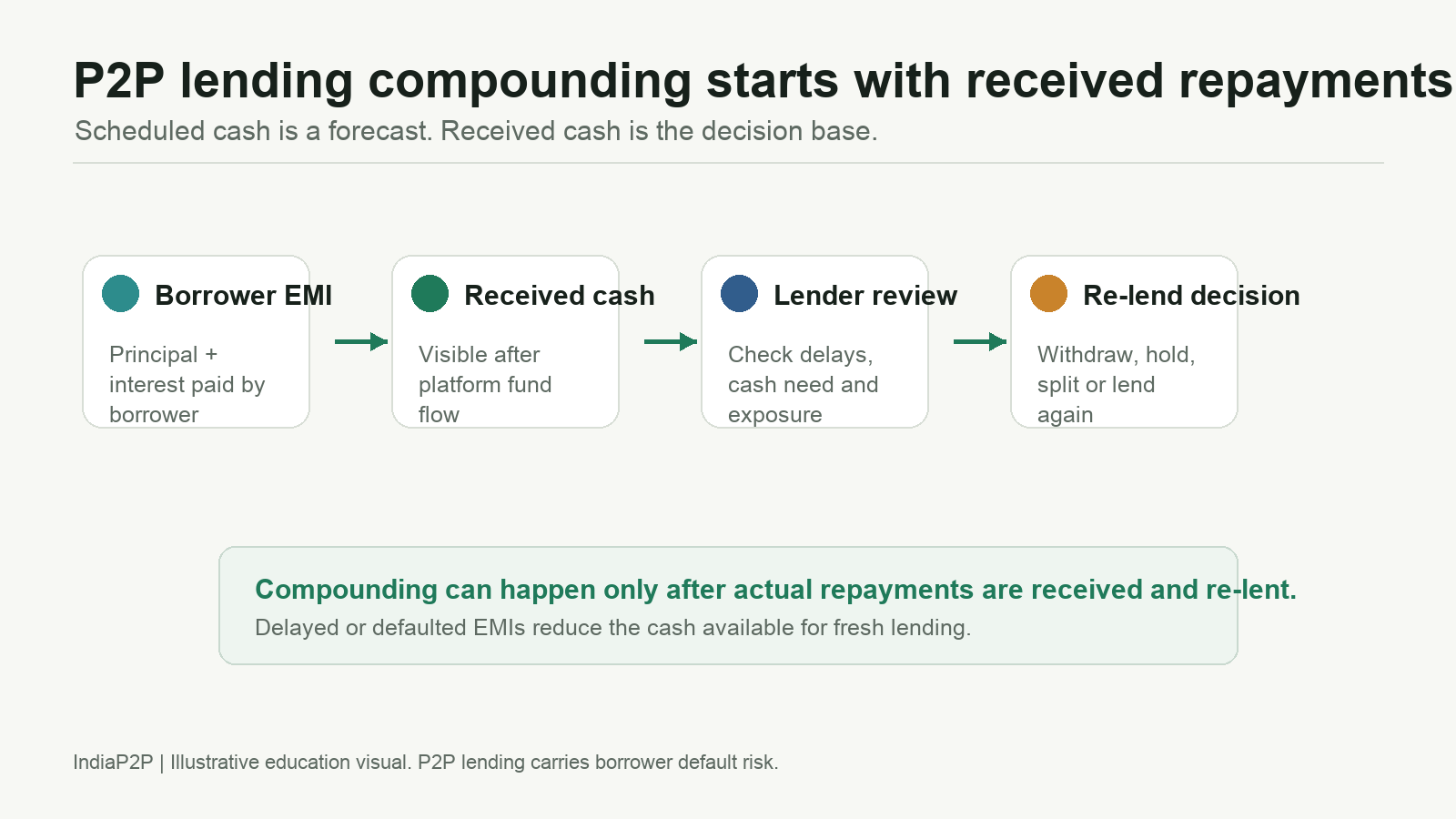
In P2P lending, compounding is not magic growth. It is a simple mechanism: borrower repayments are received, the lender reviews whether that cash should remain exposed to borrower risk, and eligible received cash is lent again into fresh borrower loans. If this happens repeatedly, more cash can stay active over time.
But the mechanism only works on cash that has actually been received. A scheduled EMI cannot be re-lent. A delayed repayment cannot compound while it is overdue. A default can reduce the principal or interest available for future lending.
So the better question is not "How much can compounding make?" It is: "What has been received, what risk remains, and should this cash be lent again?"
If you are new to the category, start with IndiaP2P's guide on how to start lending on IndiaP2P before using any re-lending strategy.
P2P Lending Compounding Starts With Received Repayments
P2P lending compounding starts with a borrower repayment. When borrowers repay through EMIs, the lender may receive principal, interest, or both, depending on the loan structure and repayment status.
The interest portion is part of the lender's return. The principal portion is the lender's own capital coming back. Both matter for compounding because both can become available for fresh lending once they are received and eligible under platform rules.
This is different from simply seeing a repayment schedule. A schedule tells you what is expected. Received cash tells you what is real.
A lender who wants to use compounding should therefore track three amounts separately:
Amount | What it means | Why it matters for compounding |
|---|---|---|
Scheduled repayment | EMI expected from borrowers | Useful for planning, but not usable until received |
Received interest | Interest actually paid by borrowers | Can add to return and may be re-lent |
Received principal | Capital repaid by borrowers | Can be withdrawn, held, or lent again |
The phrase "received" is doing the work. Compounding in P2P lending is built on actual cash flows, not projected cash flows.
Monthly Repayments In P2P Lending Are The Raw Material
Monthly repayments in P2P lending can create regular decision points. When repayments arrive, a lender can review the dashboard, check delays, assess cash needs, and decide whether to re-lend, withdraw, split, or pause.
This does not make monthly repayments assured income. Borrowers may pay on time, late, partially, or not at all. A repayment calendar helps with planning, but cash-flow planning should always be based on received repayments. IndiaP2P's guide to a P2P lending cash-flow calendar explains this tracking discipline in more detail.
Re-Lend P2P Repayments Only After They Are Received
Re-lending should happen only after cash is visible as received and available. This avoids a common mistake: treating expected repayments as if they are already usable.
If a borrower EMI is delayed, that amount should not be part of the next lending decision. If a delayed EMI is later recovered, the lender can reassess it then. The discipline is simple: scheduled cash is a forecast; received cash is the decision base.
Compound Interest In P2P Lending Is Not Guaranteed Growth
Compound interest in P2P lending is often described too cleanly. The usual explanation says: keep lending the interest you receive, and the base grows over time. The arithmetic is easy. The risk is not.
In P2P lending, compounding depends on borrower repayment behaviour. It also depends on whether suitable fresh borrower loans are available, whether cash sits idle, how fees apply, how tax affects the lender, and whether the lender chooses to withdraw some repayments for liquidity.
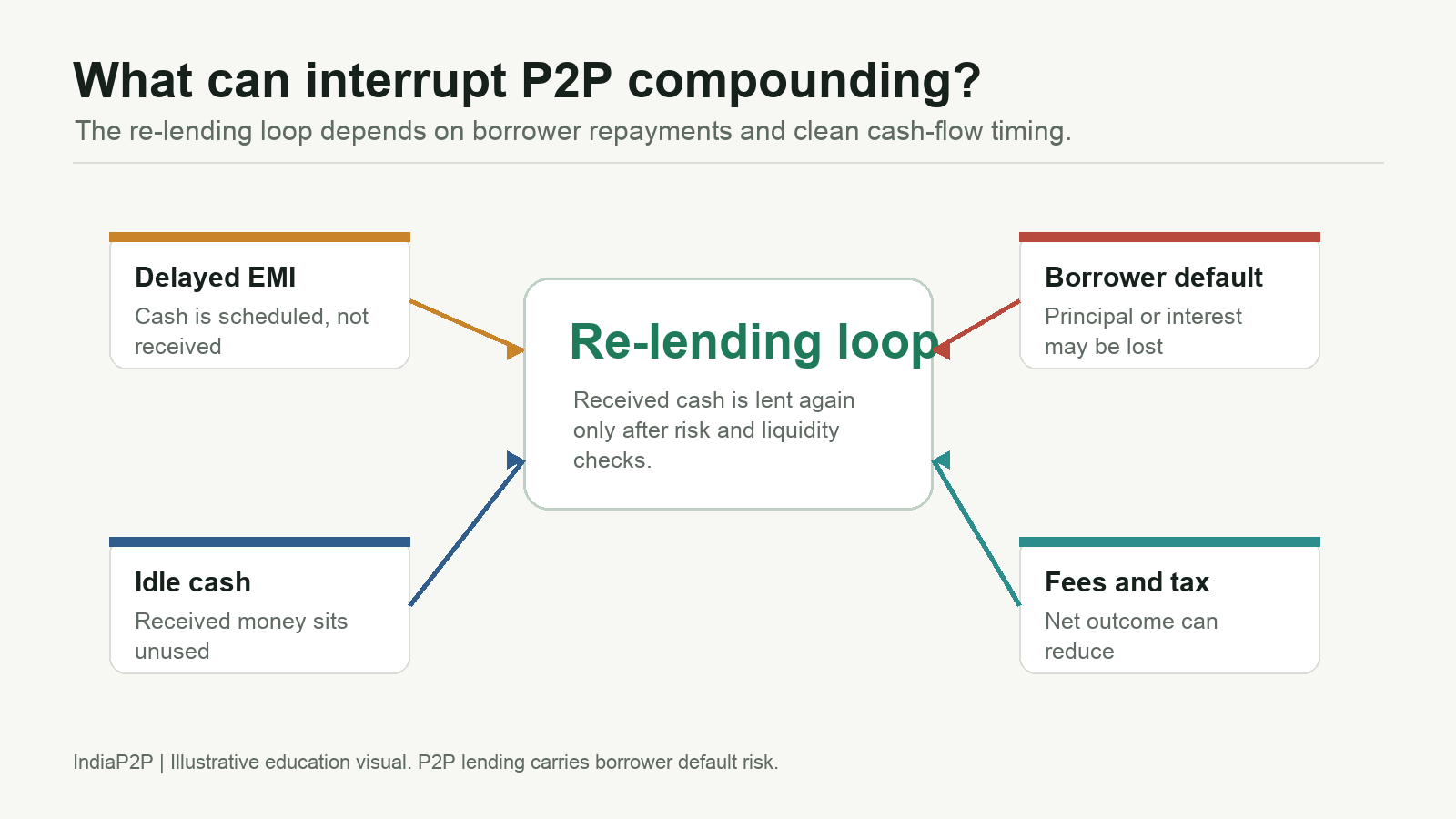
This is why a compounding example should be treated as illustrative, not predictive. The compounding effect can slow down or reverse when:
borrower EMIs are delayed
a borrower defaults
received cash sits idle for long periods
fees reduce net receipts
tax reduces post-tax outcome
the lender withdraws cash for liquidity
fresh lending creates concentration in a narrow borrower group
None of these makes re-lending wrong. They simply make the mechanism real.
Borrower Default Risk Can Interrupt Compounding
Borrower default risk is the main interruption. If a borrower does not repay, the lender may receive less interest, less principal, or both. That directly reduces the cash available to re-lend.
This is the point many return-first compounding explanations skip. Compounding is powerful only when the underlying repayment stream performs. In P2P lending, that stream comes from borrowers, not from a guaranteed payout pool.
No Principal Protection Means No Assured Compounding
IndiaP2P is registered with the Reserve Bank of India as an NBFC-P2P. That is a regulatory fact, not a guarantee or endorsement of returns.
Under RBI's NBFC-P2P framework, the platform facilitates lending between lenders and borrowers. It does not raise deposits, lend on its own, or provide a credit guarantee. Lenders should therefore treat re-lending as a fresh risk decision each time, not as an automatic compounding instruction.
Reinvest P2P Returns Is Search Language; Re-Lending Is The Better IndiaP2P Term
Many people search for "reinvest P2P returns" or "P2P reinvestment" when they want to understand compounding. The intent is understandable. They want to know what happens if the money received from lending is put back to work.
For IndiaP2P content, the more accurate term is re-lending.
Why? Because P2P is lending activity. The user is a lender. The counterparty is a borrower. The platform facilitates loan matching and servicing under the NBFC-P2P framework. Calling the activity an investment can create the wrong impression, especially if it is paired with return numbers.
So this article uses "re-lend" for the actual action: received repayments are lent again into fresh borrower loans.
Search phrase | IndiaP2P-safe phrasing | Why the distinction matters |
|---|---|---|
Reinvest P2P returns | Re-lend received P2P repayments | Keeps the activity framed as lending |
P2P investment compounding | P2P lending compounding | Avoids implying a deposit or fund product |
Invest again after EMI | Lend again after repayments are received | Keeps borrower repayment risk visible |
Lender and Borrower Language Under RBI NBFC-P2P Rules
The language is not cosmetic. RBI's framework defines the platform as an intermediary providing loan facilitation between participants. For an IndiaP2P article, that means the reader should see lender, borrower, loan, repayment, exposure and default risk.
For a fuller regulatory explanation, see IndiaP2P's guide to RBI NBFC-P2P lending guidelines.
Not A Deposit Product Or Fixed Payout Plan
Re-lending repayments is not like renewing a deposit. There is no fixed payout promise, no principal protection, and no RBI assurance of repayment. The lender's outcome depends on borrower repayments and the quality of each fresh lending decision.
That is why compounding should be presented as a possible effect of disciplined re-lending, not as a guaranteed feature.
P2P Lending Returns Calculation Changes When Cash Is Re-Lent
P2P lending returns calculation changes when received cash is lent again. A simple return calculation may look only at the starting amount and the total interest received. A re-lending calculation has to track dates, amounts, withdrawals, idle cash and new borrower exposure.
Consider an illustrative example. This is not a live IndiaP2P borrower listing and not a return forecast.
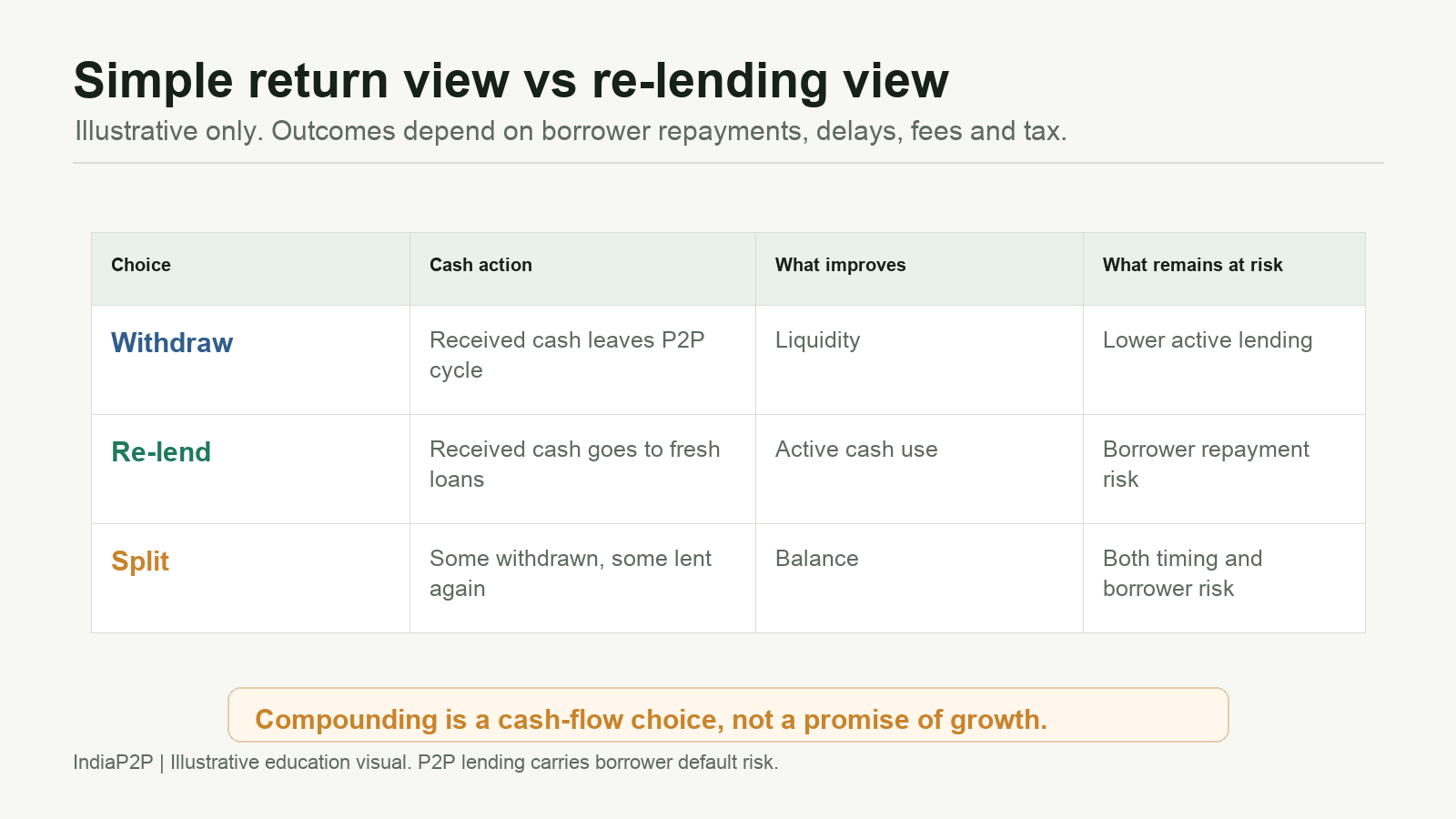
A lender starts with ₹1,00,000. Over the first few months, the lender receives ₹9,000 as a mix of principal and interest. The lender now has three choices:
Choice | What happens | Main trade-off |
|---|---|---|
Withdraw ₹9,000 | Cash leaves the P2P cycle | More liquidity, less active lending |
Re-lend ₹9,000 | Cash goes into fresh borrower loans | More active lending, continued borrower risk |
Split ₹9,000 | Some cash is withdrawn, some is lent again | Balanced liquidity and continued exposure |
If the lender re-lends the full ₹9,000, that received cash can generate further repayments if borrowers pay as expected. If the lender withdraws it, the cash is available outside the platform but no longer participates in fresh P2P lending. If the lender splits it, the strategy becomes more flexible.
The calculation is therefore not just "principal plus rate." It is a dated cash-flow problem.
For the mechanics of return measurement, see IndiaP2P's guide to P2P lending returns calculation.
Simple Interest Versus Re-Lending Received Principal And Interest
Simple interest thinking treats the starting amount as the main base. Re-lending thinking asks whether received principal and interest are being used again.
That difference matters over time. If repayments are consistently received and re-lent, more cash can remain active across lending cycles. But if repayments are delayed or cash sits idle, the compounding effect weakens. If losses occur, the base available for future lending can shrink.
Idle Cash, Fees And Tax Can Reduce The Compounding Effect
Idle cash is a quiet drag. It may be intentional, especially if the lender wants a buffer. But it should be conscious.
Fees and tax also matter. Platform charges, if applicable, reduce net receipts. Tax treatment depends on individual circumstances and may change. Lenders should consult a qualified tax advisor for personal tax treatment.
P2P Lending Diversification Makes Re-Lending More Disciplined
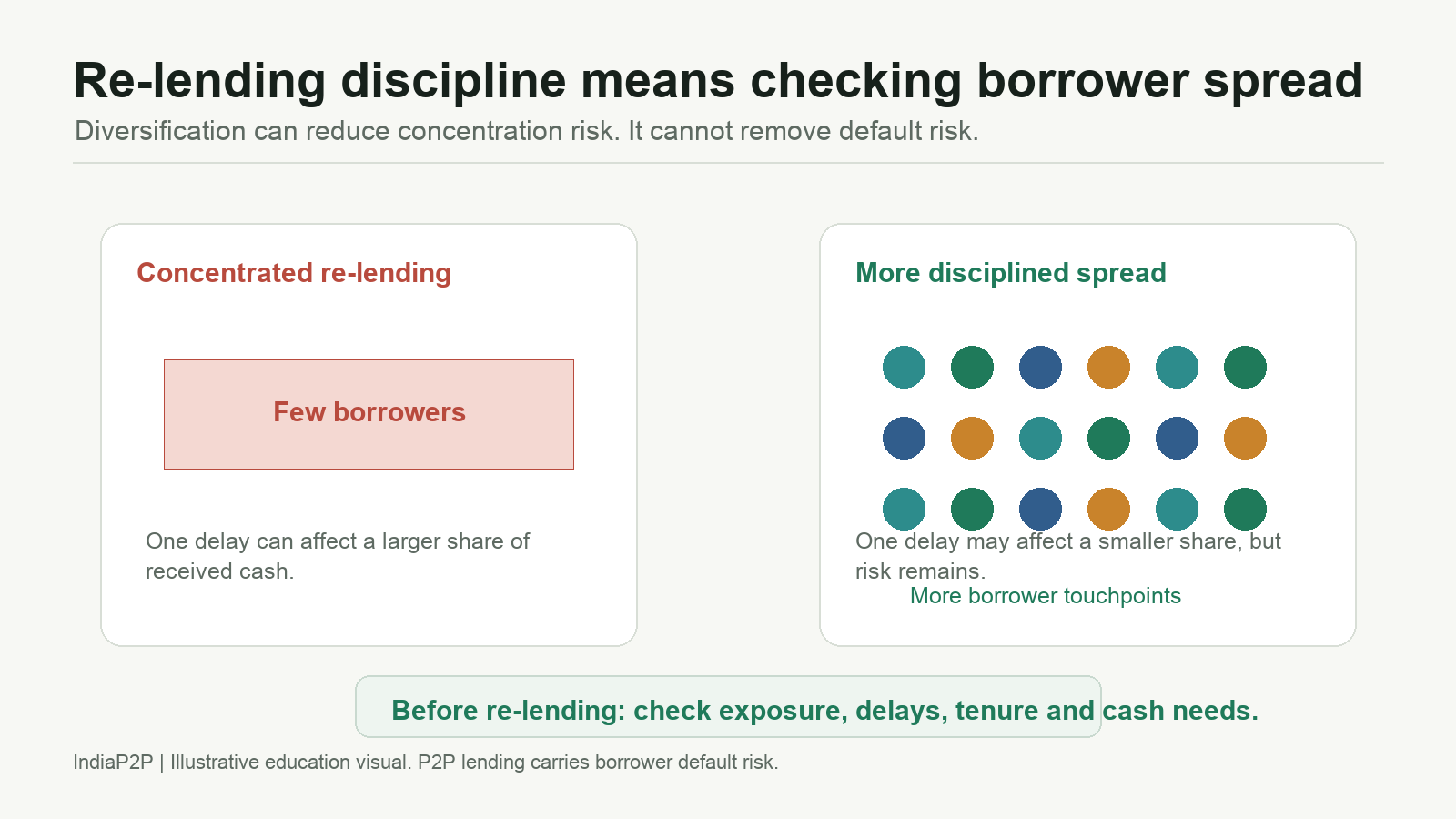
Re-lending should not mean sending received cash into the first available borrower loan. A disciplined lender checks borrower spread, risk grades, tenure, repayment behaviour and exposure limits before fresh lending.
Diversification matters because concentration increases dependence on a smaller set of borrowers. If received repayments are repeatedly lent into similar borrower types or narrow tenures, the lender may build hidden concentration without noticing.
Good re-lending discipline asks:
Is exposure spread across enough borrowers?
Has any borrower or borrower segment become too large?
Are tenures aligned with my cash-flow needs?
Are delayed EMIs rising?
Am I re-lending because the plan says so, or because cash happened to arrive?
Diversification is a risk-management tool. It is not risk removal.
Borrower Spread Reduces Concentration, Not Default Risk
Spreading exposure across borrowers can reduce the impact of one borrower delay on the overall lending experience. But several borrowers can still delay or default. A diversified book of loans can still produce lower-than-expected receipts.
That is the correct boundary: diversification can reduce concentration risk; it cannot protect principal or guarantee interest.
P2P Lending Exposure Limits India Still Apply
RBI caps a lender's aggregate exposure across all P2P platforms at ₹50 lakh. Exposure from one lender to the same borrower across all P2P platforms is capped at ₹50,000. If total exposure across P2P platforms exceeds ₹10 lakh, the lender must provide a practising Chartered Accountant certificate confirming minimum net worth of ₹50 lakh.
Re-lending does not sit outside these rules. Fresh lending from received repayments still counts as lending exposure. IndiaP2P's guide to P2P lender exposure limits in India explains this in more detail.
P2P Lending Escrow Account And T+1 Settlement In The Re-Lending Flow
A P2P lending escrow account is part of the fund-flow infrastructure. Broadly, funds move through escrow mechanisms rather than being held as a deposit with the platform. Borrower repayments are routed through the prescribed flow before they become visible to the lender.
This matters for compounding because timing matters. A lender cannot re-lend cash that has not yet moved through the required process. The practical sequence is:
Borrower repayment is made.
Funds move through the relevant escrow flow.
Lender dashboard reflects received cash, subject to platform process.
Lender decides whether to withdraw, hold or re-lend.
For more detail, see IndiaP2P's explainer on the escrow account in P2P lending.
Escrow Routing Does Not Protect Principal
Escrow routing is an operational control. It does not mean the lender's principal is protected. If a borrower does not repay, escrow cannot create a repayment that has not happened.
T+1 Settlement Helps Timing, Not Return Certainty
The RBI's updated framework tightened the movement and holding period of funds in escrow. This supports cleaner fund movement. It does not make returns certain, and it does not remove borrower default risk.
Re-Lend Or Withdraw Repayments: A Practical IndiaP2P Decision Framework
The cleanest re-lending strategy is usually a rule, not a mood. Decide in advance what you will do when repayments arrive.
Situation | Better default action | Why |
|---|---|---|
You need cash in the next few months | Withdraw received repayments | Liquidity matters more than continued exposure |
Your dashboard shows rising delays | Pause or reduce re-lending | Let repayment behaviour guide the next decision |
Your exposure is concentrated | Re-lend only with better borrower spread | Avoid adding to concentration |
Your cash buffer is complete and repayments are healthy | Consider re-lending | Keeps received cash active, subject to risk checks |
You are unsure | Hold cash temporarily | A delayed decision can be better than a rushed one |
This framework is deliberately simple. Re-lending is not always superior. Withdrawal is not always conservative. The right action depends on your cash need, your risk comfort and the actual repayment data in front of you.
For a dedicated decision guide, read IndiaP2P's article on whether to re-lend or withdraw P2P repayments.
Re-Lend When Cash Flow And Risk Checks Support It
Re-lend when repayments have been received, borrower spread remains healthy, delayed EMIs are within your comfort range, and you do not need that cash soon. Even then, treat each fresh lending cycle as a new decision.
Withdraw Or Pause When Repayments Are Delayed
Withdraw or pause when delays rise, cash needs change, or you cannot review the lending dashboard properly. Not re-lending is also a decision. Sometimes it is the more disciplined one.
Closing: Compounding Is A Mechanism, Not A Promise
P2P lending compounding on IndiaP2P works through a practical sequence: borrowers repay, cash is received, the lender reviews risk and liquidity, and eligible cash may be lent again.
The compounding effect comes from discipline, not certainty. It depends on borrower repayments, fresh lending choices, idle cash, fees, tax, diversification and the lender's own withdrawal rules.
Used carefully, re-lending can help keep received repayments active. Used carelessly, it can hide risk behind a clean compounding story.
The useful habit is to ask the same question every time cash arrives: has this money been received, and does it still deserve to be exposed to borrower repayment risk?