Most laddering strategies begin with the same idea: do not place all your money behind one date. Split it across different maturity or repayment points, so some cash returns earlier and some stays deployed for longer.
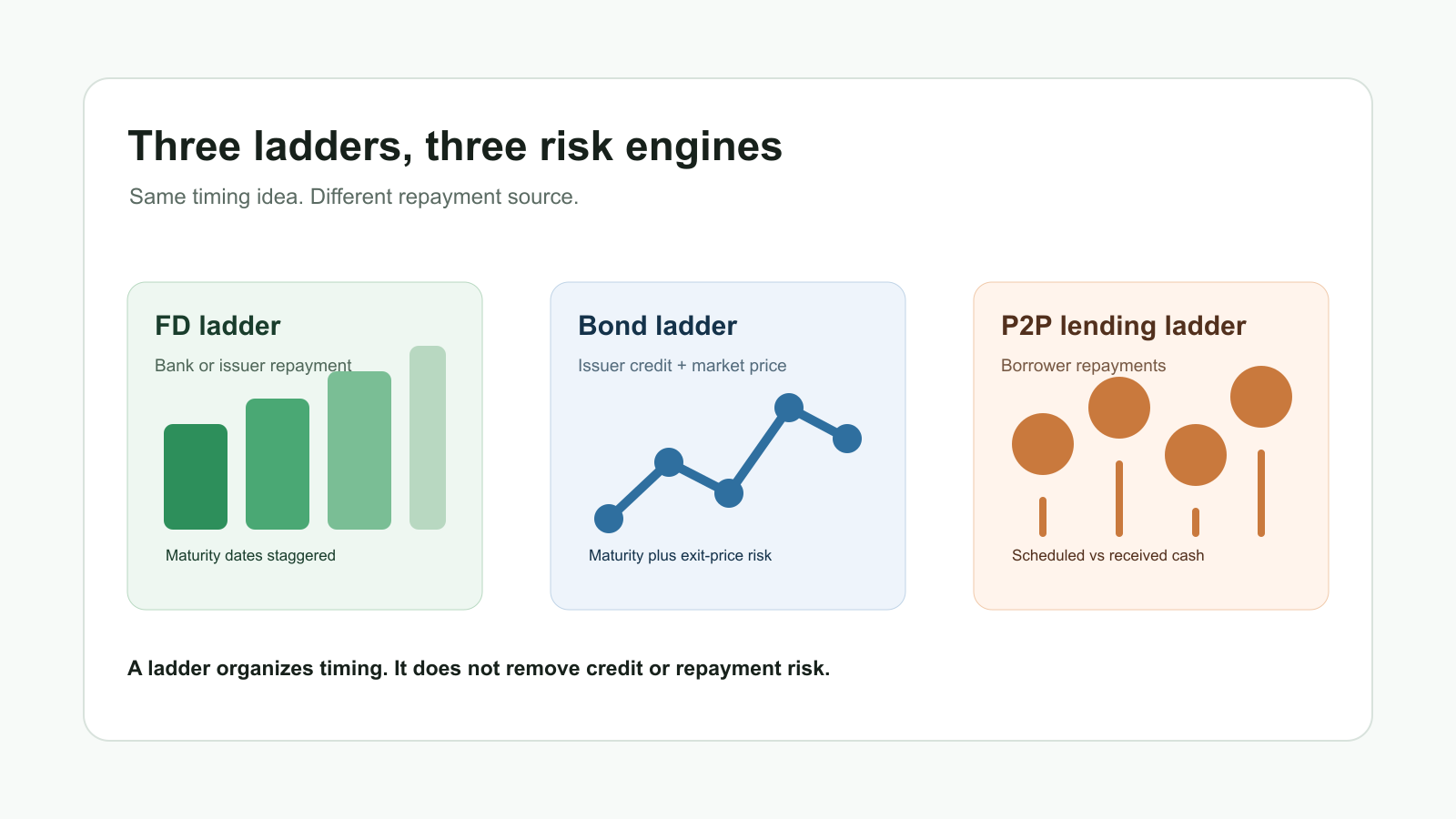
But an FD ladder, a bond ladder and a P2P lending ladder are not the same product wearing different labels. The timing structure may look similar. The risk engine is different.
An FD ladder depends on bank or issuer repayment. A bond ladder depends on issuer credit, market price if sold early, and liquidity. A P2P lending ladder depends on borrower repayments across many loans. IndiaP2P enables lenders to target up to 18% p.a. indicative returns, but those returns depend on borrower repayment performance and are not assured.
This guide compares the three ladder types without ranking them as better or worse. The useful question is narrower: what kind of cash flow do you need, what risk can you read, and what liquidity do you expect?
What is a Laddering Strategy in Fixed Income?
A laddering strategy splits a total amount across multiple tenures or repayment dates. Instead of using one maturity date, the ladder creates several "rungs". Each rung returns cash at a different time.
For example, a five-rung ladder may have cash returning after 1, 2, 3, 4 and 5 years. When the first rung matures, the user can withdraw the cash, use it for a planned expense, or place it again at the far end of the ladder.
The benefit is discipline. Laddering reduces dependence on one rate cycle, one maturity date, or one repayment event. It can also make cash-flow planning easier because money comes back in stages.
The limit is just as important. A ladder is a timing structure, not a protection structure. It does not remove credit risk, market risk, borrower default risk, tax impact, or liquidity constraints.
That is why comparing laddering strategies only by headline rate is incomplete. The better comparison is:
What creates the cash flow?
Who has to repay?
What happens if repayment is delayed?
Can you exit before maturity?
What is insured, and what is not?
What should you monitor after starting?
FD Laddering Strategy India: How an FD Ladder Works
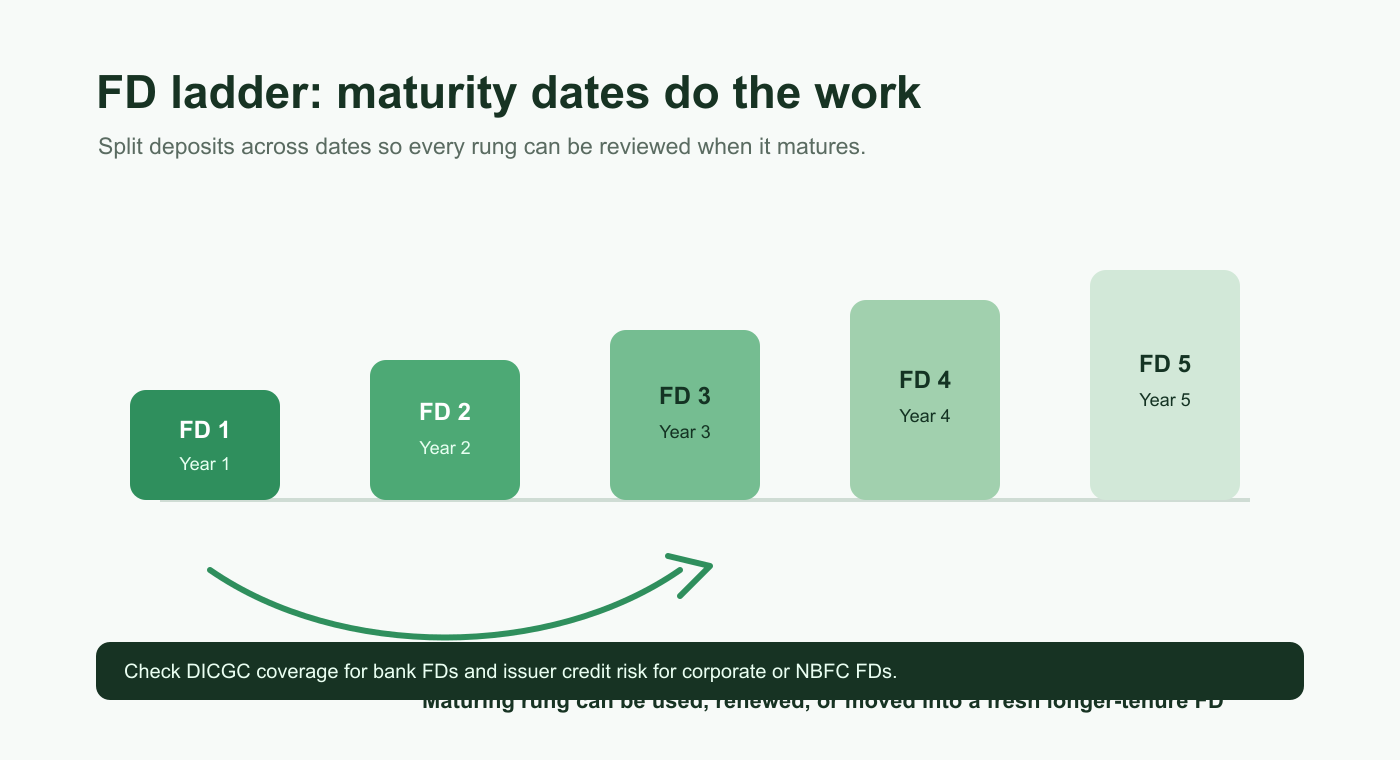
An FD ladder splits money across fixed deposits with different maturity dates. A simple version uses five deposits: one maturing each year from year 1 to year 5. When the year-1 FD matures, the depositor may use the cash or place it into a fresh 5-year FD. Over time, the ladder may settle into a structure where one FD matures every year.
The main purpose is to avoid locking the full amount into one rate and one maturity date. If interest rates rise after the first FD matures, that maturing rung can be placed at the new rate. If interest rates fall, the longer-tenure rungs may still carry the earlier rate.
For bank FDs, the important protection detail is DICGC insurance. Bank deposits, including fixed deposits, are insured up to ₹5 lakh per depositor per bank, including principal and interest, subject to DICGC rules.
That protection does not apply in the same way to every product called an FD. Corporate or NBFC fixed deposits are not bank deposits covered by DICGC. They carry issuer credit risk, and the user should review the issuer, credit rating, tenure, payout frequency and withdrawal terms.
FD interest is also taxable as per the user's income slab. A ladder can organize maturity timing, but it does not remove tax impact.
FD Ladder Benefits and Limits
An FD ladder can help with planned liquidity. If one rung matures every year or quarter, the depositor may avoid breaking a long-tenure FD early. That can reduce premature withdrawal penalties.
It can also reduce rate-timing risk. Instead of placing everything at one rate, the ladder refreshes in stages.
The limits are concentration and tax. A large ladder inside one bank may exceed the DICGC insurance limit for that depositor at that bank. A corporate FD ladder may offer higher visible rates, but it brings issuer credit risk. Interest remains taxable.
Bond Laddering Strategy India: How a Bond Ladder Works
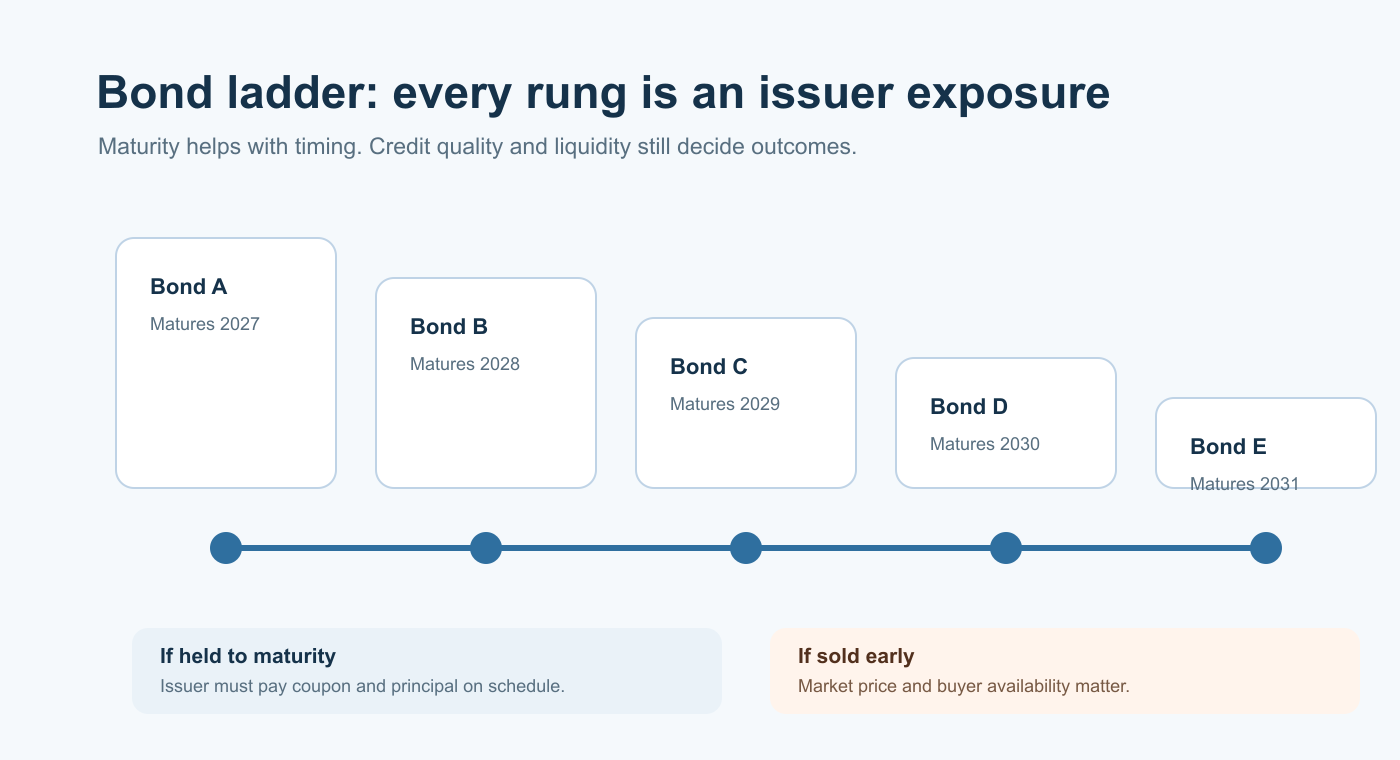
A bond ladder uses bonds with staggered maturities. For example, a user may hold bonds maturing in 2027, 2028, 2029, 2030 and 2031. Each bond may pay coupons during its life and return face value at maturity, subject to the issuer's ability to pay.
The ladder can support cash-flow planning in two ways. First, coupons may arrive periodically, depending on the bond terms. Second, principal is scheduled to return at different maturity dates.
The main distinction from an FD ladder is market price. A listed bond can usually be sold before maturity through the secondary market, but the price may be above or below the purchase price. If market rates rise, bond prices can fall. If liquidity is thin, the available exit price may be less attractive than the theoretical value.
If the bond is held to maturity, the market-price movement may matter less than issuer repayment capacity. But it does not disappear. The issuer still has to pay coupons and principal on schedule.
Bond ladders also need issuer spread. A five-rung ladder made only of bonds from one issuer is not much of a credit-risk ladder. It is mostly one borrower exposure split across dates. A more careful bond ladder looks across issuer, group, sector, rating, maturity and liquidity.
Bond Ladder Risks: Issuer Credit, Market Price, and Liquidity
Bond laddering can reduce dependence on one maturity date, but it cannot make issuer repayment certain. Credit risk remains.
If a bond is sold before maturity, market risk and liquidity risk matter. The user may receive less than expected if rates move, credit perception changes, or buyers are limited.
The practical check is simple: do not read a bond ladder only as a calendar. Read every rung as a separate credit exposure.
P2P Lending Ladder: How Borrower Repayments Create Staggered Cash Flow
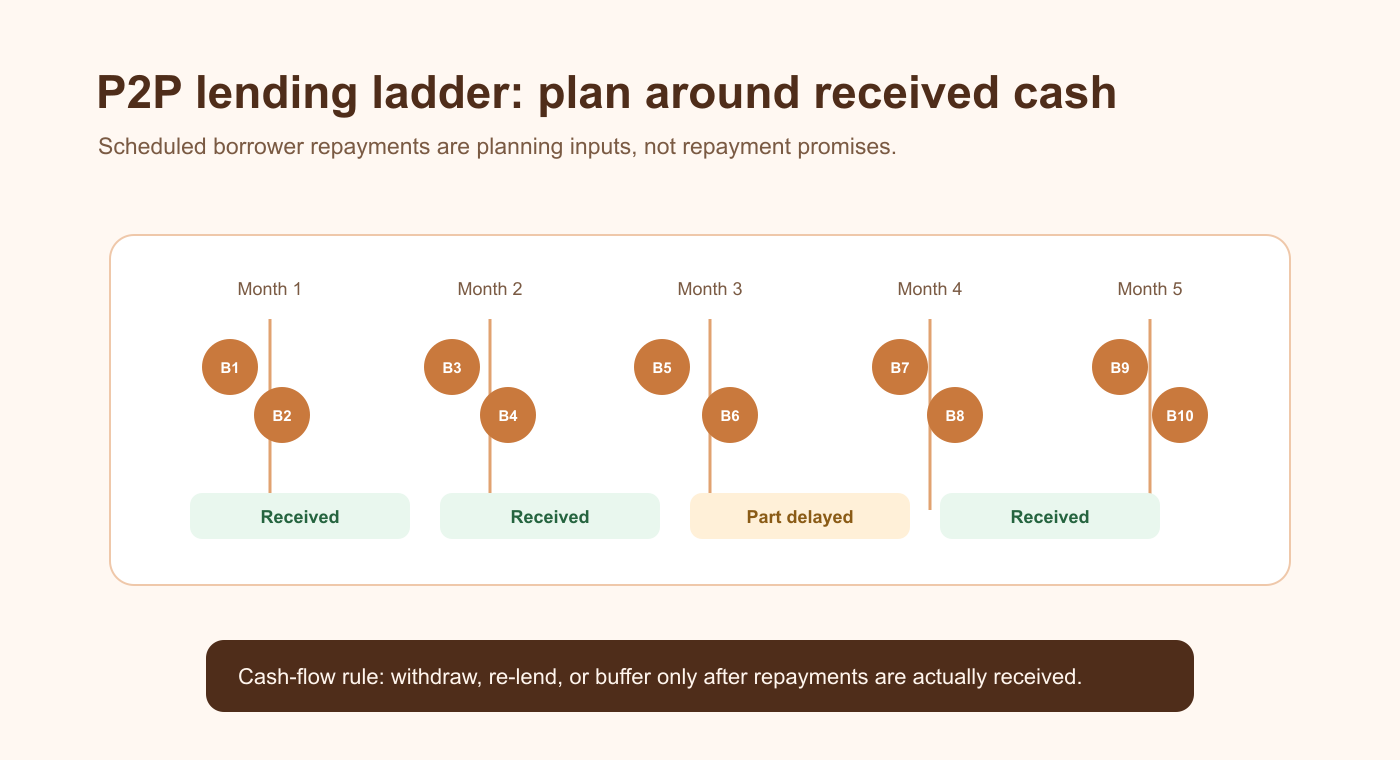
A P2P lending ladder is built around borrower repayment schedules. Instead of one issuer or one bank, the cash flow comes from many borrowers repaying through EMIs or other agreed repayment structures.
For a lender, the ladder may be created by spreading lending across different borrowers, tenures and expected repayment months. As repayments arrive, the lender can withdraw cash, re-lend received amounts, or keep a buffer for months when some borrowers are delayed.
The planning advantage is rhythm. Monthly borrower repayments may make cash flow easier to monitor than waiting for one large maturity. The lender can see what was scheduled, what was received, what is delayed, and what remains outstanding.
The risk is that scheduled repayment is not the same as received repayment. A borrower may pay late, partly, or not at all. Several borrower delays can reduce cash flow and affect principal recovery.
IndiaP2P is registered with RBI as an NBFC-P2P. Under the RBI NBFC-P2P framework, the platform acts as an intermediary for lending between lenders and borrowers. It does not provide credit enhancement or a repayment guarantee. Lenders carry borrower repayment risk.
For a practical starting point, review the Monthly Income Plan Plus and understand the P2P lending repayment process before lending.
P2P Lending Ladder Risk: Borrower Default and Concentration
The core risk in a P2P lending ladder is borrower default risk. Diversification can reduce dependence on one borrower, but it cannot remove the possibility of delayed or failed repayment.
The lender should check borrower count, largest borrower exposure, tenure spread, delayed repayment ageing, fees and platform disclosures. RBI caps total exposure across all P2P platforms at ₹50 lakh per lender and exposure to a single borrower at ₹50,000.
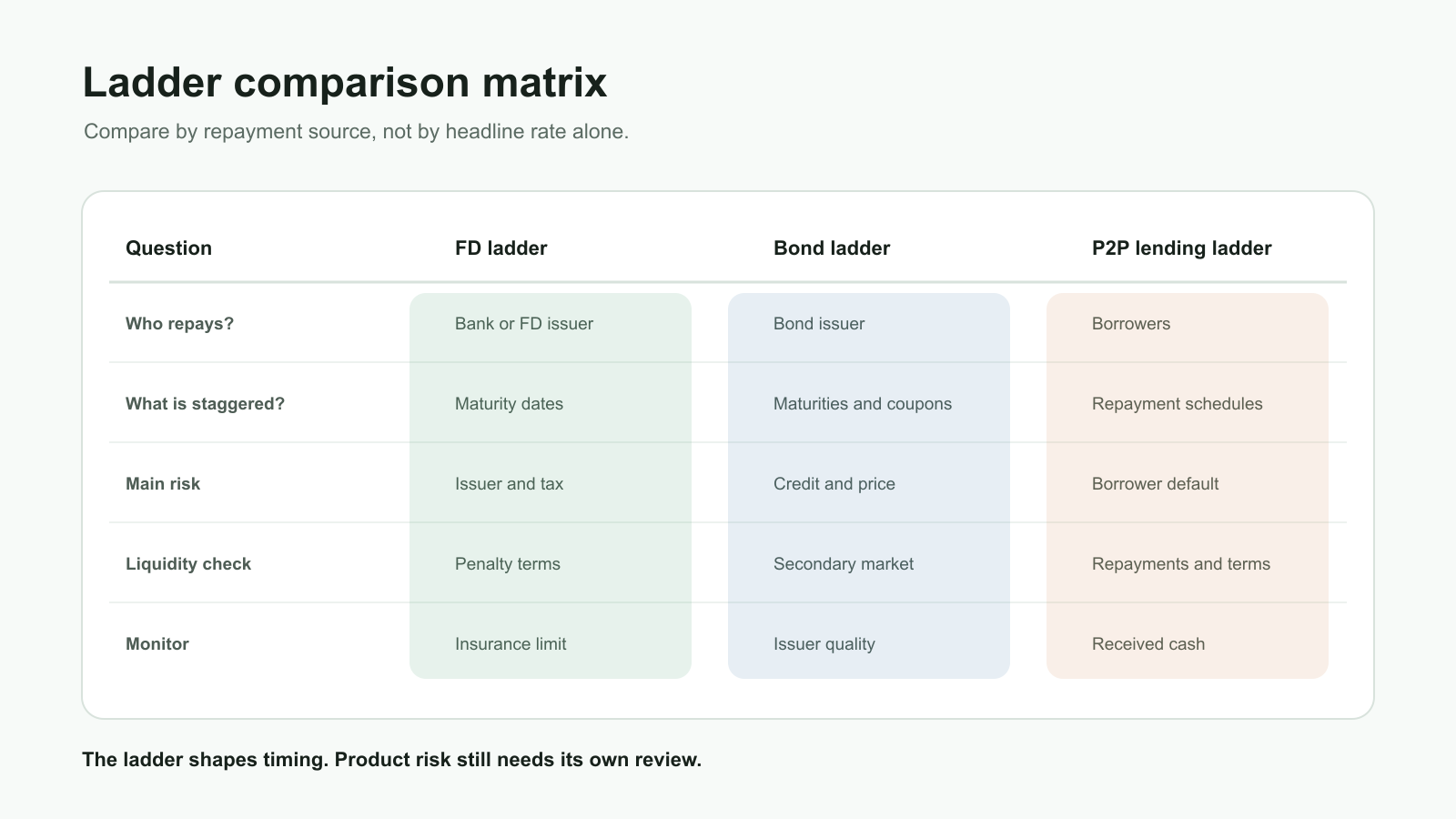
FD Ladder vs Bond Ladder vs P2P Lending Ladder: Comparison Table
Factor | FD Ladder | Bond Ladder | P2P Lending Ladder |
|---|---|---|---|
Basic structure | Multiple FDs with staggered maturity dates | Multiple bonds with staggered maturity dates | Lending spread across borrowers, tenures and repayment schedules |
Cash-flow source | FD maturity and interest payout | Coupon and maturity repayment from issuer | Borrower EMIs and repayments |
Main timing benefit | Avoids one large maturity date | Spreads maturity and coupon timing | Creates expected repayment rhythm across months |
Main risk source | Bank or corporate FD issuer | Bond issuer and market price if sold early | Borrower repayment behaviour |
Insurance/protection | Bank FDs covered by DICGC up to ₹5 lakh per depositor per bank; corporate FDs are not | No DICGC insurance; repayment depends on issuer | No principal protection; repayment depends on borrowers |
Liquidity | Premature withdrawal may be available with penalty | Secondary market exit may be available, subject to price and buyers | Usually linked to borrower repayments and platform terms |
Rate or return visibility | Interest rate known at opening | Coupon and YTM visible, subject to price and issuer performance | Indicative returns depend on borrower repayments, fees and defaults |
What to monitor | Maturity date, renewal rate, bank/issuer concentration, tax | Issuer rating, maturity, coupon, liquidity, market price | Borrower spread, delayed repayments, tenure mix, received cash |
Best-fit use case | Simple maturity planning and deposit discipline | Users who can read issuer risk and hold through maturity | Lenders comfortable with borrower repayment risk and regular monitoring |
The comparison shows why "ladder" is not enough. A ladder tells you when cash may return. It does not tell you how certain that cash is, who must repay it, or what can go wrong.
Worked Example: ₹3 Lakh Split Across Three Ladder Types
Assume a user has ₹3 lakh available for fixed-income-style planning and wants to understand the three ladder types. This is only an illustration, not a recommendation.
The user divides the amount into three separate ₹1 lakh examples.
FD ladder example: ₹1 lakh is split into four FDs of ₹25,000 each, maturing in 6, 12, 18 and 24 months. The purpose is simple liquidity scheduling. The user checks whether these are bank FDs or corporate FDs, whether DICGC applies, and how interest will be taxed.
Bond ladder example: ₹1 lakh is split across bonds with different maturities. The user checks issuer, rating, coupon, maturity, liquidity and whether the amount can be held until maturity. If an early exit is needed, market price matters.
P2P lending ladder example: ₹1 lakh is lent through a P2P platform across many borrowers and different repayment schedules. The user checks borrower spread, tenure, expected monthly repayments, delayed repayment reporting and fees. The user plans only around received cash, not scheduled cash.
In all three cases, the ladder improves timing discipline. But the monitoring work differs. The FD ladder asks: which issuer and what insurance limit? The bond ladder asks: which issuer and what exit risk? The P2P lending ladder asks: which borrowers, what repayment behaviour, and how diversified is the lending amount?
After this comparison, a lender who wants to evaluate borrower spread and expected repayments can review IndiaP2P's guide to reading a P2P loan book before lending.
Which Ladder May Fit Which Goal?
If the goal is a known expense at a known date, an FD ladder may be easier to plan around because the maturity date is visible and familiar. For bank FDs, the DICGC limit may also matter for risk planning.
If the goal is to hold listed debt securities until maturity and the user can evaluate issuer risk, a bond ladder may provide more instrument choice. The user should be comfortable reading credit rating, coupon, YTM, maturity and liquidity.
If the goal is expected monthly repayment visibility and the lender is comfortable with borrower repayment risk, a P2P lending ladder may fit as one layer of a broader cash-flow plan. It should not be used for money needed for essential expenses or near-term obligations.
A simple decision rule:
Need near-certain access for essential expenses: keep liquid cash first.
Need deposit maturity planning: consider an FD ladder.
Need listed debt exposure with issuer-level review: consider a bond ladder.
Need monthly borrower repayment visibility and accept default risk: evaluate a P2P lending ladder.
No ladder should carry the whole plan. The more important the expense, the more liquidity should sit outside the ladder.
Common Mistakes When Comparing Laddering Strategies
The first mistake is comparing only the headline number. An FD rate, bond YTM and P2P indicative return are not mechanically identical. They come from different sources and carry different risks.
The second mistake is assuming all FDs carry the same protection. Bank FDs have DICGC insurance up to the applicable limit. Corporate or NBFC FDs do not carry the same deposit insurance.
The third mistake is treating bond maturity as a guarantee. A bond's maturity date matters only if the issuer pays on schedule. If the bond is sold early, market price and liquidity matter.
The fourth mistake is treating P2P scheduled repayments as assured cash flow. P2P lending repayments depend on borrower behaviour. The useful number is received cash after delays, defaults and fees, not only scheduled receipts.
The fifth mistake is calling every spread "diversification". Spreading across dates is not the same as spreading across risks. A good ladder should avoid concentration by issuer, borrower, tenure and repayment date, depending on the product.
How to Evaluate a P2P Lending Ladder on IndiaP2P
Before lending, review the ladder as a set of borrower-linked cash flows, not as a fixed-income substitute.
Check:
How many borrowers the lending amount is spread across.
The largest exposure to one borrower.
Tenure mix and expected repayment months.
Current, delayed and overdue repayment status.
Fees and how net annual yield is shown.
Whether repayments are automatically re-lent or kept available.
What happens when a borrower misses an EMI.
Whether the platform disclosures and grievance process are easy to find.
IndiaP2P operates under the RBI NBFC-P2P framework. RBI registration identifies the regulatory category; it does not mean RBI assures borrower repayment or any return outcome.
If you decide to evaluate P2P lending for monthly cash-flow planning, start with surplus money that can tolerate repayment timing risk. Then use borrower spread, tenure discipline and received-cash tracking as your operating rules.
Conclusion: The Ladder is a Structure, Not Protection
An FD ladder, bond ladder and P2P lending ladder all organize cash flow over time. That is useful. It can reduce dependence on one maturity date and make reinvestment decisions more disciplined.
But the ladder does not remove the underlying risk. FDs still depend on the bank or issuer. Bonds still depend on issuer repayment and market liquidity. P2P lending still depends on borrower repayments.
The right comparison is not "which ladder pays more?" It is "which risk can I understand, monitor and afford?" Once that is clear, the ladder becomes a planning tool rather than a headline-rate chase.