How much to allocate to P2P lending is not a question with one fixed answer. It depends on your liquidity needs, existing financial portfolio, income stability, risk comfort, and how well the lending amount is spread across borrowers.
IndiaP2P offers up to 18% p.a. indicative returns, but P2P lending is not a bank deposit and does not carry principal protection. Returns depend on borrower repayments. That is why the better question is not, "What is the maximum I can lend?" It is, "What amount can I lend while still keeping my financial plan stable if repayments are delayed?"
This guide gives a practical framework for sizing P2P lending exposure without treating it as the base of your financial portfolio.
First, Define What Money Should Not Go Into P2P Lending
Before deciding how much to allocate to P2P lending, separate the money that should not be lent at all.
Do not use your emergency fund. A household emergency fund should remain liquid and available without depending on borrower repayments. P2P lending involves loan tenures, repayment schedules, and possible delays. It should not be the place where you keep money needed for medical needs, job-loss protection, rent, school fees, or essential family expenses.
Avoid using money needed for short-term goals. If a major expense is due in the next few months, borrower repayment timelines may not match that date. Even when a dashboard shows expected monthly receipts, actual cash flow depends on borrowers paying as scheduled.
Do not lend borrowed money. P2P lending should come from surplus capital, not from credit card balances, personal loans, or money taken from another liability. If borrower repayments are delayed, your own repayment burden can remain unchanged.
Avoid lending money you cannot emotionally leave untouched through a full repayment cycle. P2P lending requires patience with borrower repayment behavior. A lender who needs daily certainty may find the product unsuitable, even if the headline return looks attractive.
For first-time lenders, IndiaP2P's P2P lending beginner guide can help clarify the basic mechanics before deciding an amount.
A Practical P2P Lending Allocation Framework
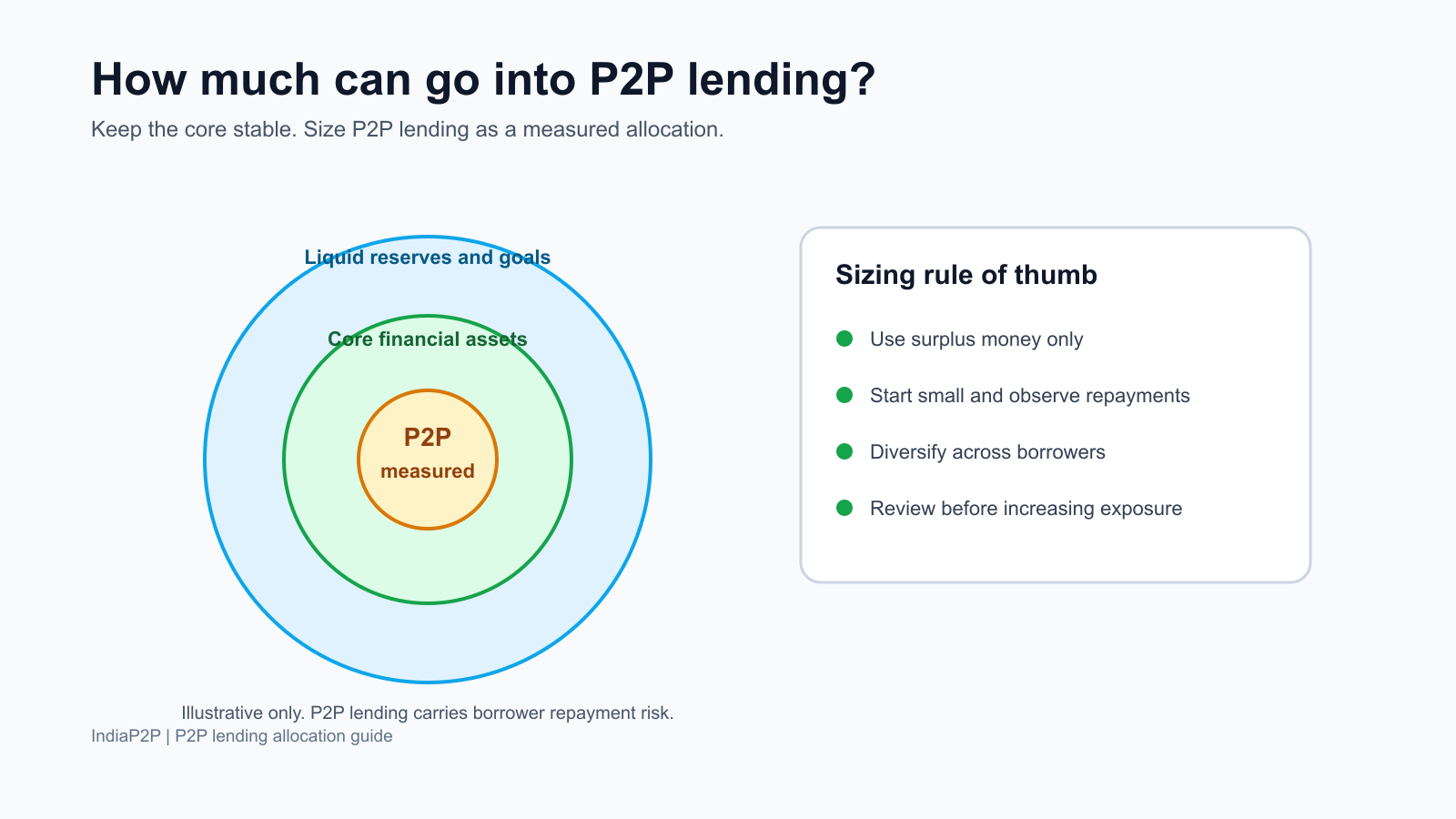
The most useful way to size P2P lending is to start with a conservative range, review actual repayment behavior, and increase only if the experience fits your risk comfort.
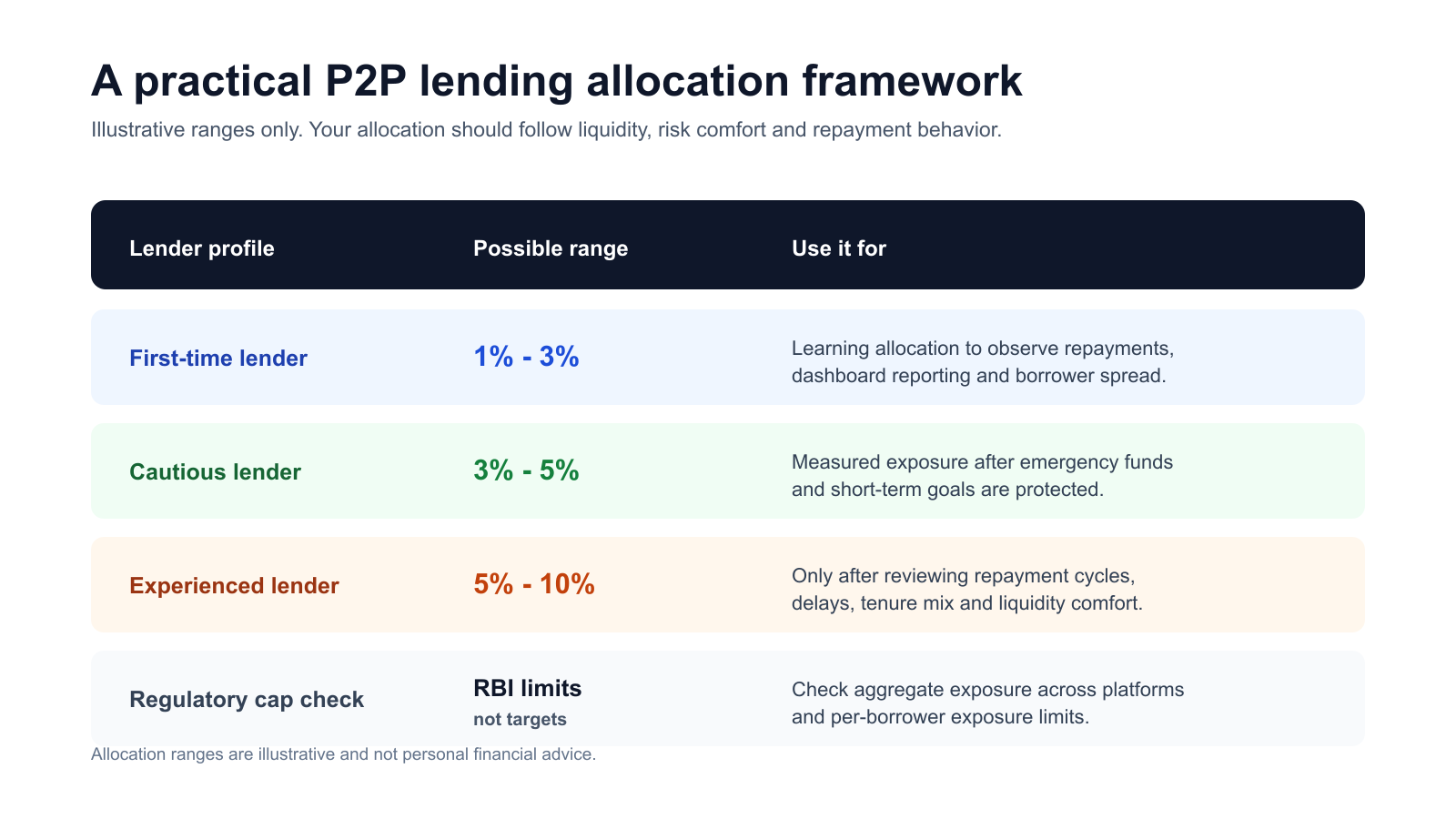
The table below is illustrative. It is not personal financial advice.
Lender Profile | Possible Allocation Range | What this means in practice | Review before increasing |
|---|---|---|---|
First-time lender | 1% to 3% of surplus financial assets | Treat it as learning capital. Observe repayments, dashboard reporting, delays, and withdrawal or relending behavior. | At least one full repayment cycle. |
Cautious lender | 3% to 5% | Keep P2P lending clearly outside emergency funds and core low-volatility assets. | Borrower spread, overdue reporting, net receipts. |
Experienced lender | 5% to 10% | Suitable only if the lender understands borrower default risk and can tolerate delayed repayments. | Diversification, tenure mix, platform disclosures, tax impact. |
Upper-bound check | Must remain within RBI exposure limits | RBI caps total lender exposure across all P2P platforms and per-borrower exposure. | Aggregate exposure across platforms and single-borrower limits. |
The important point is sequence. Start with an amount small enough that you can learn without pressure. Then review repayment behavior before increasing exposure.
For first-time lenders: start with learning capital
A first-time lender should usually begin with an amount that is meaningful enough to observe the product but small enough not to disturb the rest of the financial plan.
Learning capital means you are not only looking at the displayed return. You are checking how borrower allocations happen, how repayments arrive, how delays are shown, what fees apply, and whether the platform dashboard is clear enough for you to monitor.
The first allocation is less about maximizing return and more about understanding the behavior of the lending product.
For experienced lenders: size by repayment behavior, not headline return
Experienced lenders may be more comfortable allocating a higher share, but the decision should still be based on observed repayment behavior.
Look at actual receipts, delayed EMIs, overdue ageing, principal recovery, and how often you need liquidity. A higher indicative return is useful only if the risk and repayment behavior are understood.
If a lender increases allocation only because the displayed rate looks attractive, the sizing decision becomes return-led. A better approach is repayment-led: increase only when the borrower spread, tenure, and risk reporting remain comfortable.
Why P2P should not become the core of your financial portfolio
P2P lending can play a role in a diversified financial portfolio, but it should not become the core.
The core of a financial portfolio usually exists for stability, liquidity, and goal protection. P2P lending has a different risk profile. It carries borrower default risk, liquidity risk, concentration risk, platform or operational risk, and regulatory risk.
This does not make P2P lending unsuitable. It simply means it should be sized as a measured allocation, not treated like a savings account, bank deposit, or guaranteed-income product
RBI NBFC-P2P Limits Every Lender Should Know
RBI's NBFC-P2P framework places clear limits on lender exposure. A lender's total exposure across all P2P platforms is capped at ₹50 lakh. Exposure of a single lender to the same borrower across all P2P platforms is capped at ₹50,000.
If a lender's aggregate exposure across P2P platforms exceeds ₹10 lakh, the lender must produce a certificate to P2P platforms from a practising Chartered Accountant certifying minimum net worth of ₹50 lakh. The RBI framework also states that loan maturity cannot exceed 36 months.
These are regulatory limits, not allocation recommendations. A lender should not read ₹50 lakh as an appropriate target. It is a cap. Your own allocation may need to be far lower depending on liquidity, risk comfort, and the rest of your financial portfolio.
It is also important to understand what RBI registration does and does not mean. IndiaP2P is registered with the Reserve Bank of India as an NBFC-P2P. This means the platform operates within the applicable NBFC-P2P framework. It does not mean RBI approves returns, guarantees repayment, or protects principal.
How diversification changes the allocation conversation
When people ask how much to allocate to P2P lending, they often think only about the overall percentage. That is only half the decision.
The other half is how that amount is spread.
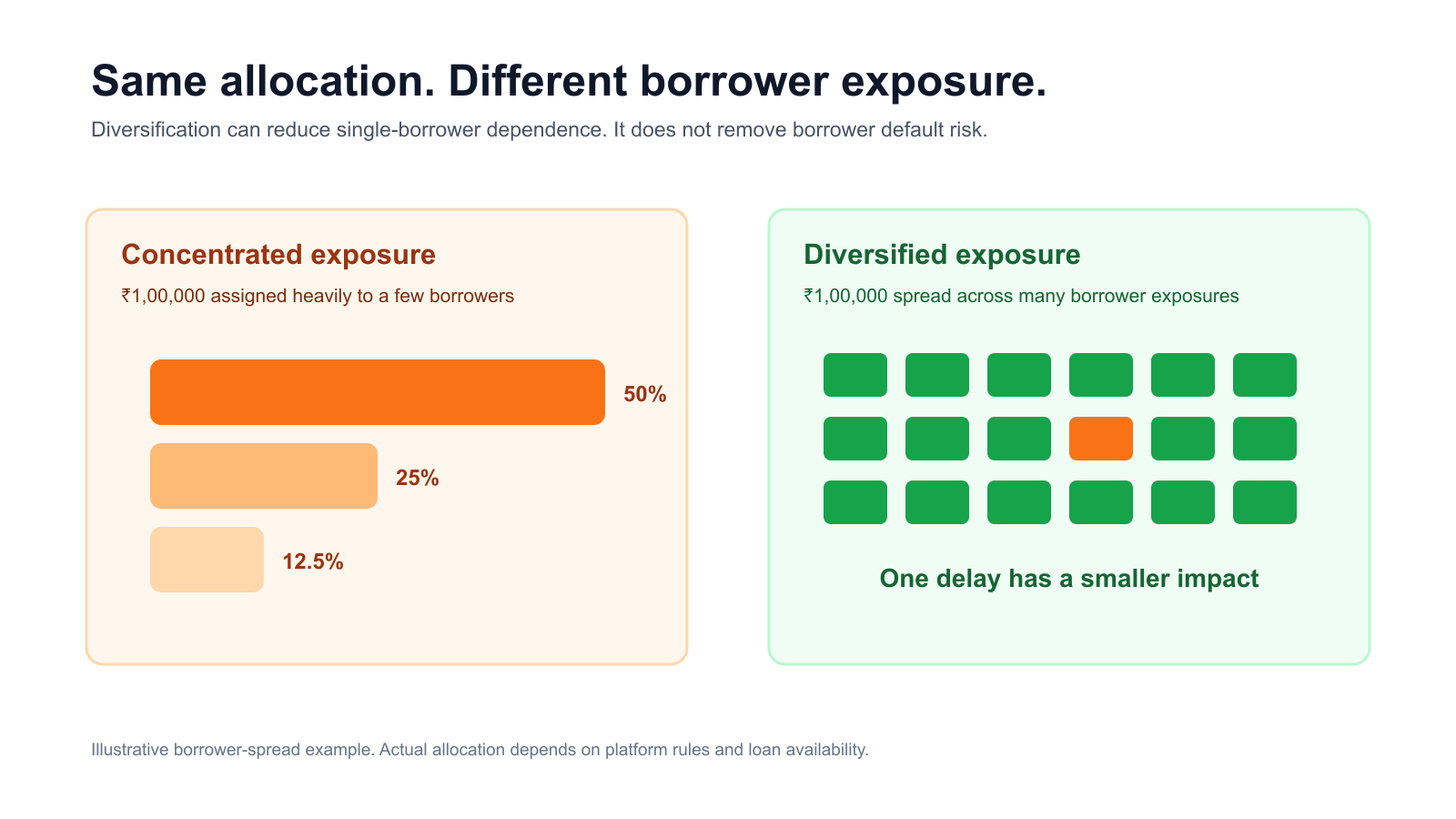
₹1,00,000 lent to one borrower is very different from ₹1,00,000 spread across many borrower exposures. The total amount is the same, but concentration risk is not. If one borrower delays, a concentrated exposure can affect the full expected cash flow. In a well-spread allocation, one delay may have a smaller effect on the overall repayment experience.
Diversification does not remove borrower default risk. It only reduces dependence on a single borrower or a small group of borrowers. A lender should still expect some repayment variation over time.
For a deeper explanation, read IndiaP2P's guide to P2P auto diversification.
Exposure per borrower
Before increasing your P2P lending allocation, check how much of your amount can reach any one borrower. A single borrower should not be large enough to materially disturb expected cash flow if that borrower delays.
The RBI per-borrower cap is a regulatory maximum. Your comfort limit may be much lower.
Exposure by tenure and risk grade
Borrower spread is not the only form of diversification. Tenure and risk mix matter too.
If all loans are long-tenure, liquidity may be lower. If all loans sit in one risk band, repayment behavior may become more correlated. A balanced allocation should help you understand how much exposure sits across borrower types, repayment periods, and risk grades where disclosed.
For tenure planning, read how to choose P2P lending tenure.
Re-lending repayments versus withdrawing
Repayments create a second allocation decision. You can withdraw receipts, reserve them for upcoming expenses, or relend them depending on platform options and your needs.
Relending can keep money active, but it also starts a fresh borrower risk cycle. If you keep relending automatically, your practical exposure may continue even after the first set of loans repays.
The re-lend or withdraw repayments decision should follow your cash-flow calendar, not only the displayed return.
Match P2P Lending Allocation to Your Financial Profile
The right P2P lending allocation depends less on age or income alone and more on financial resilience.
Use the following checks before deciding your range.
Question | If your answer is yes | Allocation implication |
|---|---|---|
Do you have 6-12 months of essential expenses in liquid assets? | You may have more room to consider a small allocation. | P2P can be sized from surplus money only. |
Do you need this money within the next 3-6 months? | P2P lending may not match your liquidity need. | Keep the amount outside P2P lending. |
Would delayed repayments affect household expenses? | The amount is too high or unsuitable. | Reduce or avoid allocation. |
Are you comfortable reviewing borrower spread and overdue status? | You can make a more informed sizing decision. | Start small and monitor. |
Are you allocating mainly because of headline returns? | The decision is return-led. | Recheck risk, liquidity, and diversification. |
For conservative lenders, a small allocation may be enough. For experienced lenders, a larger allocation may fit only when the rest of the financial portfolio is strong and the lender accepts borrower repayment risk.
The aim is not to reach the highest possible P2P allocation. The aim is to find a level that you can hold patiently, review clearly, and reduce if repayment behavior does not match expectations.
What to Check Before Increasing Your P2P Lending Exposure
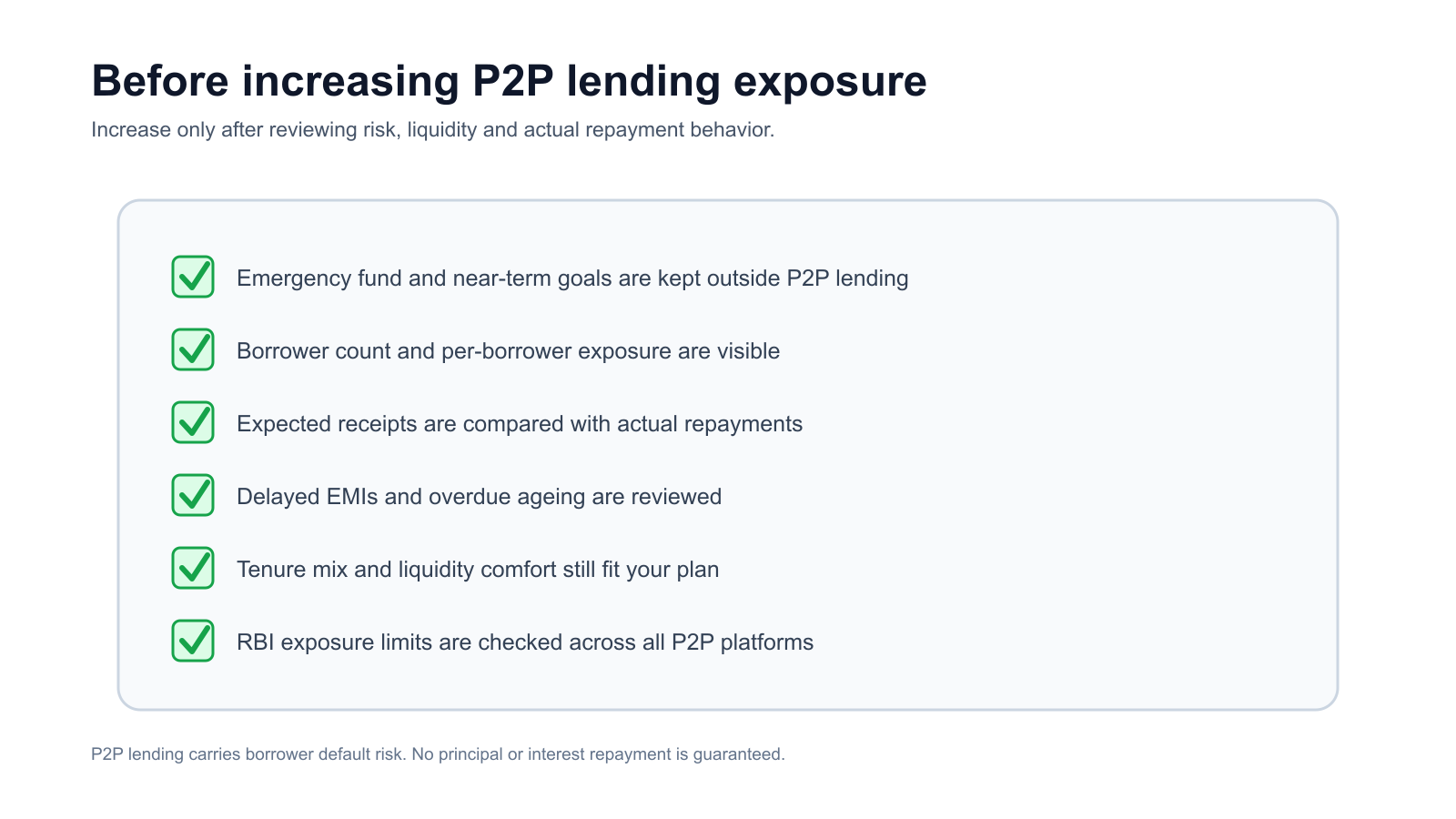
Before increasing your P2P lending exposure, review the platform dashboard like a credit report, not like a return statement.
Check borrower count. Check exposure per borrower. Check tenure mix. Check expected and actual receipts. Check delayed EMIs and overdue ageing. Check whether the displayed return is gross, net of fees, or net of delays and defaults. Check whether platform fees and tax treatment are clearly explained.
Also check your own behavior. Are you increasing exposure after reviewing a few repayment cycles, or after seeing an attractive return number? The first approach is more disciplined. The second can lead to concentration before you understand the product.
For a detailed reading checklist, use the guide on how to read a P2P loan portfolio before lending.
Where IndiaP2P Fits in this Decision
IndiaP2P is a peer-to-peer lending platform registered with the Reserve Bank of India as an NBFC-P2P. The platform connects lenders with verified borrowers and facilitates lending, repayment routing, and reporting.
IndiaP2P offers up to 18% p.a. indicative returns, subject to borrower repayment behavior and platform terms. The platform's role can help with borrower access, allocation, servicing, and dashboard visibility. It does not remove borrower default risk or guarantee return of principal or interest.
If you are considering P2P lending for monthly cash-flow planning, explore IndiaP2P Monthly Income Plan+ after deciding what allocation range fits your broader financial portfolio.
Keep P2P Lending Measured, Diversified, and Reviewed
So, how much should go into P2P lending?
For many first-time lenders, the answer may be a small learning allocation. For cautious lenders, P2P lending may remain a modest satellite allocation. For experienced lenders, a higher allocation can be considered only when emergency funds, liquidity needs, borrower diversification, repayment behavior, and RBI limits are all understood.
The discipline is simple: do not lend money you may need urgently, do not concentrate exposure, do not size the allocation only by headline return, and do not treat regulatory caps as targets.
P2P lending can have a place in a broader financial portfolio. It works best when the allocation is measured, diversified, reviewed, and honest about borrower repayment risk.