IndiaP2P enables eligible lenders to target indicative returns of up to 18% p.a. through P2P lending, subject to borrower repayment performance, platform terms, fees, timing, and risk. Once money is lent, the next question is not only what return is targeted. It is also when cash may come back, how much has actually arrived, and what the lender will do with it.
That is where a cash flow calendar helps.
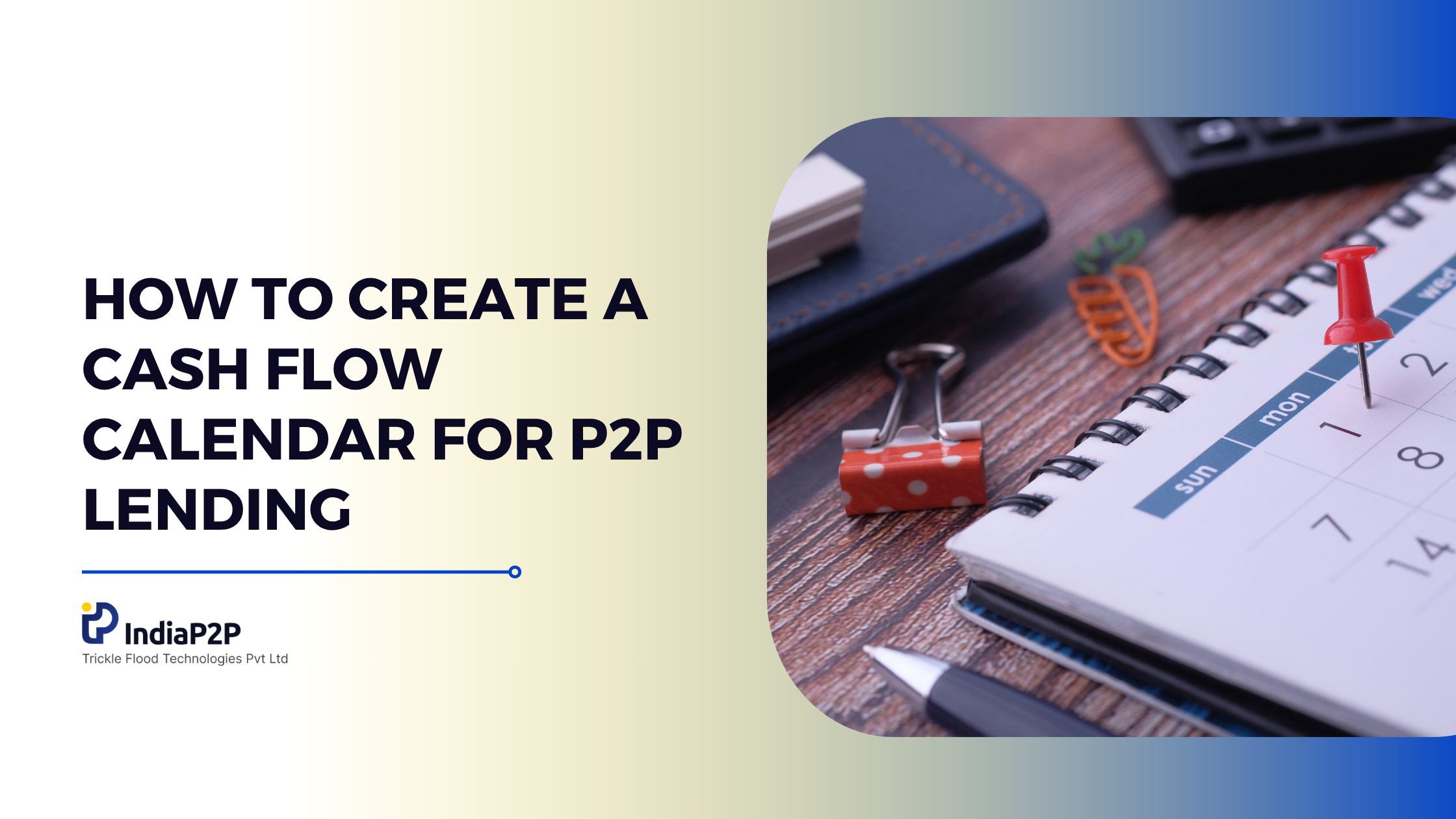
A cash flow calendar is a date-based planning tool. For a P2P lender, it can show expected borrower EMI dates, received repayments, delayed amounts, withdrawals, cash held aside, and amounts considered for fresh lending. Used well, it creates a calmer monthly review habit.
Used poorly, it can create false confidence. A scheduled borrower repayment is not the same as received cash. Borrowers may pay late or default. A calendar should make that uncertainty visible, not hide it.
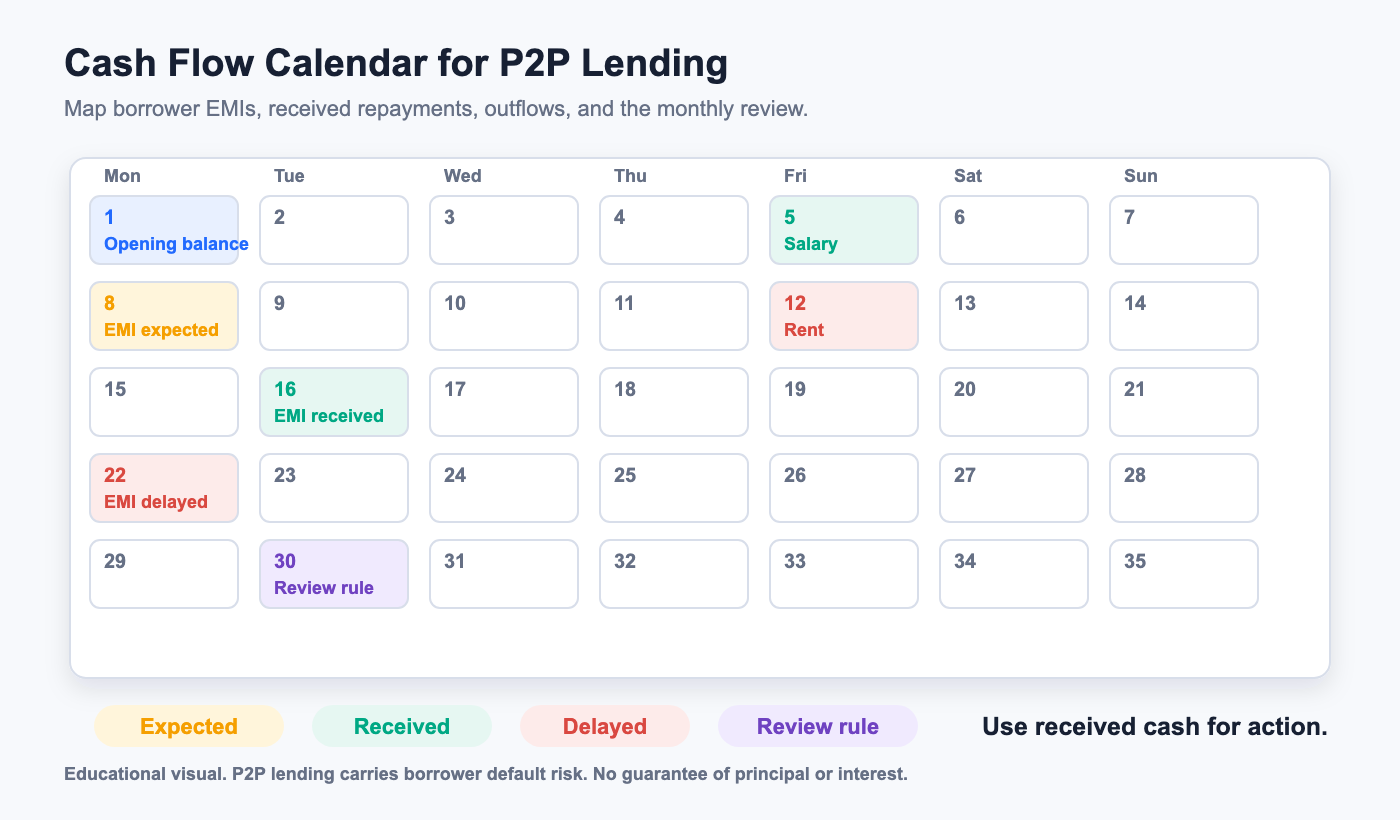
What is a Cash Flow Calendar?
A cash flow calendar maps money by date. It shows when cash is expected to come in, when cash is expected to go out, and how the available balance may change through the month.
This is different from a normal monthly budget. A budget may say you expect ₹80,000 of inflows and ₹60,000 of outflows in a month. A calendar shows whether those inflows arrive before or after the key outflows. That timing can matter more than the monthly total.
For a household, the calendar may include salary, rent, credit card due dates, school fees, tax payments, insurance premiums, and planned transfers.
For a P2P lender, it can also include expected borrower EMIs, received repayments, delayed repayments, and the next action after cash is received.
Cash flow calendar vs monthly budget
A monthly budget answers: how much should I allocate to each category?
A cash flow calendar answers: when will the money move?
Both are useful. The budget gives structure. The calendar gives timing. For P2P lending, timing matters because repayments may arrive across different dates, and the lender has to decide whether to withdraw, hold, or lend again.
Why timing matters more than averages
Monthly averages can hide cash gaps. A lender may expect ₹12,000 of repayments across a month, but if most of that cash is scheduled near month-end, it should not be used for a mid-month expense.
The same discipline applies to delayed EMIs. A delayed amount should remain separate on the calendar until it is actually received.
Why P2P Lenders Need a Repayment Calendar
P2P lending cash flow comes from borrower repayments. Each borrower EMI may include principal, interest, or both, depending on the loan structure. When several borrower loans have different due dates and tenures, cash may come back in smaller amounts across the month.
A repayment calendar helps the lender see that pattern.
It can also prevent one common mistake: treating scheduled repayments as usable cash before they arrive. In P2P lending, the platform facilitates lending between lenders and borrowers. It does not guarantee that a borrower will repay on time or in full. RBI's NBFC-P2P framework also requires platforms to act as intermediaries and not provide credit guarantees or assume credit risk.
For the wider journey after funds are lent, see IndiaP2P's guide to the P2P lending repayment lifecycle after you lend.
Scheduled repayments are not the same as received cash
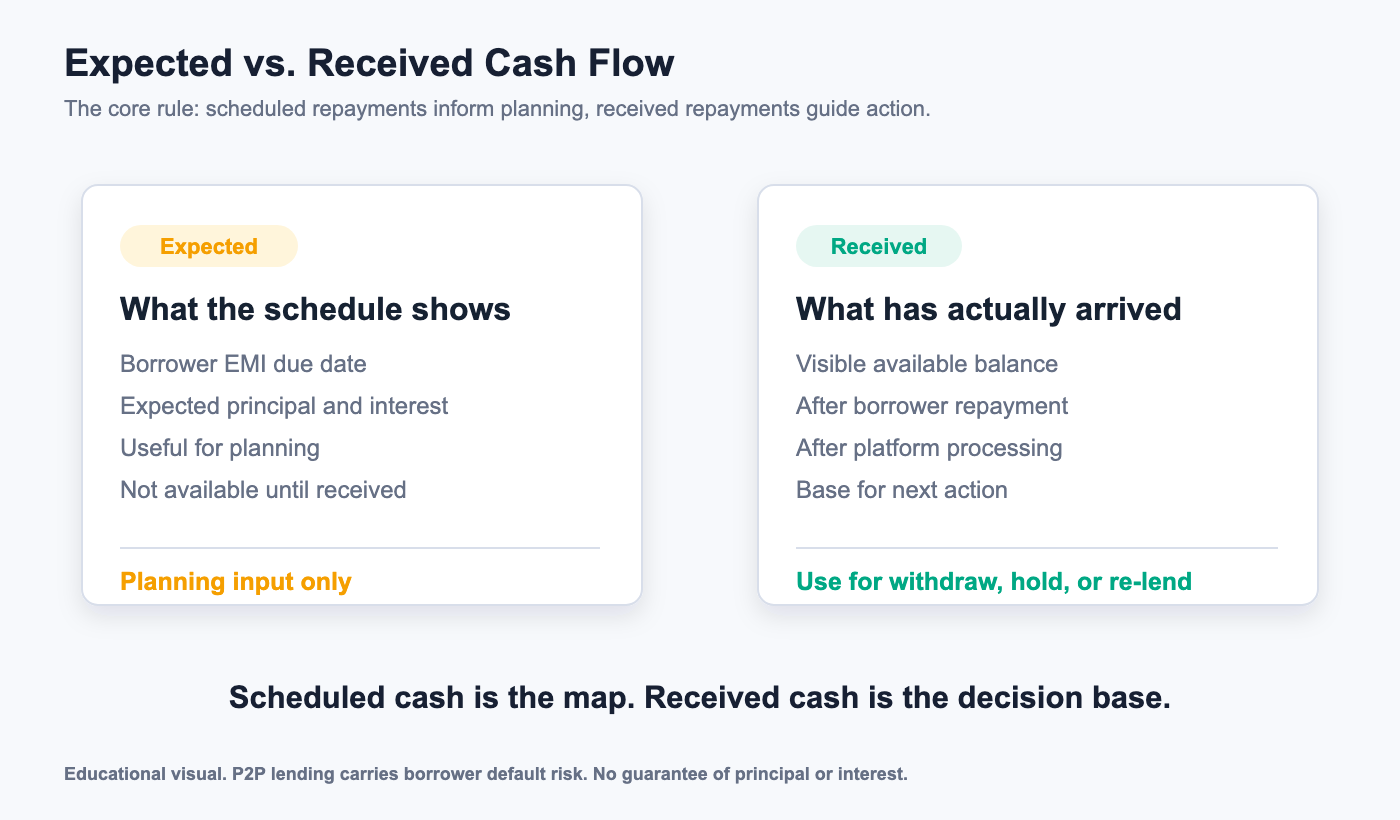
The calendar should have two separate lines:
Line item | What it means | How to use it |
|---|---|---|
Scheduled repayment | Amount expected on a due date | Planning input only |
Received repayment | Amount actually received and visible as available cash | Base for withdrawal, holding, or fresh lending |
Delayed repayment | Amount expected but not received on time | Review signal, not usable cash |
This distinction is the most important part of the calendar. If the scheduled number and received number are treated as the same, the lender may overstate liquidity.
The role of borrower EMIs in P2P lending cash flow
Borrower EMIs create the raw material for the calendar. The lender can review due dates, expected principal return, expected interest receipt, delayed EMIs, and available balance.
The calendar does not need to be complex. It only needs to separate what is expected from what has actually arrived.
Where up to 18% p.a. fits in the calendar
IndiaP2P lenders can target indicative returns of up to 18% p.a., but actual outcomes depend on borrower repayment behaviour, defaults, fees, cash drag, and how quickly received money is lent again if the lender chooses to do so.
The calendar helps connect the return discussion to real cash flow. If repayments sit idle, realised returns may differ from the target. If borrowers delay or default, actual receipts may be lower than expected. The calendar should make both situations visible.
How to Create a Cash Flow Calendar for P2P Lending
The simplest version can be built in a spreadsheet, a calendar app, or a notebook. The tool matters less than the fields.
Create one row for every important date. Then add columns for expected cash, received cash, delayed cash, planned outflows, and next action.
Suggested columns:
Date | Item | Expected inflow | Received inflow | Outflow | Delayed amount | Available balance | Action |
|---|---|---|---|---|---|---|---|
5 Aug | Borrower EMI batch | ₹5,000 | ₹4,200 | - | ₹800 | ₹4,200 | Hold until review |
7 Aug | Credit card payment | - | - | ₹12,000 | - | - | Use salary, not expected EMI |
15 Aug | Borrower EMI batch | ₹3,500 | ₹3,500 | - | - | ₹7,700 | Review for withdrawal/re-lending |
30 Aug | Monthly review | - | - | - | - | ₹7,700 | Apply rule |
The point is not to forecast perfectly. The point is to stop mixing expected cash with received cash.
Step 1: Start With Your Opening Cash Balance
Begin with cash that is already available. Do not include scheduled borrower repayments in the opening balance. If the money has not arrived, it is not available cash.
This keeps the calendar conservative from the first line.
Step 2: Add Fixed Outflows and Essential Dates
Add rent, household expenses, loan EMIs, credit card due dates, tax dates, insurance premiums, school fees, or any other fixed outflow.
Essential outflows should not depend on expected P2P repayments. If an expense must be paid on time, keep that money outside the lending cycle.
Step 3: Add Expected Borrower EMI Dates
Next, add expected borrower EMI dates from your lender dashboard or repayment schedule. Include the expected amount and due date.
If the schedule shows multiple loans, group them by date or week. A weekly view is often easier than tracking every small receipt separately.
Step 4: Separate Expected, Received, and Delayed Amounts
This is where the calendar becomes useful. When a repayment date passes, update the row:
If the full amount arrives, move it into received cash.
If part of it arrives, record the received amount and leave the balance as delayed.
If nothing arrives, keep the full amount in the delayed column.
Do not plan withdrawals or fresh lending from delayed amounts.
Step 5: Decide Your Withdraw, Hold, or Re-lend Rule
Every received repayment needs a next action. Without a rule, each repayment becomes a fresh emotional decision.
A simple rule may look like this:
Withdraw 25% of received repayments for planned cash flow.
Review 60% for fresh lending only if dashboard checks are healthy.
Hold 15% as available cash until the next monthly review.
The percentages can change. The discipline is the important part.
For a deeper decision framework, read re-lend or withdraw P2P repayments.
Step 6: Review the Calendar Monthly
Set one monthly review date. On that day, compare scheduled repayments with received repayments, check delayed EMI ageing, review borrower spread, and decide whether your rule still fits.
Avoid changing the rule after every single delay. Look for patterns.
P2P Repayment Calendar Example in India
Consider an illustrative lender who has ₹1,00,000 available for P2P lending. This example is for explanation only. It is not a recommendation, forecast, or live borrower listing.
The lender wants a repayment calendar that supports monthly review without depending on P2P repayments for essential expenses.
Illustrative ₹1,00,000 Lending Calendar
The lender starts with this structure:
Bucket | Amount | Purpose |
|---|---|---|
Shorter-tenure borrower loans | ₹35,000 | Earlier principal return |
Medium-tenure borrower loans | ₹40,000 | Core repayment rhythm |
Longer-tenure borrower loans | ₹15,000 | Extended repayment cycle |
Cash buffer | ₹10,000 | No borrower exposure yet |
In the first month, the lender expects ₹8,500 of repayments.
Date | Expected | Received | Delayed | Action |
|---|---|---|---|---|
8 Aug | ₹2,500 | ₹2,500 | - | Hold |
16 Aug | ₹3,000 | ₹2,200 | ₹800 | Do not count delayed amount |
24 Aug | ₹3,000 | ₹3,000 | - | Add to review balance |
Month-end review | ₹8,500 | ₹7,700 | ₹800 | Apply rule on ₹7,700 only |
The lender's rule applies only to ₹7,700 received cash. The delayed ₹800 stays separate until it is received.
What Changes When an EMI Is Delayed
A delayed EMI changes two things.
First, it changes available cash. The lender has less received money to withdraw, hold, or review for fresh lending.
Second, it changes the risk signal. One delay may not change the whole plan. A rising pattern of delayed EMIs or longer overdue ageing should trigger a slower review before fresh lending.
How the Same Calendar Guides Re-lending
If the lender's month-end review is healthy, the rule may continue. If delayed EMIs have increased, the lender may hold more cash temporarily or reduce the amount considered for fresh lending.
The calendar turns repayment behaviour into a decision system.
Expected vs. Received Cash Flow: The Most Important Line in the Calendar
The difference between expected and received cash flow is not accounting detail. It is the safety rail of the entire method.
Expected repayments help you plan. Received repayments let you act.
In P2P lending, a borrower repayment can be on time, delayed, partially received, or not received. A cash flow calendar should show all of these clearly.
Why You Should Not Spend Scheduled Repayments Before They Arrive
If you spend based on scheduled repayments, you are assuming borrower behaviour before it happens. That can create avoidable stress if an EMI is delayed.
A cleaner rule is: essential expenses should be covered from salary, savings, or other confirmed cash. P2P repayments can be reviewed only after they are received.
How Delays Affect Realised Yield and Liquidity
Delays can affect both return and liquidity. If expected cash arrives late, the lender may have less available money for withdrawal or fresh lending. If money sits idle while the lender waits for clarity, there may also be cash drag.
Defaults can reduce principal or interest received. That is why the calendar should include risk checks, not just inflow dates.
Re-lend, Withdraw, or Hold: Turning the Calendar Into a Rule
A cash flow calendar becomes powerful only when it leads to a decision.
After repayments are received, the lender has three broad choices:
Choice | When it may fit | What to check first |
|---|---|---|
Re-lend | Long horizon, no near-term cash need, healthy repayment pattern | Delays, borrower spread, tenure, available loans |
Withdraw | Planned expense, allocation already full, lower risk comfort | Available balance, tax/cash needs, pending delays |
Hold | Unclear repayment trend or unsuitable fresh loans | Overdue ageing, dashboard signals, liquidity buffer |
None of these choices is automatically better. The right action depends on the lender's purpose and the repayment data.
When Re-lending P2P Repayments May Fit
Re-lending may fit when the lender has a longer horizon, a separate emergency buffer, acceptable repayment performance, and fresh lending options that match their risk comfort.
Re-lending can reduce idle cash, but it also extends exposure to borrower repayment risk.
When Withdrawing Repayments May Fit
Withdrawing may fit when the lender needs cash soon, wants to reduce exposure, or has already reached a comfortable allocation to P2P lending.
Withdrawal can also be useful after a month with higher delays. It gives the lender time to review without adding fresh exposure.
When Holding Cash May Be the Better Temporary Choice
Holding cash can be a valid middle path. It may fit when repayments have arrived, but the lender wants to wait for a clearer dashboard pattern or better-suited borrower matches.
Do not lend again merely because cash is available.
Risk Checks Before You Rely on a P2P Cash Flow Calendar
A cash flow calendar should never make P2P lending look like a guaranteed monthly payout. It is a planning tool for a product that carries borrower repayment risk.
Before relying on the calendar, review four areas: borrower default risk, concentration, tenure, and liquidity.
Borrower Default Risk and Overdue Ageing
Borrower default risk is central to P2P lending. Some borrowers may pay late. Some may default. The lender may lose principal, interest, or both.
Track overdue ageing by bucket. A recently delayed EMI and a long overdue loan are not the same signal. The calendar should help you notice whether delays are isolated or becoming a pattern.
Diversification Reduces Concentration, Not Risk Itself
Spreading lending across multiple borrowers can reduce concentration risk. It does not remove borrower default risk.
For a deeper explanation of borrower spread, see IndiaP2P's guide to P2P auto diversification.
RBI Exposure Caps Every Lender Should Know
RBI's NBFC-P2P framework caps a lender's aggregate exposure across all P2P platforms at ₹50 lakh, provided the amount lent is consistent with the lender's net worth. If the amount lent is more than ₹10 lakh across P2P platforms, the lender must produce a practicing Chartered Accountant certificate certifying minimum net worth of ₹50 lakh. RBI also caps exposure of a single lender to the same borrower across all P2P platforms at ₹50,000.
These caps matter because a cash flow calendar should sit inside the regulatory framework, not outside it.
Why Essential Expenses Should Not Depend on P2P Repayments
P2P repayments can support planning, but essential expenses should not depend on them. If rent, school fees, medical needs, or tax payments are due, that money should already be available outside expected borrower repayments.
This is not pessimism. It is clean cash-flow design.
Cash Flow Calendar Checklist for P2P Lenders
Use this checklist before lending and at every monthly review.
Before lending:
Define the purpose: cash flow, re-lending, liquidity, or a mix.
Keep emergency savings separate.
Check how much money can remain exposed to borrower repayment cycles.
Review tenure options and expected repayment timing.
Understand that indicative returns are not guaranteed.
During the monthly review:
Compare scheduled repayments with received repayments.
Track delayed EMIs separately.
Review overdue ageing.
Check borrower spread and concentration.
Decide whether to withdraw, hold, or consider fresh lending.
Avoid using delayed amounts in the available balance.
After the review:
Update next month's calendar.
Adjust the rule only if your situation or repayment pattern has changed.
Keep the risk disclosure visible in your own notes.
Build the Calendar Around Received Cash, Not Hope
A cash flow calendar helps a P2P lender create structure after money is lent. It shows expected borrower EMIs, actual receipts, delayed amounts, and the next action after repayments arrive.
The best version is conservative. It does not treat expected repayments as certain. It does not force fresh lending. It separates essential expenses from borrower repayment cycles.
That is the real value of the calendar: not higher confidence in a forecast, but better discipline when the month does not behave exactly as planned.