Why Predictable Cash Flow Feels Better Than High Returns in P2P Lending
IndiaP2P enables eligible lenders to target indicative returns of up to 18% p.a. through P2P lending. Those returns depend on borrower repayments, so principal and interest are not assured. That is why the more useful question is not only "what return can I target?" It is also "how usable is the cash-flow pattern?"
For many lenders, monthly income from P2P lending feels easier to work with than a higher headline number that arrives unevenly. A visible repayment rhythm helps with planning. It gives the lender more frequent information. It also makes risk easier to review because borrower EMI behaviour shows up month after month.
This article explains why predictable cash flow can feel better than high returns, where that feeling can be misleading, and how to evaluate P2P lending without treating expected repayments as certain income.
P2P Lending Monthly Income: Why Rhythm Matters More than A Headline Number
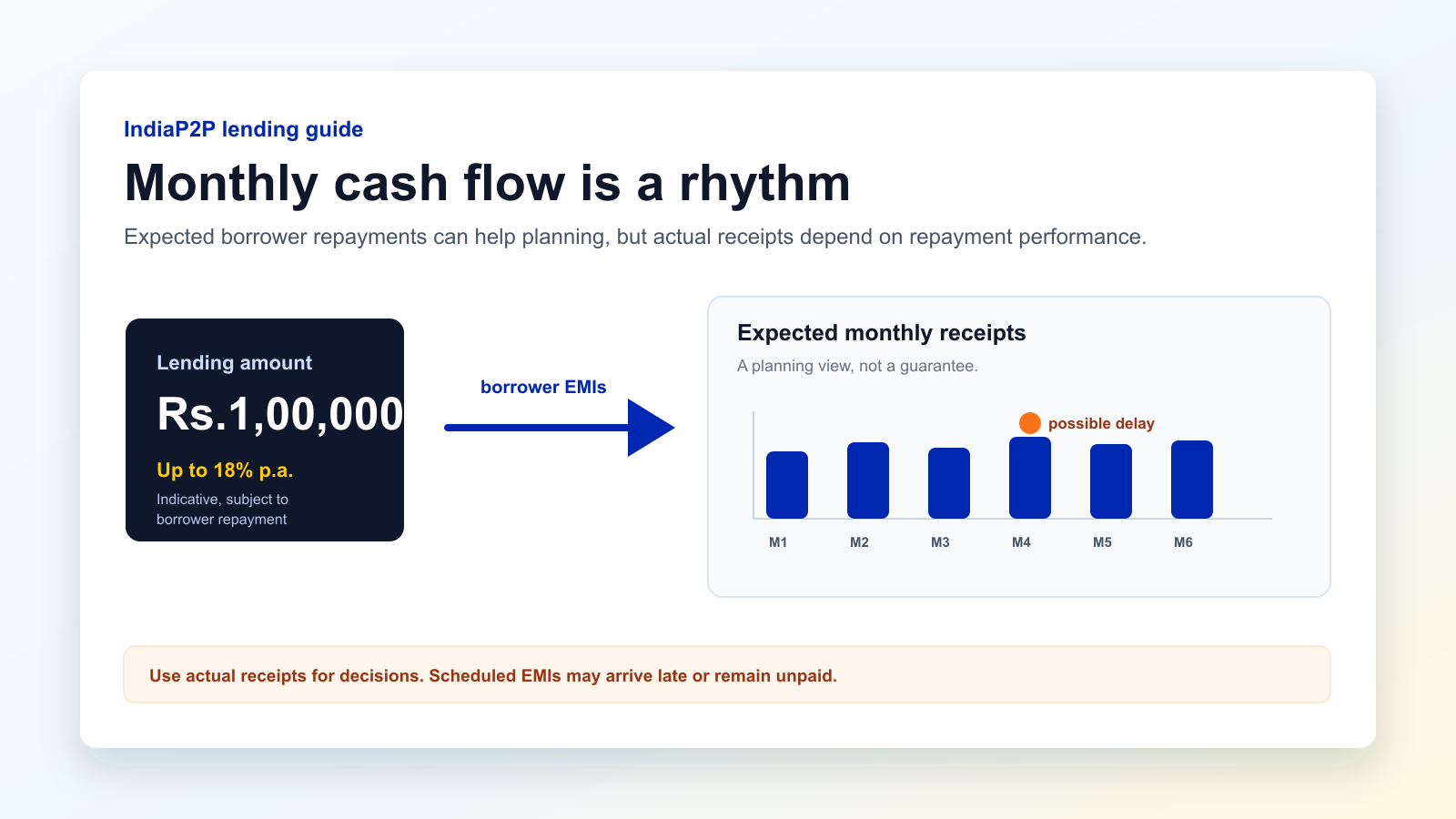
A headline return is simple to compare. Cash flow is more personal. It answers a different question: when might money come back, how often might receipts arrive, and how much uncertainty should the lender expect along the way?
P2P lending usually involves borrowers repaying through EMIs. Each EMI may include principal and interest. When those repayments arrive on schedule, the lender can see a monthly cash-flow pattern. That pattern may be withdrawn, lent again, or used as a signal to review the lending allocation.
This is why cash-flow-led thinking feels calmer than return-chasing. It does not ignore returns. It simply places timing, visibility, and risk beside the return number.
Monthly repayments in P2P lending create visibility, not certainty
Monthly repayments can make P2P lending easier to monitor because each cycle creates data. A lender can see current repayments, delayed EMIs, recovered amounts, and outstanding exposure.
But visibility is not certainty. A scheduled EMI is not the same as cash received. A borrower may pay late or default. The lender should treat expected repayments as planning inputs, not promised income.
High returns can still feel uncomfortable if cash flow is uneven
A high indicative return can look attractive on paper. It may still feel uncomfortable if cash arrives irregularly, if repayments are concentrated in a few dates, or if delays are hard to interpret.
For a lender using P2P lending to supplement monthly cash flow, timing matters. A lower-noise repayment pattern can sometimes feel more useful than a higher target return that requires more patience and more uncertainty.
High Returns vs Regular Cash Flow: The Lender’s Trade Off
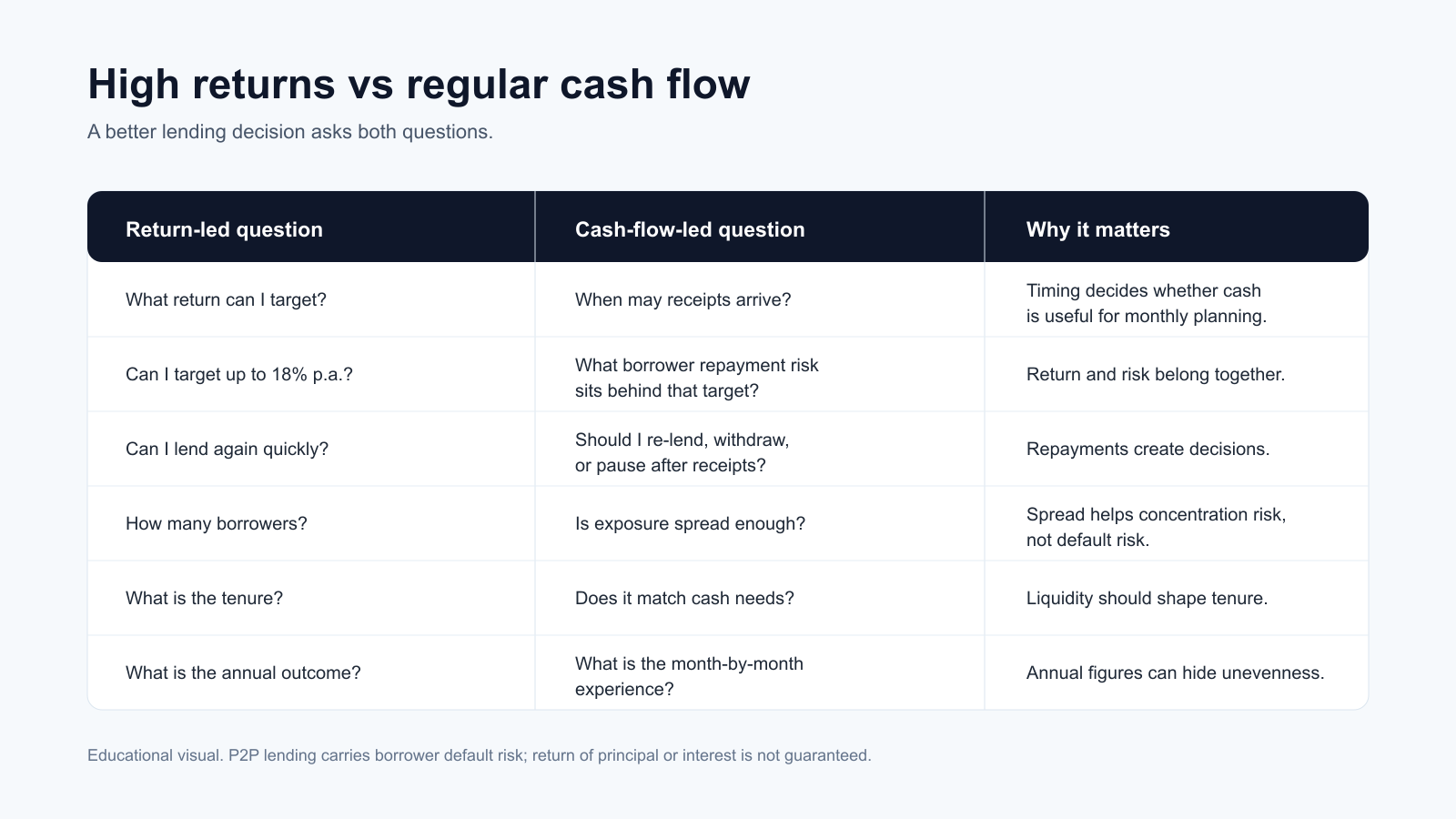
The healthiest way to compare return and cash flow is to ask better questions. A return-led lens asks how much can be targeted. A cash-flow-led lens asks how the lending plan behaves after the money is deployed.
Return-led question | Cash-flow-led question | Why it matters |
|---|---|---|
What indicative return is available? | When are borrower repayments expected to arrive? | Timing affects whether the receipts are useful for monthly planning. |
How much can I target in a year? | How much may come back each month if borrowers repay on schedule? | Annual numbers can hide uneven monthly receipts. |
Can I target up to 18% p.a.? | What borrower repayment risk sits behind that target? | Higher return expectations usually need clearer risk discipline. |
Can I lend again quickly? | Should I re-lend, withdraw, or pause after receipts arrive? | Each repayment creates a fresh decision. |
How many borrowers am I matched with? | Is my exposure spread enough for my risk comfort? | Diversification can reduce concentration risk, but it does not remove default risk. |
What is the tenure? | Will the repayment schedule match my cash needs? | Liquidity needs should shape tenure choices. |
The table does not make high returns unimportant. It makes them incomplete. A lender should understand return, repayment rhythm, borrower spread, tenure, liquidity needs, and downside risk together.
How Borrower EMI Repayments Shape the Lender Experience
In P2P lending, the lender experience after deployment is shaped by borrower EMI repayments. A clean lending plan should help the lender distinguish three things: scheduled receipts, actual receipts, and delayed receipts.
Scheduled receipts are expected cash flows based on the borrower's repayment plan. Actual receipts are amounts that have been received and reflected. Delayed receipts are amounts that were expected but have not arrived on time.
This distinction is central to cash-flow planning. A lender should never plan expenses around money that has not yet been received. It is better to use actual receipts as the decision base, especially when deciding whether to withdraw, lend again, or wait.
For a fuller process view, see IndiaP2P's guide to the P2P lending repayment process.
Expected repayments are not the same as received cash
Expected repayments can help a lender plan. Received cash is what can actually be used.
This difference becomes important when a borrower EMI is delayed. If an expected monthly receipt does not arrive, the lender's available balance may be lower than planned. Any re-lending or withdrawal decision should be based on received money, not projected money.
The dashboard should make the pattern visible
A useful lender dashboard should show the repayment pattern clearly: current EMIs, delayed EMIs, received principal, received interest, outstanding exposure, and available balance.
The value is not only administrative. It helps the lender judge whether the monthly cash-flow pattern is behaving as expected or needs a pause and review.
Worked Example: Same Target Return, Different Cash-Flow Feel
Consider two illustrative lenders, each lending Rs.1,00,000 through P2P lending. Both see an indicative target return of 16% p.a. This example is only for explanation. It is not a forecast, recommendation, or live borrower listing.
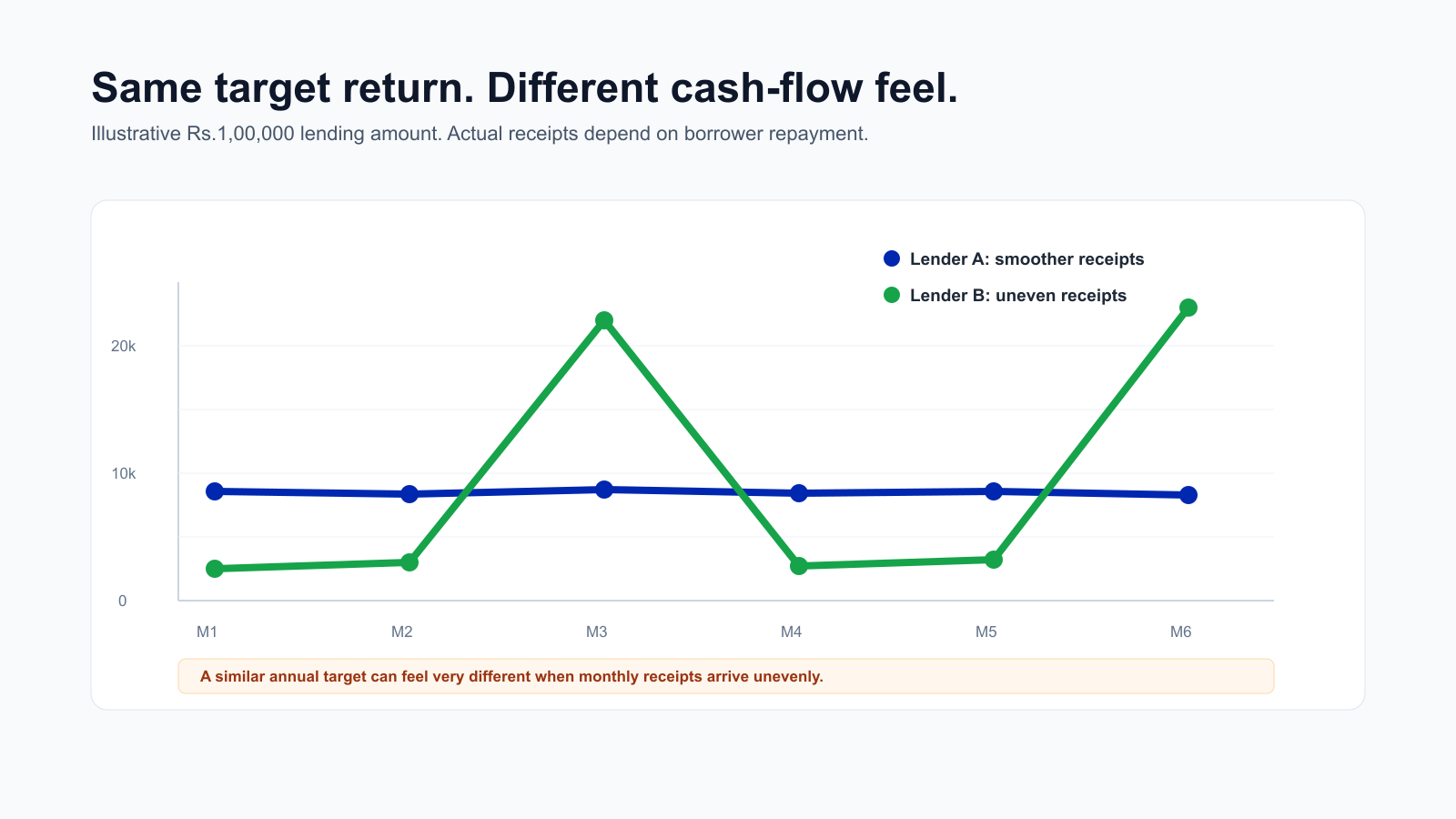
Month | Lender A: Smoother expected receipts | Lender B: Uneven expected receipts |
|---|---|---|
Month 1 | Rs.8,600 | Rs.2,500 |
Month 2 | Rs.8,400 | Rs.3,000 |
Month 3 | Rs.8,700 | Rs.18,000 |
Month 4 | Rs.8,500 | Rs.2,700 |
Month 5 | Rs.8,600 | Rs.3,200 |
Month 6 | Rs.8,300 | Rs.19,000 |
Lender A may feel more comfortable because cash appears in a steadier rhythm. Lender B may still have a similar annual target, but the receipt pattern feels less useful for monthly planning. This is the difference between a return number and a cash-flow experience.
Now add risk. Suppose Rs.2,000 of Month 3 receipts are delayed. Lender A may notice a smaller disruption. Lender B may feel the delay more sharply because cash was already concentrated in fewer months.
The point is not that one pattern is always better. The point is that timing changes lived experience. A lender who wants monthly cash flow should review repayment timing, borrower spread, and delay tolerance before focusing on the return target.
Why Predictable Cash Flow Can Go Wrong in P2P Lending
"Predictable" should be used carefully in P2P lending. A repayment schedule may be predictable in structure, but actual repayment depends on borrower behaviour. Borrowers can delay or default. Recovery can take time. Some principal or interest may not be recovered.
This is the main risk of treating monthly income from P2P lending as if it were certain income from a protected product. It is not. P2P lending is lending to borrowers through an NBFC-P2P framework regulated by the Reserve Bank of India. The platform facilitates the process; it does not remove borrower repayment risk.
Lenders should also watch liquidity risk. Once money is lent, the lender may need to wait for borrower repayments rather than assume immediate access to principal. That is why P2P lending should usually be done with surplus money, after near-term cash needs are already covered.
Before lending, it helps to review how to read a P2P loan allocation before lending.
Diversification reduces concentration risk, not borrower default risk
Spreading lending across many borrowers can reduce the impact of one borrower delay. It does not make repayments certain.
Diversification is best understood as a risk-control habit. It helps avoid over-reliance on one borrower or one type of borrower. It cannot protect principal or interest from borrower default. For a deeper explanation, see IndiaP2P's guide to P2P auto diversification.
Liquidity needs should decide how much you lend
If a lender needs money in the next few months, the lending amount and tenure should reflect that. Monthly repayment schedules can support planning, but they should not replace an emergency buffer.
For lenders comparing different repayment timelines, IndiaP2P's guide on how to choose tenure in P2P lending is a useful next step.
How to Decide if Monthly Income from P2P Lending Fits Your Plan
A cash-flow-led lender should make the decision before the first repayment arrives. Otherwise, every EMI becomes a fresh emotional choice: withdraw, lend again, wait, or worry.
Use a simple rule:
Lend only the amount you can keep exposed to borrower repayment cycles.
Keep near-term expenses outside P2P lending.
Review actual receipts, not only scheduled receipts.
Track delayed EMIs and overdue ageing.
Spread exposure across borrowers where the platform allows it.
Re-lend only after reviewing repayment performance.
Withdraw receipts if liquidity or risk comfort has changed.
The aim is not to remove uncertainty. The aim is to make uncertainty visible enough to manage.
Use a cash-flow rule before the first repayment arrives
A rule could be simple. For example: withdraw all receipts until a cash buffer is complete; then lend again only a fixed portion of monthly receipts. Or pause fresh lending if delayed EMIs cross a personal comfort threshold.
The exact rule can differ by lender. What matters is that the rule exists before emotions do.
Review actual receipts, not only target returns
Target returns are useful at the start. Actual receipts are more useful after lending begins.
Each month, compare expected receipts with received receipts. If the gap widens, review borrower spread, tenure mix, delayed repayments, and whether fresh lending still fits your plan.
IndiaP2P Monthly Income Plan+: Where to Evaluate the Cash-Flow Fit
IndiaP2P's Monthly Income Plan+ is designed for eligible lenders who want to evaluate P2P lending through a monthly cash-flow lens. The platform enables lenders to target indicative returns of up to 18% p.a., subject to borrower repayment performance and platform terms.
The right way to evaluate the plan is not to look only at the return number. Review the expected repayment schedule, borrower spread, tenure, dashboard visibility, and what happens if some repayments are delayed.
If the cash-flow pattern fits your needs and you understand the borrower repayment risk, the next step is to start with a clear lending amount and a written repayment rule.
Choose the Cash-Flow Habit Before Chasing the Return Number
High returns can attract attention. Predictable cash flow builds comfort more slowly, through repeated visibility.
For P2P lenders, that visibility comes from borrower repayments, dashboard data, and disciplined review. Monthly income from P2P lending can feel better than chasing the largest return because it gives the lender a rhythm to work with. But that rhythm is still subject to borrower repayment risk.
The better question is not "which return looks largest?" It is "which lending plan can I live with if repayments arrive on time, late, or partly delayed?"
Risk disclosure: Lending on a peer-to-peer platform involves the risk of borrower default. There is no guarantee of return of principal or interest. Investments are not insured. Lenders should assess the risks before lending and should not lend funds they cannot afford to lose. RBI caps total exposure across all P2P platforms at ₹50 lakh per lender and exposure to a single borrower at ₹50,000. IndiaP2P is registered with the Reserve Bank of India as an NBFC-P2P.