Monthly Income Plan Checklist Before You Lend
ndiaP2P enables lenders to target up to 18% p.a. indicative returns, subject to borrower repayment performance, fees and platform terms. But if your goal is monthly cash flow, the first step is not to chase a headline number. It is to use a monthly income plan checklist before you lend.
P2P lending monthly income is built from borrower repayments. Those repayments may arrive monthly when borrowers pay as scheduled. They may also be delayed, partial, or affected by default. A good checklist helps you read that difference before committing funds.
This guide gives you a practical way to assess monthly repayment potential, risk, diversification, liquidity and regulatory checks before lending through a P2P platform.
What A Monthly Income Plan Should Mean for a P2P Lender
A monthly income plan in P2P lending should mean expected monthly receipts from borrower EMIs. It should not mean guaranteed monthly income.
That distinction matters. In P2P lending, you lend to borrowers through a regulated platform. Borrowers repay principal and interest as per their loan schedule. The lender receives repayments when borrowers pay, after the platform processes the transaction. The platform facilitates the process, but it does not insure the lender against borrower default.
So the right question is not, "How much income can I get every month?" The better question is, "How reliable is the repayment pattern, and what happens if some borrowers do not pay on time?"
Monthly repayments are expected cash flows, not assured income
Monthly repayments can make P2P lending easier to track. Each month gives you a fresh view of what was scheduled, what was received, and what remains overdue. But expected cash flow is not the same as assured income. Treat repayment projections as planning inputs, not promises.
Principal and interest come back through borrower EMIs
Each borrower EMI may include principal, interest, or both, depending on the loan structure. A lender should check the repayment schedule before lending: due dates, tenure, outstanding principal, expected interest, and the share of each EMI linked to the lender's amount.
Why a checklist matters before you lend
A checklist keeps the monthly-income conversation honest. It forces you to check platform registration, borrower risk, repayment schedule, exposure spread, fees, delayed EMI treatment, and liquidity before focusing on the indicative return.
Monthly Income Plan Checklist: What to Check Before You Lend
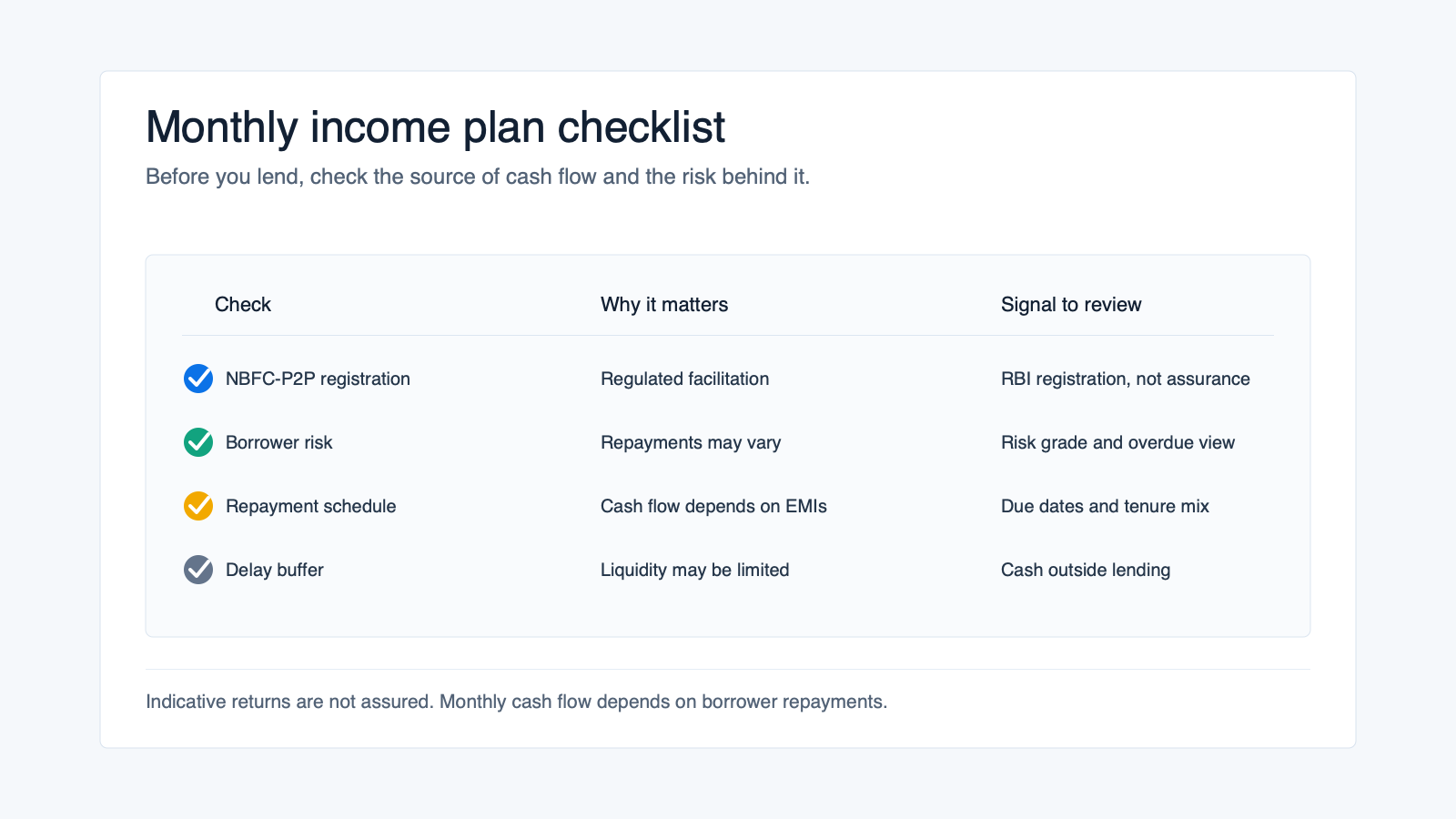
Use this monthly income plan checklist before lending through a P2P platform.
Checklist question | Why it matters | What to look for |
|---|---|---|
Is the platform registered as an NBFC-P2P? | P2P lending in India is regulated under RBI's NBFC-P2P framework. | Registration wording, risk disclosures, fair-practices documents and grievance details. |
What borrower default risk are you taking? | Borrowers may delay or fail to repay. | Borrower assessment process, risk grade logic, overdue reporting and recovery updates. |
How are funds spread across borrowers? | Concentration can make one borrower delay more painful. | Many borrowers, low exposure per borrower, no single borrower dominating the account. |
What is the loan tenure and repayment schedule? | Monthly cash flow depends on when borrowers are due to repay. | EMI dates, tenure mix, principal repayment pattern and expected closure dates. |
What fees, delays and taxes affect net receipts? | Headline return and received cash can differ. | Platform fees, overdue amounts, net receipts and tax records. |
Can you wait if repayments are delayed? | P2P lending is not an on-demand withdrawal product. | Emergency savings outside P2P lending and a delay buffer. |
1. Is the platform registered as an NBFC-P2P?
IndiaP2P is registered with the Reserve Bank of India as an NBFC-P2P. This means it operates within RBI's framework for peer-to-peer lending platforms. It does not mean RBI approves returns, protects principal, or endorses a specific lending outcome.
2. What borrower default risk are you taking?
Borrower default risk is the main risk in P2P lending. A borrower may pay late, pay partly, or fail to repay. Before lending, check how the platform assesses borrowers, how risk grades are shown, and how missed EMIs are reported to lenders.
3. How are funds spread across borrowers?
Diversification reduces dependence on one borrower. It does not remove risk. A monthly income plan should avoid being too dependent on one borrower, one tenure bucket, or one risk category. Review borrower count and exposure per borrower before lending.
4. What is the loan tenure and repayment schedule?
Tenure decides how long funds may remain lent. The repayment schedule decides when cash may come back. A 6-month loan, a 12-month loan and a 24-month loan can create very different monthly receipt patterns. Read the schedule before reading the return number.
5. What fees, delays and taxes affect net receipts?
Net receipts matter more than the headline return. Platform fees, borrower delays, recovery timelines and tax treatment can change the final result. Tax treatment depends on individual circumstances and may change. Please consult a qualified tax advisor.
6. Can you wait if repayments are delayed?
Do not use money needed for essential expenses or near-term obligations. P2P lending is linked to borrower repayment, so early liquidity may be limited. A lender planning monthly cash flow should hold a separate emergency buffer outside P2P lending.
P2P Lending Monthly Income: How Repayments May Actually Behave
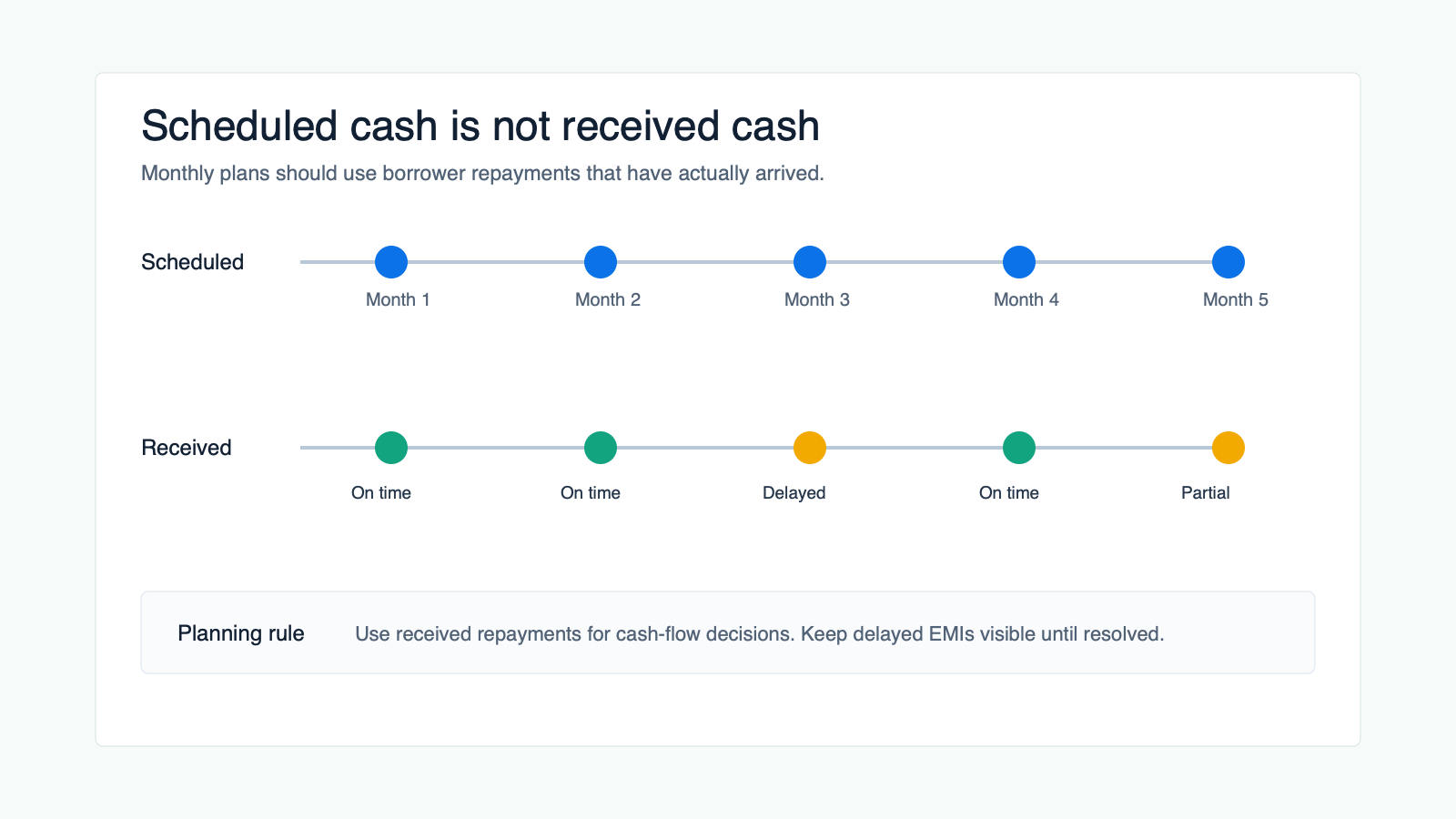
Monthly repayments in P2P lending can follow different paths. The schedule may look neat on day one, but actual receipt depends on borrower behaviour.
On-time repayments
If borrowers pay on schedule, the lender receives expected monthly cash flow after processing. The dashboard should show received principal, received interest, outstanding principal, and the next due date. This is the cleanest path, but it should not be assumed for every borrower.
Delayed EMIs
If a borrower misses a due date, the EMI may show as delayed or overdue. A short delay may be resolved quickly. A longer delay can affect monthly cash flow and realised return. The lender should watch overdue ageing, not only the total amount due.
Partial recovery or default
Some delayed repayments may be recovered partly or after a longer period. Some may not be recovered in full. Servicing and recovery efforts can help, but they cannot assure repayment. The lender bears borrower credit risk.
Why cash-flow planning needs a buffer
A monthly income plan should be based on received cash, not only scheduled cash. If ₹10,000 is scheduled but ₹8,500 is received, the plan should use ₹8,500. The missing ₹1,500 remains a risk item until it is recovered or written down as per platform treatment.
Compare Monthly Income Options by Risk, Liquidity and Payout Source
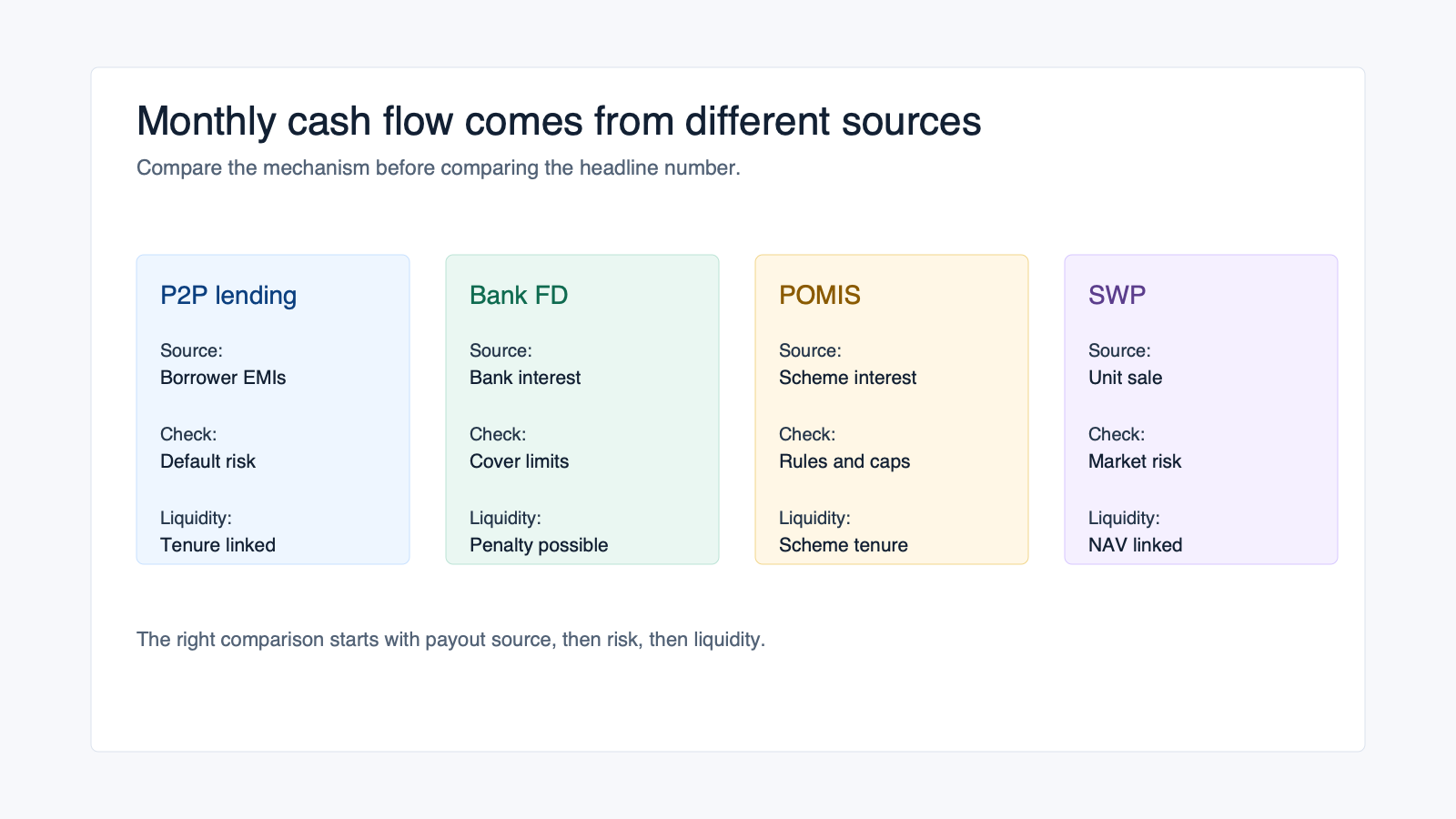
Monthly cash-flow products do not all work the same way. A bank fixed deposit with monthly interest payout, Post Office Monthly Income Scheme, SWP from mutual funds, and P2P lending all have different sources of payout, risk and liquidity.
Option | Source of monthly cash flow | Main risk to check | Liquidity lens |
|---|---|---|---|
P2P lending | Borrower EMIs | Borrower default risk and concentration risk | Linked to loan tenure and borrower repayments |
Bank FD with monthly payout | Bank interest | Bank credit risk beyond DICGC cover limits | Premature withdrawal may carry penalty |
Post Office Monthly Income Scheme | Government-backed scheme interest | Product limits, tenure and reinvestment risk | Lock-in and scheme rules apply |
SWP from mutual funds | Withdrawal from fund units | Market risk, sequence risk and NAV movement | Redemption rules and market value apply |
This comparison is not about which option is better. It is about matching the source of cash flow to the risk you are willing to accept. For P2P lending, the key difference is that monthly receipts depend on borrower repayment.
Worked Example: Using the Checklist for ₹1,00,000 of Planned Lending
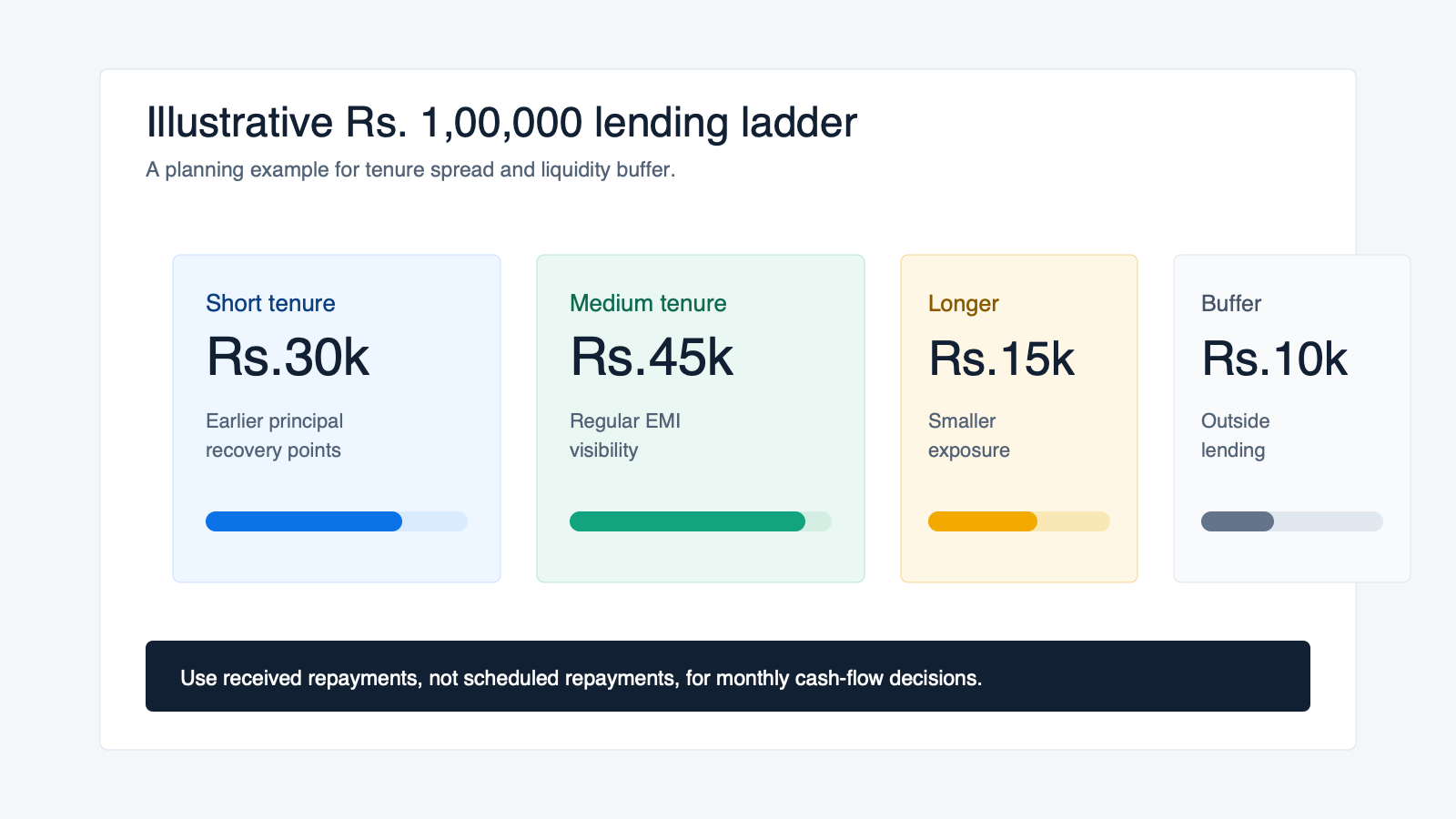
Assume a hypothetical lender has ₹1,00,000 available for P2P lending. This example is illustrative only. It does not refer to any live borrower listing or recommendation.
The lender wants some monthly cash flow but does not want all funds tied to one repayment window. A simple structure may look like this:
Bucket | Illustrative amount | Purpose |
|---|---|---|
Short-tenure borrower loans | ₹30,000 | Earlier principal recovery |
Medium-tenure borrower loans | ₹45,000 | Regular EMI flow |
Longer-tenure borrower loans | ₹15,000 | Extended repayment cycle |
Cash buffer outside lending | ₹10,000 | Liquidity and delay buffer |
Example allocation across borrowers and tenures
The lender spreads the ₹90,000 lending amount across many borrowers rather than one or two large exposures. The short-tenure bucket supports earlier review points. The medium-tenure bucket supports steadier EMI visibility. The longer-tenure bucket is kept smaller because liquidity matters to this lender.
The lender also writes a repayment rule in advance:
Withdraw 30% of received repayments for monthly cash-flow needs.
Consider lending 50% again only after reviewing dashboard health.
Keep 20% as available cash until the next monthly review.
What changes if some borrowers miss EMIs
Suppose ₹8,000 is scheduled in a month, but only ₹6,800 is received because some borrowers are late. The lender should plan around ₹6,800, not ₹8,000. The unrecovered ₹1,200 should remain visible as delayed cash.
If delays increase, the lender can reduce fresh lending, increase the buffer, or pause until repayment behaviour improves. The checklist is useful because it makes that decision evidence-based instead of emotional.
Regulatory Checks for P2P Lending in India
RBI's Master Direction - Non-Banking Financial Company - Peer to Peer Lending Platform (Reserve Bank) Directions, 2017 treats an NBFC-P2P platform as an intermediary providing loan facilitation between participants. That framing affects how monthly income claims should be read.
P2P lending is not a deposit. It is not principal-protected. It is not an assured-return product. The platform facilitates lending, repayment routing, servicing and disclosures. Borrower repayment risk remains with the lender.
Lender exposure caps
RBI caps a lender's total exposure across all P2P platforms at ₹50 lakh. It also caps exposure to a single borrower at ₹50,000. These limits matter when building any monthly cash-flow plan through P2P lending.
Platform disclosures and consent
Before lending, check whether the platform clearly shows borrower information, tenure, interest rate, fees, repayment status, risk disclosures and grievance channels. Strong disclosure is not a formality. It is part of lender protection.
RBI registration is not RBI assurance
RBI registration confirms the regulatory category under which the platform operates. It does not mean RBI assures borrower repayment, principal recovery, or any return outcome. A monthly income plan should never rely on regulatory status as a substitute for risk assessment.
Before You Lend: A Final Monthly Income Plan Checklist
Use this final checklist before making a P2P lending decision for monthly cash flow:
I understand that monthly repayments depend on borrower EMIs.
I have read the loan tenure and repayment schedule.
I know the borrower default risk.
I have checked borrower spread and exposure per borrower.
I am not relying on one borrower, one tenure or one risk bucket.
I understand that up to 18% p.a. is indicative, not assured.
I have checked platform fees and net receipt reporting.
I know how delayed EMIs are shown in the dashboard.
I have a cash buffer outside P2P lending.
I am not planning essential expenses around expected repayments.
I have checked RBI exposure caps.
I understand that RBI registration is not return assurance.
If most of these answers are clear, you are in a better position to evaluate P2P lending for monthly cash-flow planning. If several answers are unclear, pause before lending.
To explore IndiaP2P's approach, review the Monthly Income Plan Plus, the P2P lending repayment process, and P2P auto diversification explained with examples before making a lending decision.
Closing: Choose Cash-Flow Clarity Over Headline Returns
A monthly income plan should begin with clarity. In P2P lending, that means knowing where monthly cash flow comes from, how borrower repayments work, what can delay receipts, and how much principal is exposed.
IndiaP2P's up to 18% p.a. indicative return potential can be attractive for lenders who understand the risk. But the better habit is to read repayments, diversification, liquidity and regulation together. A calm checklist will usually tell you more than a headline number.