P2P Lending Risks and Returns: An Anti-Yield Chasing Guide
IndiaP2P enables eligible lenders to target up to 18% p.a. indicative returns through P2P lending. That number can be useful, but it should not be the only reason to lend.
In P2P lending, returns depend on borrower repayments. A lender is not placing money in a bank deposit. A lender is taking exposure to multiple borrowers, repayment schedules, delayed EMIs, platform processes, and the possibility of borrower default. There is no guarantee of return of principal or interest.
That is why the better starting point is not, "Where can I get the biggest displayed rate?" It is, "What risks sit behind this return, and am I comfortable lending through them?"
This guide is for lenders who want to understand P2P lending risks and returns without being pulled into headline-return chasing.
Why Chasing Only the Highest P2P Lending Return Can Mislead Lenders
A high displayed return can make a lending opportunity look simple. The actual lending experience is usually more layered.
Two P2P lending opportunities may show similar indicative returns, but the risk underneath can be very different. One may be spread across many borrowers with different repayment dates. Another may have higher concentration in a few borrowers. One may have a shorter tenure. Another may keep funds lent for longer. One may show expected monthly repayments clearly. Another may make it harder to understand delays, fees, and net receipts.
The headline number does not show all of this.
It also does not show how you may react when one EMI is delayed, when a borrower becomes overdue, or when you need money before the loan tenure ends. A lending decision made only for the displayed rate can become uncomfortable once repayment behavior starts to vary.
This does not mean a higher indicative return is automatically unsuitable. It means the return should be read with the lending structure around it.
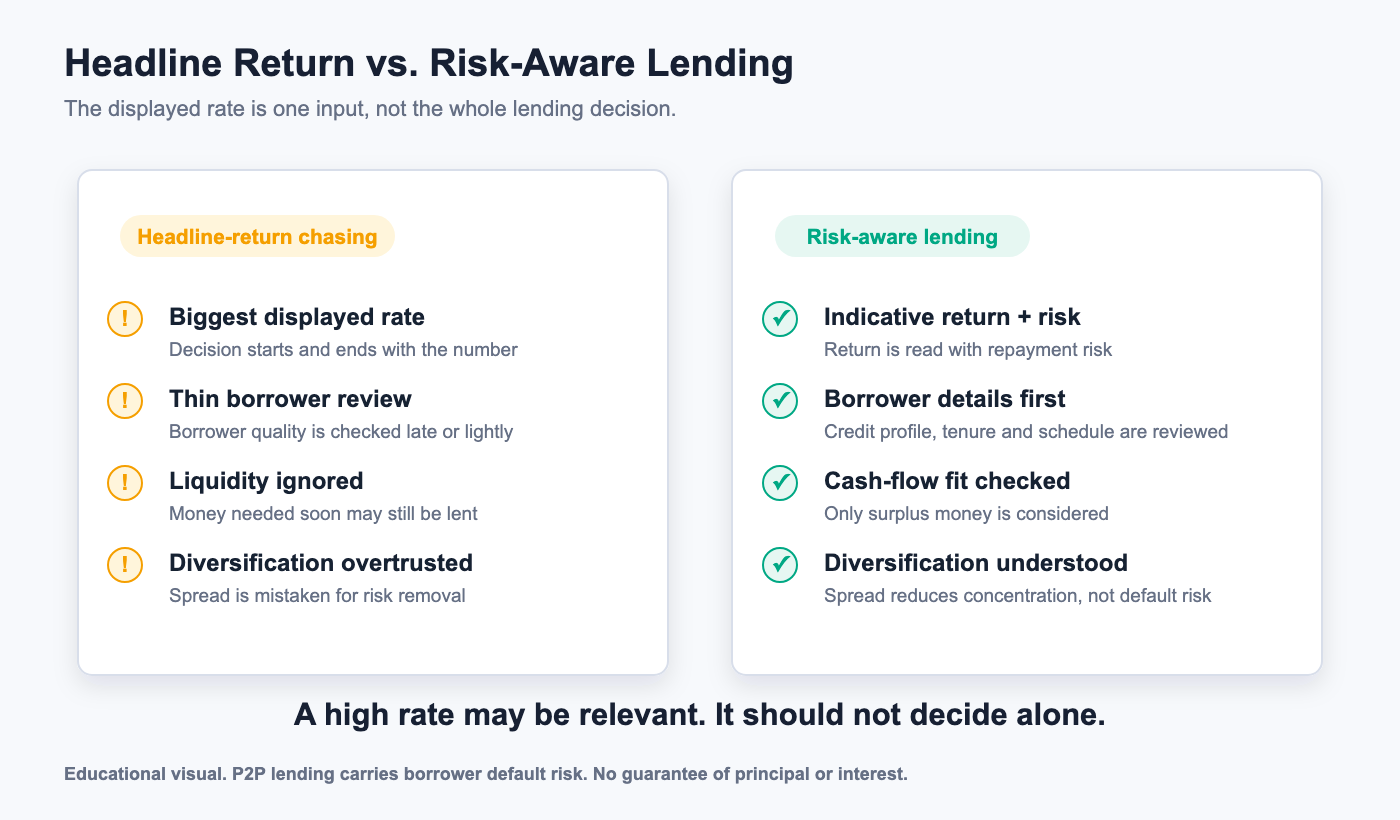
If you chase only the headline return | If you make a risk-aware lending decision |
|---|---|
You ask, "What is the biggest rate?" | You ask, "What risk comes with this rate?" |
You focus on the return number first | You check borrower spread, tenure, fees and repayment visibility |
You may ignore delayed EMI behavior | You plan for repayment variation before lending |
You may lend money needed soon | You lend only surplus money that can stay lent through the tenure |
You assume diversification solves risk | You understand diversification reduces concentration risk, not borrower default risk |
The anti-yield-chasing habit is simple: do not let the biggest displayed return make the decision on its own.
P2P Lending Risks and Returns: What the Headline Number Does Not Show
P2P lending risks and returns should be read together. The return is the visible part. The risk is the structure that decides whether the return is suitable for you.
Borrower Default Risk
Borrower default risk is the central risk in P2P lending.
When you lend through a P2P platform, borrowers are expected to repay principal and interest according to the loan schedule. If a borrower delays or defaults, your actual receipts can be lower or later than expected. In some cases, principal can be at risk.
A platform may assess borrowers, display loan information, facilitate repayment routing, and support recovery processes. It cannot make borrower risk disappear. A lender should therefore read the return number as linked to borrower repayment performance, not as a promise.
Delayed EMI and Cash-Flow Risk
Expected repayments and received repayments are not the same.
Your dashboard may show an expected monthly repayment schedule. That schedule helps you plan. But actual cash flow depends on borrowers paying on time. If an EMI is delayed, your received cash may differ from the expected amount for that month.
This matters especially for lenders who want monthly cash flow. P2P lending can create scheduled repayments, but those repayments may vary. It should not be used for money needed for urgent expenses, rent, medical needs, school fees, or other essential obligations.
Platform, Operational and Regulatory Risk
P2P lending also has platform and operational dimensions.
The platform facilitates borrower assessment, loan listing, agreements, fund routing, repayment servicing, reporting, and collections support. Any process failure, technology issue, regulatory change, or operational disruption can affect the lending experience.
Regulation can also evolve. The RBI's NBFC-P2P framework has become more specific over time on issues such as exposure limits, fund routing, settlement timelines, disclosures, and the role of platforms. Lenders should stay aware that a regulated framework improves structure, but it does not remove borrower repayment risk.
The RBI NBFC-P2P Framework: Registration is not a Return Guarantee
IndiaP2P is registered with the Reserve Bank of India as an NBFC-P2P. This means the platform operates under RBI's NBFC-P2P framework for peer-to-peer lending.
That framing is important. RBI registration is not the same as RBI approval of returns, RBI endorsement of the platform's statements, or RBI assurance of repayment.
The RBI Master Direction requires NBFC-P2P platforms to display a caveat that the platform is registered with the Reserve Bank, but that the Reserve Bank does not accept responsibility for statements or representations made by the platform and does not provide assurance for repayment of loans lent on it. The same Master Direction also sets prudential limits for lender and borrower exposure. See the RBI Master Direction for NBFC-P2P platforms.
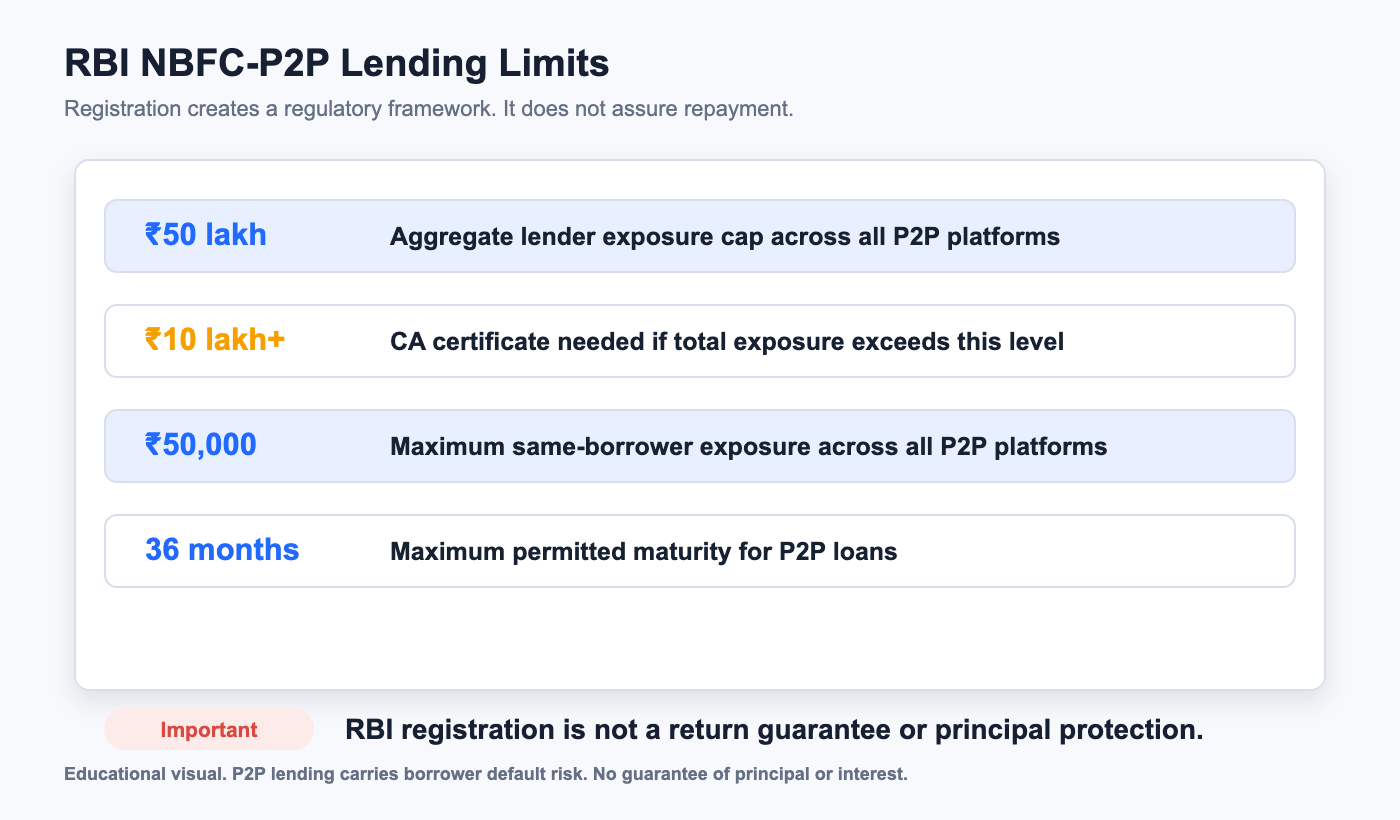
Key limits every lender should know:
RBI framework point | What it means for lenders |
|---|---|
Aggregate lender exposure cap | A lender's total exposure across all P2P platforms is capped at ₹50 lakh. |
Higher exposure documentation | If a lender's exposure across P2P platforms exceeds ₹10 lakh, a practising Chartered Accountant certificate certifying minimum net worth of ₹50 lakh is required. |
Same-borrower exposure cap | Exposure of a single lender to the same borrower across all P2P platforms cannot exceed ₹50,000. |
Loan maturity limit | P2P loan maturity cannot exceed 36 months. |
RBI repayment framing | RBI registration does not provide assurance for repayment of loans lent through the platform. |
RBI's updated NBFC-P2P FAQ also clarifies that T+1 refers to a bank working day and that disbursals and repayments must be routed through the respective lender and borrower bank accounts via escrow accounts. See the RBI NBFC-P2P FAQ updated September 03, 2025.
For a simpler starting point, IndiaP2P's P2P lending beginner guide explains the basic mechanics before you decide how much to lend.
A Better Question Than “ What Rate Can I Get?”
The rate is only one input. A more useful lending decision starts with four questions.
Who is the Borrower?
A borrower is not just a rate attached to a loan. The borrower has an income profile, repayment capacity, loan purpose, credit history, and risk characteristics assessed by the platform.
Before lending, check what borrower information is available. Look at credit assessment, risk grade where shown, loan tenure, repayment schedule, and how the platform explains borrower selection. If borrower information is too thin for your comfort, the rate should not compensate for that lack of clarity.
How Spread Out is the Lending Amount?
Concentration risk matters.
₹1,00,000 spread across many borrower exposures behaves differently from ₹1,00,000 concentrated in a few borrowers. The total lending amount may be the same, but the effect of one delayed borrower can be very different.
A wider borrower spread can reduce dependence on any one borrower. It cannot remove borrower default risk. This distinction is important enough to repeat: diversification helps with concentration risk, not with certainty.
What Happens If Repayments Are Delayed?
Before lending, ask how delays are shown.
Can you see expected repayments and received repayments separately? Can you see delayed EMIs? Can you see overdue ageing? Can you understand what part of your return assumption is affected by fees, delays, or defaults?
If the platform makes repayment behavior easy to monitor, you can review your lending experience more calmly. If the reporting is unclear, a high displayed return may hide too much practical uncertainty.
Can This Money Stay Lent Through the Tenure?
P2P lending is not a place for emergency money.
The loan tenure decides how long your money may stay lent. Repayments may come monthly, but your ability to exit early can be limited. Lend only money that can remain outside your immediate cash needs.
For more on this decision, read IndiaP2P's guide on how to choose P2P lending tenure.
Tenure and Liquidity Matter as Much as the Return Number
Lenders often compare return numbers first. Experienced lenders also compare time.
A short-tenure loan and a longer-tenure loan can have different liquidity implications. Longer tenure may mean your money stays lent for longer. Shorter tenure may bring principal back sooner, but the available return and borrower mix may differ. The right tenure depends on your cash-flow plan, not only the displayed rate.
This is where many headline-return decisions become fragile. If you lend money needed in three months into a longer repayment cycle, the issue is not only borrower risk. It is a mismatch between your liquidity need and the lending structure.
Before lending, write down the purpose of the money:
Is it surplus money that can remain lent through the full tenure?
Is it money you may need for a planned expense?
Is it part of a monthly cash-flow plan?
Would a delayed EMI affect your household budget?
If a delayed repayment would disturb essential expenses, the amount is too high or the product may not be suitable for that money.
For repayment mechanics, use IndiaP2P's guide to the P2P lending repayment process.
How to Research Before You Lend Through a P2P Platform
The supplied phrase "research and recommend" is a useful habit, even if it is not a precise search keyword for this topic. Research first. Recommend to yourself only after the risk checks are clear.
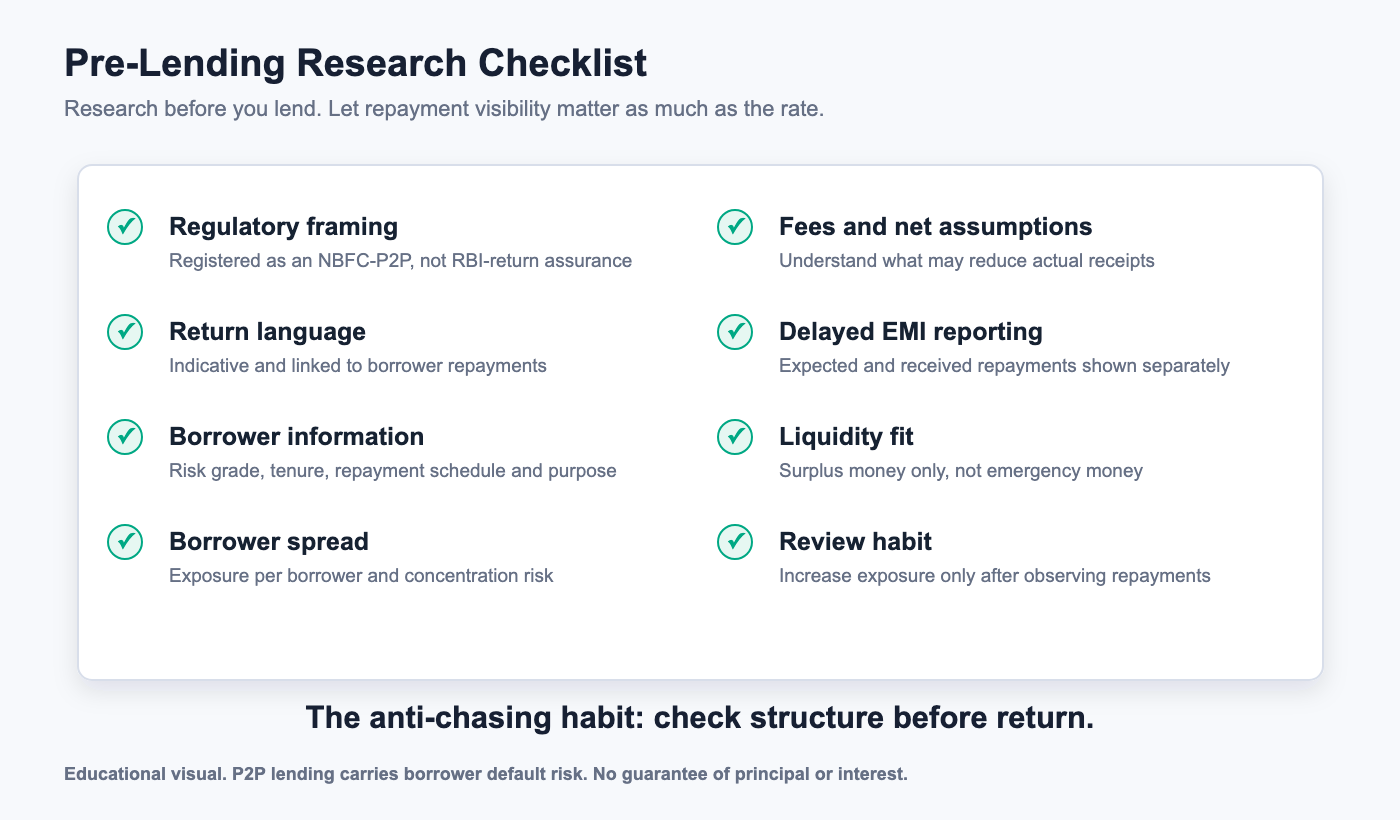
Use this pre-lending checklist.
Check | What to look for |
|---|---|
Regulatory framework | The platform should be registered as an NBFC-P2P where it facilitates P2P lending in India. Avoid reading registration as repayment assurance. |
Return language | The return should be described as indicative or dependent on borrower repayments, not guaranteed. |
Borrower information | Look for borrower assessment, loan purpose, repayment schedule, tenure and risk information where available. |
Borrower spread | Check how much exposure can go to one borrower and whether lending is spread enough for your comfort. |
Fees and net assumptions | Understand platform fees and whether the displayed return is before or after relevant costs. |
Delays and overdue reporting | Confirm whether delayed EMIs and overdue ageing are visible. |
Liquidity fit | Lend only surplus money that can stay lent through the loan tenure. |
Tax review | Tax treatment depends on individual circumstances and may change. Consult a qualified tax advisor if needed. |
Before committing a larger amount, start with an amount that lets you observe the platform. Review received repayments, delays, reporting, fees, and your own comfort. Increase only if the experience fits your risk tolerance and cash-flow needs.
IndiaP2P's checklist on how to read borrower allocation before lending can help you evaluate the details before deciding.
Where IndiaP2P Fits for Risk-Aware Lenders
IndiaP2P is a peer-to-peer lending platform registered with the Reserve Bank of India as an NBFC-P2P. The platform connects lenders with verified borrowers and facilitates lending, repayment routing, and reporting.
IndiaP2P enables eligible lenders to target up to 18% p.a. indicative returns. The word "indicative" matters. Actual outcomes depend on borrower repayments, borrower delays or defaults, platform terms, fees, and the lending spread selected.
For lenders who want monthly repayment visibility, IndiaP2P Monthly Income Plan Plus can be reviewed after understanding the risk framework. The decision should come after the checks in this article, not before them.
A risk-aware lender does not ignore return potential. A risk-aware lender refuses to let the return number stand alone.
Summary: Do Not Let the Highest Displayed Rate Make the Decision
P2P lending risks and returns should always be evaluated together.
Up to 18% p.a. indicative returns may be relevant for eligible lenders, but the decision should also include borrower default risk, delayed EMI behavior, borrower spread, tenure, fees, liquidity needs, RBI exposure limits, and principal exposure.
The anti-yield-chasing rule is not complicated:
Do not lend money you may need urgently.
Do not treat RBI registration as repayment assurance.
Do not assume diversification removes risk.
Do not judge a P2P lending opportunity only by the displayed return.
Do review actual repayments before increasing exposure.
Lend with clarity, not impulse.