P2P Lending Cash Flow: Build a Repayment Ladder
IndiaP2P lenders can target up to 18% p.a. indicative returns, subject to borrower repayment performance, platform terms, fees, and credit risk. A P2P repayment ladder helps you plan how borrower EMIs may come back over time, and what you will do once cash is actually received.
That last phrase matters: actually received.
A repayment ladder is not a guarantee of monthly income. It is a planning method. It helps you map expected borrower repayments, track received principal and interest, decide what to re-lend, decide what to withdraw, and keep a buffer for months when EMIs are delayed.
Used well, the ladder can make P2P lending cash flow easier to follow. Used carelessly, it can create a false sense of certainty. The right approach is to build the ladder around received repayments, not hope.
What is P2P Repayment Ladder?
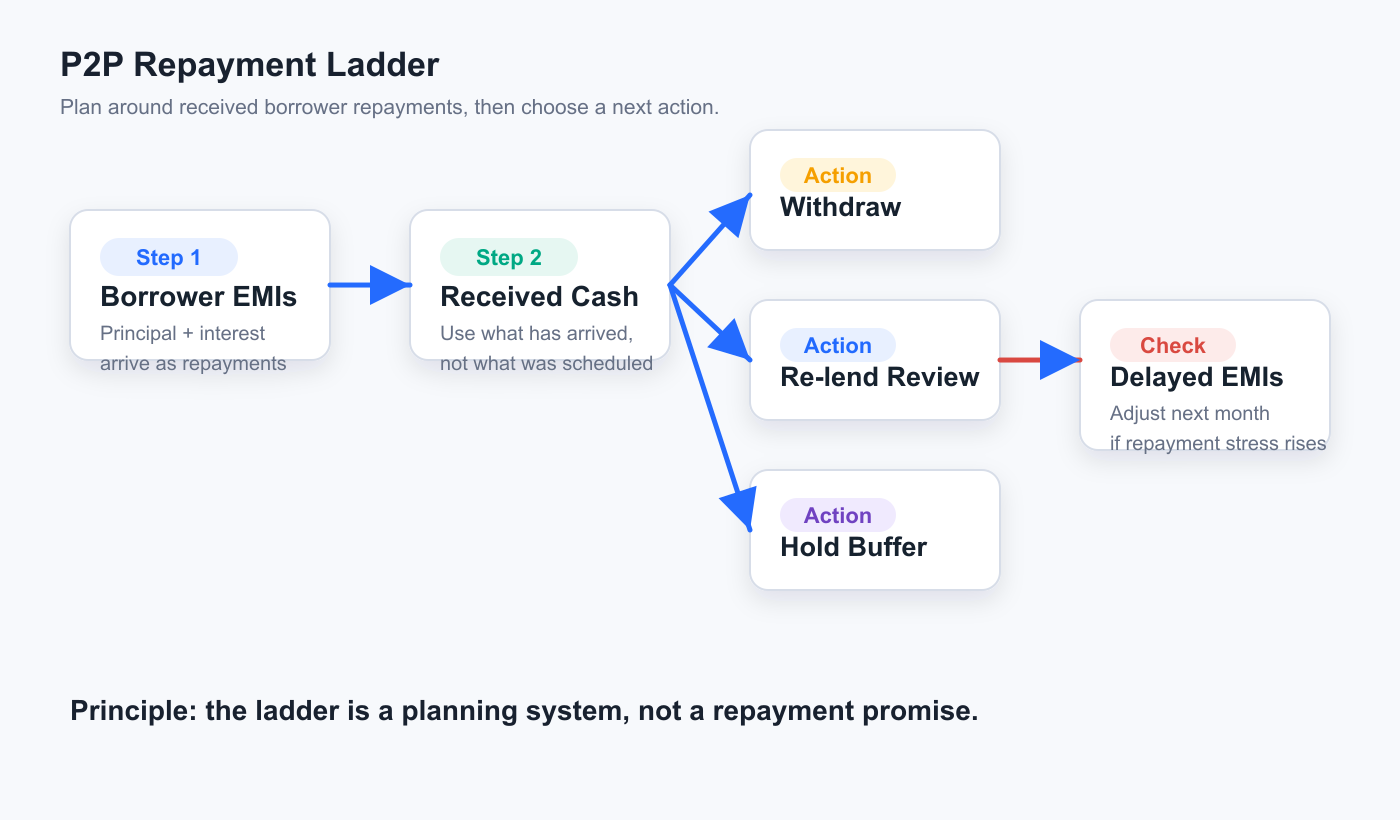
A P2P repayment ladder is a cash-flow plan built around borrower repayment schedules. When you lend through a P2P platform, borrowers repay through EMIs. Each EMI may include a principal portion, an interest portion, or both, depending on the loan structure and repayment status.
The ladder takes those expected repayment dates and turns them into a monthly review system.
Instead of asking, "How much can I earn?", the ladder asks more useful questions:
What repayments are scheduled this month?
What repayments have actually arrived?
How much of the received cash should be withdrawn?
How much should be considered for fresh lending?
How much should be held as a buffer?
Did any borrower delays change the next decision?
That is the practical value of the ladder. It gives cash flow a rule.
Scheduled repayments vs received repayments
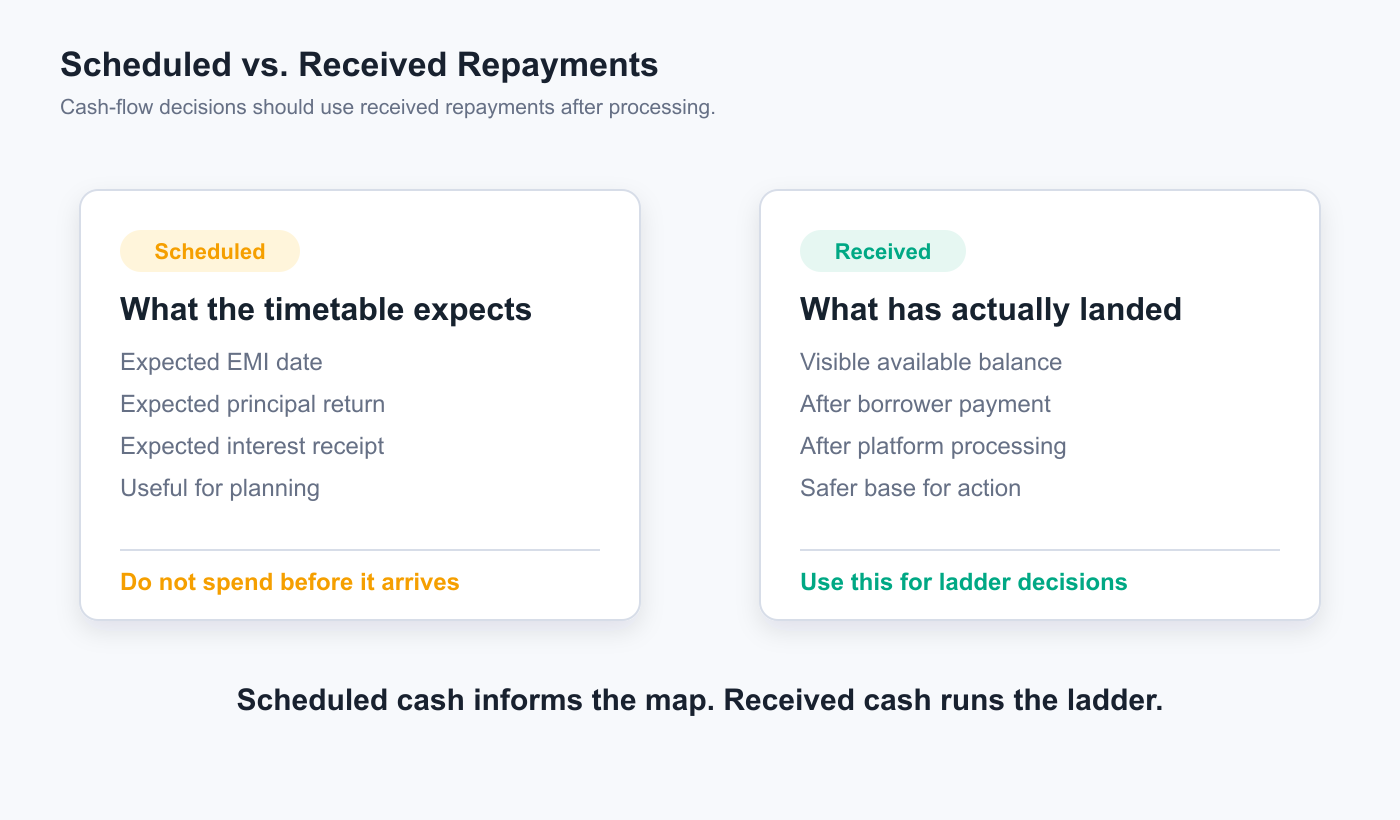
Scheduled repayment is what the loan timetable expects. Received repayment is what has actually landed after borrower payment, platform processing, and any applicable deductions.
For cash-flow planning, received repayment is the safer base. A lender should not plan expenses around scheduled cash before it arrives. If an EMI is delayed, the ladder should adjust automatically.
Why this is not a bank-deposit payout
P2P lending is exposure to borrower repayment behaviour. IndiaP2P facilitates lending between lenders and borrowers as an RBI-registered NBFC-P2P platform. It does not guarantee repayment of principal or interest.
That is why a repayment ladder should never be treated like a fixed payout calendar. It is better understood as a disciplined way to track, review, and act on repayments as they arrive.
How Monthly Repayments in P2P Lending Create Cash-Flow Visibility
Monthly repayments in P2P lending can make cash flow easier to observe. A lender can see when borrower EMIs are expected, how much principal has come back, how much interest has been received, and whether any repayment is delayed.
This visibility is useful because P2P lending is not only about the headline return number. The actual experience is shaped by repayment timing, borrower spread, delays, fees, and whether received cash is re-lent or withdrawn.
For a fuller explanation of the repayment lifecycle after lending, see IndiaP2P's guide to the P2P lending repayment process.
Borrower EMI dates and repayment cycles
Each borrower loan has a repayment schedule. If you lend across several borrower loans, repayments may arrive across different dates or cycles. This can create cash-flow visibility through the month, but it also means tracking matters.
The goal is not to make every month identical. The goal is to know what was expected, what arrived, and what changed.
Principal repayment and interest receipt
Repayments can include both principal and interest. The distinction matters.
Principal repayment reduces outstanding exposure to that borrower loan. Interest receipt contributes to the lender's return. A useful dashboard should help the lender see both clearly, along with delayed EMIs and net receipts.
Dashboard checks before counting cash
Before treating repayments as usable cash, check:
available balance
received principal
received interest
delayed EMIs
overdue ageing
borrower spread
tenure remaining
platform fees or deductions
The ladder should follow the dashboard, not the other way around.
Step-by-Step: Building an Income Ladder with Repayments
Building an income ladder with repayments is less about predicting a perfect monthly number and more about setting a disciplined operating rule.
Here is a practical sequence.
Step 1: Choose the money purpose
Start with the purpose. Is this money meant to support monthly cash flow, long-term re-lending, a planned expense, or a mix?
If the purpose is monthly cash flow, withdrawals will be part of the plan. If the purpose is longer-term compounding discipline, re-lending may be more relevant. If liquidity matters, a buffer should sit inside the rule from day one.
Step 2: Spread lending across borrower loans
Spreading lending across many borrower loans may reduce concentration risk. It means one delayed EMI is less likely to dominate the entire cash-flow picture.
But diversification does not remove borrower default risk. It only reduces dependence on a single borrower, borrower group, or repayment date. For a deeper view of this trade-off, see P2P auto diversification explained with examples.
Step 3: Mix tenures to avoid one repayment cluster
Tenure mix shapes the ladder. If all borrower loans follow one broad tenure, repayments may cluster in a way that feels uneven. If tenures are mixed carefully, the lender may get more review points and a clearer sense of cash movement.
Shorter tenures may return principal earlier. Longer tenures may keep exposure running for more months. The right mix depends on liquidity needs and risk comfort. For a dedicated framework, read how to choose P2P lending tenure.
Step 4: Write a re-lend, withdraw and buffer rule
The most useful ladder is written before the repayment arrives.
For example:
withdraw 25% of received repayments for monthly cash flow
review 60% for fresh lending only if dashboard checks are healthy
keep 15% as a cash buffer
This is not a recommended split. It is a sample rule. A lender with near-term expenses may withdraw more. A lender with a longer horizon may re-lend more. A lender seeing rising delays may pause fresh lending.
For a deeper decision framework, see should you re-lend P2P repayments or withdraw them.
P2P Repayment Ladder Example in India
Assume a lender starts with ₹1,00,000 for P2P lending. This example is illustrative only. It is not based on a live borrower listing and is not a recommendation.
The lender wants monthly cash-flow visibility, but does not want all money exposed to one repayment date or one tenure bucket. So the lender uses a simple ladder plan.
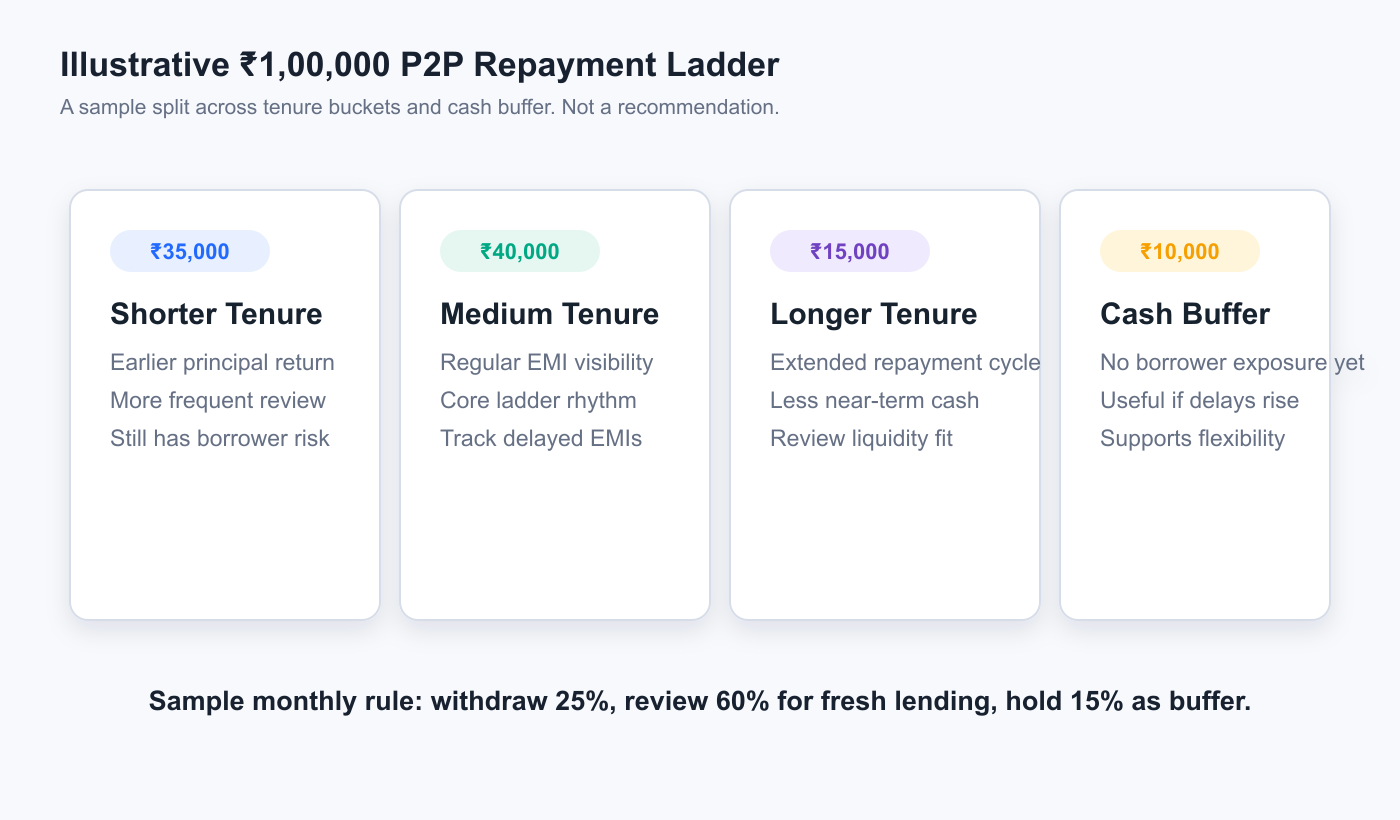
Ladder bucket | Illustrative amount | Purpose |
|---|---|---|
Shorter-tenure borrower loans | ₹35,000 | Earlier principal return |
Medium-tenure borrower loans | ₹40,000 | Regular EMI visibility |
Longer-tenure borrower loans | ₹15,000 | Extended repayment cycle |
Cash buffer | ₹10,000 | No borrower exposure yet |
The Lender also sets a monthly rule:
Received repayment action | Illustrative split | Why it exists |
|---|---|---|
Withdraw | 25% | Supports monthly cash flow |
Review for fresh lending | 60% | Keeps received cash active if risk checks pass |
Hold as buffer | 15% | Creates flexibility if EMIs are delayed |
Example monthly split: withdraw, re-lend, buffer
Assume ₹8,000 is received in a month after borrower repayments and platform processing.
Using the sample rule:
₹2,000 is withdrawn
₹4,800 is reviewed for fresh lending
₹1,200 stays in the buffer
The important part is not the exact split. It is the habit. The lender does not decide emotionally after every EMI. The rule creates a calm review rhythm.
What delayed EMIs do to the same ladder
Now assume the dashboard had shown ₹9,500 as scheduled repayments, but only ₹8,000 was received because some borrower EMIs were delayed.
The ladder should use ₹8,000, not ₹9,500.
The delayed amount should stay outside the cash-flow plan until received. The lender may also reduce the fresh-lending percentage for that month, increase the buffer, or pause fresh lending until overdue ageing improves.
How to adjust next month’s lending rule
The next month's rule should respond to evidence.
If repayments were broadly on time and borrower spread remains healthy, the rule may continue unchanged. If delays increased, the lender can shift more received cash into withdrawal or buffer. If liquidity needs changed, the lender can lower fresh lending even if dashboard performance looks fine.
A repayment ladder is useful because it adapts without panic.
Risk Checks Before Relying on P2P Lending Cash Flow
P2P lending cash flow should always be read with risk. IndiaP2P is registered with the Reserve Bank of India as an NBFC-P2P, and P2P platforms operate under RBI's NBFC-P2P framework. Registration creates a regulated operating perimeter. It does not mean the RBI guarantees repayment outcomes.
RBI's NBFC-P2P framework treats platforms as intermediaries for loan facilitation. Lenders still bear borrower repayment risk. The RBI framework also includes exposure limits, including a ₹50 lakh aggregate exposure cap across all P2P platforms and ₹50,000 exposure to a single borrower, as reflected in IndiaP2P's compliance guidance and the RBI Master Direction.
Borrower default risk
Borrower default risk is the core risk in P2P lending. A borrower may delay, partly repay, or fail to repay. This can reduce interest receipts, principal recovery, and actual returns.
The repayment ladder should therefore include delayed EMI review and overdue ageing. A recent delay and a long unresolved overdue amount should not be treated the same.
Liquidity and tenure risk
P2P lending is linked to borrower loan tenures. A lender should not assume instant access to money that is still outstanding in borrower loans.
Monthly repayments can partially improve cash visibility because principal may return over time. But this is not the same as an on-demand withdrawal facility. Keep emergency savings outside P2P lending.
Concentration risk
Concentration risk appears when too much money depends on too few borrowers, one risk band, one tenure, or one repayment window.
Spreading lending across borrower loans can reduce this dependence. It does not assure repayment. The ladder should track borrower spread and repayment pattern together.
Why indicative returns are not assured
Up to 18% p.a. is an indicative return figure, not a guaranteed outcome. Actual returns depend on borrower repayments, delays, defaults, fees, tenure, and how long received cash remains idle before it is re-lent or withdrawn.
Any return discussion should sit beside the risk picture. If the risk picture changes, the ladder should change.
P2P Repayment Ladder Checklist Before Lending
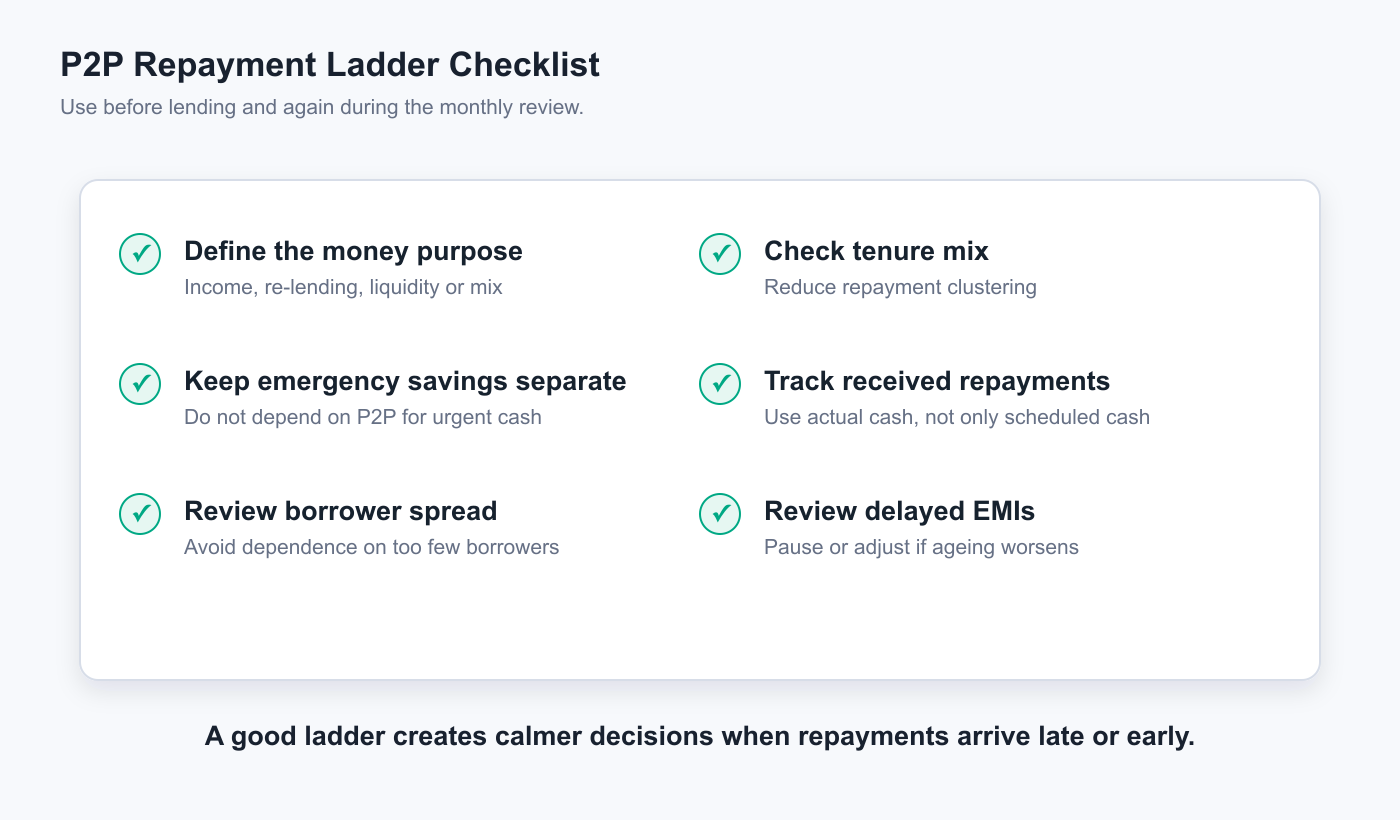
Use this checklist before building a repayment ladder:
Define whether the goal is monthly cash flow, re-lending, liquidity, or a mix.
Keep emergency savings outside P2P lending.
Review borrower spread before lending.
Avoid depending on one borrower or one repayment date.
Check tenure mix.
Read the repayment schedule.
Understand platform fees and deductions.
Set a re-lend, withdraw, and buffer rule.
Track received repayments, not only scheduled repayments.
Review delayed EMI and overdue ageing each month.
Treat up to 18% p.a. as indicative, not assured.
Pause fresh lending if dashboard signals weaken.
When to re-lend, withdraw, or pause
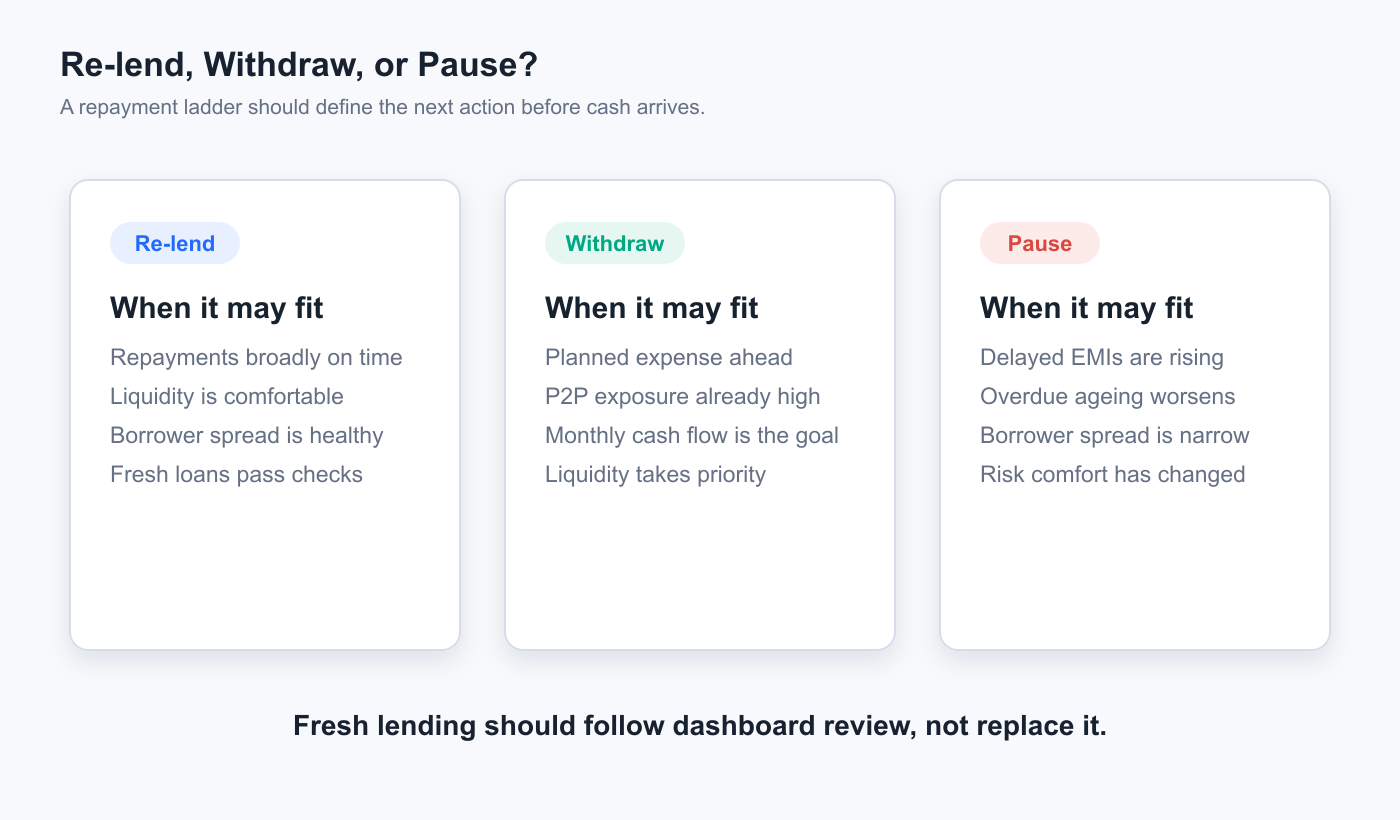
A repayment ladder becomes easier when common situations already have a rule.
Situation | Consider this action | Why |
|---|---|---|
Repayments are received broadly on time and liquidity is comfortable | Review for fresh lending | Keeps received cash active if risk checks pass |
A planned expense is coming up | Withdraw received cash | Liquidity takes priority |
Delayed EMIs are rising | Pause or reduce fresh lending | The ladder should respond to repayment stress |
Borrower spread is too narrow | Lend more gradually, or hold buffer | Avoid dependence on too few borrowers |
The lender already has enough P2P exposure | Withdraw or hold buffer | Avoid overexposure |
Cash is available but suitable borrower loans are not | Hold cash temporarily | Fresh lending should pass the same checks as the first lending decision |
Build the Ladder Around Received Cash
A P2P repayment ladder is useful because it turns borrower repayments into a review habit. It helps a lender decide what to withdraw, what to consider for fresh lending, and what to keep as a buffer.
The discipline is simple: do not rely on expected cash before it arrives. Start with the repayment schedule, but make decisions from received cash and dashboard evidence.
That is how the ladder stays realistic. It supports cash-flow planning without pretending that borrower repayment risk has disappeared.