How to Plan Passive Income for Irregular Expenses
IndiaP2P enables eligible lenders to target indicative return potential of up to 18% p.a., subject to borrower repayment performance, fees, delays, defaults and platform terms. For anyone trying to plan passive income for irregular expenses, that return potential is only one part of the decision. The more important question is timing: will cash be available before the bill is due?
Most households can name their monthly expenses quickly. Rent, groceries, fuel, utilities and domestic help follow a rhythm. The harder expenses arrive unevenly: school fees, annual insurance premiums, medical needs, repairs, tax payments, festive spending, professional renewals and family travel.
These expenses are not always unexpected. They only feel stressful when the cash is not planned in advance.
This guide explains how to build an expense calendar, where P2P lending repayments may fit, and where you should keep liquidity outside lending.
Passive Income for Irregular Expenses: Start with the Bill Calendar
Passive income for irregular expenses begins with a calendar, not a product. Before deciding how much to lend, list the next 12 months of non-monthly expenses. Add the expected due month, amount, importance and flexibility of each bill.
A school fee due in June is different from a vacation in December. One is essential and date-bound. The other can usually be postponed, reduced or cancelled. A medical buffer is different from a phone upgrade. One protects household resilience. The other is discretionary.
Use three simple labels:
Expense type | What it means | Planning rule |
|---|---|---|
Essential | Missing the date creates serious cost or disruption | Keep cash ready before the due date |
Flexible | The expense matters, but timing can move | Use repayments as support, with a buffer |
Optional | The expense can be skipped or reduced | Do not force lending decisions around it |
This step prevents a common mistake: counting expected income as if it were already available. In P2P lending, monthly repayments may help build cash flow, but borrower repayments can be delayed. That means the calendar should decide the lending plan, not the other way around.
Irregular Expense Planning: Separate Essential, Flexible and Optional Costs
Good irregular expense planning starts by asking what happens if the payment is late.
Late school fees, insurance lapses, medical shortfalls and tax penalties can create real consequences. A delayed home upgrade or holiday usually does not. P2P lending can support a broader cash-flow plan, but it should not become the only source for essential due-date payments.
Think in layers.
The first layer is liquid cash for urgent or mandatory expenses. This should stay outside P2P lending. The second layer is expected monthly repayments from lending. This can help refill reserves or support expenses that are months away. The third layer is future surplus that can be lent, withdrawn or held depending on what the calendar shows.
Essential Expenses Need Liquidity
If a bill is due within the next few weeks, keep the amount outside P2P lending. This applies to rent, insurance premiums, medical requirements, school fees, tax deadlines and any payment where delay creates a penalty.
P2P lending is not a substitute for emergency cash. Once money is lent, access depends on borrower repayments and the loan schedule. Even when repayments are expected monthly, they are not the same as money already in your bank account.
Flexible Expenses Can Use Repayment Support
Flexible expenses are better suited for repayment-based planning. For example, if home maintenance is expected in six months, monthly receipts may help build the amount gradually. If a family trip is planned for December, repayments received between now and then may support the goal.
The rule is simple: use repayments to strengthen a plan, not to rescue one.
How P2P Lending Can Support Passive Income Planning
P2P lending connects lenders with borrowers through an RBI-registered NBFC-P2P platform. After money is matched to borrower loans, borrowers repay according to the agreed schedule. Repayments may include principal and interest, depending on the loan structure.
This is where P2P lending can help passive income planning: it may create recurring receipts that can be assigned to future expenses. Instead of waiting for one large payout, a lender may receive monthly repayments that can be directed toward school fees, insurance premiums, repairs or a household reserve.
IndiaP2P's Monthly Income Plan Plus is designed around monthly repayments, borrower diligence and diversification across borrower loans. IndiaP2P communicates return potential as up to 18% p.a., but that figure should be read as indicative, not assured.
There is an important trade-off. P2P lending may offer higher return potential than idle cash, but it carries borrower default risk and lower liquidity once money is lent. A repayment may arrive late. A borrower may default. Fees and delays may reduce net receipts.
That is why P2P repayments should be treated as a planning layer, not as guaranteed income.
Monthly Cash Flow Planning with a P2P Repayment Ladder
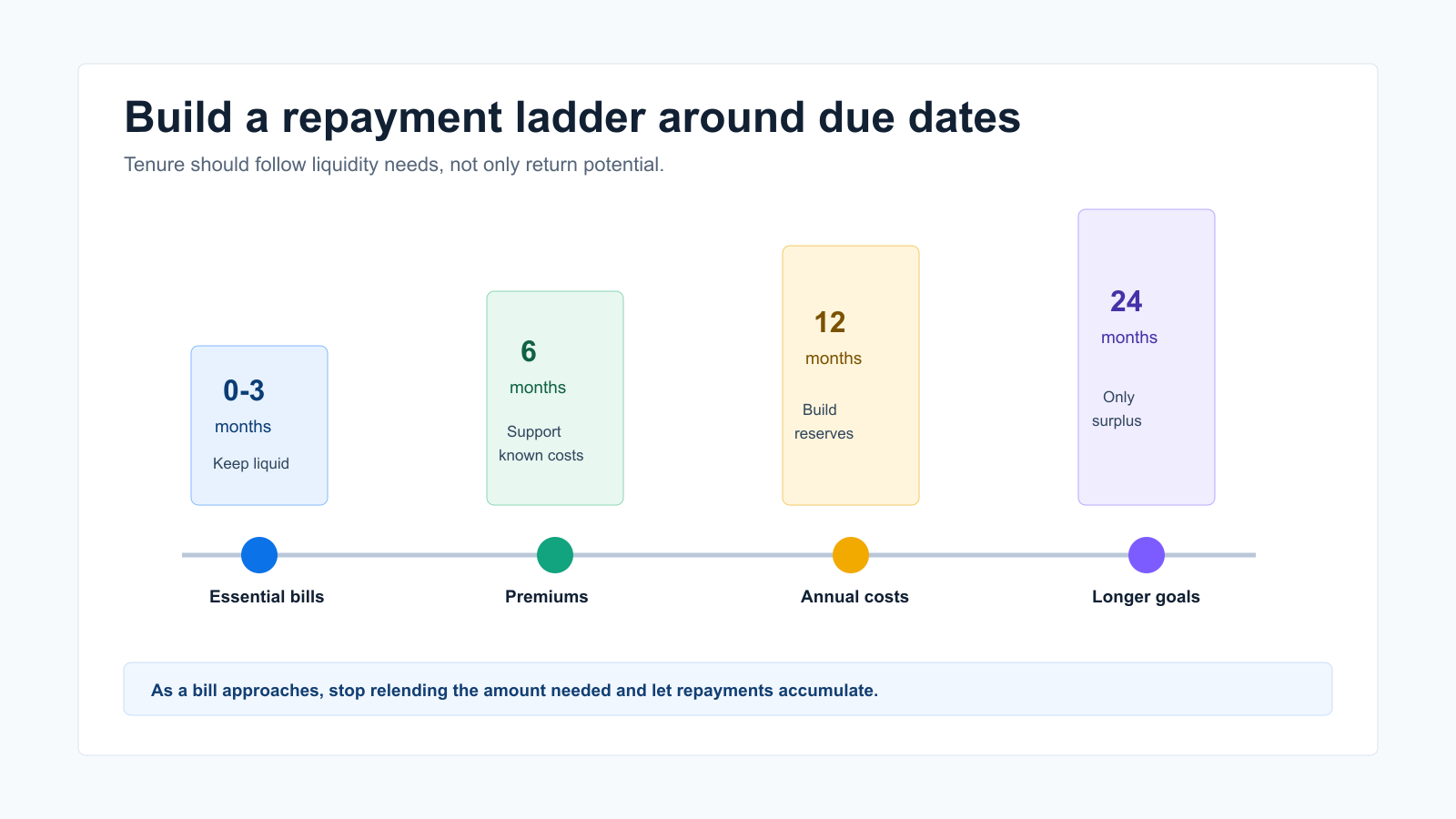
Monthly cash flow planning means matching expected receipts to expected bills. A repayment ladder spreads lending across different repayment windows so that cash does not return too late for the expenses you are planning.
For irregular expenses, this ladder should be conservative. Near-term essential bills come first. Then you decide how much surplus can be lent for longer periods. Do not choose tenure only because the displayed return potential is attractive. Tenure also determines how long your cash remains exposed to borrower repayment risk.
Match Tenure to Bill Timing
If a bill is due within three months, keep most or all of that amount liquid. If a bill is due in six to twelve months, expected repayments may support it when paired with a buffer. For longer-term goals, you can consider a wider repayment ladder, provided essential expenses are not dependent on future borrower payments.
For a deeper view, use IndiaP2P's guide on choosing P2P lending tenure before deciding how long to lend.
Stop Relending Before a Due Date
As an important bill approaches, stop relending the amount you need. Let repayments accumulate in your bank account or expense reserve. If the due date is still far away and your buffer is healthy, relending may fit. If the due date is close, withdrawal discipline matters more.
IndiaP2P's guide on whether to re-lend or withdraw P2P repayments can help structure this decision.
Worked Example: Planning for School Fees, Insurance and Repairs
The following example is illustrative and hypothetical. It is not a recommendation to lend a specific amount or choose a specific borrower loan.
Suppose a lender expects three irregular expenses over the next year:
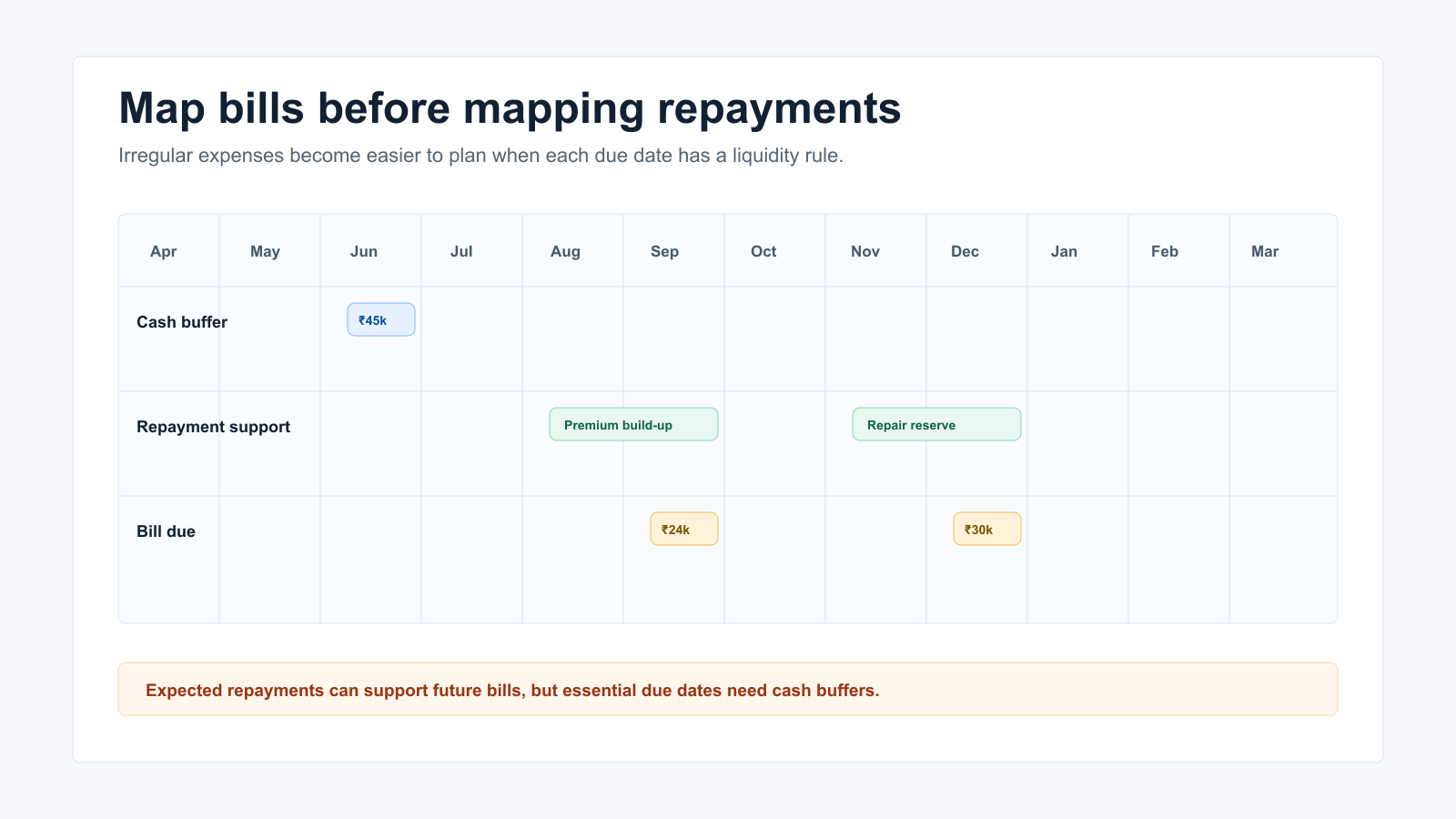
Expense | Due month | Amount | Expense type | Planning approach |
|---|---|---|---|---|
School fees | June | ₹45,000 | Essential | Keep fully liquid if due soon |
Insurance premium | September | ₹24,000 | Essential | Keep a partial buffer and build balance early |
Home repairs | December | ₹30,000 | Flexible | Use repayments only if timing remains comfortable |
Total planned outflow: ₹99,000.
If the lender has ₹1,50,000 of surplus, lending the entire amount without regard to the calendar would be poor planning. A more disciplined approach could look like this:
Step | Action | Reason |
|---|---|---|
1 | Keep ₹45,000 liquid for June school fees | Essential and close due date |
2 | Keep ₹12,000 liquid toward September premium | Reduces dependence on future repayments |
3 | Use received repayments from April to August to build the premium reserve | Supports a known bill gradually |
4 | Use post-September repayments for repairs only if collections are on track | Flexible expense, easier to postpone |
5 | Review borrower spread, repayment schedule and overdue status monthly | Keeps the plan tied to actual receipts |
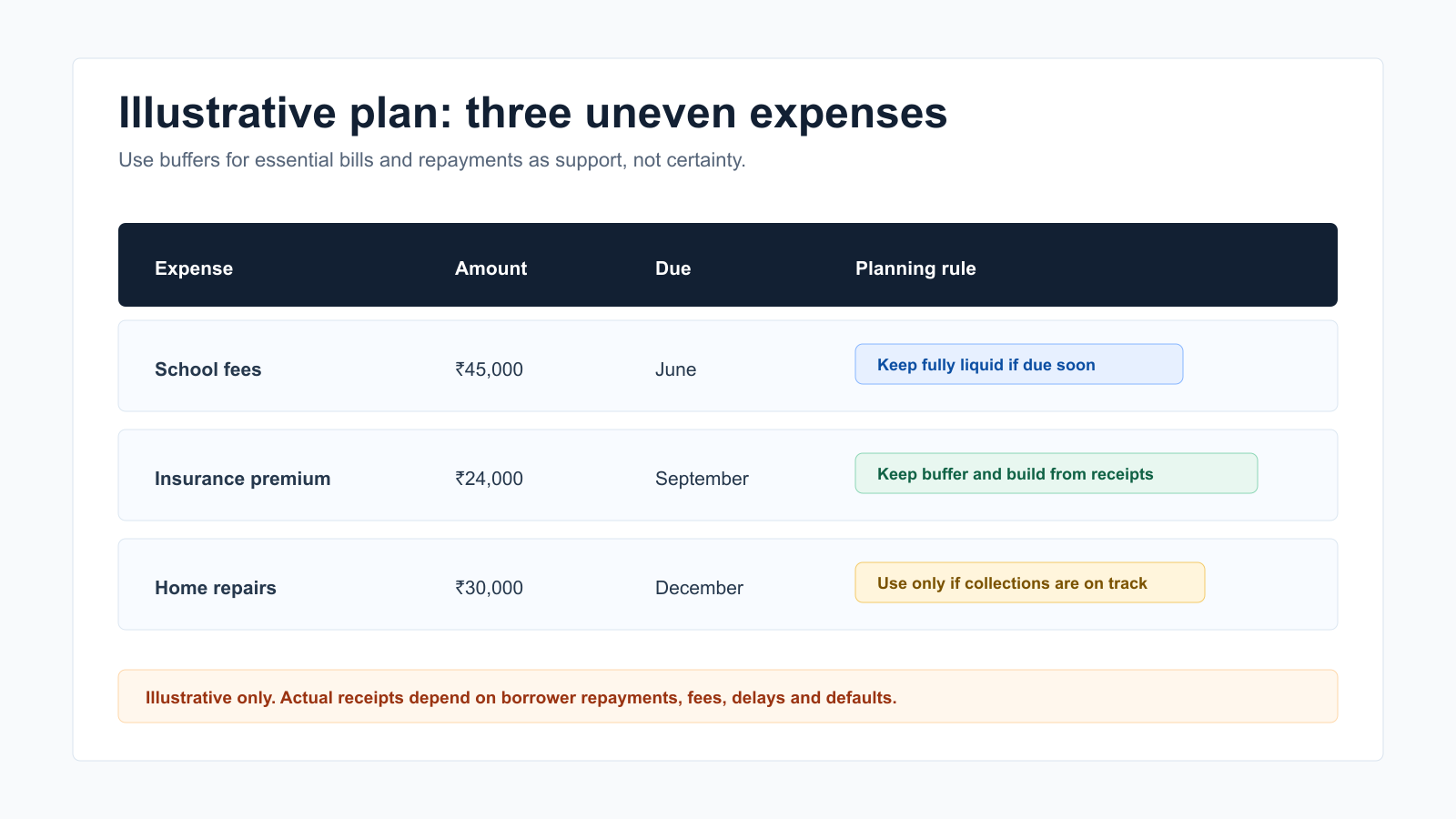
Now assume repayments are delayed in July and August. The September premium reserve may fall short. In that case, the lender should use cash kept outside P2P lending rather than miss the premium date. This is why essential expenses need prefunding and why P2P repayments should support, not replace, liquidity.
Before lending for income, review borrower loan details, repayment dates, delayed EMI visibility, fees and concentration. IndiaP2P's guide on reading borrower loan details before lending can help with this pre-lending check.
P2P Lending Risk: What Can Disrupt the Plan
P2P lending risk is mainly borrower repayment risk. An NBFC-P2P platform facilitates the lending process, documentation, disclosures and collections, but it does not guarantee repayment of principal or interest.
The RBI's NBFC-P2P framework caps lender exposure across P2P platforms and limits exposure to a single borrower. It also makes clear that P2P platforms cannot provide or arrange credit enhancement or credit guarantee. The practical meaning is simple: if a borrower delays or defaults, the lender bears that risk.
Returns are not assured
P2P lending returns are not assured. Up to 18% p.a. should be read as indicative return potential, subject to borrower repayments, fees, delays, defaults and platform terms. It should not be treated like a bank deposit, assured coupon or capital-protected product.
This matters even more when planning irregular expenses. A high return figure is not useful if cash is unavailable when an essential bill is due.
Diversification reduces concentration, not risk
Spreading lending across many borrowers can reduce dependence on one borrower. It does not remove borrower default risk. A diversified set of borrower loans can still experience delayed repayments, lower-than-expected receipts or principal loss.
If using automated allocation or platform-led diversification, understand the rules. Check borrower count, exposure per borrower, risk grades, tenure mix, expected repayments and delayed EMI reporting. IndiaP2P's P2P auto diversification guide explains how borrower spread works and where its limits remain.
Liquidity needs come before return potential
Do not lend money needed for an emergency reserve, rent, medical needs, tax deadlines or near-term school fees. Liquidity is a feature. For essential expenses, certainty of access is often more important than return potential.
Passive Income Ideas in India: Where P2P Lending Fits
Passive income ideas in India are often compared only by return. That is too narrow. For irregular expenses, the better comparison is timing, liquidity, risk and effort.
Liquid savings may offer lower return potential, but they provide access when a bill is due. P2P lending may offer higher indicative return potential, but the cash flow depends on borrower repayments and the loan schedule. Rental income, dividends, coupons and business income each have their own timing and risk profile.
P2P lending may fit when:
You have surplus cash after emergency and essential buffers.
Your expense calendar is visible for the next 6 to 12 months.
You are comfortable with borrower repayment risk.
You can review repayment status and withdraw before important due dates.
You understand that return potential is indicative, not assured.
It may not fit when:
You need the money in the next few weeks.
A missed repayment would cause a missed bill.
You are looking for principal protection.
You do not want to monitor repayments or risk.
Checklist Before Using P2P Lending for Irregular Expenses
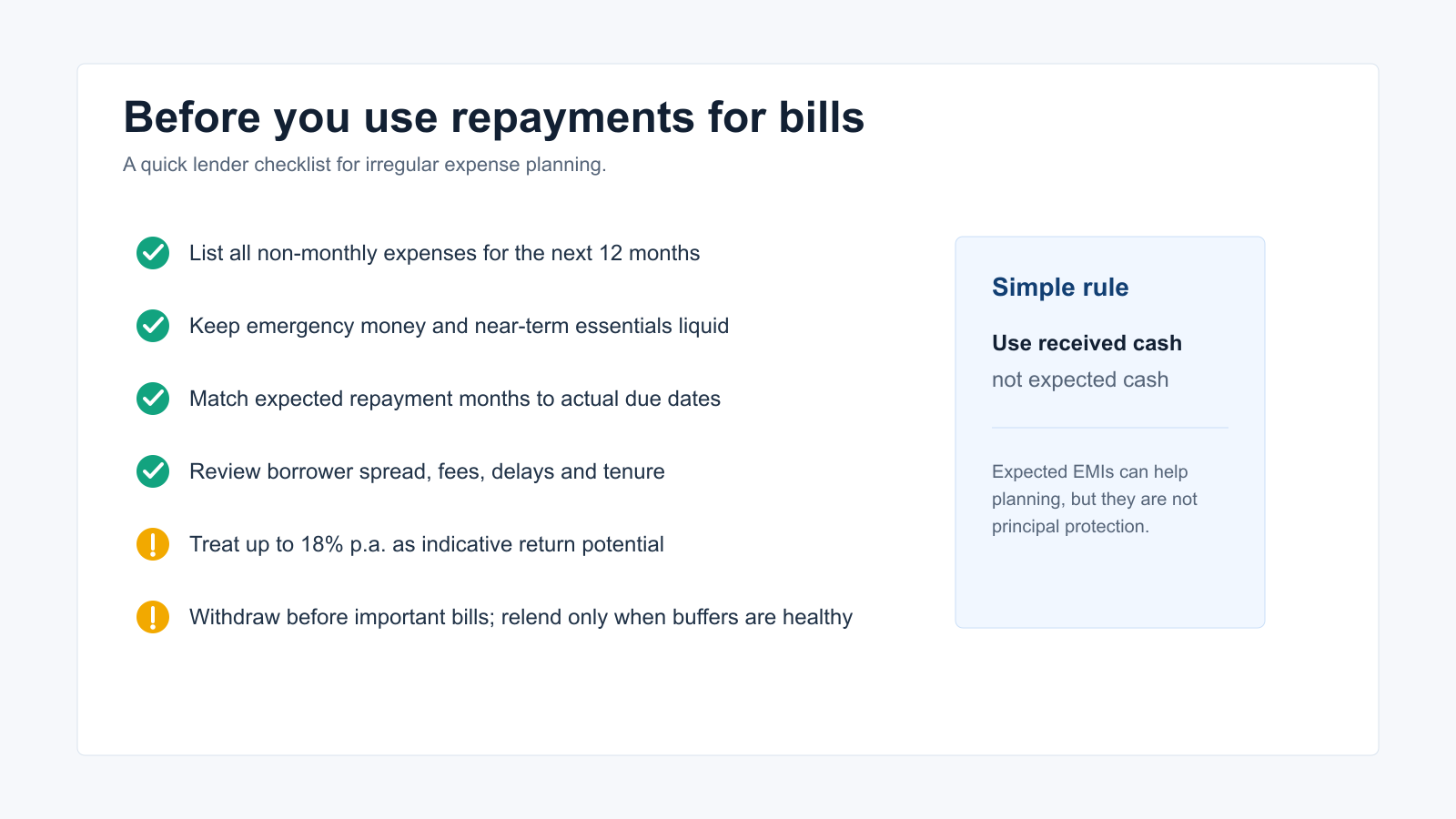
Use this checklist before lending:
List every irregular expense for the next 12 months.
Mark each expense as essential, flexible or optional.
Keep emergency money and near-term essential bills outside P2P lending.
Match expected repayment months to actual due dates.
Review tenure, borrower spread and repayment schedule.
Treat up to 18% p.a. as indicative return potential, not certainty.
Check fees, delays, defaults and withdrawal process.
Decide in advance when to withdraw and when to re-lend.
Review the plan monthly, especially before large bills.
Plan Passive Income for Irregular Expenses with Care
Passive income for irregular expenses works best when the calendar leads and the product follows. Start with due dates. Protect essential bills. Keep liquidity for emergencies. Then use expected P2P repayments as one planning layer for future expenses.
IndiaP2P enables eligible lenders to target indicative return potential of up to 18% p.a., but outcomes depend on borrower repayment behaviour, fees, delays, defaults and platform terms. Used with discipline, P2P lending may help turn irregular expenses into a more planned monthly cash-flow system. Used without buffers, it can create avoidable pressure.
If your expense calendar is ready and your surplus can tolerate repayment timing risk, you can explore Monthly Income Plan Plus and start with a lending amount that fits your risk comfort.