Borrower selection is one of the most important parts of P2P lending because borrower repayments drive the lender's actual outcome.
It is also one of the easiest parts to misunderstand. A credit process can filter, classify and monitor borrowers. It can reduce weak selection. It can improve the quality of information shown to lenders. It cannot make repayment certain.
This article explains how P2P lending borrower selection works on IndiaP2P at a process level: what borrower information is reviewed, how credit assessment is framed, what risk grades are meant to signal, and what lenders should still check before lending.
It is not a promise of repayment. It is a guide to reading the process with the right level of confidence and caution.
IndiaP2P enables eligible lenders to target up to 18% p.a. indicative returns, subject to borrower repayment performance, fees, delays, defaults and platform terms. That return potential should be read after understanding the credit process, not before it.
If you are new to the category, start with IndiaP2P's P2P lending beginner guide. The vocabulary matters: P2P is lending, users are lenders, and outcomes depend on borrower repayments.
Why P2P Lending Borrower Selection Matters Before You Lend
In peer-to-peer lending, the platform connects lenders with borrowers. The lender's receipts depend on borrower EMIs being paid as scheduled. If a borrower pays late, pays partly or defaults, the lender's cash flow and final outcome can change.
That is why borrower selection matters before any return number is considered.
A displayed return can be tempting to read as the whole story. It is not. The more useful question is: what borrower risk sits behind that return, and how did the platform assess it before listing or allocating the loan?
On IndiaP2P, the selection process is intended to create a disciplined borrower pool. It looks at identity, credit history, repayment capacity, existing obligations, policy filters and repayment behaviour over time. The goal is to make lending decisions more informed.
But informed does not mean assured. P2P lending remains exposed to borrower default risk. A borrower may pass assessment and still face job loss, business stress, medical expenses, family shocks, macro pressure or simple repayment indiscipline later. Credit assessment works with available information and observed patterns. It cannot predict every future event.
For a lender, this distinction is practical. Borrower review should be read as one layer of risk management, alongside diversification, exposure limits, tenure, repayment tracking and the ability to keep money lent through the loan period.
Borrower Risk in P2P Lending Is Different From Platform Process Risk
P2P lending has more than one risk layer. Borrower risk and platform process risk should not be mixed up.
Borrower risk is the risk that a borrower pays late, pays partly or does not repay. This is the core credit risk in P2P lending.
Platform process risk is the risk that disclosures, dashboards, servicing, collections or communication are not strong enough for lenders to understand what is happening. The platform can improve process discipline. It cannot take the borrower's repayment obligation onto itself.
IndiaP2P's guide on P2P lending risks and returns explains why lenders should read return potential alongside borrower default risk, delayed EMI risk and liquidity risk.
Lens | Borrower risk | Platform process risk |
|---|---|---|
Main question | Can borrowers repay as scheduled? | Is the lending process transparent and well serviced? |
Where it appears | EMI delays, partial payments, defaults | Weak disclosure, unclear dashboard, poor updates |
What helps | Credit assessment, diversification, exposure limits | Clear reporting, collections process, grievance routes |
What remains true | Borrowers may still default | Process discipline is not a repayment guarantee |
Neither layer should be described as removing risk. The point is to know which part of the process you are relying on.
IndiaP2P Credit Process: From Borrower Application to Eligibility
The IndiaP2P credit process starts before a borrower reaches a lender-facing allocation or listing view.
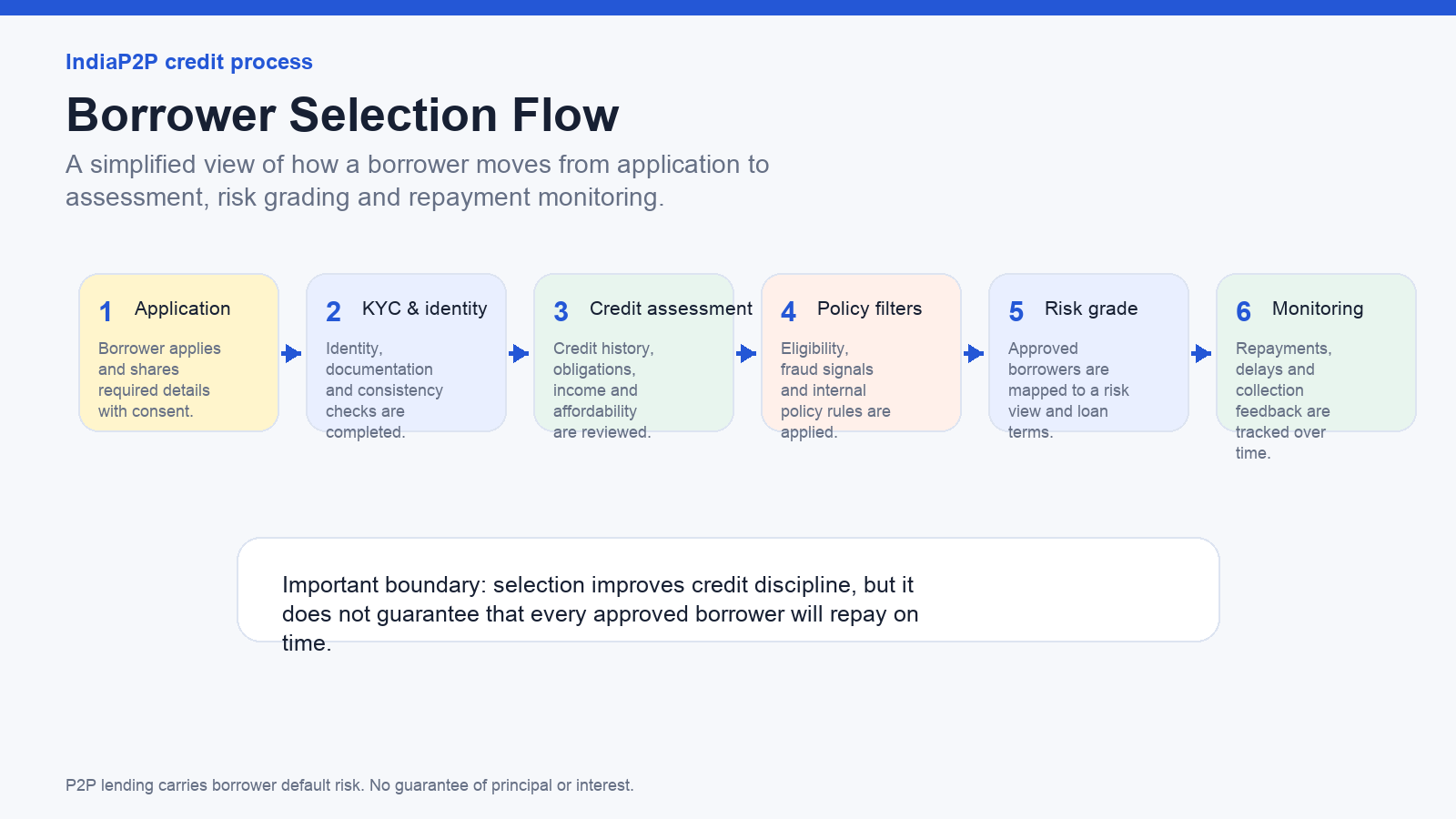
At a high level, a borrower first applies and shares required information. The platform then reviews identity and KYC details, credit history, repayment behaviour, income or cash-flow information where applicable, existing obligations, loan purpose, tenure fit and internal policy filters.
The process is layered because no single input is enough.
A credit bureau score can be useful, but it is not the whole borrower. Income may look adequate, but existing obligations may reduce repayment capacity. A borrower may have documentation but fail a policy or fraud-consistency check. A loan purpose may be acceptable, but tenure and EMI size may not fit the borrower's cash-flow profile.
That is why the process should be read as a sequence of filters:
Stage | What it checks | Why it matters |
|---|---|---|
Application and consent | Basic borrower details and permissioned information | Establishes the starting borrower record |
KYC and identity | Identity, documentation, data consistency | Helps reduce identity and onboarding risk |
Credit history | Bureau data, past repayment behaviour, credit usage | Shows previous credit conduct |
Income and obligations | Earning capacity, existing debt, EMI burden | Tests affordability |
Policy filters | Eligibility rules, fraud signals, internal exclusions | Removes borrowers outside platform criteria |
Risk grading | Assessed risk category and terms | Helps lenders interpret return-risk trade-off |
Monitoring | EMI status, overdue ageing, collection updates | Tracks whether assessment is matching actual repayment behaviour |
This flow is deliberately simple in this article. IndiaP2P should not publish proprietary model weights, exact cutoffs, scorecard formulas or borrower-identifying details in a public blog. For lenders, the important point is not the hidden formula. It is whether the platform can explain the assessment logic clearly enough for a risk-aware lending decision.
Borrower Verification in P2P Lending Starts With Identity and KYC Checks
Borrower verification in P2P lending begins with identity.
Before credit behaviour is assessed, the platform needs confidence that the borrower record is valid, internally consistent and supported by required documentation. This may include KYC checks, document verification, mobile/email validation, bank-account checks where applicable, and fraud or mismatch signals.
This stage does not answer whether the borrower will repay. It answers a more basic question: is this a borrower the platform can assess, document and service within its process?
If identity checks are weak, the rest of the credit assessment becomes less reliable. If they are strong, they create a cleaner base for the next layer: repayment capacity.
P2P Lending Credit Assessment Looks at Repayment Capacity, Not Just Credit Score
P2P lending credit assessment should not be reduced to a credit score.
A score or bureau history can be useful because it shows past borrowing and repayment conduct. But repayment capacity also depends on current income, existing obligations, EMI size, tenure, cash-flow stability and the borrower's ability to absorb stress.
For example, two borrowers may have similar bureau profiles but different affordability. One may have lower existing EMIs and a stable salary cycle. Another may already have several obligations due around the same dates. The credit process should care about that difference.
Similarly, a clean repayment history is helpful, but not absolute. A borrower can have a decent past record and still face future stress. A borrower can also have limited credit history, making the assessment more dependent on other signals.
For lenders, the practical reading is this: a stronger credit assessment process considers several signals together. It does not treat one number as the answer.
Credit Underwriting in P2P Lending: How Risk Grades Are Built
Credit underwriting in P2P lending is the process of deciding whether a borrower fits the platform's policy and, if so, how that borrower should be classified for risk and loan terms.
Underwriting usually combines hard filters and judgement-led or model-led assessment.
Hard filters decide whether the borrower is eligible at all. These may relate to KYC, age, geography, documentation, credit profile, income, obligations, fraud signals, loan purpose or other internal rules.
Assessment then looks at the accepted borrower more closely. The platform may evaluate credit history, repayment patterns, affordability, banking behaviour, employment or business stability, loan tenure and EMI burden. The output may be a risk grade, borrower category, pricing band or eligibility decision.
The important compliance boundary is this: underwriting is not a guarantee. It is a structured decision based on available information at a point in time.
A good credit process should be explainable without becoming simplistic. It should also have feedback loops. If certain borrower segments repay differently from expected, that learning should inform future rules, monitoring and collection processes.
P2P Lending Risk Grade Is a Signal, Not a Repayment Promise
A P2P lending risk grade is a signal. It is not a repayment promise.
The grade helps lenders interpret borrower risk, expected return, tenure and allocation mix. A higher displayed return may reflect a higher assessed borrower risk. A lower-risk grade may suggest stronger observed credit characteristics, but it does not remove default risk.
Lenders should avoid treating a risk grade as a label that makes further review unnecessary. The better approach is to read the grade alongside borrower spread, exposure per borrower, repayment schedule, overdue ageing and platform disclosures.
Risk grades are useful when they make uncertainty visible. They become dangerous only when lenders treat them as certainty.
How P2P Platforms Assess Borrowers Without Removing Default Risk
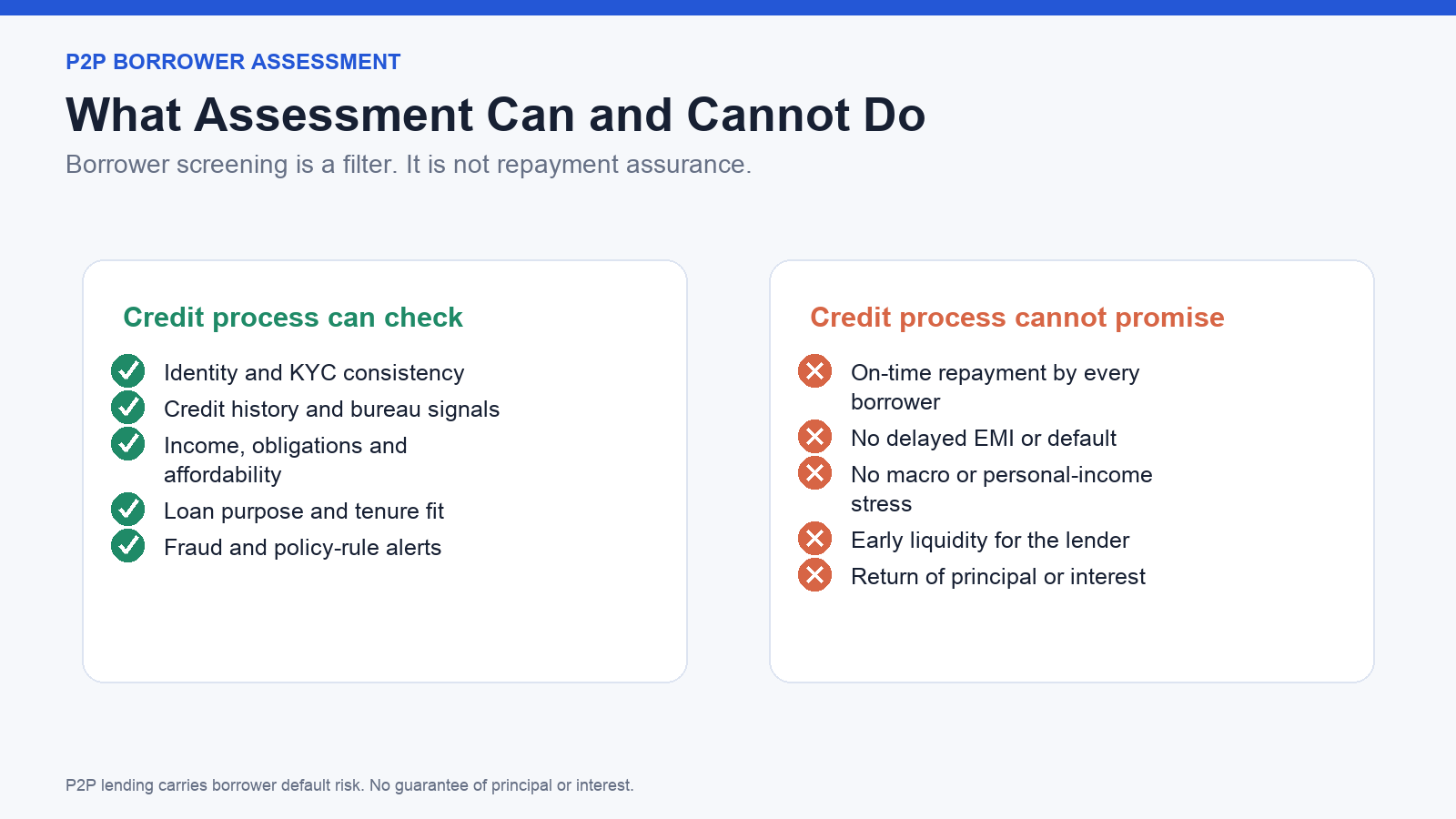
The most important sentence in this article is simple: borrower assessment reduces selection risk, but it does not remove borrower default risk.
That may sound conservative, but it is the correct way to read any P2P lending credit process.
A platform can verify identity. It can analyse credit history. It can review income and obligations. It can reject borrowers who do not fit policy. It can classify approved borrowers by risk. It can monitor repayments and support collections. These are meaningful functions.
What the platform cannot do is control every future event in a borrower's life.
Borrowers can lose income. Small businesses can face delayed receivables. Families can face medical expenses. Broader economic stress can affect repayment capacity. A borrower who looked eligible at approval can still delay or default later.
This is why underwriting language must stay measured. The right phrasing is not "we select borrowers so lenders are protected." The right phrasing is closer to: "we assess borrowers to support more informed lending, while borrower repayment risk remains with the lender."
P2P Lending Default Risk Remains With the Lender
P2P lending default risk means the borrower may not repay as scheduled.
The effect can show up in different ways. A borrower may pay late. A borrower may make a partial payment. A borrower may miss multiple EMIs. Recovery may take time and may not recover the full amount.
This is why lenders should read borrower selection together with diversification. Spreading money across many borrowers can reduce dependence on any single borrower. It cannot eliminate borrower default risk.
The same applies to platform registration and fund-flow rules. Regulation improves the operating perimeter. It does not convert borrower credit risk into a guaranteed outcome.
For a broader risk view, see IndiaP2P's guide to P2P lending risks and returns.
What Borrower Details Should a P2P Lender Check?
Borrower selection is partly the platform's process and partly the lender's review habit.
Even when the platform has completed its assessment, a lender should still ask what information is visible and how the lending amount is spread.
The practical checklist is:
How many borrowers is the amount spread across?
What is the exposure to the largest borrower?
What risk grades or borrower categories are shown?
Is the lending amount concentrated in one risk band?
What is the tenure mix?
Are EMI dates visible?
Are expected and received repayments shown separately?
Are overdue loans and overdue ageing visible?
Are platform fees and net returns explained clearly?
What happens when a borrower delays payment?
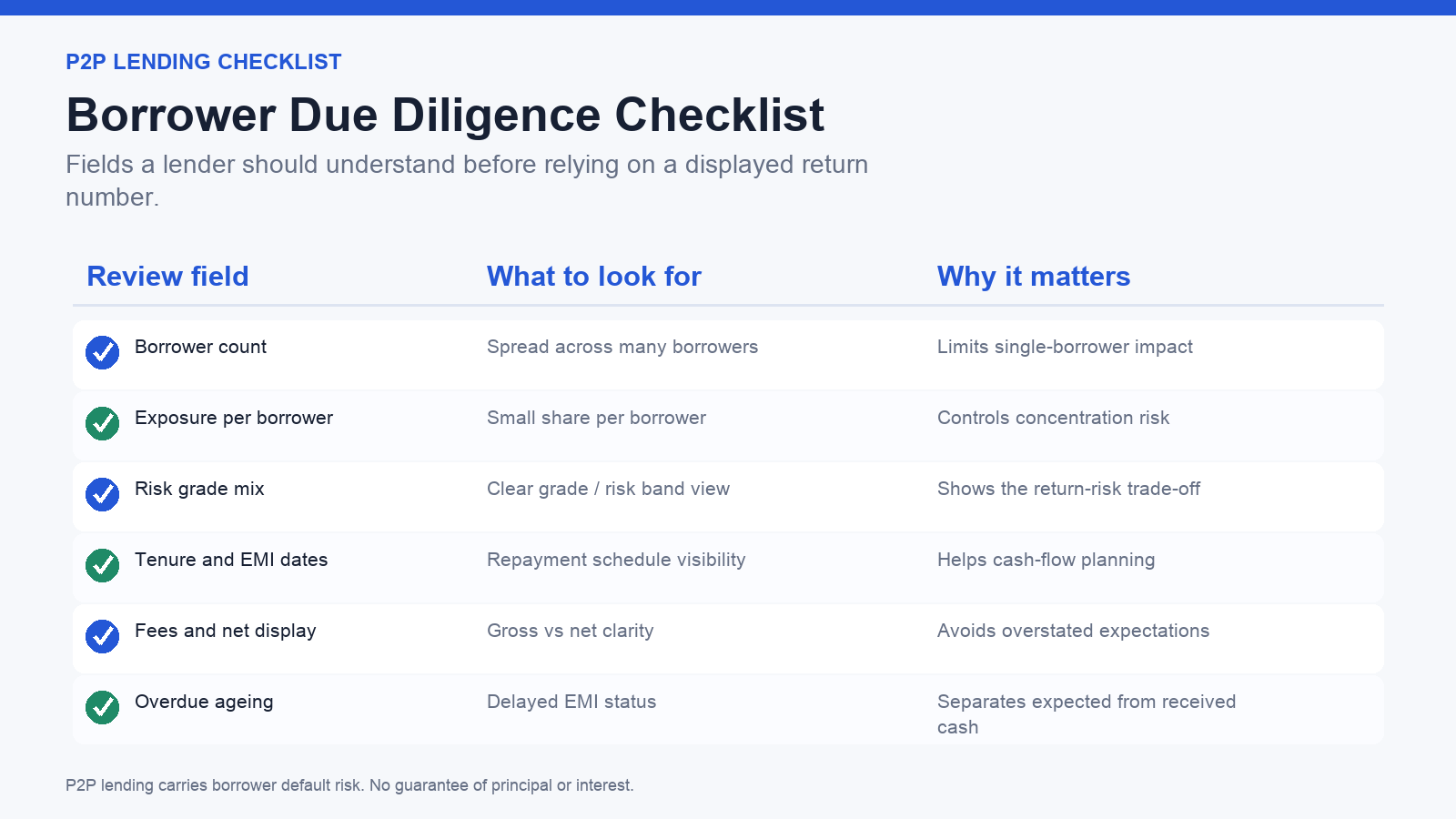
This checklist matters because a portfolio can look attractive if the only visible number is the displayed return. It may look different when you examine borrower count, concentration, tenure and delayed EMI status.
For example, a lender with exposure spread across many borrowers may experience one delay differently from a lender whose amount is concentrated in a few borrowers. The headline rate may not show that difference.
How to Choose Borrowers in P2P Lending Without Chasing Only the Rate
If borrower choice is available, do not choose only by rate.
A higher rate may compensate for higher assessed borrower risk. It may also reflect tenure, borrower profile, demand-supply conditions or platform pricing. Without context, the rate is an incomplete signal.
A more careful approach is to review borrower risk grade, loan purpose, tenure, EMI size, repayment history where shown, and exposure size. Then ask whether that borrower fits the role you want P2P lending to play in your overall money plan.
If the platform uses automated allocation or diversification, the review shifts from one borrower to the resulting borrower pool. In that case, check borrower count, largest exposure, risk-grade mix, tenure spread and overdue reporting.
The aim is not to find a borrower with no risk. That borrower does not exist. The aim is to avoid relying on one number, one borrower, one grade or one assumption.
NBFC-P2P Borrower Assessment Under the RBI Framework
IndiaP2P is registered with the Reserve Bank of India as an NBFC-P2P.
The RBI NBFC-P2P framework treats the platform as an intermediary between lenders and borrowers. That means the platform facilitates onboarding, credit assessment, matching, documentation, fund routing, servicing and disclosures. It is not a borrower. It is not a deposit-taker. It does not guarantee returns.
The framework is important because it creates a defined perimeter for how P2P platforms operate. It also requires lenders to understand that the platform does not assure return of principal or payment of interest.
RBI also caps lender exposure. A lender's total exposure across all P2P platforms is capped at ₹50 lakh, and exposure of a single lender to the same borrower across all P2P platforms is capped at ₹50,000.
These limits are not just regulatory trivia. They reflect the central risk idea in P2P lending: do not allow one lender to become too exposed to the platform category or to one borrower.
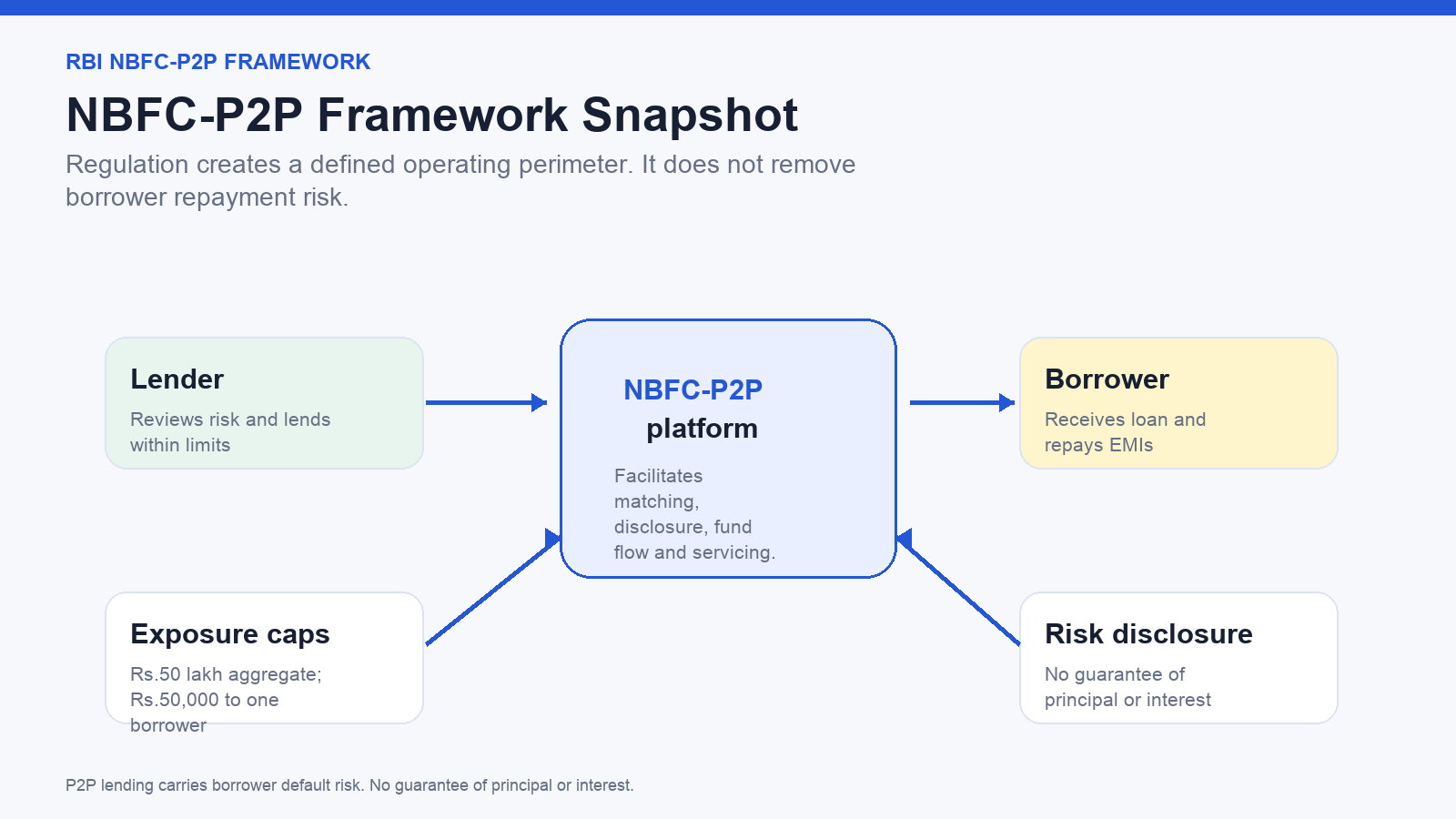
The RBI Master Directions for NBFC-P2P platforms are the primary source for this framework. A lender should treat RBI registration as a regulatory operating boundary, not as an RBI endorsement of a particular borrower, platform return or repayment outcome.
Borrower Screening After Approval: Monitoring, Collections, and Feedback
Borrower screening does not end when a loan is approved.
After disbursal, the platform tracks repayment schedules, actual receipts, missed EMIs, overdue ageing and recovery updates. This post-approval monitoring is essential because it turns the original credit assessment into observed repayment behaviour.
For lenders, this matters in two ways.
First, repayment monitoring helps distinguish expected cash flow from received cash flow. A schedule may show what should happen. The dashboard should help show what actually happened.
Second, post-approval data should improve future lending discipline. If a borrower segment, tenure type, loan purpose or risk band performs differently from expected, that learning can inform underwriting, portfolio construction and collections priorities.
Collections also need careful language. Collection follow-up can support recovery. It cannot promise full recovery. A delayed borrower may cure the overdue amount, partially repay, remain overdue, or move into deeper recovery. Lenders should not assume recovery support equals guaranteed repayment.
The practical question for a lender is: can I see the status of my lending clearly enough to make the next decision? That next decision may be to lend more, pause, withdraw received repayments, change tenure preference, review IndiaP2P's Monthly Income Plan Plus with risk disclosures, or reduce exposure.
## IndiaP2P Borrower Selection Checklist for Risk-Aware Lenders
Before lending through any P2P platform, use borrower selection as a checklist rather than a comfort label.
Ask:
Question | Why it matters |
|---|---|
Is the platform registered with RBI as an NBFC-P2P? | Confirms the regulatory framework |
Is borrower assessment explained clearly? | Shows how eligibility and risk classification are approached |
Are KYC and identity checks part of the process? | Reduces basic onboarding and identity risk |
Does assessment look beyond credit score? | Helps test repayment capacity and obligations |
Are risk grades or borrower categories understandable? | Makes the return-risk trade-off more visible |
Is exposure spread across borrowers? | Reduces dependence on any single borrower |
Are tenure and EMI schedules visible? | Helps match lending with cash-flow expectations |
Are overdue loans reported clearly? | Separates expected repayment from received repayment |
Is the no-guarantee disclosure visible? | Keeps the risk boundary clear |
Can the money remain lent through the tenure? | Reduces liquidity mismatch |
If these questions are hard to answer, the return number should not be the deciding factor.
Borrower selection is not a guarantee. It is a process for making credit risk more reviewable. The lender still needs diversification, patience, monitoring and the ability to tolerate delayed or lower-than-expected repayments.
That is the balanced way to read IndiaP2P's credit process: useful, structured, and still subject to borrower repayment behaviour.
For a closer dashboard-level reading habit, use IndiaP2P's guide on how to read a P2P loan portfolio before lending.