When two financial products show different headline returns, the higher number is not automatically the better number. The first question is simpler: are you comparing pre-tax vs post-tax returns, or only comparing quoted rates?
IndiaP2P enables eligible lenders to target indicative returns of up to 18% p.a. through P2P lending, subject to borrower repayment performance, platform terms, fees, timing, tax treatment, and risk. That last part matters. A return figure becomes useful only when you know what may remain after tax and what risks can affect the amount actually received.
This guide explains how pre-tax and post-tax returns differ, how to calculate a basic after-tax return, and how to compare P2P lending returns with tax, fees, liquidity, and borrower repayment risk in view.
For product context, you can review IndiaP2P's Monthly Income Plan Plus, but use the framework below before comparing any quoted return.
What Is a Pre-Tax Return?
A pre-tax return is the return before tax is applied.
It is often the number shown first because it is clean, comparable, and not dependent on one person's tax position. A bank FD rate, a bond coupon, an indicative annual return range, or a target return shown on a platform may all be pre-tax unless the page clearly says otherwise.
Pre-tax numbers are useful, but incomplete. They tell you what the product may generate before the tax system enters the calculation. They do not tell you what arrives in your bank account after tax, whether fees have been deducted, or whether the return is assured, market-linked, or dependent on borrower repayments.
This is why the same quoted return can mean different things for two people. A 10% pre-tax return does not create the same post-tax outcome for someone in a 5% tax bracket and someone in a 30% tax bracket.
What Is a Post-Tax Return or After-Tax Return?
A post-tax return, also called an after-tax return, is the return left after applicable tax is accounted for.
If a product earns ₹10,000 before tax and ₹3,000 is payable as tax, the post-tax amount is ₹7,000. On an original amount of ₹1,00,000, that is a 7% post-tax return.
Post-tax return is not always a single universal number because tax treatment depends on the product, the holding period, the type of income, the tax regime, surcharge or cess where applicable, and the person's overall income. Interest income, capital gains, tax-exempt income, and borrower repayment receipts may not be taxed in the same way.
That is why a product page may show a pre-tax figure while the post-tax calculation remains the lender's or taxpayer's responsibility. The practical question is not only "what is quoted?" It is "what do I keep after the rules that apply to me?"
Tax treatment depends on individual circumstances and may change. Please consult a qualified tax advisor.
How to Calculate Post-Tax Returns
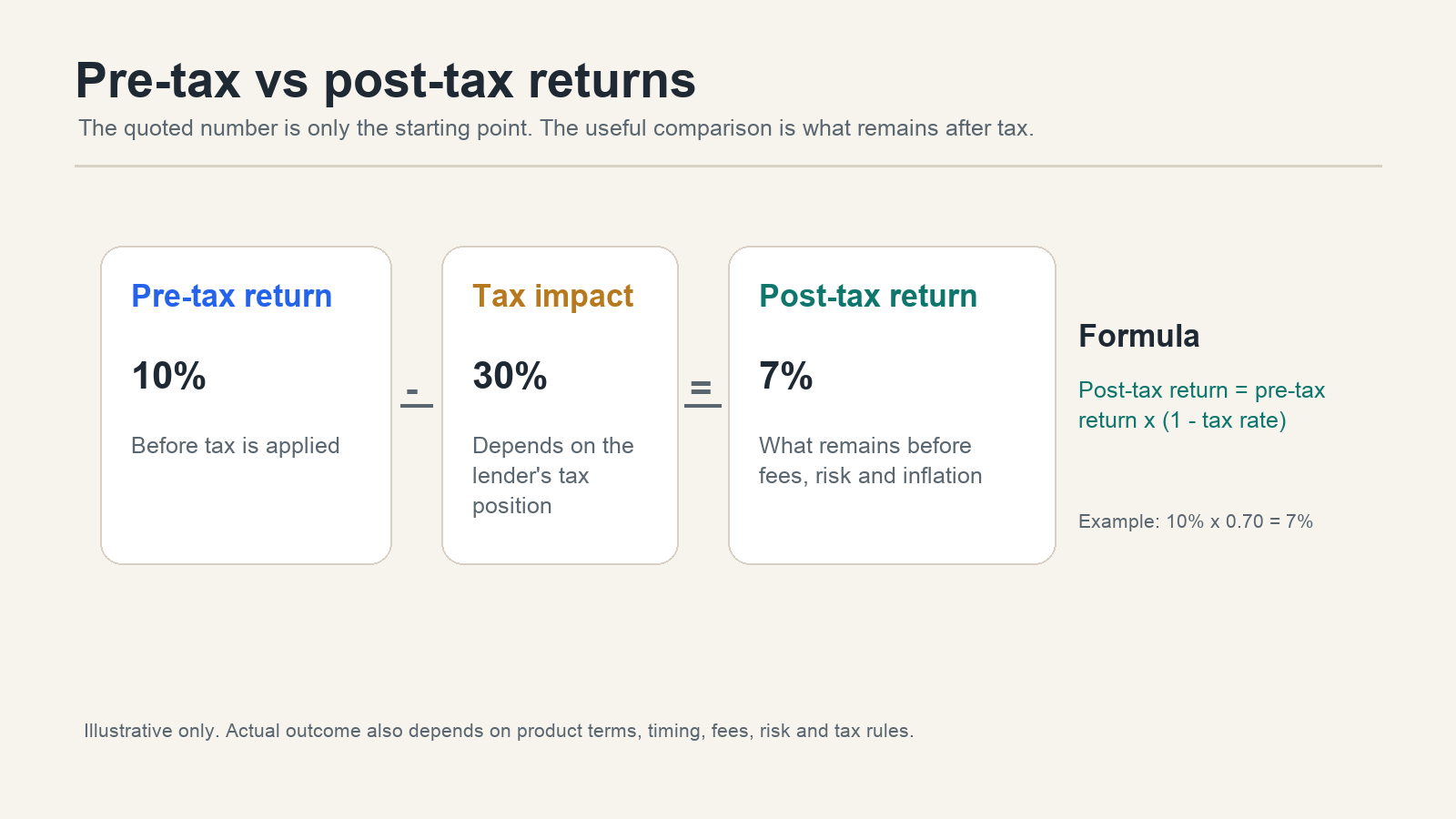
For a simple taxable interest-style return, the basic formula is:
Post-tax return = Pre-tax return x (1 - applicable tax rate)
Suppose a product shows a 10% pre-tax return and the applicable tax rate is 30%.
Step | Calculation | Result |
|---|---|---|
Pre-tax return | 10.0% | 10.0% |
Tax impact | 10.0%x x 30% | 3.0% |
Post-tax return | 10.0% - 3.0% | 7.0% |
The same method can be shown in rupees. On ₹1,00,000, a 10% pre-tax return is ₹10,000. If ₹3,000 is payable as tax, the post-tax amount is ₹7,000.
This formula is a useful starting point, not the full answer for every product. Some products are taxed on interest each year. Some are taxed when sold or redeemed. Some may have tax-exempt treatment under specific provisions. Some may involve TDS and later adjustment while filing the return. Some may also have fees, delayed receipts, or credit losses that are separate from tax.
Example: Same Pre-Tax Return, Different Tax Slabs
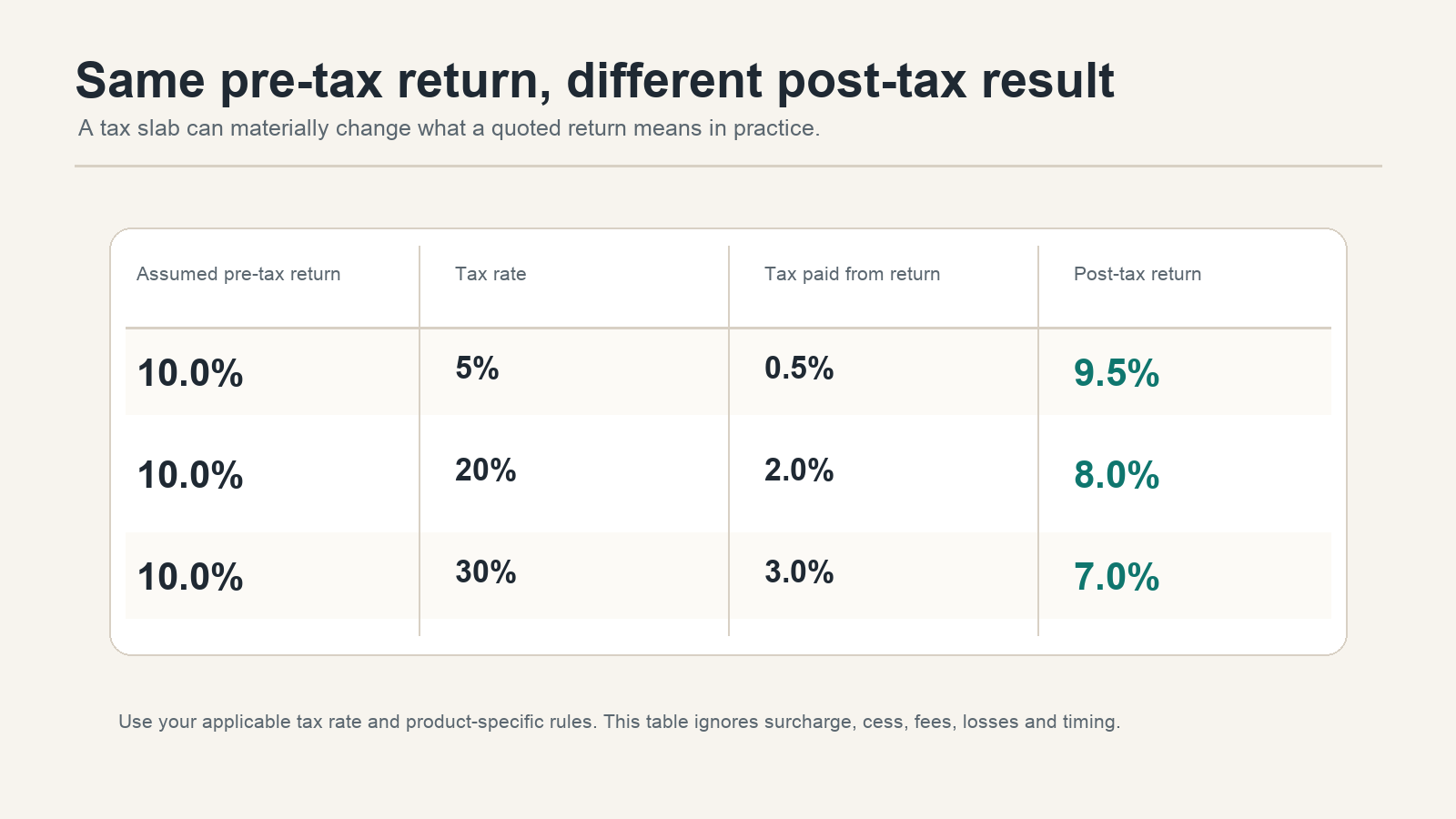
This is why post-tax returns India comparisons should not stop at the product's stated rate. The product may be the same, but the taxpayer is not.
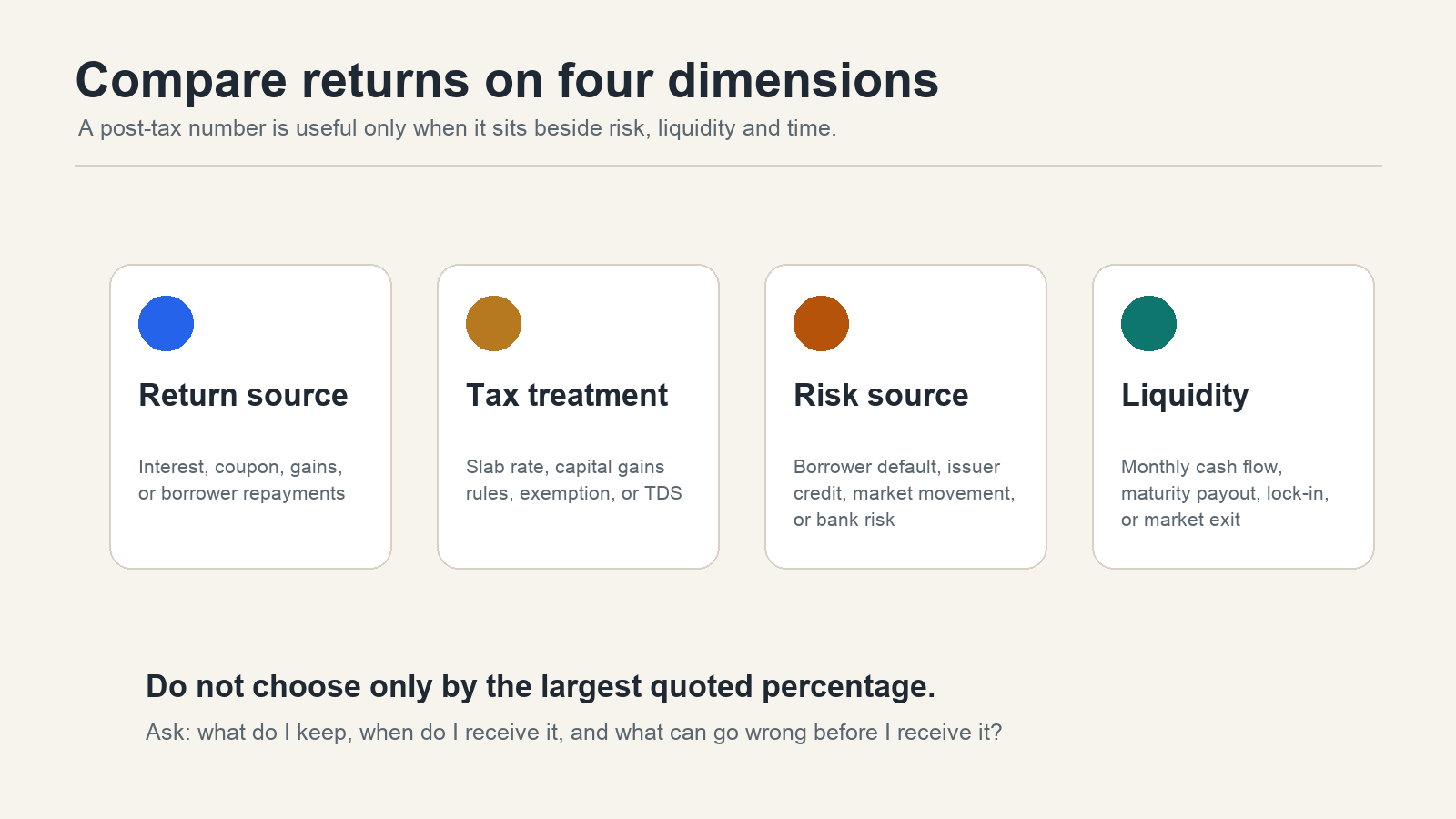
Pre-Tax vs Post-Tax Returns: A Comparison Table
Before comparing two return options, separate four things: the source of return, the tax treatment to check, the risk source, and the cash-flow pattern.
Return option | Return source | Tax treatment to check | Risk note | Cash-flow question |
|---|---|---|---|---|
Bank FD | Interest paid by bank | Interest is usually taxable according to slab; check TDS and senior citizen rules | Bank credit risk; DICGC insurance applies only within eligible limits | Interest monthly, quarterly, cumulative, or at maturity? |
Listed corporate bond | Coupon and possible price movement | Interest and capital gains treatment may differ | Issuer credit risk, downgrade risk, liquidity risk | Coupon schedule and exit liquidity? |
Mutual fund | NAV movement and distributions where applicable | Tax depends on category, holding period, and current rules | Market risk, credit risk depending on fund type | Redemption timing and tax event? |
PPF or eligible tax-exempt option | Scheme-defined return | Check exemption rules and lock-in | Product-specific rules and government scheme terms | Is the lock-in acceptable? |
P2P lending | Borrower repayments of principal and interest | Interest-like receipts are commonly reviewed for tax reporting; confirm treatment with a tax advisor | Borrower delay/default risk; no principal protection | Are repayments received monthly, delayed, or re-lent? |
This table is not a ranking. It is a reminder that two options with the same pre-tax return may behave very differently after tax, risk, and liquidity are considered.
How Tax Changes the Way You Compare P2P Lending Returns
P2P lending needs one extra layer of care because tax is not the only adjustment between the quoted return and the lender's actual experience.
With IndiaP2P, eligible lenders can target indicative returns of up to 18% p.a. through P2P lending. That figure should be read as indicative return potential, not a guarantee. Actual outcomes depend on whether borrowers repay as scheduled, whether some repayments are delayed or defaulted, how fees apply, whether received cash is withdrawn or lent again, and how tax applies to the lender.
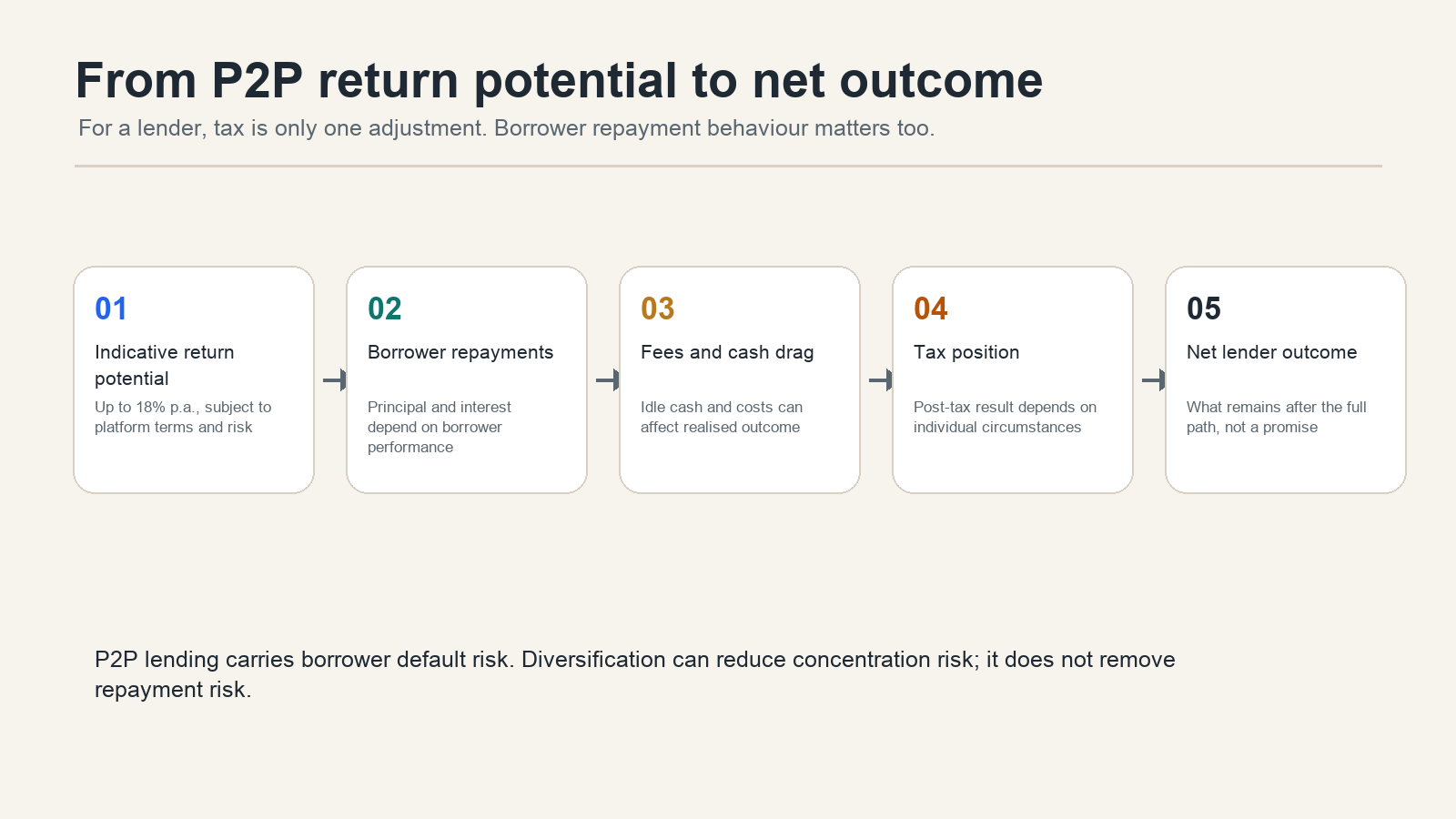
For P2P lending, the return path usually has five moving parts:
Layer | What to check |
|---|---|
Indicative return | Is the number pre-tax? Is it net of platform fee? What assumptions sit behind it? |
Borrower repayment | Are repayments scheduled, received, delayed, or defaulted? |
Fees and cash drag | Are platform fees deducted? Does idle cash reduce the effective outcome? |
Tax | How should interest-like receipts be reported for your situation? |
Realised outcome | What actually remains after repayments, fees, delays, defaults, timing, and tax? |
The important distinction is this: post-tax return is a tax calculation, while realised P2P lending outcome is a repayment experience. A lender can calculate tax correctly and still receive less than expected if borrower repayments are delayed or defaulted.
For a broader risk framework before lending, see IndiaP2P's guide to P2P lending for first-time lenders.
Where Up to 18% p.a. Fits in the Comparison
The "up to 18% p.a." figure should sit near the start of the comparison, but never alone.
A careful comparison would say: IndiaP2P enables eligible lenders to target indicative returns of up to 18% p.a., subject to borrower repayment performance, fees, platform terms, timing, tax, and risk.
That wording matters because it keeps the number in the right category. It is not a fixed deposit rate. It is not principal-protected. It is not assured by IndiaP2P or by RBI. It is a target return potential within a lending structure where borrowers may pay on time, pay late, or default.
Why Defaults and Delays Are Not a Tax Detail
Tax reduces what you keep from income that is received or taxable. Borrower delay/default risk affects whether the expected repayment arrives in the first place.
Do not merge these two ideas. If a borrower EMI is delayed, that is a repayment and liquidity issue. If a borrower defaults, principal or interest may be lost. Tax planning cannot remove borrower repayment risk.
Diversification can reduce concentration risk by spreading exposure across more borrowers. It does not eliminate borrower default risk. To understand borrower spread before lending, use IndiaP2P's guide on how to review borrower exposure before lending.
Do Not Compare Returns Without Risk, Liquidity, and Time
Post-tax return is useful, but it should not become the only comparison point.
Before choosing between two quoted return options, ask:
Is the return pre-tax or post-tax?
Is the return assured, indicative, market-linked, or dependent on borrower repayment?
What tax rule applies to this type of income?
Are fees already deducted?
Can principal or interest be delayed or lost?
When does cash actually come back?
Is there a lock-in, tenure, exit cost, or secondary-market uncertainty?
Does the cash-flow pattern match your purpose?
For P2P lending, time matters because borrower loans have tenures and repayment schedules. A return number does not tell you whether the cash returns monthly, at maturity, or with delays. See IndiaP2P's guide on how to choose tenure in P2P lending for a deeper view of liquidity and repayment timing.
A Practical Checklist Before You Compare Any Return
Use this checklist before relying on any headline number:
Question | Why it matters |
|---|---|
Is this pre-tax or post-tax? | Prevents comparing a gross number with a net number. | |
What is taxed? | Interest, gains, and repayments may need different treatment. |
Which rate applies to me? | Your tax slab may change the answer. |
Are fees included? | A post-tax calculation can still overstate the result if fees are ignored. |
Is principal protected? | For P2P lending, principal is exposed to borrower default risk. |
When does cash arrive? | Monthly receipts, maturity payouts, and delayed repayments are different experiences. |
Can I exit early? | Liquidity can matter more than a slightly higher quoted return. |
For experienced lenders, this checklist should become part of the monthly review process. IndiaP2P's guide to P2P lending risk management explains the dashboard and borrower-risk checks that sit beside return review.
Short Worked Example for a P2P Lender
Consider an illustrative lender reviewing ₹1,00,000 for P2P lending. This is only an example. It is not based on a live borrower listing, platform performance claim, or recommendation.
Assume the lender is reviewing an indicative annual return target of 15% before personal tax. Also assume ₹15,000 is scheduled as annual interest-like receipt before tax and before considering any borrower delay/default effect.
Item | Illustration |
|---|---|
Amount reviewed for lending | ₹1,00,000 |
Indicative pre-tax return used for illustration | 15.0% |
Scheduled interest-like receipt before tax | ₹15,000 |
Illustrative tax rate | 30% |
Tax impact on receipt | ₹4,500 |
Approximate post-tax receipt before defaults/cash drag | ₹10,500 |
Approximate post-tax return before defaults/cash drag | 10.5% |
Now add the P2P-specific discipline. If some borrower repayments are delayed, the lender cannot treat scheduled receipts as received cash. If borrower defaults occur, principal or interest may be lower than expected. If repayments sit idle for long periods before fresh lending, cash drag may reduce the realised outcome.
That is why a P2P lending comparison should not stop at "15% pre-tax becomes 10.5% post-tax." The better sentence is: "The approximate post-tax return before defaults and cash drag is 10.5%, but the realised outcome depends on borrower repayment performance, fees, timing, and risk."
If the purpose is monthly cash flow, also review IndiaP2P's guide to monthly income from P2P lending.
Conclusion: Compare What You Keep, Not Only What Is Quoted
Pre-tax return is the starting point. Post-tax return is closer to what you keep. But even post-tax return is not the whole decision.
For any return option, compare tax, risk, liquidity, fees, and timing together. For P2P lending, add borrower repayment behaviour, diversification, defaults, and cash drag to the review.
IndiaP2P enables eligible lenders to target indicative returns of up to 18% p.a., but the right lending decision should still be made with tax and risk in view. A clear comparison is not the one with the biggest quoted percentage. It is the one where you understand what may remain, when it may arrive, and what can affect it before it does.