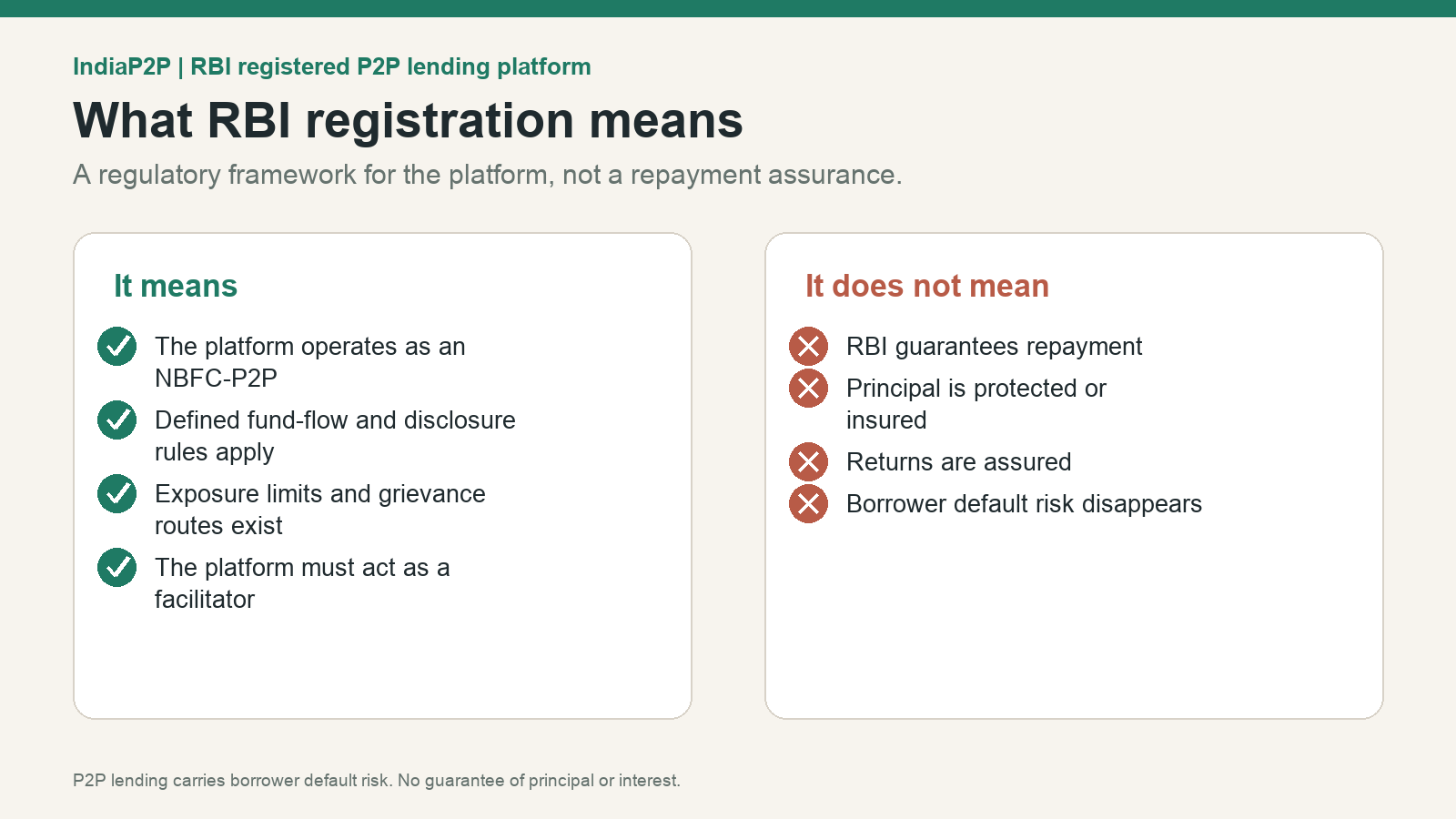
IndiaP2P, legally Trickle Flood Technologies Pvt Ltd, is registered with the Reserve Bank of India as an NBFC-P2P. For lenders, that registration matters. It means the platform operates within RBI's peer-to-peer lending framework, with rules on fund flows, disclosures, exposure limits, grievance handling and platform conduct.
It does not mean RBI guarantees repayment.
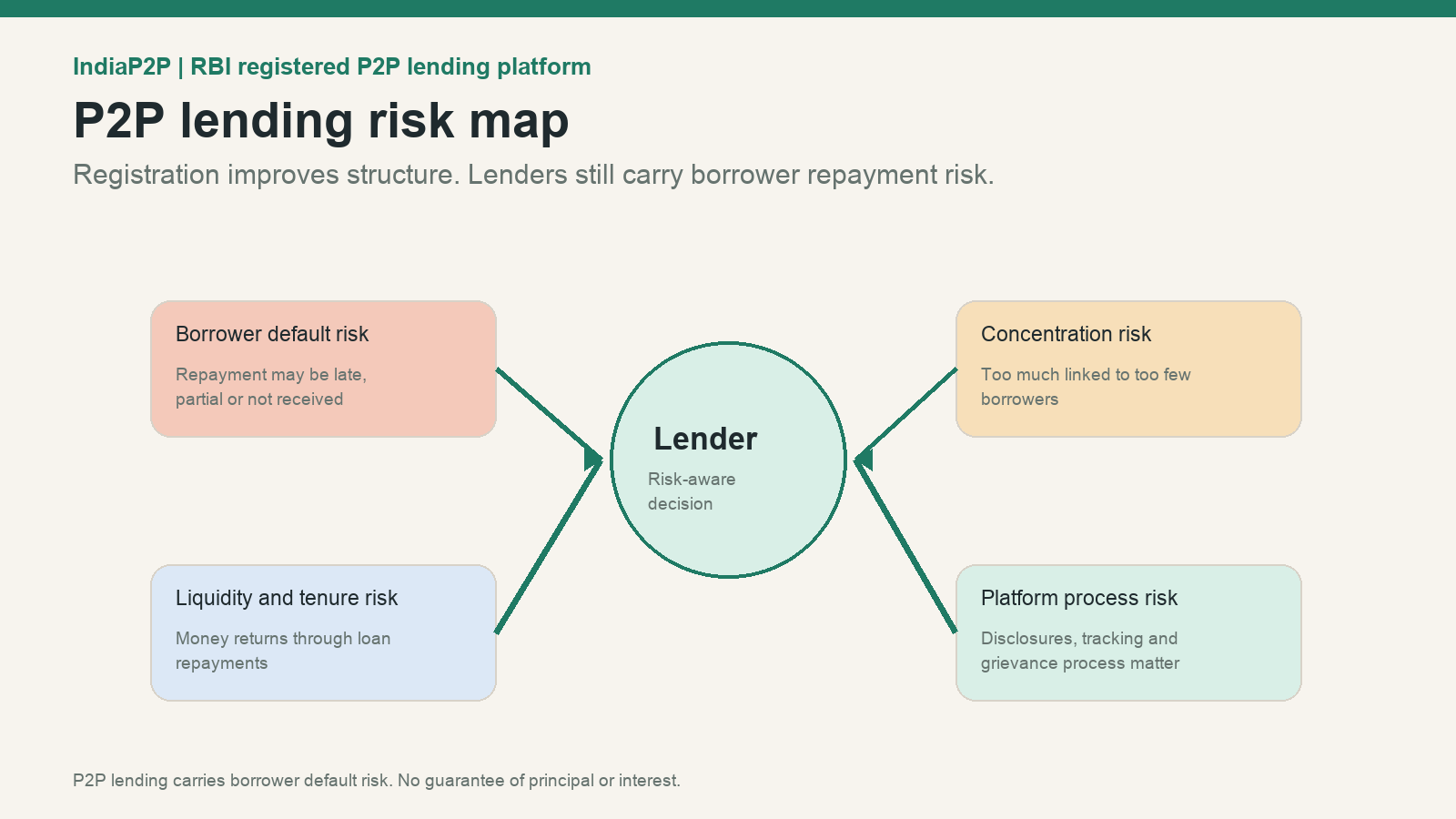
That distinction is the whole point of this article. On IndiaP2P, lenders may target up to 18% p.a. indicative returns through borrower repayments, but the outcome depends on how borrowers repay. Some borrowers may pay on schedule. Some may delay. Some may default. RBI registration creates a regulated structure around the platform; it does not remove borrower default risk or protect principal.
What is an RBI registered P2P lending platform?
An RBI registered P2P lending platform is a platform that has permission to operate as a Non-Banking Financial Company - Peer to Peer Lending Platform, or NBFC-P2P.
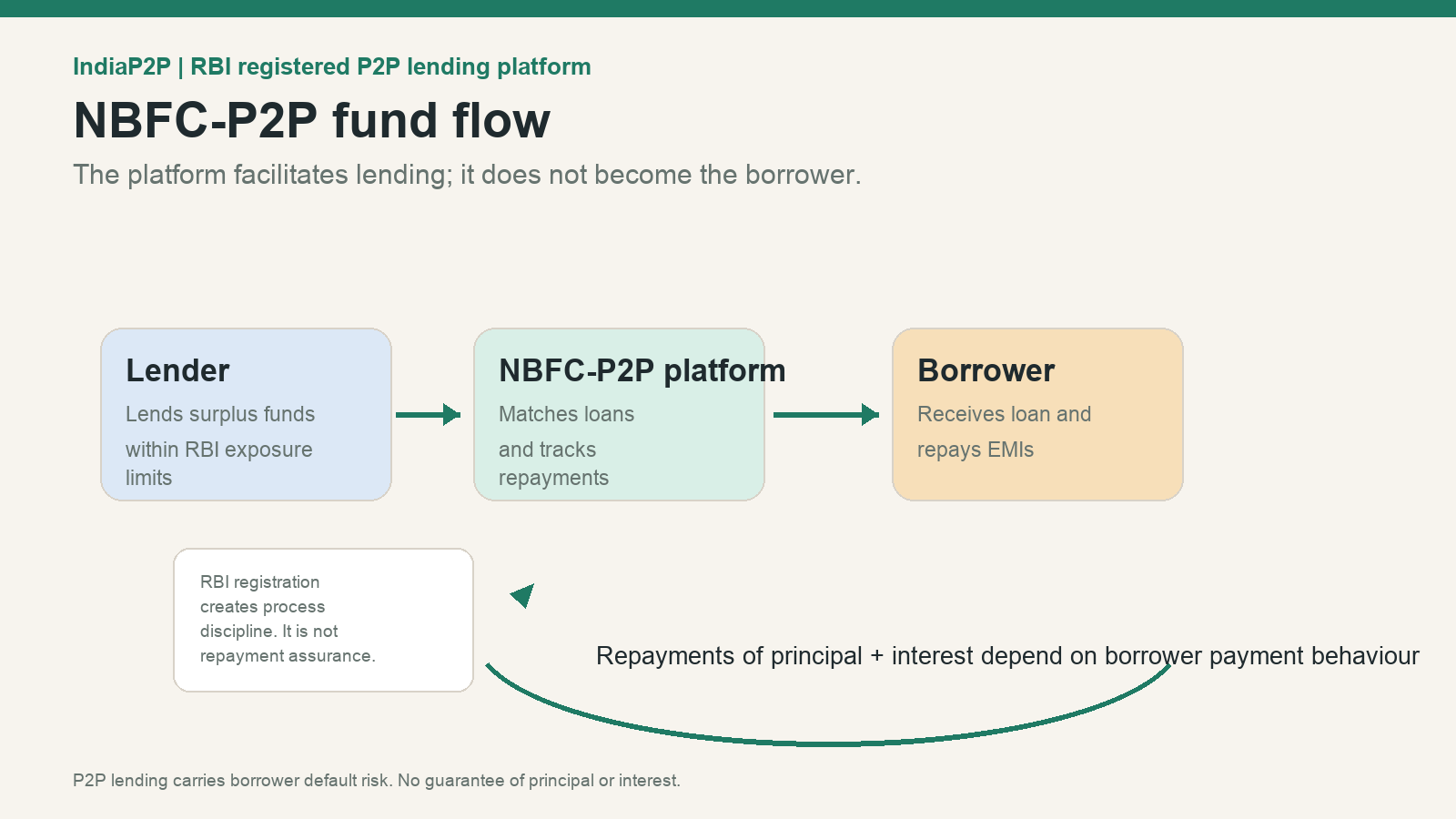
In plain language, an NBFC-P2P facilitates lending between lenders and borrowers through an online platform. The platform does not take deposits like a bank. It does not lend its own money like a traditional lender. It creates the regulated operating layer through which eligible borrowers can be listed, lenders can participate, documentation can happen, and repayments can be tracked.
The RBI's Master Direction for NBFC-P2P platforms was issued in 2017 and has been updated over time, including updates incorporated after the 2024 tightening of P2P rules. The framework sets the perimeter within which P2P platforms must operate.
For a lender, this is useful because it separates a regulated P2P lending platform from an informal arrangement, a private loan group, or a loosely run online matching service. But it should not be read as a promise about returns.
What RBI registration means for lenders
RBI registration is first a platform-level regulatory status. It tells you that the entity has a Certificate of Registration to carry on the business of a peer-to-peer lending platform, subject to RBI's conditions.
For lenders, that has several practical implications.
The platform is a facilitator, not a bank
An NBFC-P2P platform facilitates loans between lenders and borrowers. This matters because your exposure is to borrower repayment behaviour, not to a bank deposit obligation.
When you lend through a P2P platform, you are not placing money in a deposit. You are funding borrower loans through a regulated platform process. The platform may support borrower assessment, documentation, servicing, reporting and collections, but it does not become the borrower.
Lenders should receive clearer disclosures before lending
The RBI framework expects platforms to provide information that helps participants understand the transaction. That includes borrower and loan information, platform fees, risk disclosures, grievance details and performance-related disclosures where applicable.
Good disclosure does not make a loan risk-free. It makes the risk more visible before you decide whether to lend.
Fund flows must follow regulated processes
RBI's framework also deals with how money moves between lenders and borrowers. P2P platforms are expected to follow defined fund-flow and escrow account structures rather than casually holding or routing money.
The purpose is process discipline: lender funds should move through permitted structures, borrower repayments should be traceable, and the platform should not behave like an uncontrolled pool of money.
There is a formal grievance and conduct framework
Registration also brings expectations around fair practices, complaints, participant information, recovery conduct and operational governance. A lender should be able to identify the grievance redressal route and read the platform's terms before lending.
This is not a substitute for credit risk assessment. It is a regulated conduct layer around the platform.
What RBI registration does not mean
The most important part of understanding an RBI registered P2P lending platform is knowing where the registration stops.
RBI does not guarantee P2P returns or repayment
RBI registration does not mean RBI has approved the returns shown by a platform. It does not mean RBI has checked and guaranteed every borrower. It does not mean repayment is assured.
The RBI Master Direction requires NBFC-P2P platforms to display a caveat that RBI does not accept responsibility for statements made by the platform and does not provide assurance for repayment of loans lent on the platform.
This is why return language must be read carefully. A number such as up to 18% p.a. on IndiaP2P is an indicative return potential, not a guaranteed outcome.
Borrower default risk remains with the lender
If a borrower delays or defaults, the lender bears the effect. That can reduce interest received, delay monthly receipts, or affect principal recovery.
The platform may have collection processes. It may show repayment status. It may follow up with borrowers. But the platform cannot remove the possibility of borrower default.
Registration is not principal protection
Bank deposits have a different legal and risk structure. P2P lending does not carry principal protection. It is also not insured by DICGC or any comparable deposit insurance framework.
A lender should therefore use surplus money only. Money needed for emergency savings, rent, tax payments, school fees, business payroll or near-term medical expenses should not be lent through P2P.
Diversification reduces concentration risk, not default risk itself
Diversification can help reduce dependence on one borrower or a small number of borrowers. If your lending amount is spread across many borrowers, one delayed repayment may have a smaller effect than it would in a concentrated loan.
But diversification does not make every borrower repay. It is a risk management practice, not a guarantee.
RBI P2P lending rules every lender should know
A lender does not need to read every line of the Master Direction before starting. But some rules are worth knowing because they shape how P2P lending works in India.
P2P lending is regulated through the NBFC-P2P category
Platforms that carry on the business of peer-to-peer lending must operate within the NBFC-P2P framework. This is why the platform's legal entity and registration status matter.
On IndiaP2P, the relevant entity is Trickle Flood Technologies Pvt Ltd, registered with RBI as an NBFC-P2P.
There are lender exposure limits
RBI caps a lender's aggregate exposure across all P2P platforms at ₹50 lakh. Exposure to a single borrower across P2P platforms is capped at ₹50,000.
If a lender's total exposure across P2P platforms exceeds ₹10 lakh, the framework requires a certificate from a practising Chartered Accountant certifying minimum net worth of ₹50 lakh.
These limits are not return targets. They are guardrails on exposure.
Loan maturity is capped
The RBI framework caps loan maturity in P2P lending. This matters because P2P lending is tenure-linked: your funds generally come back through borrower repayments over the loan period, not through on-demand withdrawal.
Before choosing a tenure, read how to choose P2P lending tenure. A shorter tenure may suit faster cash rotation. A longer tenure may suit surplus money that can stay lent for more time. Neither removes risk.
Platforms cannot present P2P as an assured-return product
RBI has made the direction of travel clear: P2P lending should not be promoted as a product with assured minimum returns, platform-backed liquidity, or repayment assurance.
This is important for lenders because it keeps the category honest. If a P2P platform sounds like a fixed-return deposit with instant liquidity, read the fine print carefully.
Platforms cannot assume credit risk
An NBFC-P2P platform is not supposed to absorb the credit risk of loans on its platform. If borrower repayment fails, the loss of principal, interest, or both is borne by the lender.
This is uncomfortable but necessary to say plainly. It is also why any serious P2P article should explain risk before it explains return.
How to use RBI registration in lender due diligence
RBI registration should be your starting filter, not your final decision.
Use it to exclude unregulated arrangements. Then ask more practical questions.
Due diligence question | Why it matters | What to look for |
|---|---|---|
Is the platform registered as an NBFC-P2P? | Confirms the regulatory perimeter | Legal entity name, RBI registration details, platform disclosures |
What return language is used? | Shows whether risk is being presented honestly | "Indicative", "subject to borrower repayment", no guarantee language |
How are funds spread? | Helps reduce concentration risk | Borrower count, exposure per borrower, risk bands, tenure spread |
What fees apply? | Affects net outcome | Platform fee, timing of fee deduction, net return display |
How are repayments shown? | Helps track actual performance | Principal received, interest received, overdue amount, delayed EMIs |
What happens if a borrower delays? | Shows servicing discipline | Collection process, overdue ageing, recovery updates |
What is the grievance route? | Shows operational seriousness | Grievance officer, escalation route, complaint timelines |
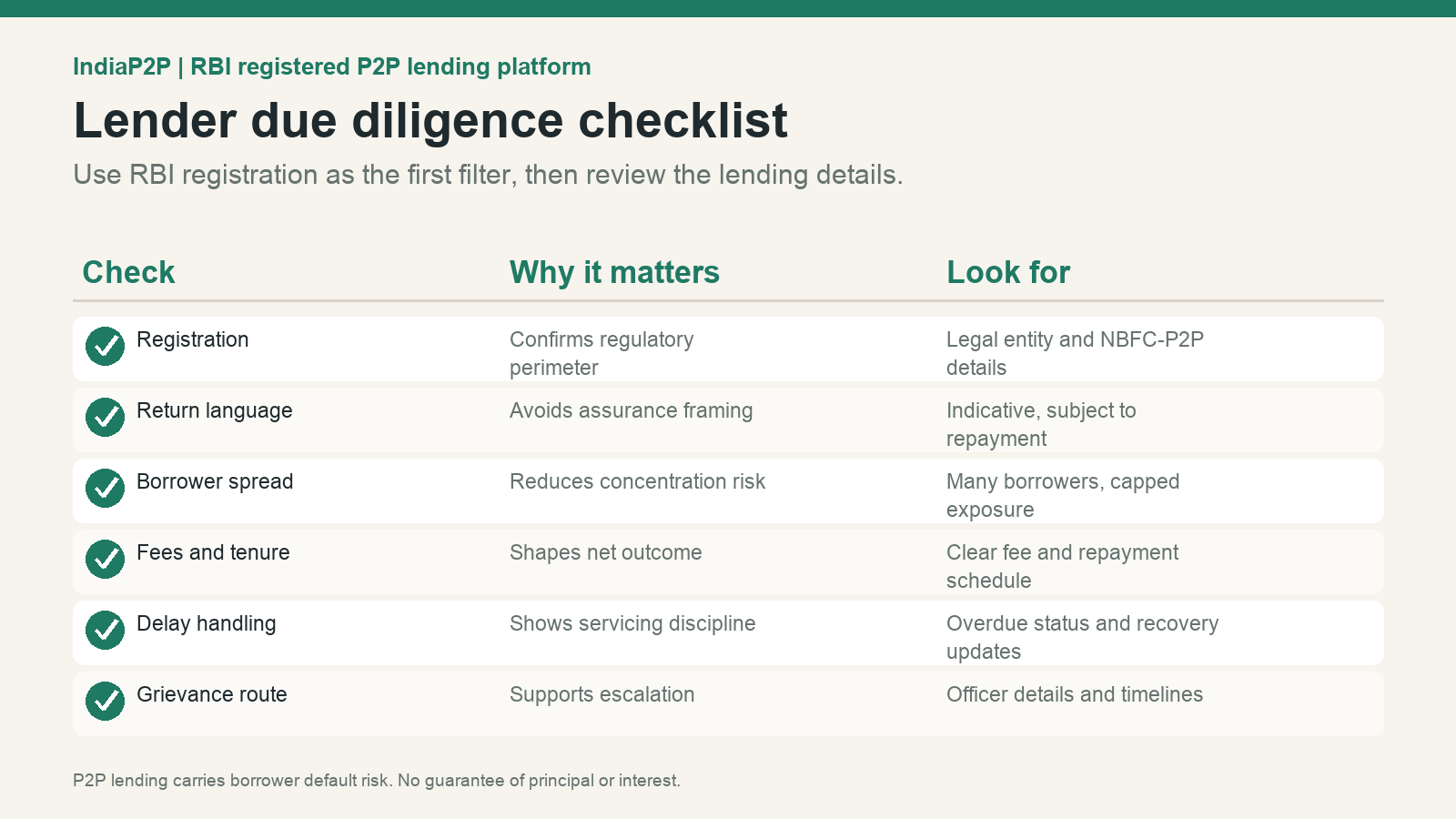
This checklist is more useful than asking only whether a platform is "RBI registered." Registration matters, but the lending decision still depends on borrower risk, diversification, tenure, liquidity needs and your ability to tolerate delayed repayment.
RBI registered P2P lending platform vs unregulated lending arrangement
The difference between a regulated P2P platform and an informal lending arrangement is not that one has no risk. The difference is that the regulated platform operates inside a defined framework.
Feature | RBI registered P2P lending platform | Informal or unregulated arrangement |
|---|---|---|
Regulatory category | NBFC-P2P | No clear P2P regulatory status |
Platform role | Facilitates lender-borrower loans | May be unclear |
Fund flow | Expected to follow permitted structures | May depend on private transfer methods |
Disclosures | Required under RBI framework | Often inconsistent |
Exposure limits | RBI caps apply | May not be monitored |
Grievance process | Formal route should exist | May be informal |
Risk to lender | Borrower default risk remains | Borrower/default/process risk remains, often with less visibility |
The regulated framework improves structure and accountability. It does not convert borrower credit risk into guaranteed repayment.
What this means when lending through IndiaP2P
IndiaP2P enables lenders to lend across curated borrower loans through an RBI registered NBFC-P2P platform. On the Monthly Income Plan Plus, lenders can target up to 18% p.a. indicative returns, net of platform fee, with expected monthly borrower repayments of principal and interest.
That sentence has two parts, and both matter.
The first part is the opportunity: P2P lending can support monthly repayment-led cash flow from borrower EMIs. The second part is the risk: repayments depend on borrower behaviour and may vary.
IndiaP2P's role is to facilitate the platform process: onboarding, borrower assessment, lending workflow, repayment tracking and related disclosures. The lender still needs to decide whether P2P lending fits their surplus money, time horizon and risk comfort.
For allocation discipline, read how much to allocate to P2P lending before deciding an amount.
Before you lend: a practical lender checklist
Use this checklist before treating RBI registration as enough.
I understand that RBI registration is not RBI assurance of repayment.
I am using surplus money, not emergency or near-term expense money.
I understand that up to 18% p.a. is indicative return potential, not a promise.
I know the loan tenure and expected repayment pattern.
I have checked how funds may be spread across borrowers.
I understand that diversification does not remove borrower default risk.
I know the platform fees and how net outcome is shown.
I can tolerate delayed repayments without needing to exit urgently.
I know the grievance route and where platform disclosures are available.
I am within RBI exposure limits across P2P platforms.
Read RBI registration as a starting point
RBI registration is important because it places a P2P platform inside a defined regulatory framework. It tells lenders that the platform is not operating outside the perimeter.
But it is not the finish line. A lender should still read the product terms, understand borrower default risk, review repayment visibility, check fees, diversify sensibly and lend only an amount that can remain exposed for the selected tenure.
That is the right way to read an RBI registered P2P lending platform: not as a guarantee, but as a regulated structure within which a risk-aware lending decision can be made.