IndiaP2P enables eligible lenders to target indicative returns of up to 18% p.a. through P2P lending, subject to borrower repayment performance, platform terms, fees, timing, and risk. One part of that risk-aware experience is understanding the escrow account in P2P lending.
An escrow account does not make borrower repayment certain. It does something more specific. It creates a regulated route for money to move between lenders and borrowers without the P2P platform treating participant money as its own.
For lenders, this distinction matters. Escrow improves the money-movement process. Borrower default risk still remains.
What Is an Escrow Account in P2P Lending?
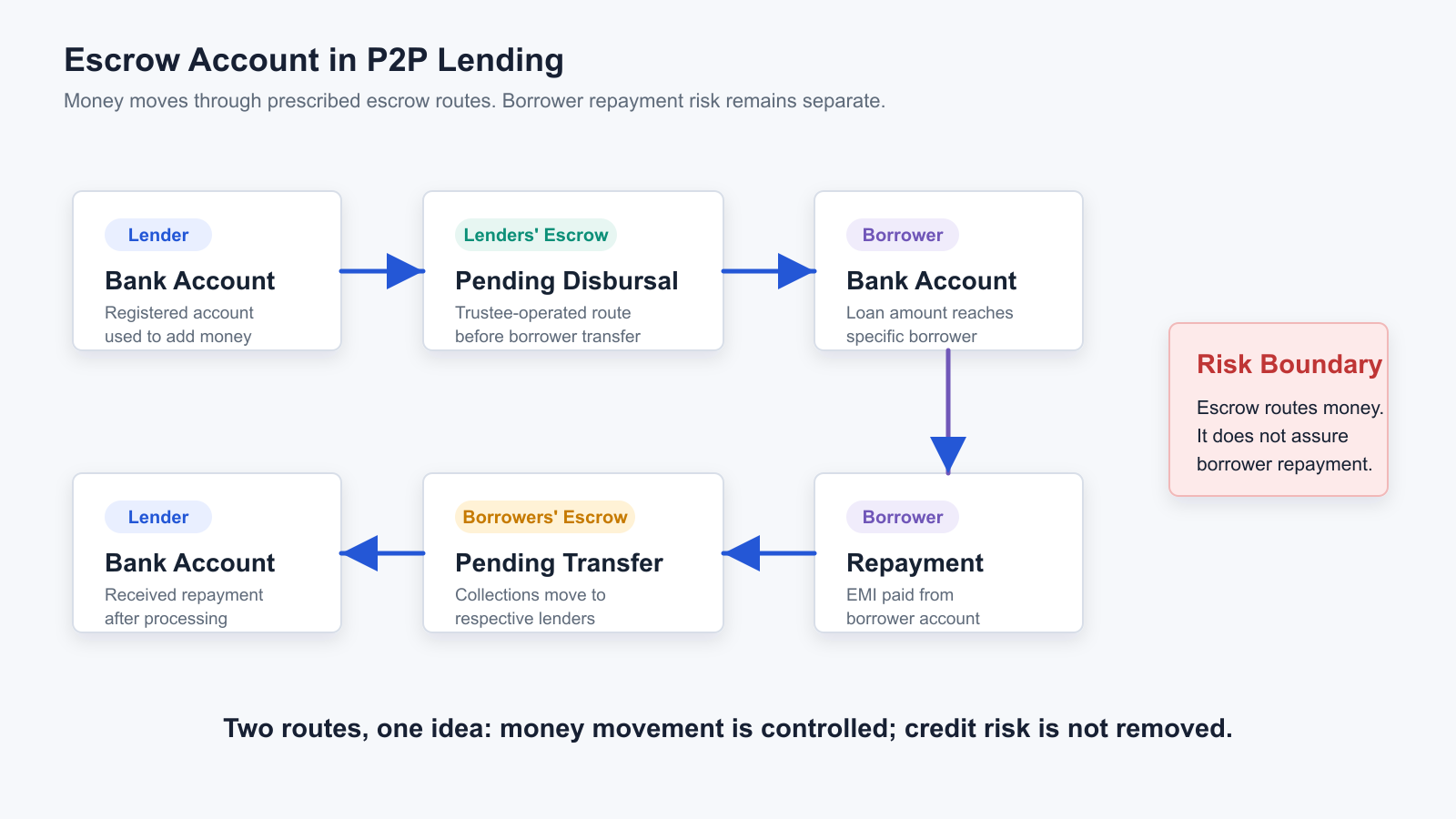
An escrow account in P2P lending is a controlled account used to route money between lenders and borrowers under the applicable NBFC-P2P framework. It is not the platform's operating bank account. It is part of the fund-transfer mechanism used for loan disbursal and repayments.
In simple terms, escrow answers one operational question: where does money sit while it is moving from one participant to another?
When a lender adds money for lending, the money should move through the prescribed lenders' escrow route before it is disbursed to a specific borrower's bank account. When a borrower repays, the repayment should move through the borrowers' escrow route before reaching the respective lender's bank account.
This makes the money trail cleaner. It separates participant money from platform operating money. It also helps the lender understand that the platform is facilitating a loan, not accepting a deposit or guaranteeing repayment.
Why RBI Requires Escrow Accounts for NBFC-P2P Platforms
P2P lending in India operates under RBI's NBFC-P2P framework. Under the RBI Master Direction for NBFC-P2P platforms, an NBFC-P2P acts as an intermediary providing an online marketplace or platform for participants involved in peer-to-peer lending.
That role comes with clear limits. The platform must not raise deposits. It must not lend on its own. It must not provide or arrange credit enhancement or credit guarantee. It must not hold lender money or borrower repayment money on its own balance sheet.
The escrow mechanism supports this framework by keeping fund movement structured and traceable. RBI states that fund transfer between participants on the P2P platform shall happen through escrow account mechanisms operated by a bank-promoted trustee. It also requires at least two escrow accounts: one for lender money pending disbursal, and one for borrower collections.
This is why escrow should be understood as compliance infrastructure. It reduces fund-handling confusion. It does not change who bears the risk if a borrower fails to repay.
The Two Escrow Accounts: Lenders' Escrow and Borrowers' Escrow
RBI's fund-transfer mechanism separates the two directions of money movement.
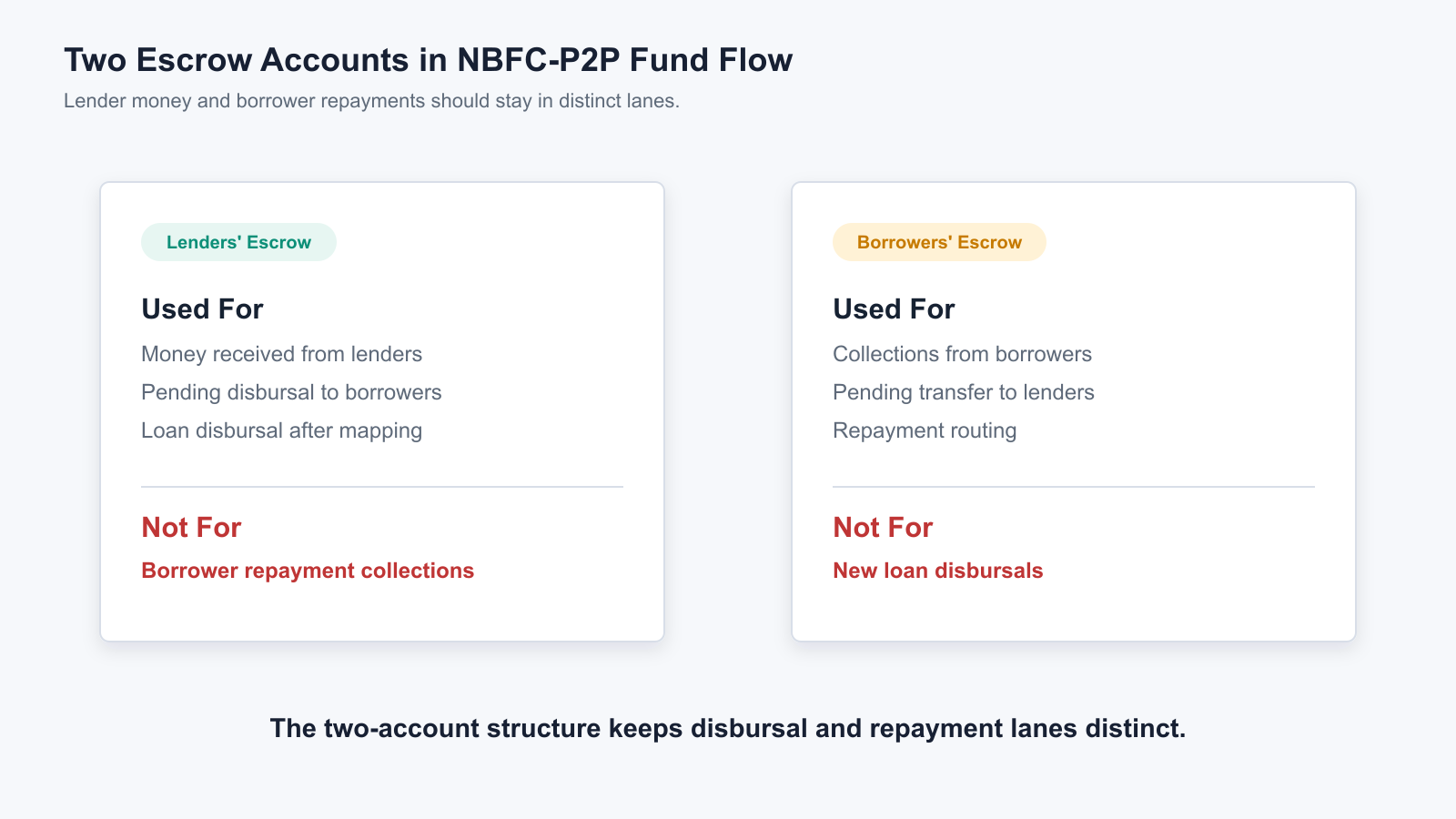
Escrow account | What it is used for | What it should not be used for |
|---|---|---|
Lenders' escrow account | Money received from lenders and pending disbursal to specific borrowers | Borrower repayments |
Borrowers' escrow account | Collections received from borrowers and pending transfer to respective lenders | Loan disbursal to borrowers |
This separation matters because it prevents the two flows from being mixed. Lender money pending loan disbursal should not be used to service repayments. Borrower repayment money should not be used to disburse new loans.
In practice, the lender should think of these as two lanes in the same road system. One lane moves money toward borrowers after matching and documentation. The other lane moves borrower repayments back toward lenders.
How the Escrow Mechanism in P2P Lending Works
The escrow mechanism in P2P lending can be understood in five steps.
The lender transfers money from a registered bank account to the lenders' escrow account.
The platform matches or maps the lender to borrower loans under its board-approved policy.
After borrower mapping, participant approval, and loan documentation, money moves from the lenders' escrow account to the specific borrower's bank account.
The borrower repays from their bank account into the borrowers' escrow account.
Repayments move from the borrowers' escrow account to the respective lender's bank account.
The platform facilitates the workflow, documentation, reporting, and servicing. The escrow mechanism supports the money movement. The borrower remains responsible for repayment.
This is an important boundary. A well-designed escrow process can reduce operational risk around routing, commingling, and traceability. It cannot remove credit risk. If the borrower delays or defaults, the existence of escrow does not itself create a repayment.
For the wider repayment journey after money is lent, see IndiaP2P's guide to P2P lending repayment flow.
What the T+1 Rule Means for P2P Lending Escrow Accounts
The T+1 rule is one of the most important current rules for P2P lending escrow accounts.
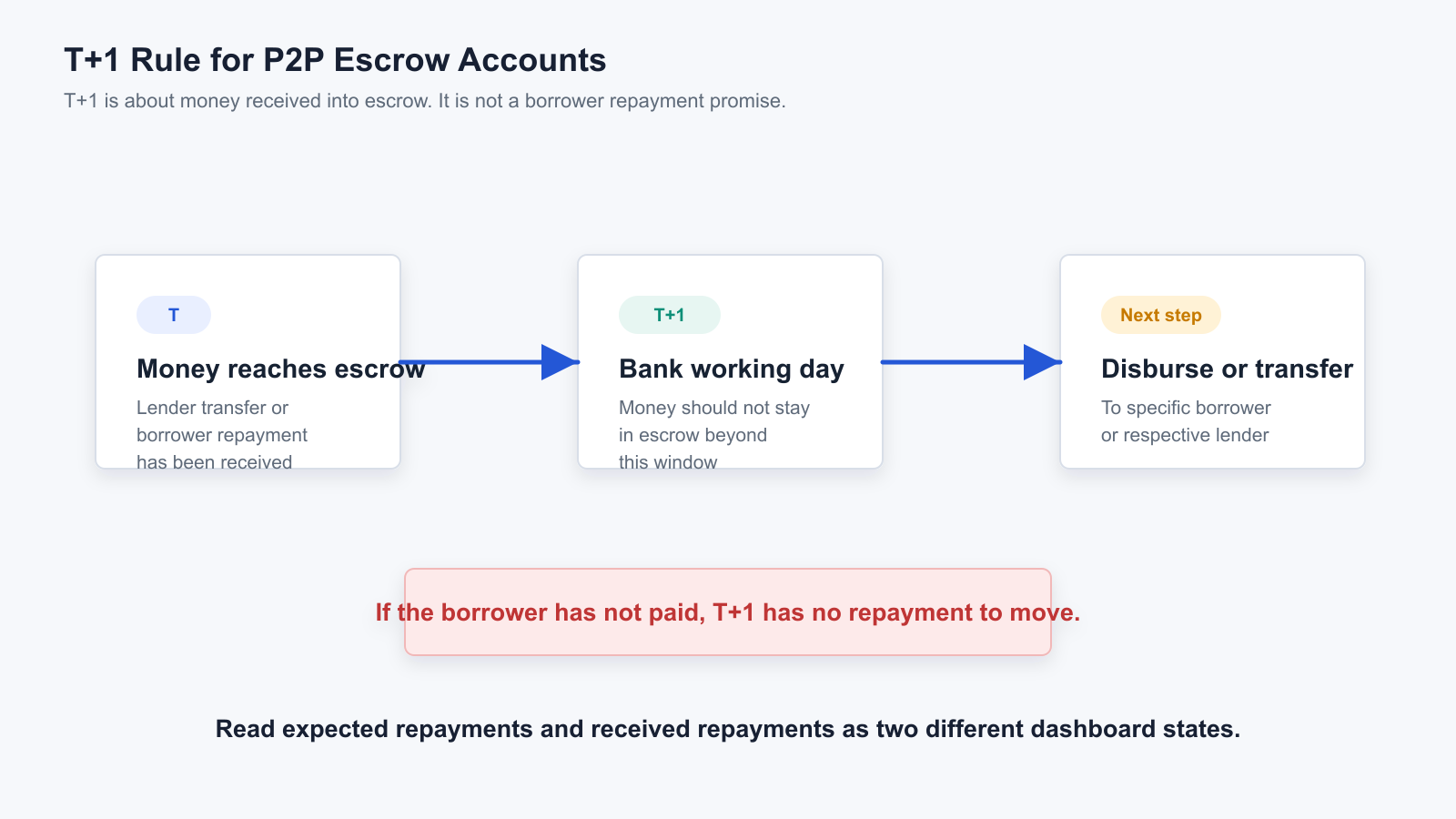
Under RBI's updated NBFC-P2P directions, money transferred into the lenders' escrow account or borrowers' escrow account should not remain in those escrow accounts for more than T+1 day, where T is the date on which the money is received. RBI's NBFC-P2P FAQ updated on September 03, 2025 clarifies that T+1 refers to a bank working day.
For a lender, this rule is about escrow settlement timing. If money is received into the applicable escrow account, the escrow account is not meant to become a long-stay holding place.
But T+1 should not be misunderstood as a borrower repayment guarantee. If a borrower has not paid the EMI, there is no borrower repayment sitting in escrow to settle. The rule governs money that has reached escrow. It does not eliminate borrower default risk.
This is why a lender should read the dashboard in two parts: expected repayments and received repayments. The T+1 clock applies to received money in escrow, not to scheduled borrower payments that have not arrived.
What Escrow Does Not Do: Default Risk Still Remains
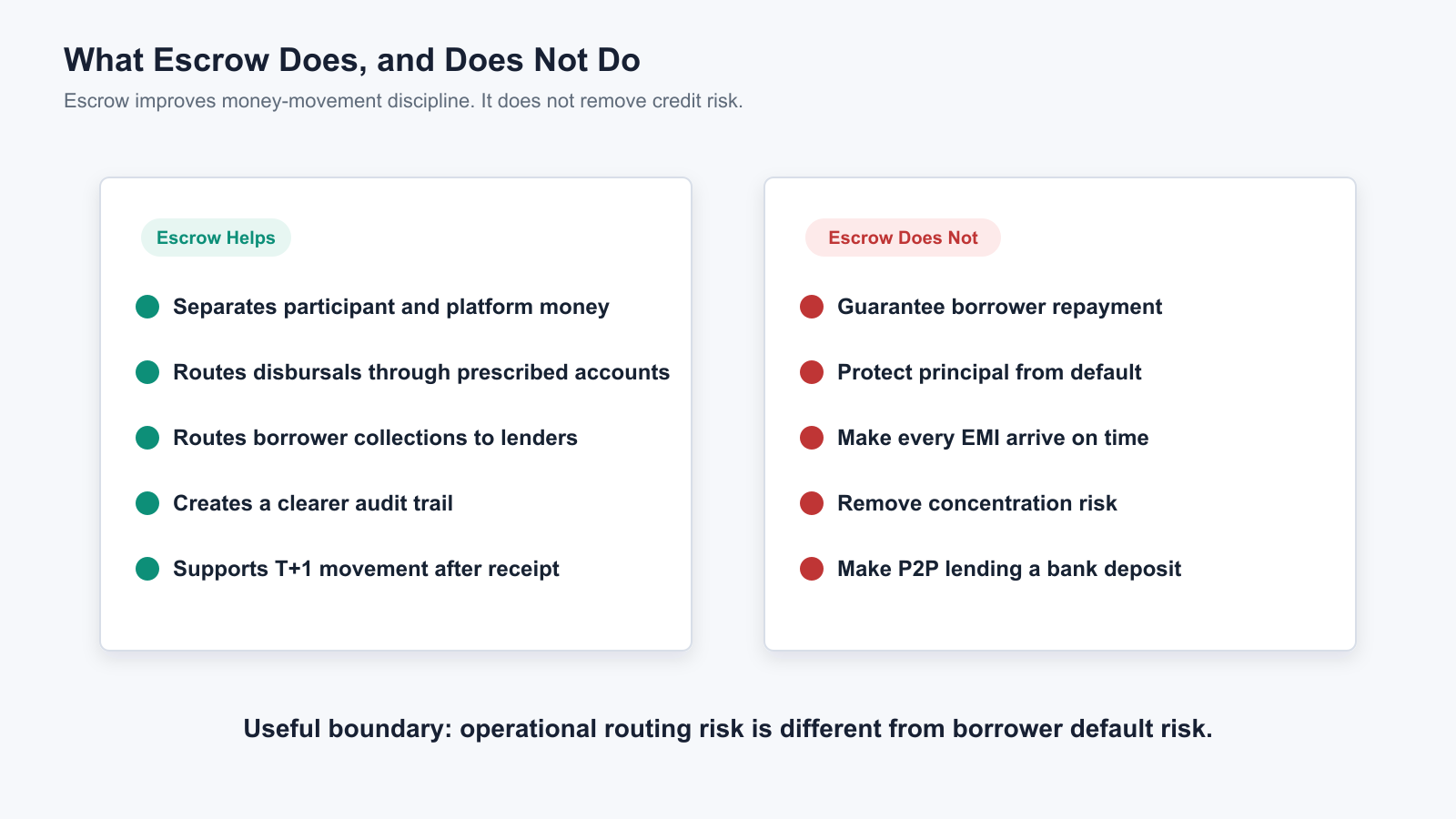
Escrow is useful because it makes money movement more disciplined. It is not useful if it is mistaken for principal protection.
Escrow helps with | Escrow does not help with |
|---|---|
Separating participant money from platform operating funds | Guaranteeing borrower repayment |
Routing money through prescribed accounts | Protecting principal from borrower default |
Creating a clearer audit trail | Ensuring every EMI arrives on time |
Supporting T+1 movement after money reaches escrow | Removing credit risk or concentration risk |
Reducing money-movement confusion | Making P2P lending equivalent to a bank deposit |
The main risk in P2P lending is borrower default risk. A borrower may repay late, partly, or not at all. The lender bears that risk. RBI's framework also requires platforms to avoid presenting P2P lending as if it carried assured minimum returns or liquidity options.
Diversification can help reduce dependence on one borrower or a small group of borrowers. It cannot eliminate default risk. A lender should still review borrower spread, tenure, repayment history, overdue ageing, fees, and liquidity needs before lending.
For a deeper risk-aware sizing framework, see IndiaP2P's guide on how much to allocate to P2P lending. For borrower-spread mechanics, read P2P auto diversification explained.
Escrow, Repayments, and Your Lender Dashboard
Escrow explains how money moves. Your lender dashboard should help explain what has happened.
A useful dashboard view separates:
money added for lending
money mapped to borrower loans
expected borrower repayments
repayments received
delayed or overdue EMIs
available balance
money withdrawn or lent again
This separation prevents a common mistake: treating expected cash as received cash. A repayment schedule may show that an EMI is due on a certain date. That does not mean the borrower has paid it.
Once borrower repayments are received and processed, the lender can decide what to do next. Some lenders may withdraw received cash. Others may lend again after reviewing risk and liquidity. The right choice depends on the lender's broader cash-flow plan and risk comfort.
For a practical framework, read IndiaP2P's guide on how to read P2P loan details before lending.
Pre-Lending Checklist: Questions to Ask About Escrow and Risk
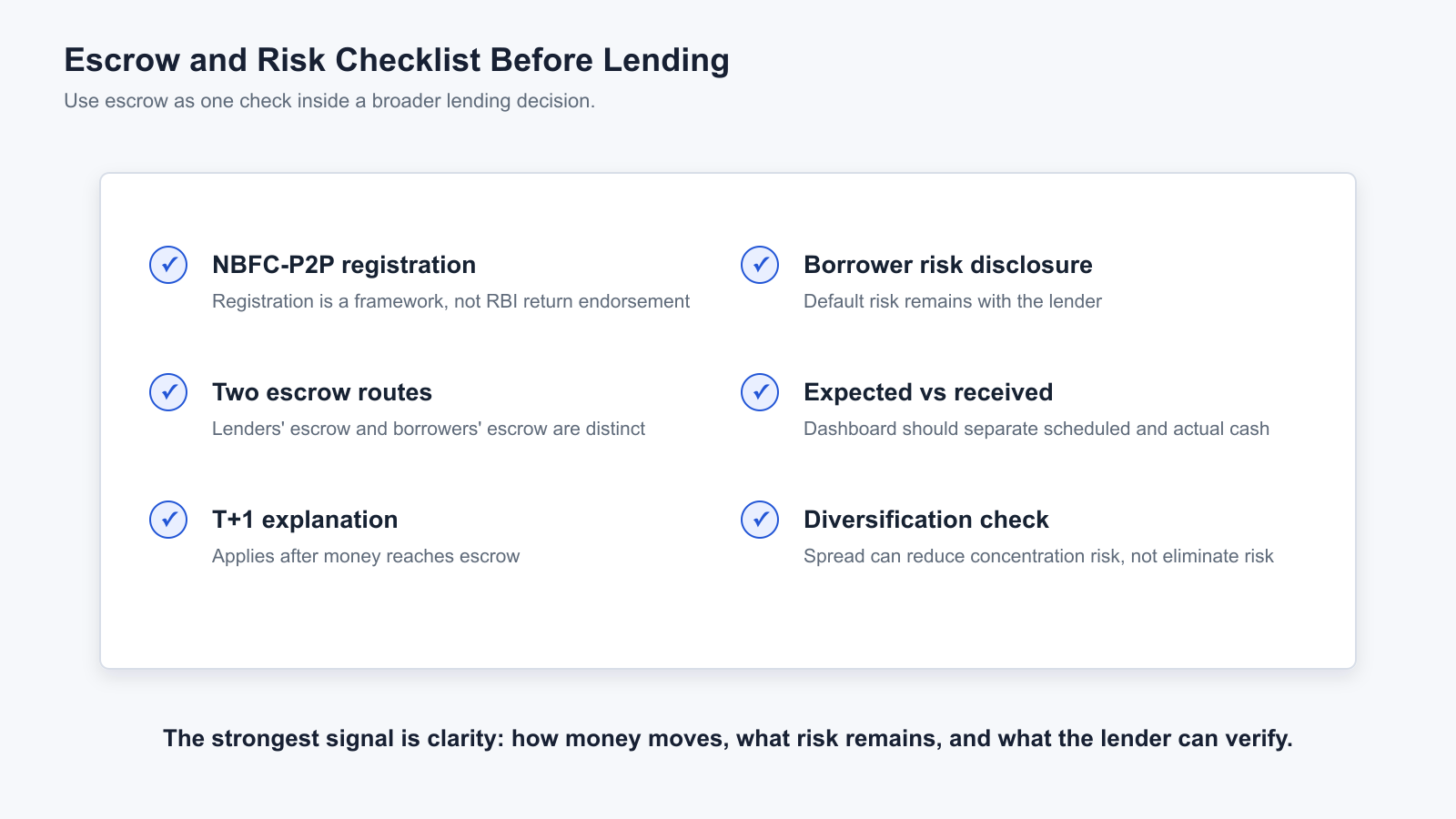
Before lending through any P2P platform, use escrow as one part of the evaluation, not the whole evaluation.
Ask these questions:
Is the platform registered with RBI as an NBFC-P2P?
Does it explain how lender money and borrower repayments move?
Does it distinguish the lenders' escrow account from the borrowers' escrow account?
Does it explain T+1 timing without implying guaranteed liquidity?
Does it avoid assured-return or capital-protection language?
Does it disclose borrower default risk clearly?
Does it show borrower details, credit assessment inputs, fees, and loan terms before lending?
Does it publish a fair-practices code and grievance redressal process?
Does it help the lender track expected versus received repayments?
Does it make clear that diversification reduces concentration risk but does not eliminate default risk?
IndiaP2P is registered with the Reserve Bank of India as an NBFC-P2P. The platform connects lenders with verified borrowers and facilitates lending, repayment routing, and reporting. Eligible lenders can explore IndiaP2P Monthly Income Plan+, where returns of up to 18% p.a. are indicative and depend on borrower repayment performance, fees, timing, and risk.
The Bottom Line on Escrow Accounts in P2P Lending
An escrow account in P2P lending is essential plumbing. It helps route money through a regulated structure, separates participant money from platform operating money, and supports clearer tracking of disbursals and repayments.
It is not a guarantee.
The right way to read escrow is: it improves the money-movement process, while borrower repayment risk remains with the lender. A lender should evaluate escrow rules, borrower quality, diversification, tenure, liquidity needs, and dashboard transparency together before lending.