Choosing between IndiaP2P Monthly Income Plan+ and Growth Plan should start with one question: what role should the repayments play in your money plan?
If you want a visible monthly repayment rhythm, Monthly Income Plan+ may be the clearer lens. If you do not need regular withdrawals and prefer to review received repayments for fresh lending, a Growth Plan approach may fit better.
Both routes remain peer-to-peer lending. They are not deposits. Principal is not protected. Returns and repayments depend on borrower repayment behaviour. That means the better comparison is not "which plan is better?" It is "which plan can I live with if repayments arrive on time, late, or partly delayed?"
Monthly Income Plan+ and Growth Plan in IndiaP2P: The Quick Difference
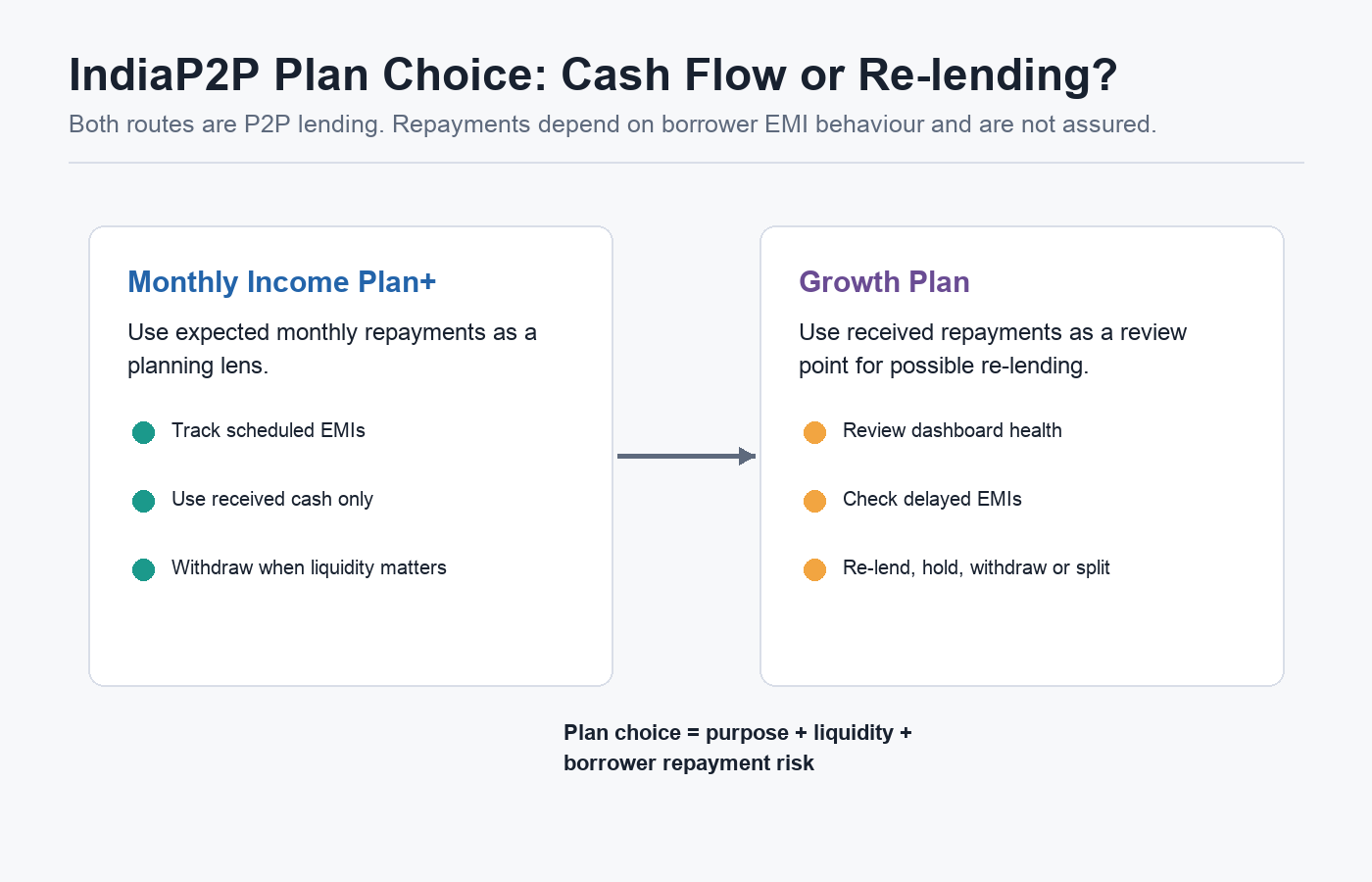
IndiaP2P Monthly Income Plan+ is designed around expected monthly repayments. Borrowers repay through EMIs, and repayments may include principal and interest. On the live Monthly Income Plan+ page, IndiaP2P states that lenders can target up to 18% p.a. / APR, net of platform fee, with the important qualification that displayed values are estimates and actual outcomes may vary.
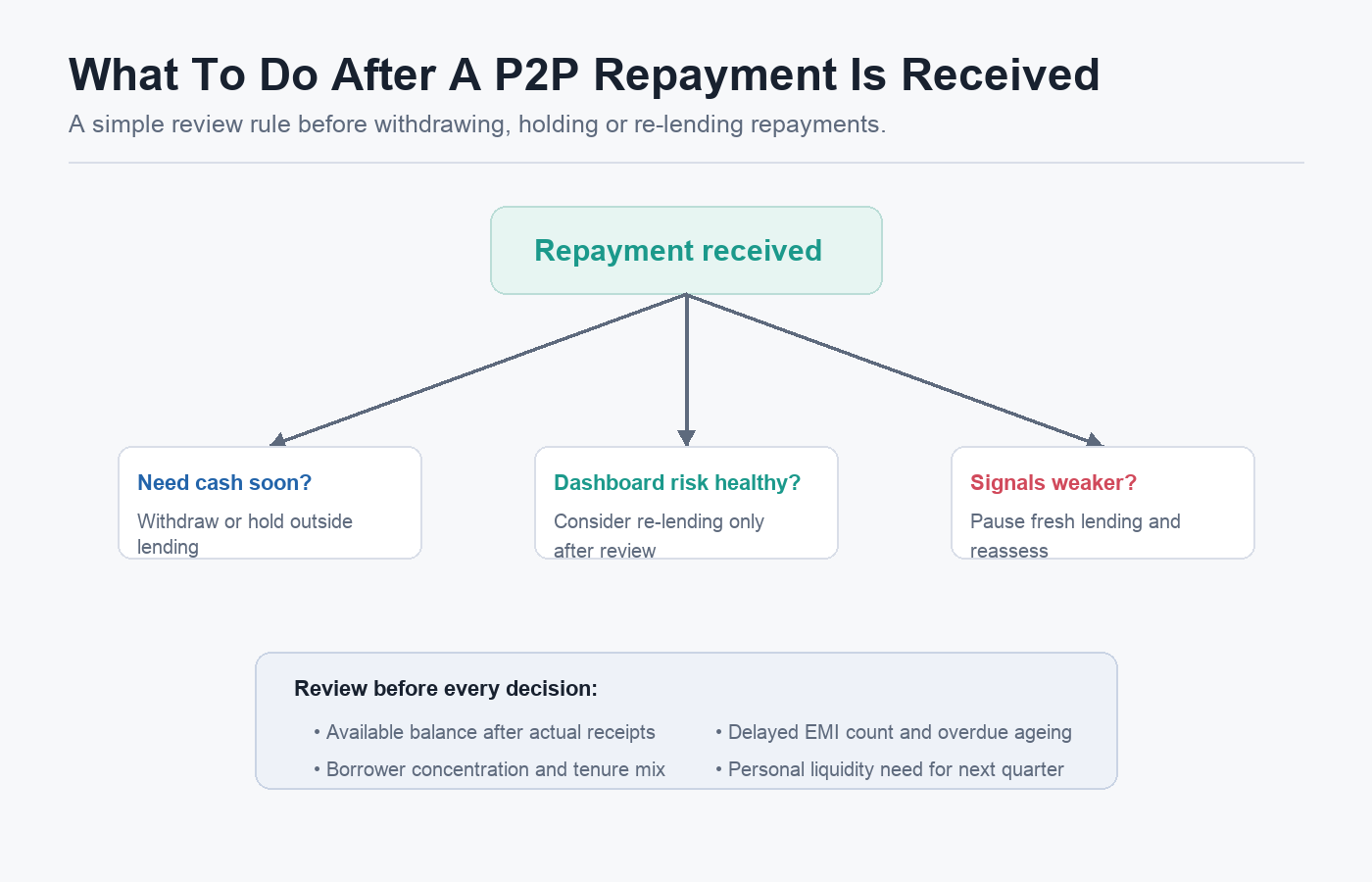
The Growth Plan lens is different. Instead of treating repayments as monthly spending cash, the lender uses repayments as a review point. Received cash may be re-lent, held, withdrawn, or split after checking dashboard performance, borrower spread, delayed EMIs, and personal liquidity needs.
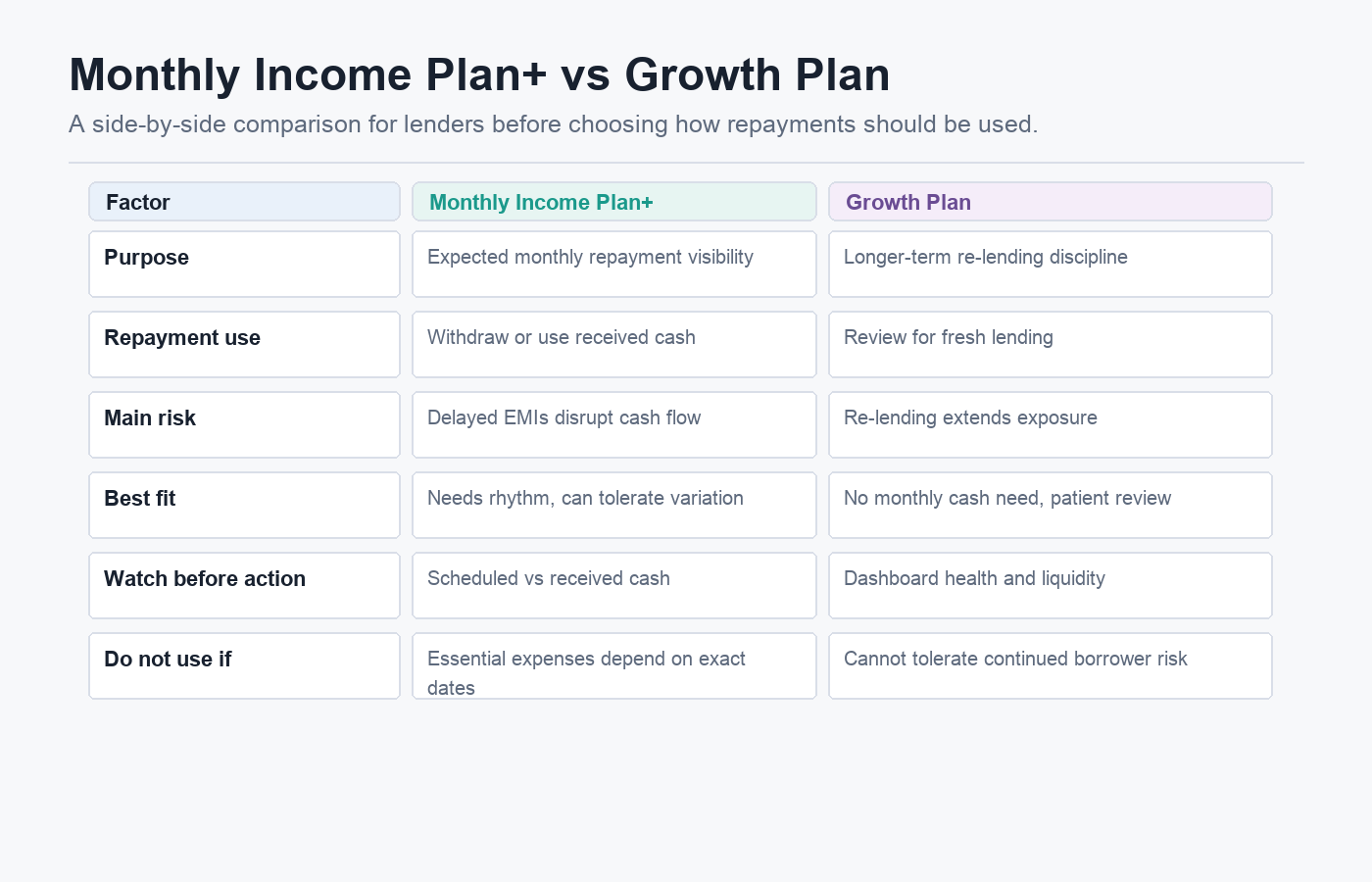
Decision point | Monthly Income Plan+ lens | Growth Plan lens |
|---|---|---|
Primary purpose | Expected monthly cash-flow visibility | Longer-term re-lending discipline |
Repayment use | Withdraw or use received repayments as planned cash flow | Review received repayments for fresh lending |
Main habit | Track monthly scheduled vs received cash | Re-lend only after risk and liquidity review |
Risk to watch | Delayed EMIs disrupting monthly cash flow | Re-lending extending exposure to borrower risk |
Better fit when | You want repayment rhythm and can tolerate variation | You do not need monthly withdrawals and can review patiently |
Monthly Income Plan+ for expected monthly repayments
IndiaP2P Monthly Income Plan+ is useful for lenders who want to evaluate P2P lending through expected monthly repayments. The plan page states that the expected monthly payout schedule is available on the dashboard and that repayments of principal plus interest are transferred to the lender's bank account.
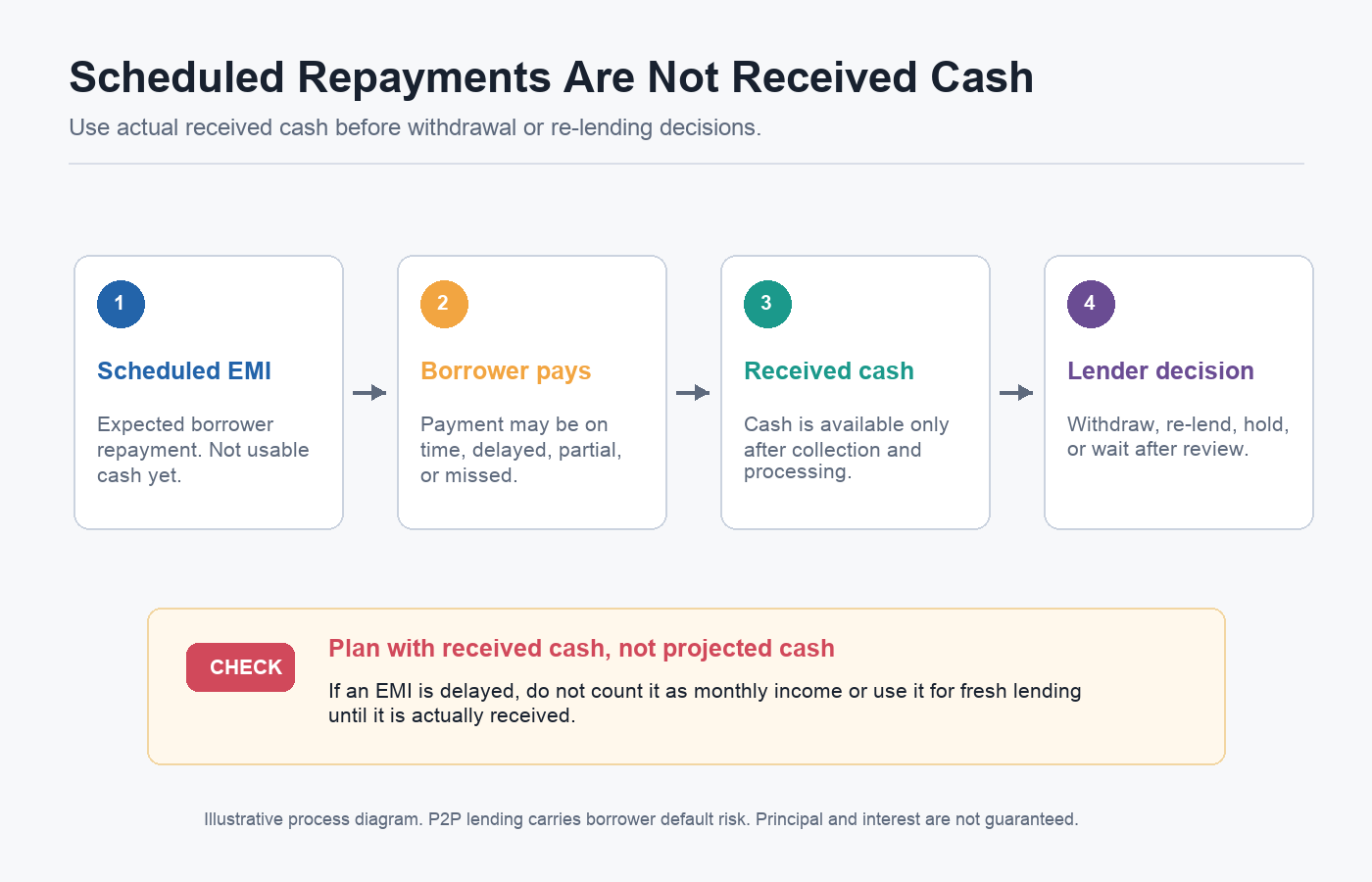
This does not make monthly repayments assured income. A scheduled EMI is only an expectation until it is received. Borrowers may pay late or default, so monthly cash-flow planning should always be based on actual received cash.
Growth Plan for re-lending repayments over time
A Growth Plan approach fits lenders who do not need to use repayments every month. Instead, they may prefer to re-lend received principal and interest after review. This can keep more money active across borrower loans, but it also keeps money exposed to fresh borrower repayment cycles.
The important phrase is "after review." Re-lending should follow dashboard checks, not happen automatically because cash is available. If delayed EMIs rise, liquidity needs change, or borrower spread looks concentrated, holding or withdrawing repayments may be more sensible.
P2P Lending Plan Comparison by Cash Flow, Re-Lending and Risk
The right IndiaP2P plan depends on how you read repayments.
Monthly Income Plan+ is easier to understand when your focus is monthly cash flow. You want to know when borrower EMIs are expected, how much was received, what is delayed, and what can be withdrawn.
Growth Plan is easier to understand when your focus is continuity. You are not asking, "What can I use this month?" You are asking, "Should received repayments be lent again after I check risk?"
Neither plan removes borrower default risk. Both require the same core discipline: read the dashboard, check borrower spread, understand tenure, and keep essential expenses outside the lending cycle.
Factor | What to check before choosing |
|---|---|
Cash-flow need | Do you need repayments as monthly cash, or can they stay available for re-lending? |
Delay tolerance | Can your plan handle a month where some EMIs are delayed? |
Liquidity | Is emergency money already separate from P2P lending? |
Tenure | Are you comfortable with funds staying linked to borrower repayment cycles? |
Borrower spread | Is exposure spread across enough borrowers and not concentrated in one bucket? |
Tax and records | Can you track interest income, fees, delayed receipts, and realised cash? |
Scheduled repayments vs received repayments in P2P lending
Scheduled repayments are what borrowers are expected to pay. Received repayments are the amounts actually collected, processed, and available.
This difference matters most for Monthly Income Plan+. If Rs. 10,000 is scheduled but Rs. 8,500 is received, your usable cash is Rs. 8,500. The unrecovered Rs. 1,500 remains a risk item until it is recovered or treated as overdue according to platform rules.
It also matters for Growth Plan. Re-lending should use received repayments, not projected repayments. A lender should not extend fresh exposure based on money that has not actually arrived.
Re-lending repayments and compounding in P2P lending
Re-lending repayments can support long-term discipline because received principal and interest may be put back into fresh borrower loans. That can reduce idle cash, sometimes called cash drag.
But re-lending is not a promise of compounding. It depends on borrower availability, platform rules, fees, timing, delayed EMIs, defaults, and the lender's own review process.
For a deeper framework, read IndiaP2P's guide on whether to re-lend or withdraw P2P repayments].
Who Should Consider IndiaP2P Monthly Income Plan+?
Monthly Income Plan+ may fit a lender who wants repayment visibility and has a use for received cash. The key word is "received". The plan should not be used as if every scheduled EMI will arrive exactly on time.
It may be relevant for someone who wants to map expected borrower EMIs against household cash-flow needs, optional expenses, or a monthly review habit. It may also suit a lender who wants to see repayment performance frequently rather than wait for one long maturity event.
The plan is not suitable for essential monthly expenses if those expenses depend on exact repayment timing. Rent, school fees, medical needs, and emergency money should not rely on borrower EMIs arriving without delay.
Monthly cash-flow planning with borrower EMI repayments
Borrower EMI repayments may include principal and interest. When borrowers pay on schedule, the lender sees cash returning through the platform's repayment process.
This visibility can help monthly planning. It gives the lender a chance to compare expected receipts with received receipts. It can also show early warning signs: missed EMIs, overdue ageing, lower-than-expected available balance, or concentration in one borrower group.
For a practical planning method, use IndiaP2P's guide to create a P2P cash-flow calendar.
Liquidity needs before choosing Monthly Income Plan+
Before choosing Monthly Income Plan+, ask whether you can wait if repayments are delayed. P2P lending is linked to borrower repayment. It is not an on-demand withdrawal product for money already lent.
A lender should keep an emergency buffer outside P2P lending. If the money may be needed in the next few months, reduce the lending amount or pause until the liquidity need is clearer.
IndiaP2P's monthly income plan checklist before lending is useful because it separates expected monthly receipts from assured income.
Who Should Consider IndiaP2P Growth Plan?
Growth Plan may fit lenders who do not need monthly withdrawals and want a more deliberate repayment-use rule. The goal is not to spend each repayment. The goal is to review each repayment and decide whether to re-lend, hold, withdraw, or split.
This approach suits a longer horizon better than a monthly expense plan. The lender can allow repayments to remain part of a continuing lending cycle, provided dashboard signals and personal liquidity still support that choice.
But the Growth Plan route still carries borrower repayment risk. Re-lending keeps money exposed to borrowers. It can help maintain lending continuity, but it cannot assure returns or principal recovery.
Longer-term lending goals and repayment redeployment
A longer-term lender needs a rule before the first repayment arrives.
For example, the lender may decide to re-lend 70% of received repayments, hold 20% as available cash, and withdraw 10% for tax or liquidity. Another lender may re-lend only if delayed EMIs remain below a personal threshold.
The exact split is personal. The discipline is universal: received cash should trigger review before redeployment.
Growth Plan details to confirm before lending
Before using Growth Plan, confirm the current product terms on the platform or with IndiaP2P support:
Whether repayments are automatically re-lent or require lender action.
Whether any cash is paid out monthly.
Minimum lending amount, fees, and tenure options.
Dashboard visibility for received cash, delayed EMIs, and active exposure.
How borrower selection, diversification, and risk categories are shown.
How exit, pause, or withdrawal rules work for received repayments.
Do not choose a growth route only because it sounds more productive. Choose it only if the actual repayment and re-lending rules fit your liquidity and risk comfort.
Borrower Default Risk in Both IndiaP2P Plans
Monthly Income Plan+ and Growth Plan differ in how repayments are used. They do not differ in the core risk: borrower repayment risk.
Under RBI's NBFC-P2P framework, a peer-to-peer lending platform acts as an intermediary for loan facilitation. It does not raise deposits, lend on its own, or provide a credit guarantee. The RBI framework also requires lenders to understand that principal and interest repayment are not assured.
This is the central compliance point. IndiaP2P's registration as an NBFC-P2P is a regulatory fact. It is not an RBI endorsement of returns. It does not protect principal. It does not make borrower EMIs certain.
Diversification reduces concentration risk, not P2P default risk
Diversification can reduce dependence on one borrower. It can spread lending across borrowers, tenures, repayment dates, or risk categories. That may reduce the impact of one delayed EMI on the overall plan.
It does not remove default risk. If several borrowers delay or fail to repay, both monthly cash flow and longer-term re-lending outcomes can be affected.
Before lending, read borrower count, exposure per borrower, risk mix, tenure mix, and repayment status. IndiaP2P's guide on how to read a P2P loan portfolio before lending explains this review in detail.
RBI NBFC-P2P rules that apply to both plans
The RBI Master Directions cap a lender's total exposure across all P2P platforms at Rs. 50 lakh and exposure to one borrower at Rs. 50,000. The Directions also require fund transfers through escrow account mechanisms and require platforms to disclose relevant borrower and loan information.
For lenders, the practical lesson is simple. Regulation improves the operating perimeter. It does not convert P2P lending into a deposit or a guaranteed-return product.
If you want to review IndiaP2P's platform-level disclosures, see the IndiaP2P portfolio performance disclosures.
IndiaP2P Plan Decision Checklist for Lenders
Use this checklist before choosing between IndiaP2P Monthly Income Plan+ and Growth Plan.
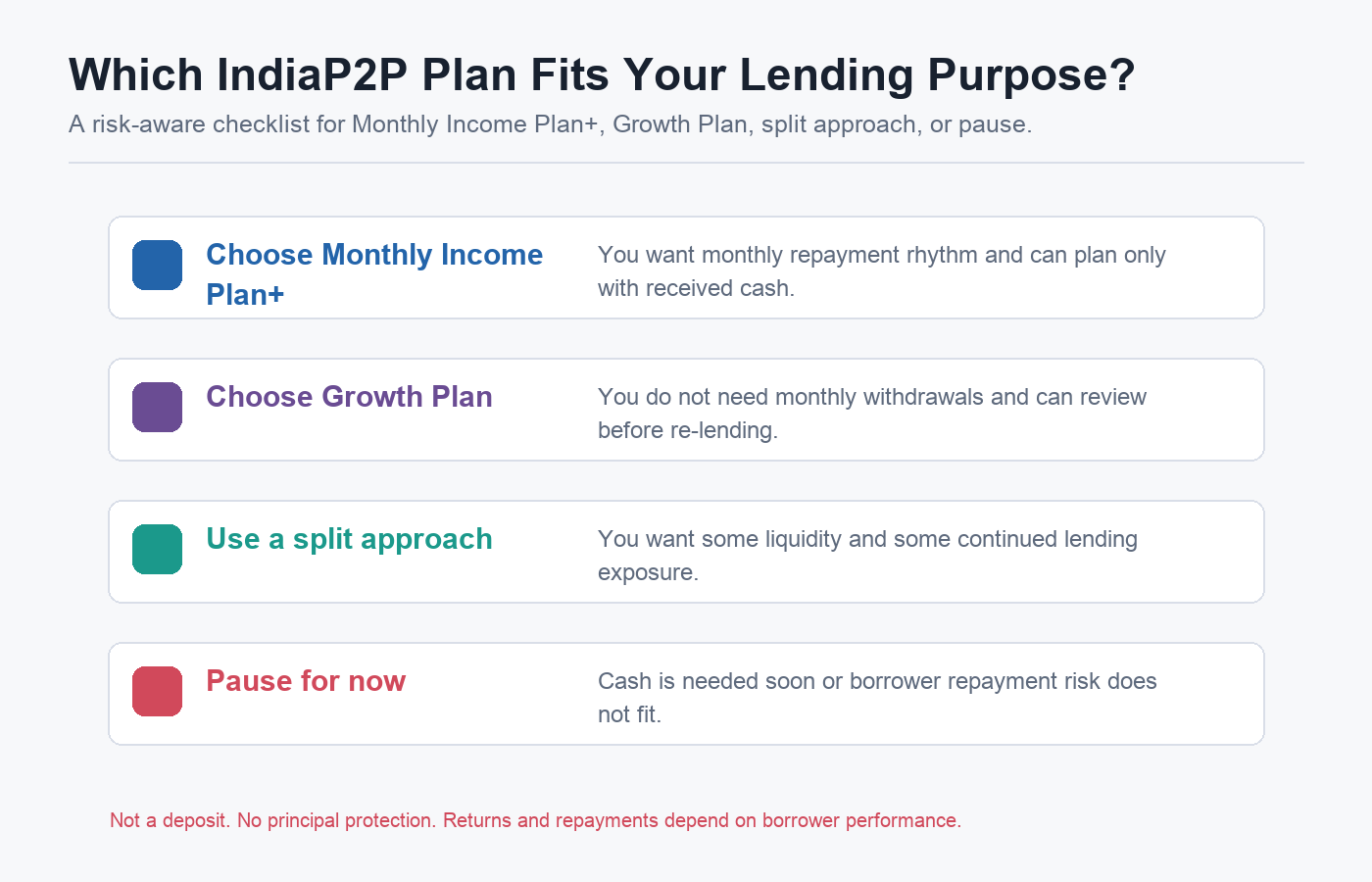
Choose this lens | When it may fit | What can go wrong |
|---|---|---|
Monthly Income Plan+ | You want expected monthly repayment visibility and may withdraw received cash | Scheduled repayments may not arrive on time |
Growth Plan | You do not need monthly withdrawals and may re-lend after review | Re-lending can extend borrower exposure |
Split approach | You want some cash flow and some continued lending | Requires discipline and monthly review |
Pause for now | You need liquidity or cannot tolerate delay/default risk | You may miss lending opportunities, but protect cash flexibility |
Choose Monthly Income Plan+ if:
You want a monthly repayment rhythm.
You can plan using received cash, not scheduled cash.
You have an emergency buffer outside P2P lending.
You are willing to monitor delayed EMIs.
You understand that up to 18% p.a. is indicative and subject to borrower repayment performance.
Choose Growth Plan if:
You do not need repayments for monthly expenses.
You want to review and potentially re-lend received cash.
You can tolerate longer exposure to borrower repayment cycles.
You will pause re-lending if dashboard risk signals weaken.
You understand that re-lending does not assure compounding or principal recovery.
Choose neither plan yet if cash cannot stay exposed
Sometimes the right answer is not Monthly Income Plan+ or Growth Plan. It is to wait.
Pause before lending if the money is needed for essential expenses, emergency reserves, near-term fees, medical needs, tax payments, or business working capital. Also pause if you are uncomfortable with the possibility that some principal or interest may be delayed or lost.
P2P lending can be useful only when the risk fits the money's role. If the money cannot stay exposed to borrower repayment cycles, it should not be placed into a plan that depends on borrower EMIs.
Summary: Monthly Payouts or Re-Lending Discipline?
IndiaP2P Monthly Income Plan+ and Growth Plan are best understood as two repayment-use choices.
Monthly Income Plan+ is the cash-flow lens. It helps lenders evaluate expected monthly repayments, received cash, and withdrawal planning. Growth Plan is the re-lending lens. It helps lenders think about whether received repayments should be redeployed after review.
Both require the same foundation: understand borrower default risk, check diversification, read the dashboard, keep liquidity outside the lending cycle, and avoid treating any return figure as a promise.
Eligible lenders may see up to 18% p.a. communicated by IndiaP2P, but that figure should be read as indicative and subject to borrower repayment performance, fees, timing, defaults, and platform terms.
After reviewing the risks, you can explore IndiaP2P Monthly Income Plan+ or use the repayment framework above to decide whether a re-lending-led Growth Plan approach fits your goals.