Liquidity planning before alternative investments is less about finding the most attractive return number and more about deciding which money should remain available.
This distinction matters for P2P lending. IndiaP2P enables eligible lenders to target up to 18% p.a. indicative returns, subject to borrower repayment behaviour, platform terms, fees, timing, and risk. P2P lending is not a bank deposit. It does not carry principal protection. Cash comes back through borrower repayments, and those repayments may be on time, delayed, partial, or not received.
So before evaluating any alternative asset, ask a simpler question first: what money must not be tied to a repayment cycle?
This guide explains how to build that liquidity plan before considering alternative assets, including P2P lending.
Why Liquidity Planning Matters Before Alternative Investments
Liquidity is the ability to access usable cash when you need it.
In listed shares or mutual funds, liquidity usually means the ability to sell or redeem. In fixed deposits, it may mean premature withdrawal with conditions. In many alternative assets, liquidity may be limited by lock-ins, exit windows, buyer availability, platform rules, or repayment schedules.
For P2P lending, liquidity is repayment-led. The lender receives cash when borrowers repay principal and interest through EMIs. The platform may show an expected repayment schedule, but expected cash is not the same as available cash.
That is why liquidity planning should come before return comparison.
An attractive return is useful only if the money can stay committed for the product's realistic cash-flow pattern. If the same money is needed for rent, school fees, medical needs, a tax payment, or a known purchase, it should not depend on borrower repayments.
First, Separate Money That Should Stay Liquid
Before considering any alternative asset, separate the money that should remain outside it.
Start with emergency reserves. A household emergency fund should remain available without depending on a borrower, platform process, market exit, or buyer. For many households, this means keeping several months of essential expenses in liquid savings or another suitable low-volatility option.
Next, list known payment dates. Insurance premiums, school fees, rent deposits, tax payments, loan EMIs, medical expenses, travel commitments, and planned family expenses should be mapped by date.
Then identify money that is psychologically short-term even if the date is not fixed. If you would feel pressure if the money did not come back within a few weeks, it is not suitable for a tenure-linked lending product.
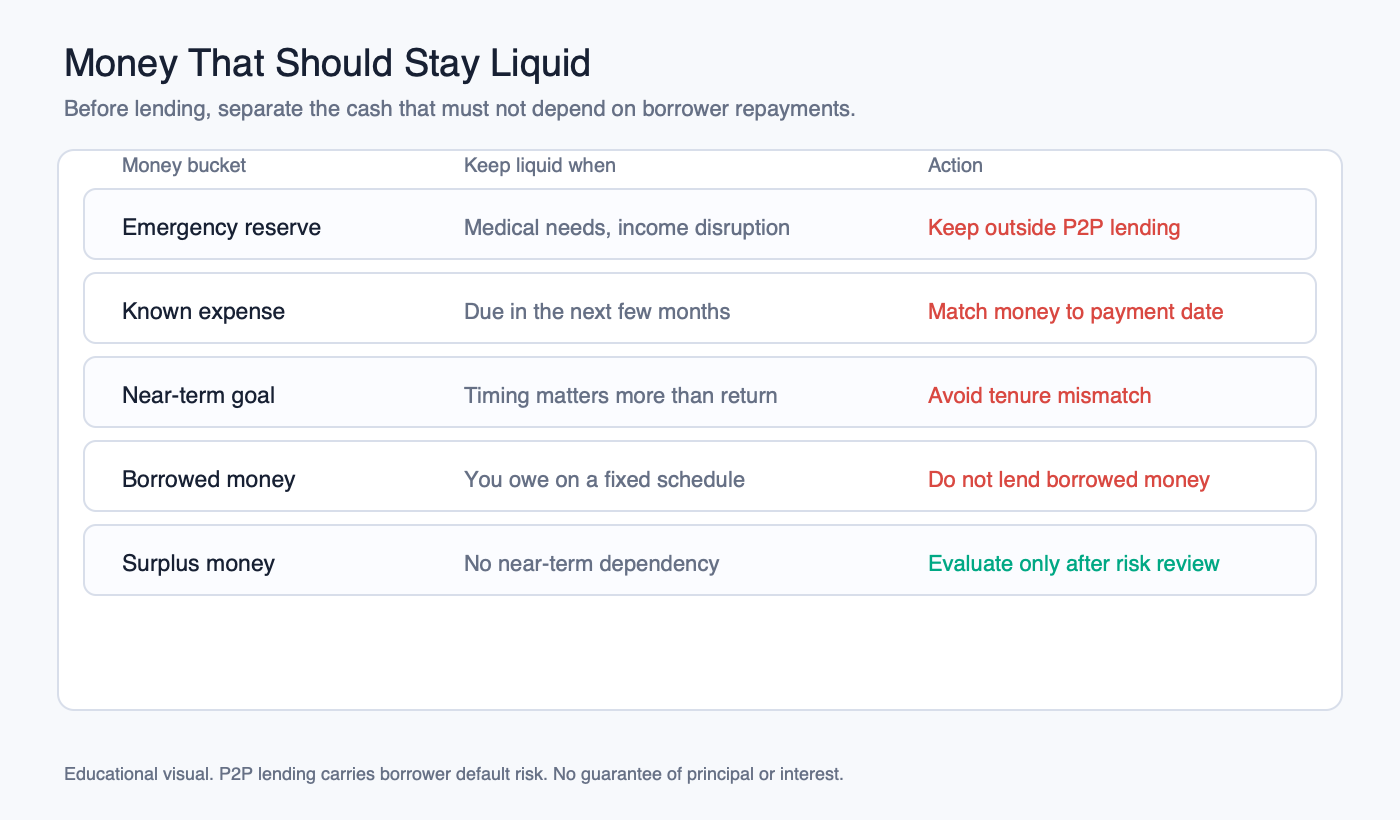
Use this simple filter:
Money bucket | Keep it liquid if | P2P lending implication |
|---|---|---|
Emergency reserve | It protects essential expenses or income disruption | Keep outside P2P lending |
Known expense | Payment is due in the next few months | Keep outside P2P lending |
Near-term goal | Timing matters more than return | Avoid tenure mismatch |
Borrowed money | You owe someone else on a fixed schedule | Do not use for P2P lending |
Surplus money | No near-term dependency and risk is understood | Can be evaluated for measured lending |
This is not about avoiding alternative assets. It is about making sure they do not compete with liquidity needs.
Alternative Investments Liquidity Planning: A Simple Bucket Framework
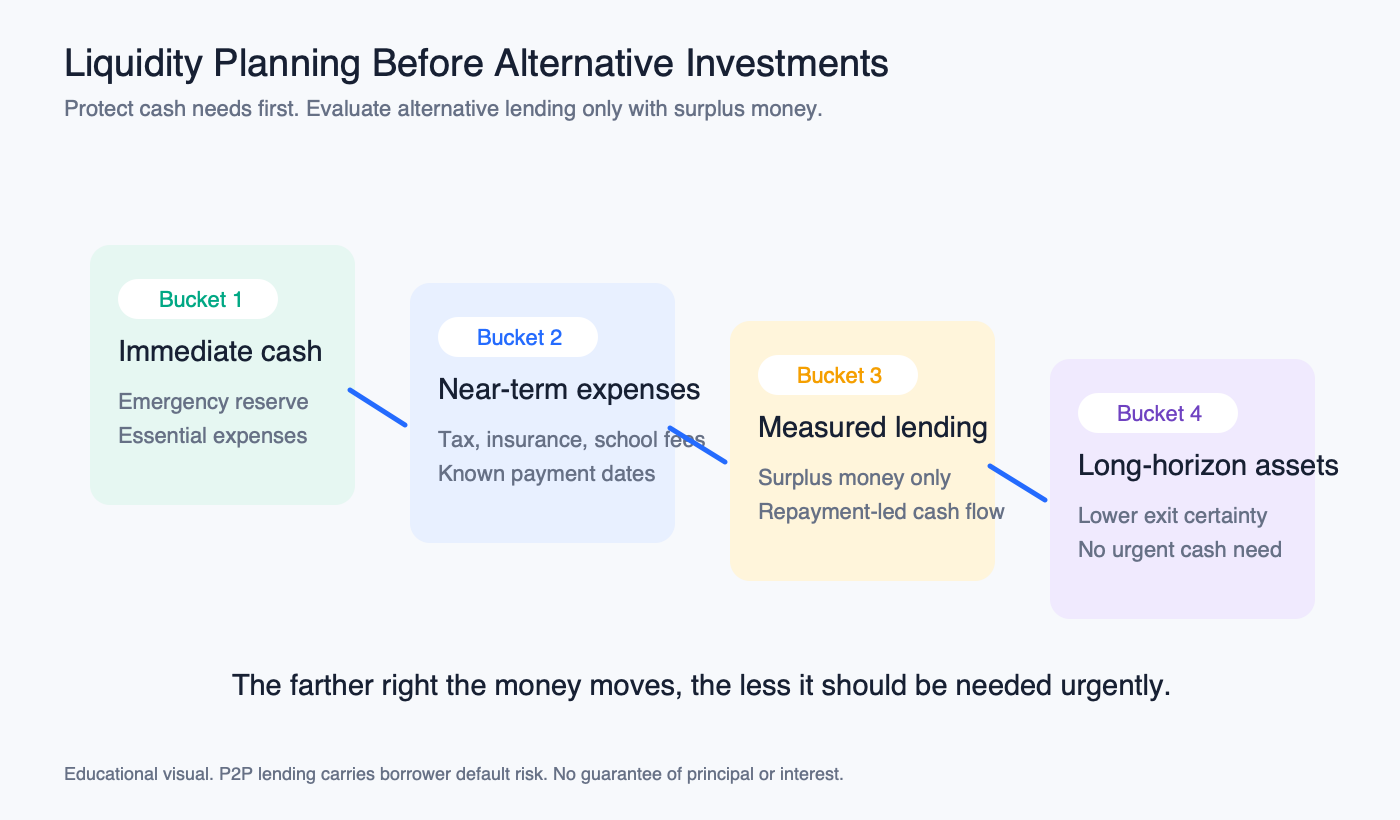
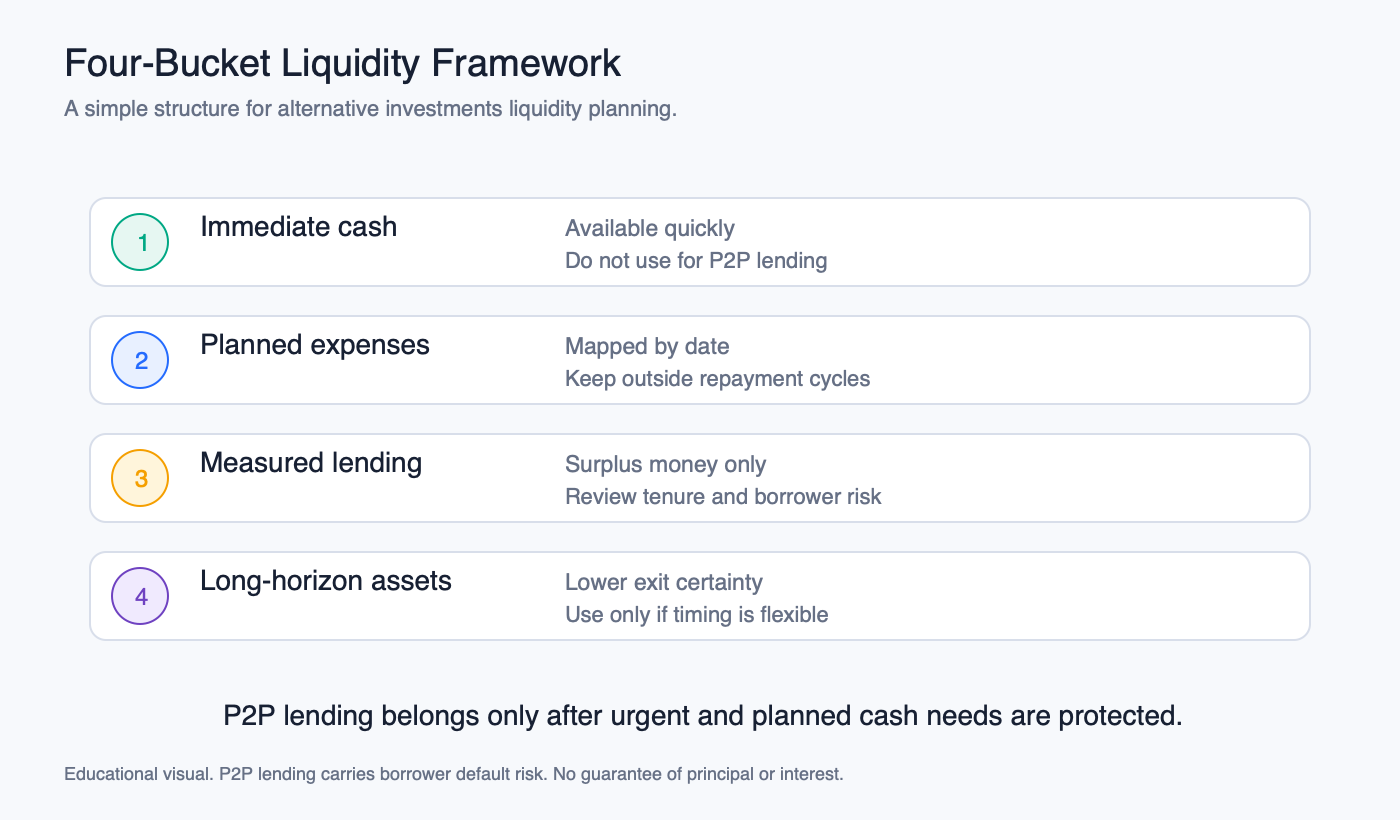
A practical liquidity plan can be built in four buckets.
Bucket 1: Immediate Cash
This is money that should be available quickly.
It covers emergency expenses, monthly essentials, medical needs, and unavoidable payments. This bucket should not depend on borrower repayments or asset exits.
Bucket 2: Planned Near-Term Expenses
This bucket covers money needed over the next few months.
The timing may be known: insurance renewal, tax payment, school fee, rent deposit, business expense, or family commitment. The money may sit in a suitable liquid option until the payment date.
Bucket 3: Measured Alternative Lending Allocation
This is the surplus amount that can be evaluated for P2P lending after the first two buckets are protected.
For IndiaP2P, the lender should understand borrower repayment risk, tenure, expected repayment schedule, delayed EMI reporting, diversification, fees, and withdrawal or re-lending choices before lending.
The amount should be measured. It should not become the base of the household's liquidity plan.
Bucket 4: Long-Horizon Alternative Assets
Some alternative assets may require longer holding periods, lower exit certainty, or less frequent valuation. They may fit only when the reader has long-term surplus money and understands the specific risks.
This bucket should not be confused with cash reserve.
Where P2P Lending Fits In A Liquidity Plan
P2P lending connects lenders with borrowers through an RBI-regulated NBFC-P2P framework. The lender provides money to borrowers, and borrowers repay through scheduled EMIs.
IndiaP2P is registered with the Reserve Bank of India as an NBFC-P2P. This means the platform operates within the applicable regulatory framework. It does not mean RBI approves returns, assures repayments, or protects principal.
P2P lending may fit a liquidity plan when the lender has surplus money, understands borrower repayment risk, and is comfortable receiving money over time rather than through an instant exit.
The useful question is not, "How much return can I target?"
The better question is, "Can this money remain in a repayment cycle without disturbing my essential liquidity?"
For first-time lenders, IndiaP2P's P2P lending beginner guide explains the basic mechanics before deciding an amount.
P2P Lending Is Repayment-Led, Not Exit-Led
In P2P lending, liquidity comes primarily from borrower repayments.
Each borrower EMI may include principal and interest. As borrowers repay, the lender receives cash according to platform processes and the loan structure. If borrowers delay, available cash may be lower than the expected schedule.
This is different from selling a listed asset on an exchange. A repayment schedule gives visibility, but it does not create a guarantee.
Where Up To 18% p.a. Indicative Returns Fit
IndiaP2P lenders can target up to 18% p.a. indicative returns. That number should be read with the risk and liquidity context beside it.
Actual outcomes depend on borrower repayments, delays, defaults, fees, timing, and whether received cash is withdrawn, held, or lent again. If repayments are delayed, cash flow may shift. If defaults occur, principal or interest may be affected.
For readers comparing cash flow and return expectations, IndiaP2P's guide to monthly income from P2P lending is a useful next step.
Scheduled Repayments Are Not The Same As Available Cash
This is the most important line in a P2P liquidity plan.
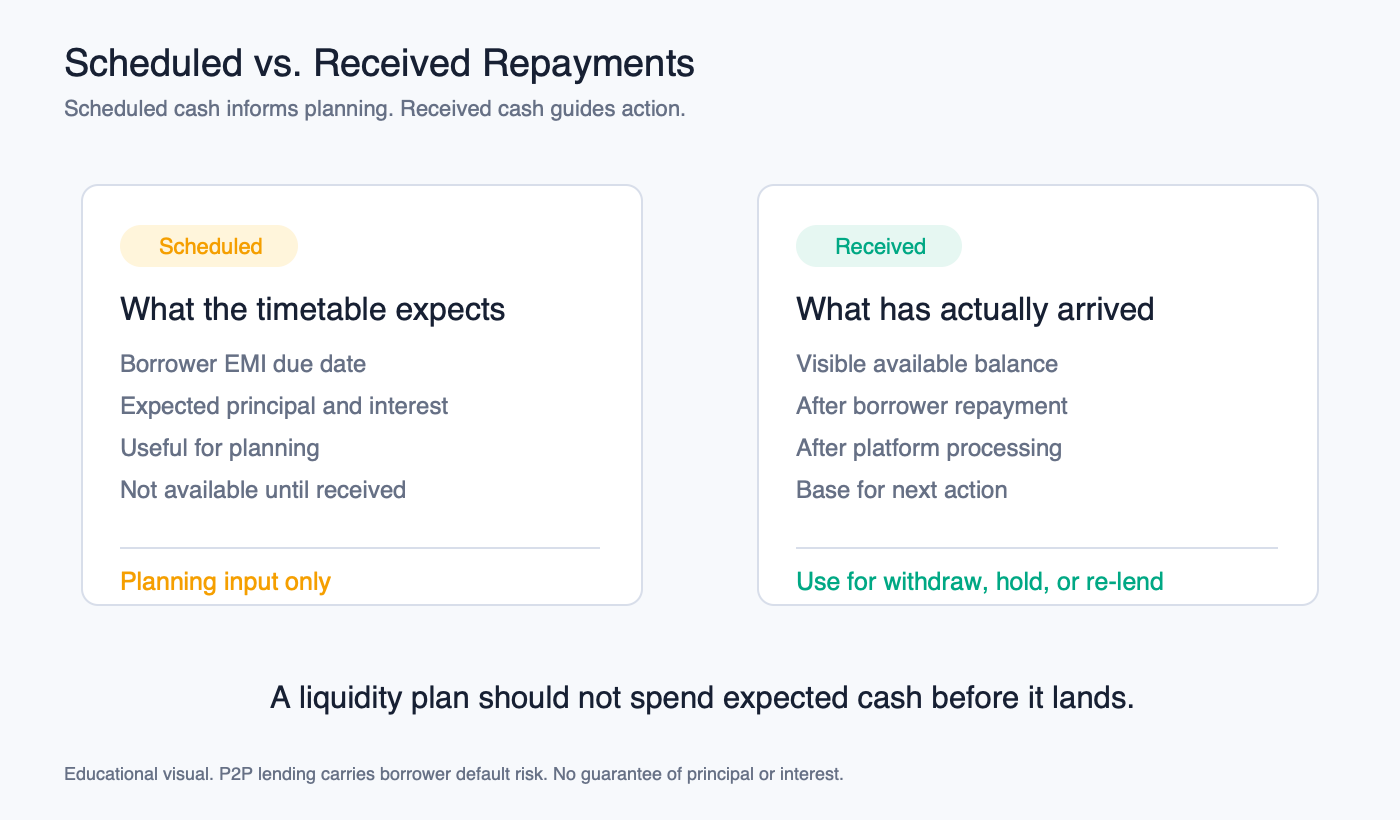
A scheduled repayment is what the dashboard expects. A received repayment is money that has actually arrived and is available for the next action.
The two should be tracked separately.
Line item | What it means | How to use it |
|---|---|---|
Scheduled repayment | Borrower EMI expected on a due date | Planning input only |
Received repayment | Cash actually received and visible as available | Base for withdrawal, holding, or fresh lending review |
Delayed repayment | Amount expected but not received on time | Risk signal, not usable cash |
If a lender treats scheduled repayments as available cash, the liquidity plan becomes too optimistic. A delayed EMI can then affect a planned expense.
This is why a cash-flow calendar helps. It separates expected borrower EMIs, received repayments, delayed amounts, withdrawals, and re-lending decisions by date.
For a detailed framework, read IndiaP2P's guide on how to create a cash-flow calendar for P2P lending.
Why Essential Expenses Should Not Depend On Borrower EMIs
Essential expenses should be paid from confirmed cash.
Borrower EMIs can support planning, but they should not become the only source for a fixed outgoing payment. If a borrower pays late, the household obligation remains due.
This is especially important for irregular-income professionals, freelancers, and business owners. Their income already varies. Adding repayment uncertainty to essential expenses can make monthly planning harder.
P2P Lending Liquidity Risk: What To Check Before You Lend
P2P lending liquidity risk is the risk that cash does not return when the lender expects or needs it.
Before lending, review these points.
Tenure And Repayment Timing
Tenure affects how long money remains linked to borrower repayments.
A shorter tenure may return principal sooner, while a longer tenure may extend the repayment cycle. The right choice depends on the lender's cash-flow needs, not only the indicative return.
If part of the money may be needed after a year, avoid placing the full amount into a longer-tenure structure. A tenure mismatch can create avoidable stress.
For a deeper view, read IndiaP2P's guide on how to choose P2P lending tenure.
Borrower Diversification And Concentration Risk
Diversification reduces dependence on one borrower or a small borrower group. It does not remove borrower default risk.
A lender should check how the amount is spread across borrowers, borrower types, risk grades where available, and repayment schedules. If too much of the lending amount depends on too few borrowers, one delay can have a larger effect on cash flow.
IndiaP2P's guide to P2P auto diversification explains how borrower spread changes the risk conversation.
Re-Lending, Withdrawal, And Cash Drag
Every received repayment creates a decision.
The lender can withdraw it, hold it as cash, or review it for fresh lending. Each choice has a different liquidity effect.
Re-lending keeps money active, but it starts a new borrower repayment cycle. Withdrawing improves cash availability, but reduces the amount deployed. Holding creates flexibility, but may reduce realised return if cash sits idle.
The decision should follow a rule set in advance, not the emotion of the month.
For a practical decision framework, read re-lend or withdraw P2P repayments.
RBI NBFC-P2P Rules That Shape Liquidity And Exposure
RBI's NBFC-P2P framework matters because it defines what a P2P platform can and cannot do.
Under the RBI Master Direction for NBFC-P2P platforms, an NBFC-P2P acts as an intermediary providing an online marketplace or platform for participants involved in P2P lending. The framework also states that NBFC-P2P platforms must not provide or arrange credit enhancement or credit guarantee, and that loss of principal or interest, if any, is borne by lenders.
RBI also sets exposure limits:
RBI rule | Plain-language meaning |
|---|---|
Lender aggregate exposure across all P2P platforms: ₹50 lakh | This is a regulatory cap, not an allocation recommendation |
If lending exceeds ₹10 lakh across P2P platforms, CA certificate of minimum net worth ₹50 lakh is required | Higher exposure requires net-worth certification |
Single lender exposure to the same borrower across all P2Ps: ₹50,000 | Avoids unlimited concentration in one borrower |
Borrower aggregate loans across all P2Ps: ₹10 lakh | Borrower-side exposure is also capped |
Loan maturity cannot exceed 36 months | Tenure has a regulatory ceiling |
These rules should not be read as targets. A lender's suitable amount may be much lower depending on liquidity, risk comfort, income stability, and existing obligations.
The source for these points is the RBI's Master Direction - Non-Banking Financial Company - Peer to Peer Lending Platform (Reserve Bank) Directions, 2017, updated as on February 27, 2025.
A Practical Liquidity Decision Table Before Alternative Lending
Use the table below before deciding whether money can be considered for alternative lending.
If this is true | Better action | Why |
|---|---|---|
You may need the money within the next 1-3 months | Keep it liquid | Timing matters more than indicative return |
It is your emergency reserve | Keep outside P2P lending | Emergency cash should not depend on borrower repayments |
A fixed payment is due soon | Match the money to the payment date | Borrower EMI timing may not match your obligation |
You are unsure about tenure | Start with the tenure guide before lending | Tenure drives liquidity experience |
You understand risk and have surplus cash | Consider a measured P2P lending amount | The amount can enter a repayment cycle without disrupting essentials |
Repayments are arriving but delays are rising | Hold or withdraw more cash temporarily | Repayment behaviour should guide the next action |
You want to keep money active | Review for re-lending only after cash is received | Scheduled repayments are not available cash | |
For lenders who want to review borrower spread, tenure, repayments, and delayed EMI signals before lending, IndiaP2P's guide on how to read borrower exposure and repayment details before lending can help.
Summary: Keep Liquidity Outside The Lending Cycle
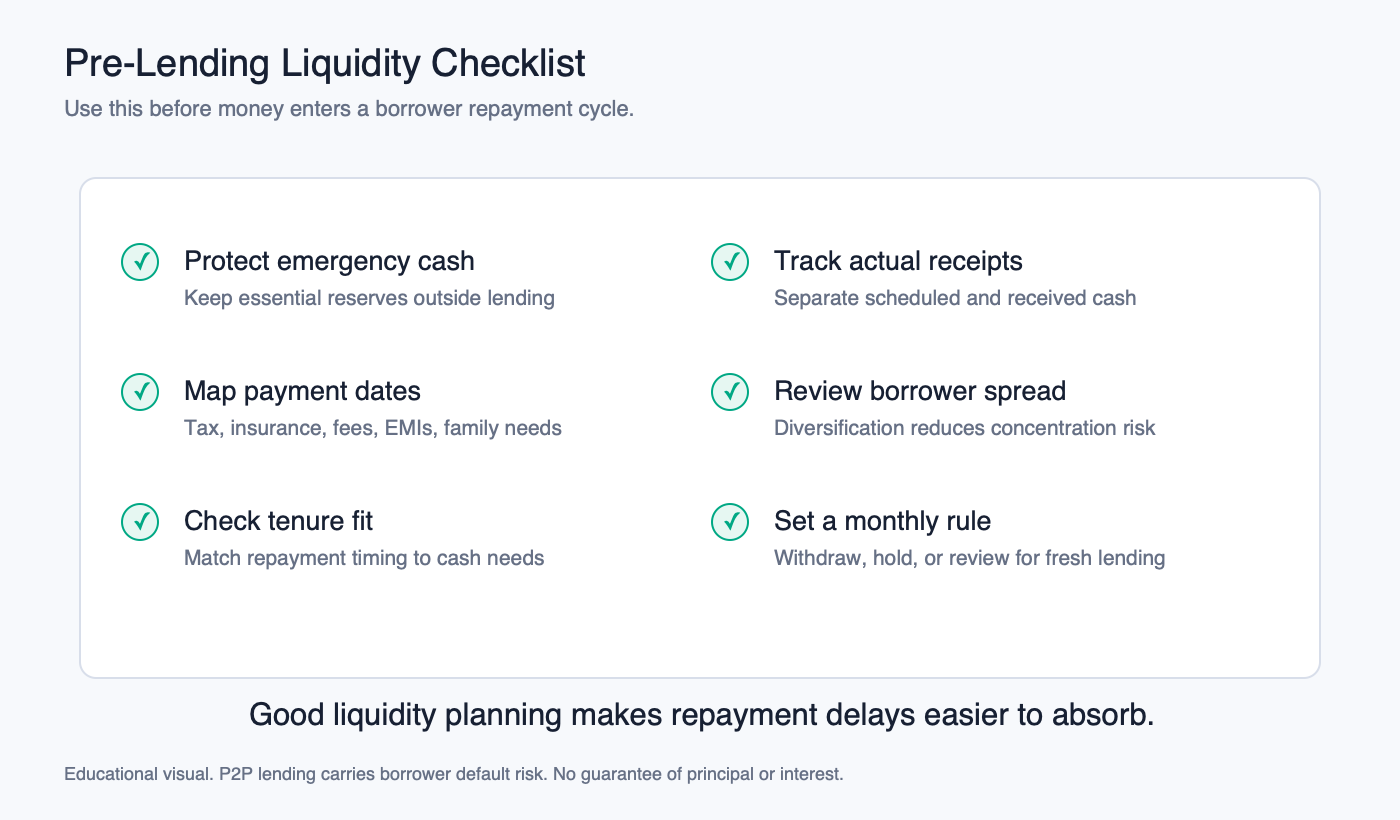
Liquidity planning before alternative investments starts with a simple rule: protect cash needs first, then evaluate surplus money.
For P2P lending, this means separating emergency reserves and planned expenses before lending. It also means understanding tenure, borrower repayment risk, diversification, delayed EMIs, and the difference between scheduled and received repayments.
IndiaP2P can support eligible lenders who want to target up to 18% p.a. indicative returns through P2P lending. But the right starting point is not the return number alone. It is a liquidity plan that can remain stable even if borrower repayments vary.
Once that plan is clear, you can explore IndiaP2P Monthly Income Plan+ and decide whether P2P lending fits your broader cash-flow needs.