RBI P2P lending limits are often read as a simple number: "How much can I lend?" That is only the first layer. The more useful question is: "How much exposure am I carrying, across whom, and what risk remains after the RBI cap?"
IndiaP2P is registered with the Reserve Bank of India as an NBFC-P2P. That registration places the platform inside RBI's peer-to-peer lending framework. It does not mean RBI guarantees repayment, protects principal, or assures any return outcome. P2P lending remains lending to borrowers, and borrower repayment behaviour determines what lenders actually receive.
This guide explains the RBI P2P lender exposure limits in plain language: the ₹50 lakh aggregate cap, the ₹10 lakh Chartered Accountant certificate trigger, the ₹50,000 same-borrower cap, and how lenders should think about these rules before increasing exposure.
For the broader regulatory framework, read IndiaP2P's guide to RBI P2P lending guidelines.
RBI P2P lending limits in one table
The RBI NBFC-P2P framework sets several limits that matter directly to lenders. These are not product features or recommended lending amounts. They are regulatory boundaries within which P2P lending activity must remain.
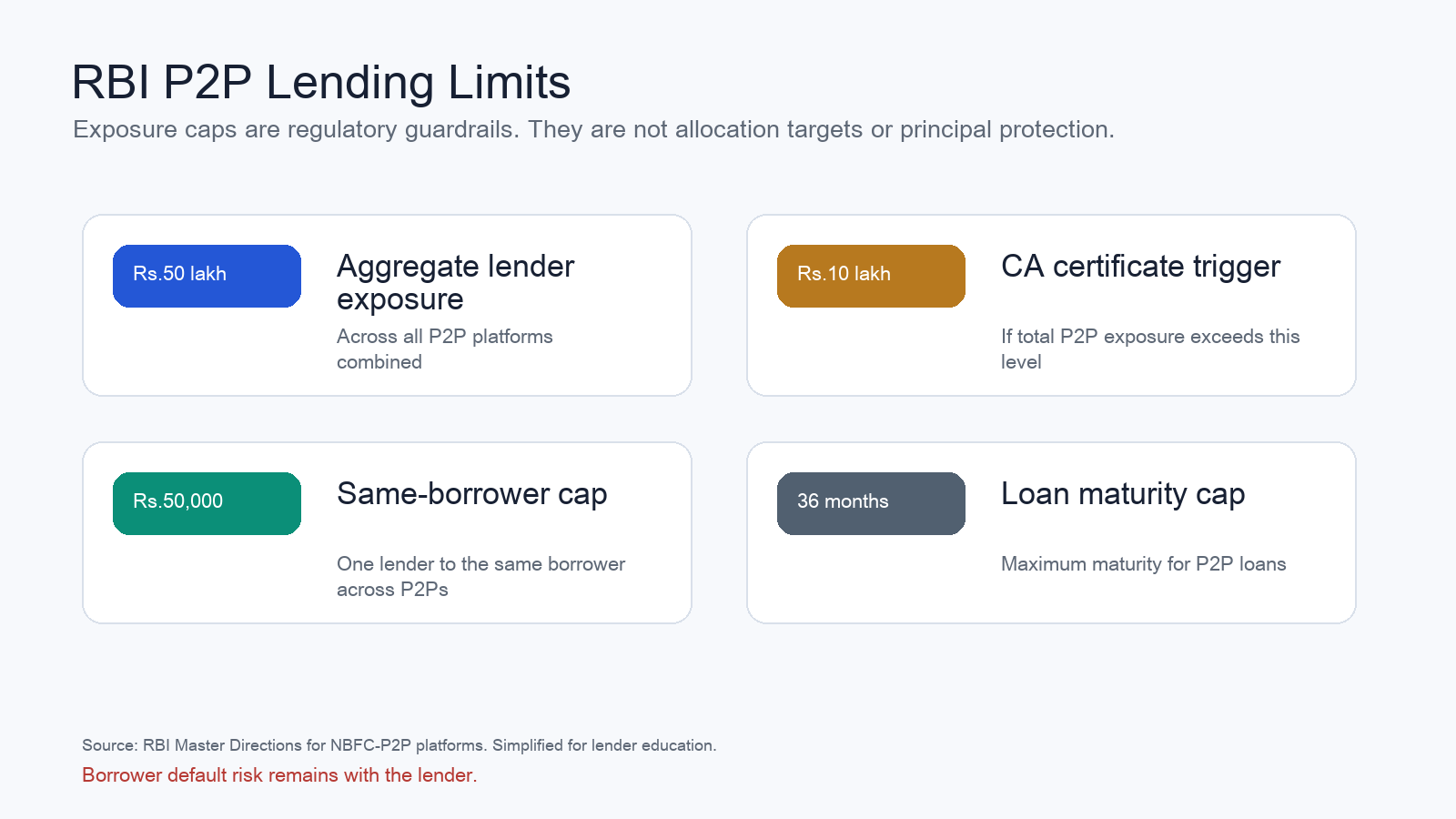
RBI P2P Lending Limit | What it means for a lender |
|---|---|
₹50 lakh aggregate lender exposure cap | A lender's aggregate exposure to all borrowers across all P2P platforms must not exceed ₹50 lakh, provided the amount lent is consistent with the lender's net worth. |
₹10 lakh CA certificate trigger | If a lender's total P2P exposure exceeds ₹10 lakh across P2P platforms, the lender must produce a certificate from a practising Chartered Accountant certifying minimum net worth of ₹50 lakh. |
₹50,000 same-borrower cap | Exposure from one lender to the same borrower, across all P2P platforms, must not exceed ₹50,000. |
36-month loan maturity cap | The maturity of loans originated through P2P platforms must not exceed 36 months. |
The current RBI Master Directions state these limits in the prudential norms for NBFC-P2P platforms. The important phrase is "across all P2P platforms." A lender cannot treat the limit as separate for each platform.
NBFC-P2P exposure limits are ceilings, not allocation advice
NBFC-P2P exposure limits define the outer boundary. They do not tell a lender how much to lend.
A lender with a ₹50 lakh regulatory ceiling may still decide to lend far less. That decision should depend on surplus money, liquidity needs, income stability, existing obligations, risk comfort, tenure preference, and whether the lender can tolerate delayed or reduced repayment.
This distinction matters because a cap can create false comfort. A legal maximum is not the same as a sensible personal allocation. Before increasing exposure, use a risk-aware framework such as how much to allocate to P2P lending.
P2P lending not a deposit: why the cap does not protect principal
P2P lending is not a deposit product. The platform facilitates lending between lenders and borrowers; it does not take deposits, act as a bank, or insure principal.
The RBI cap limits exposure size. It does not absorb borrower default risk. If a borrower delays or defaults, the lender may receive repayment late, partly, or not at all. Recovery support may continue, but recovery timing and amount cannot be promised.
That is why the right reading of the cap is conservative: "This is the maximum permitted exposure boundary, not a protected amount."
P2P lending 50 lakh limit across all platforms
The P2P lending 50 lakh limit applies across all P2P platforms combined. It is not a per-platform limit.
For example, if a lender has ₹12 lakh exposed through one RBI-registered NBFC-P2P platform and ₹8 lakh through another, the lender's aggregate P2P exposure is ₹20 lakh. The number to watch is the total exposure across platforms, not the balance visible on one dashboard.
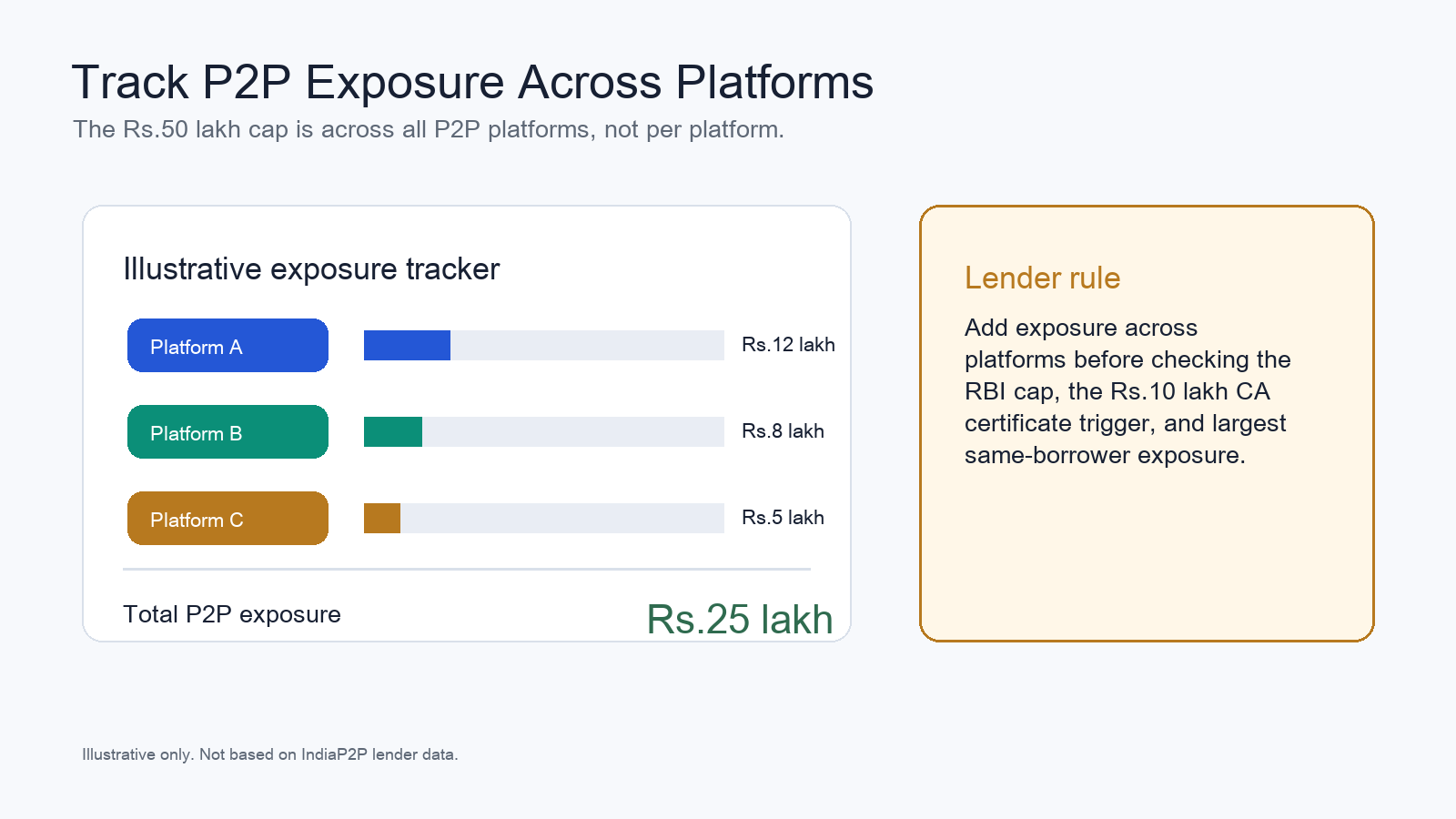
This across-platform rule is important because lenders may open accounts on more than one platform over time. Without a consolidated tracker, it is easy to underestimate total exposure. A simple spreadsheet can help track:
amount currently lent through each P2P platform
money committed but not yet repaid
borrower count and largest borrower exposure
expected repayment dates and actual received repayments
whether total exposure is below or above ₹10 lakh
P2P lending exposure across platforms: what to count
For practical monitoring, lenders should focus on outstanding P2P exposure: money that is currently lent or committed through P2P loans and remains subject to borrower repayment.
Received repayments are different. Once money is repaid and available to withdraw, it is no longer exposed to that borrower loan. But if the lender re-lends the received amount, it becomes new exposure again.
The discipline is simple: track what is still exposed to borrower repayment risk. For the post-lending journey, see the P2P lending repayment process.
P2P lending 10 lakh CA certificate requirement
The ₹10 lakh threshold is not the maximum P2P lending limit. It is the point where additional documentation applies.
If a lender's amount lent through P2P platforms is more than ₹10 lakh across platforms, the RBI framework requires a certificate from a practising Chartered Accountant certifying minimum net worth of ₹50 lakh.
Exposure level across P2P platforms | What to check |
|---|---|
Up to ₹10 lakh | Stay within platform onboarding, KYC, risk declaration, and exposure rules |
More than ₹10 lakh | CA certificate requirement applies, certifying minimum net worth of ₹50 lakh. |
Up to ₹50 lakh | Still subject to net-worth consistency and the aggregate exposure cap. |
Above ₹50 lakh | Not permitted under the RBI lender aggregate exposure cap. |
The certificate requirement does not make lending safer by itself. It is a financial-standing check. Borrower default risk continues to sit with the lender.
P2P lending 50000 borrower limit and concentration risk
The P2P lending 50000 borrower limit is the rule that most directly addresses concentration risk. A single lender cannot have exposure of more than ₹50,000 to the same borrower across all P2P platforms.
This matters because borrower risk is personal and specific. Even a borrower who looks low-risk at the time of assessment can face job loss, business stress, medical expenses, family disruption, or other repayment pressure later.
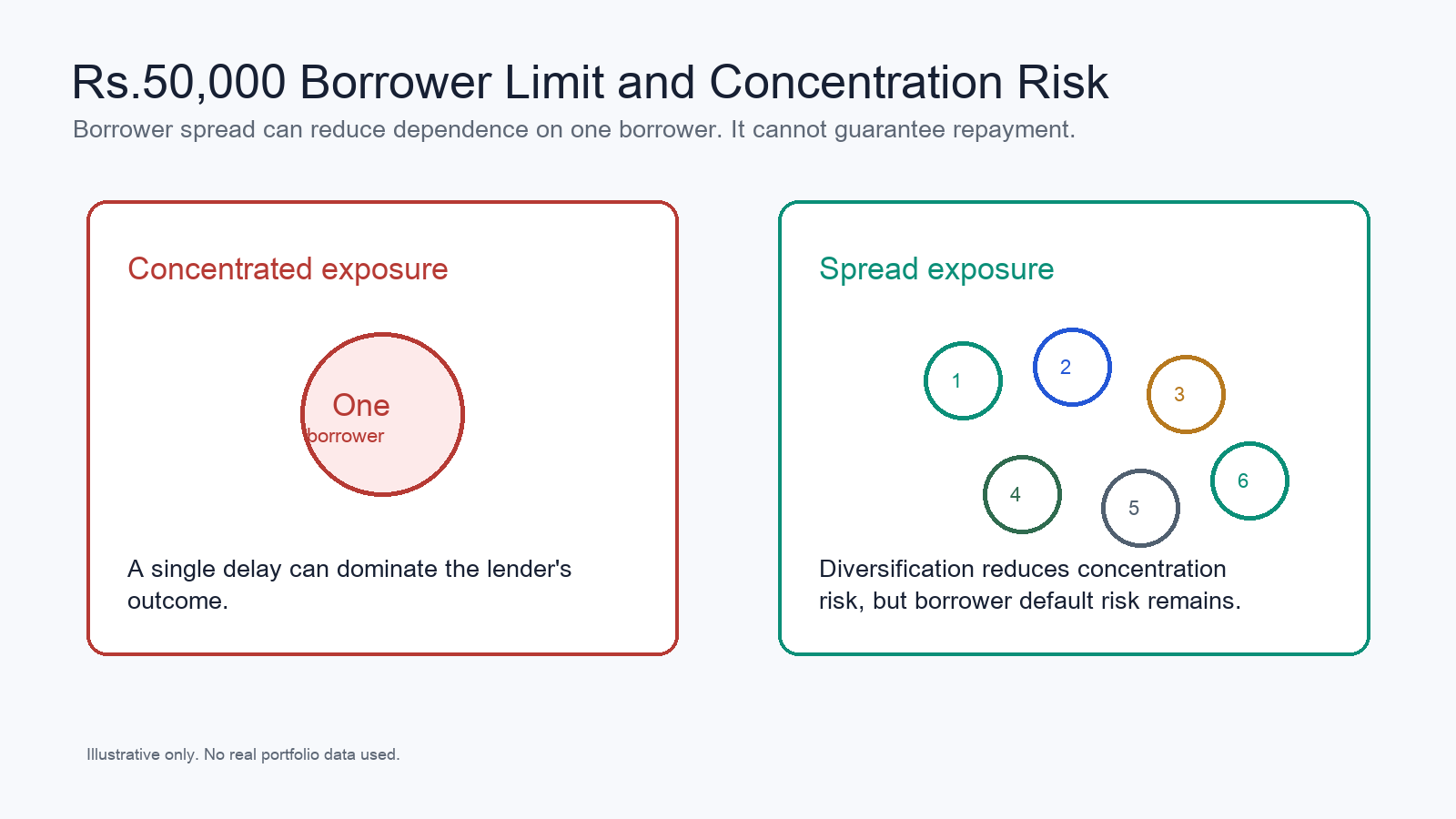
The ₹50,000 cap prevents one lender from taking a very large exposure to one borrower. It also encourages borrower spread. But it should not be read as "₹50,000 is always comfortable." For many lenders, a much smaller per-borrower exposure may be more appropriate.
P2P lending diversification limit: what the ₹50,000 cap can and cannot do
Diversification can reduce dependence on one borrower. It can make the effect of a single delay or default less severe at the overall lending level.
Diversification cannot guarantee repayment. It cannot remove borrower default risk, assure principal recovery, or make every EMI arrive on schedule. A diversified lender can still experience delayed repayments and losses.
Before lending more, understand how IndiaP2P assesses borrowers in the borrower selection credit process.
RBI P2P lending rules for lenders before increasing exposure
Before increasing exposure, a lender should ask five questions:
Question | Why it matters |
|---|---|
Is this surplus money? | Funds needed for emergency expenses or near-term obligations should not depend on borrower repayment. |
Is my total P2P exposure within RBI limits? | The ₹50 lakh cap and ₹10 lakh CA certificate trigger apply across platforms. |
Is my exposure spread across borrowers? | Borrower spread reduces concentration risk but does not remove default risk. |
Do I understand tenure and repayment timing? | P2P loans are tenure-linked; early exit may not be available. |
Have I read fees, taxes, likely return, and risk disclosures? | Net outcome depends on more than the headline rate. |
This is also where return discipline matters. IndiaP2P may refer to indicative return potential of up to 18% p.a., but that figure must be read with borrower repayment risk, platform terms, fees, timing, and tax treatment. It is not a guaranteed outcome for every lender.
For onboarding steps, see how to start lending on IndiaP2P.
RBI registered P2P lending platform checks
An RBI registered P2P lending platform should be the starting filter, not the final decision.
Before lending, check whether the platform names the legal entity, explains its NBFC-P2P registration, avoids assured-return language, shows borrower and loan information before lending, explains fund flow through escrow accounts, and provides clear grievance information.
For a deeper regulatory trust check, read what RBI registration means for P2P lenders.
P2P lender exposure limits example for ₹2 lakh, ₹10 lakh and ₹50 lakh
The examples below are illustrative. They are not lending recommendations and are not based on live borrower listings.
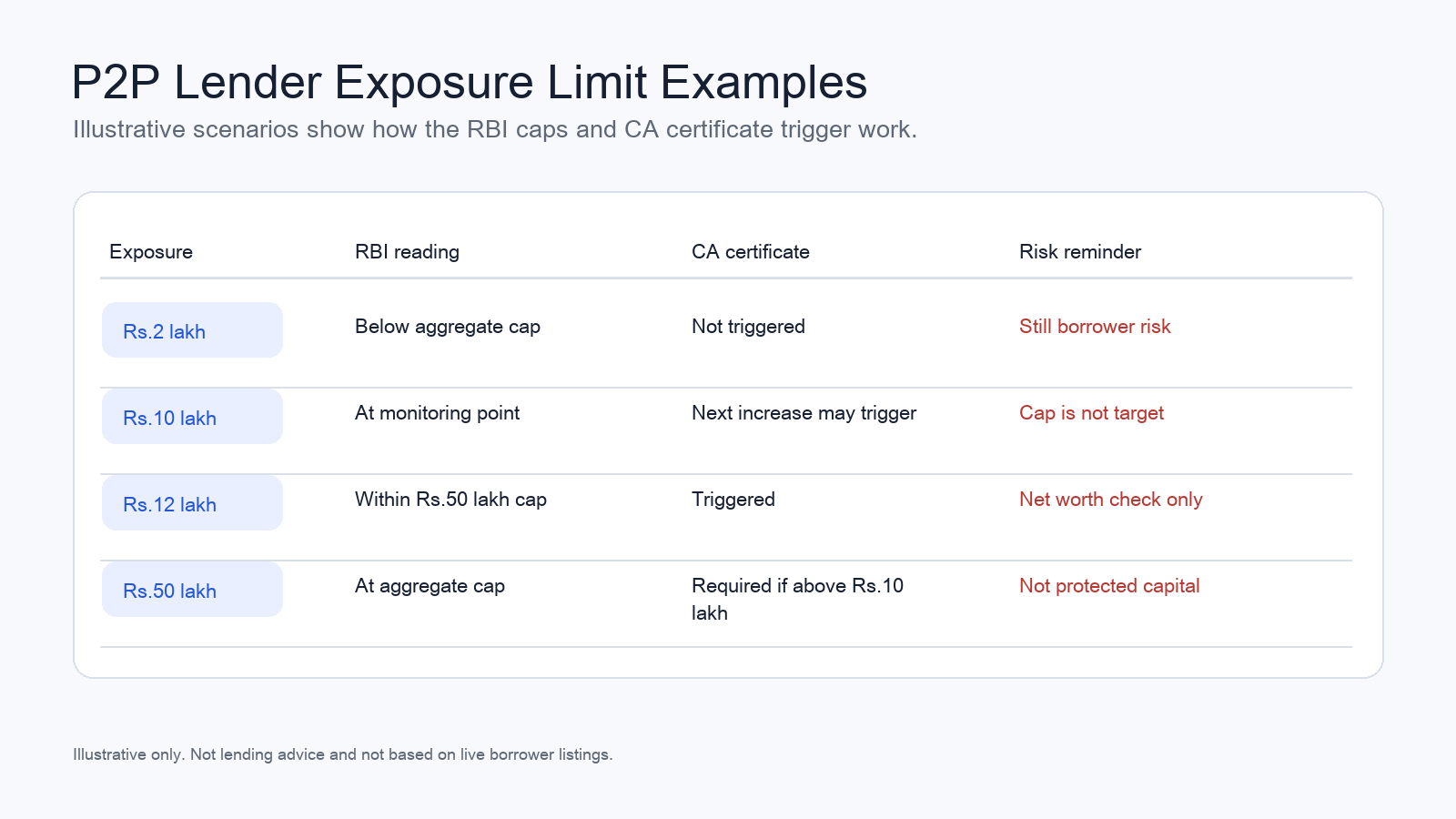
Illustrative total P2P exposure | What the RBI limit means | What the lender should still review |
|---|---|---|
₹2 lakh | Below ₹10 lakh and below ₹50 lakh aggregate cap. Same-borrower cap still applies. | Borrower spread, largest borrower exposure, tenure mix, and whether funds are surplus. |
₹10 lakh | At the threshold where the lender should monitor any further increase carefully. | Whether a move above ₹10 lakh will require a practising CA certificate. |
₹12 lakh | Above ₹10 lakh, so the CA certificate requirement applies. | Net worth documentation, risk comfort, borrower spread, and liquidity needs. |
₹50 lakh | At the aggregate lender exposure cap, subject to net-worth consistency. | Whether this much borrower-risk exposure is personally suitable. The cap is not a target. |
Notice that every row still includes borrower risk. That is the point. RBI P2P lending limits control the size and spread of exposure, but the underlying repayment depends on borrowers.
Borrower default risk after RBI P2P lending limits
RBI P2P lending limits do not remove borrower default risk. They set boundaries around the lending activity.
If a borrower pays on time, repayment may flow back through the platform's prescribed process. If a borrower delays, there may be no borrower money available to route. If a borrower defaults, the lender may lose interest, principal, or both.
Escrow rules are also sometimes misunderstood. Escrow supports structured fund flow. It is not principal protection. Learn more in IndiaP2P's guide to the escrow account in P2P lending.
IndiaP2P lender checklist for NBFC-P2P exposure limits
Use this checklist before adding more P2P exposure:
My total P2P exposure across platforms is within the ₹50 lakh RBI cap.
I know whether I am below or above the ₹10 lakh CA certificate trigger.
No single borrower exposure crosses ₹50,000 across P2P platforms.
I understand P2P lending is not a deposit product.
I am using surplus money, not emergency or near-term expense money.
I have checked borrower spread, tenure mix, expected repayments, and actual received repayments.
I understand that borrower delay or default can reduce interest, principal, or both.
I have read the platform's risk disclosure and grievance process.
Review your lending limits and risk comfort before you lend on IndiaP2P.
Closing summary
RBI P2P lending limits create a defined regulatory perimeter for lenders. The ₹50 lakh cap limits total exposure across platforms. The ₹10 lakh threshold introduces a CA net-worth certificate requirement. The ₹50,000 borrower cap reduces concentration in a single borrower.
But none of these rules convert P2P lending into a guaranteed product. The lender still carries borrower default risk. The practical way to use the rules is not to ask only "How much is allowed?" It is to ask "How much exposure is suitable, how well is it spread, and what happens if repayments are delayed?"