RBI P2P lending guidelines in 2026 are best understood as rules for how a peer-to-peer lending platform should operate. They create a regulated framework for registration, fund flow, disclosures, exposure limits, borrower assessment, grievance handling, and platform conduct.
They do not guarantee repayment.
That distinction matters for every lender. An RBI-registered NBFC-P2P platform facilitates lending between lenders and borrowers. It is not a deposit-taking bank, it does not lend its own money through the P2P marketplace, and it cannot assure return of principal or interest. If borrowers repay as expected, the lender receives principal and interest according to the loan terms. If borrowers delay or default, the lender bears the effect.
This guide explains the RBI NBFC-P2P rules that matter most in 2026, what changed after the 2024 tightening of the framework, and how a lender should read these rules before lending through IndiaP2P or any other registered P2P platform.
What the RBI NBFC-P2P Rules Mean in 2026
The Reserve Bank of India regulates peer-to-peer lending platforms through the NBFC-P2P framework. The current Master Direction is the Master Direction - Non-Banking Financial Company - Peer to Peer Lending Platform (Reserve Bank) Directions, 2017, updated over time, including updates reflected in 2024 and 2025.
The purpose of the framework is not to remove P2P lending risk. It is to define what a platform may do, what it must disclose, how participant money should move, and where the platform's role ends.
For lenders, the short version is this: RBI registration helps confirm that the platform sits inside a regulated category, but the lending decision still depends on borrower repayment risk, diversification, tenure, liquidity needs, and your ability to tolerate delays.
NBFC-P2P Meaning for Lenders and Borrowers
NBFC-P2P means Non-Banking Financial Company - Peer to Peer Lending Platform. In plain language, it is a regulated platform category for entities that facilitate loans between lenders and borrowers through an online platform.
The lender provides funds to borrower loans. The borrower takes the loan and repays according to the agreed terms. The platform facilitates onboarding, borrower assessment, documentation, matching or mapping, fund transfer, repayment tracking, servicing, disclosures, and recovery support.
That role is important, but limited. The platform is not the borrower. It does not turn borrower credit risk into platform-backed repayment.
RBI Registration Is Not RBI Guarantee
RBI registration should be read as a platform-level regulatory fact. It should not be read as RBI approval of returns, borrower quality, liquidity, or principal recovery.
The RBI framework requires platforms to make this clear. A P2P platform must not provide assurance or guarantee for loan recovery, and it must not promote peer-to-peer lending as an assured-return product with liquidity features.
IndiaP2P, legally Trickle Flood Technologies Pvt Ltd, is registered with the Reserve Bank of India as an NBFC-P2P. That registration creates a regulatory perimeter for platform conduct. It does not remove borrower default risk.
For a deeper registration-specific explainer, read IndiaP2P's guide to what RBI registration means for P2P lenders.
P2P Lending Regulation in India: What Platforms Can and Cannot Do
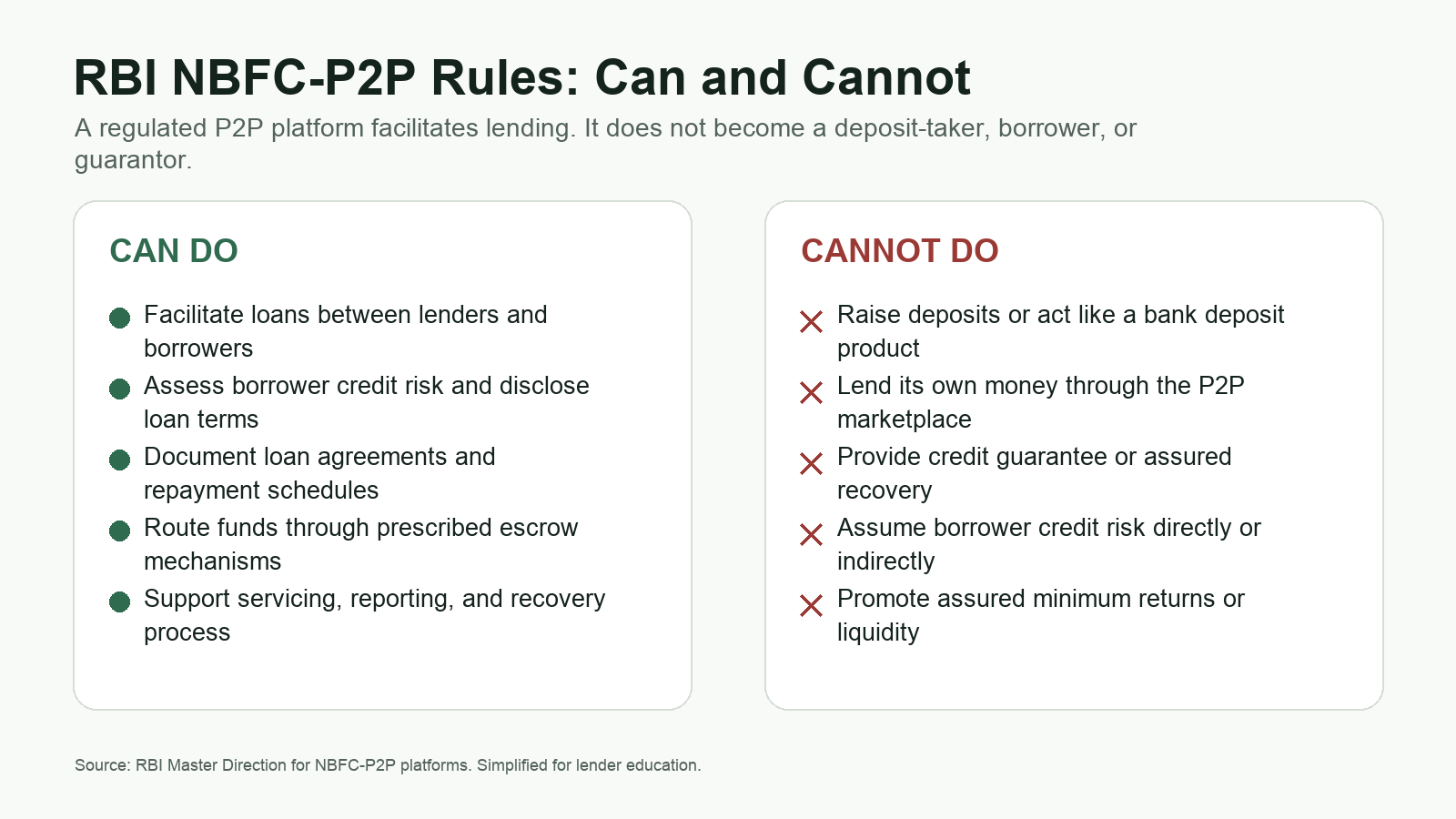
The RBI P2P lending guidelines define the platform as an intermediary. This is the core idea behind almost every rule.
An NBFC-P2P platform can provide an online marketplace or platform for participants involved in peer-to-peer lending. It can undertake participant due diligence, assess borrower credit risk, disclose borrower and loan information, document loan agreements, help with disbursement and repayment, and support recovery activity.
But it cannot behave like a bank, deposit-taker, pooled fund, balance-sheet lender, or guarantor.
NBFC-P2P Platforms Must Act as Intermediaries
Under the RBI framework, an NBFC-P2P acts as an intermediary for loan facilitation. This means the platform supports the lending process between participants; it should not substitute itself for the borrower or quietly absorb credit risk.
This distinction protects the integrity of the category. If a platform markets P2P lending as though the platform itself is promising repayment, the lender may underestimate the actual risk: borrower repayment behaviour.
P2P Lending Is Not a Deposit Product
P2P lending is not a deposit. A deposit involves a different legal relationship and a different risk framework. In P2P lending, the lender is exposed to one or more borrower loans through an NBFC-P2P platform.
RBI rules state that an NBFC-P2P must not raise deposits. This is not a minor technical point. It means a lender should not read the platform balance as deposit-like money, should not assume on-demand withdrawal, and should not treat scheduled repayments as assured cash.
For a focused explanation, read P2P lending vs fixed deposit: why P2P is not a deposit.
Credit Guarantee and Assured Return Claims Are Not Allowed
The RBI framework is explicit that NBFC-P2P platforms must not provide or arrange credit enhancement or credit guarantee. It also states that the platform must not assume credit risk directly or indirectly.
For lenders, this is the most important risk line in the rules. If there is any loss of principal, interest, or both on funds lent to borrowers through the platform, that loss is borne by the lender.
The same principle applies to return language. P2P lending should not be presented as an assured minimum-return product. If IndiaP2P refers to return potential such as up to 18% p.a., it must be read as indicative and subject to borrower repayment performance, fees, timing, and risk. It is not a promise of outcome for every lender.
RBI P2P Lending Limits Every Lender Should Know
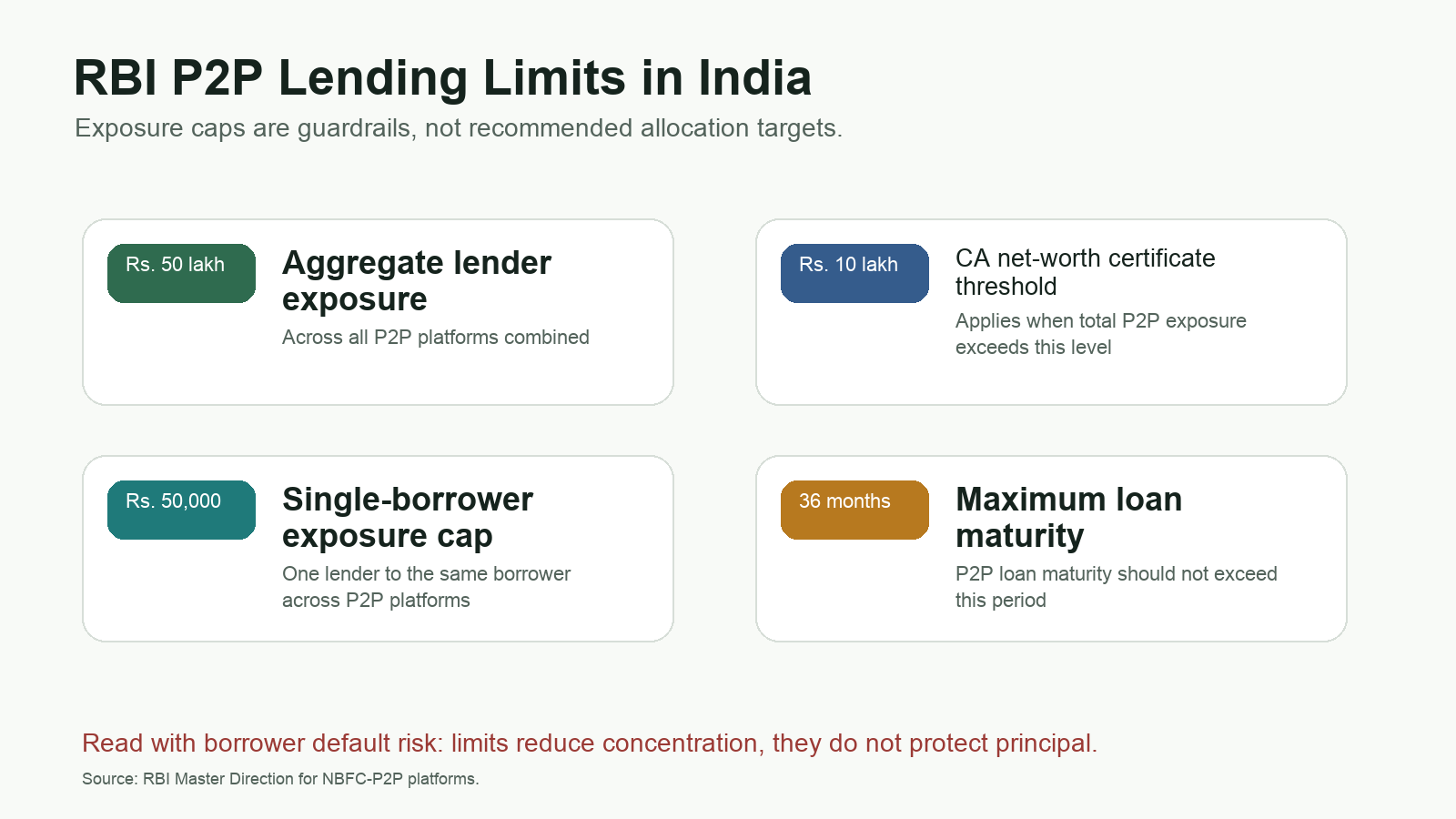
RBI P2P lending limits are exposure guardrails. They do not tell you how much you should lend. They tell you the outer limits within which P2P exposure must remain.
The three limits most relevant to lenders are the aggregate lender exposure cap, the single-borrower cap, and the loan maturity cap.
Rs. 50 Lakh Aggregate Lender Exposure Cap
RBI caps a lender's aggregate exposure across all P2P platforms at Rs. 50 lakh. This is an across-platform cap, not a per-platform cap.
If a lender's exposure across P2P platforms exceeds Rs. 10 lakh, the framework requires a certificate from a practising Chartered Accountant certifying minimum net worth of Rs. 50 lakh.
The cap should not be treated as a recommended allocation. A prudent lending amount may be much lower, depending on surplus cash, risk comfort, existing obligations, and liquidity needs. For sizing discipline, read how much to allocate to P2P lending.
Rs. 50,000 Single-Borrower Exposure Cap
RBI caps exposure from a single lender to the same borrower across all P2P platforms at Rs. 50,000.
This rule helps reduce concentration, but it does not remove risk. A borrower can still delay or default. The cap only limits how much one lender can be exposed to one borrower.
That is why lender diversification still matters. Spreading lending across many borrower loans can reduce dependence on a single repayment, but it cannot guarantee that every borrower will repay on schedule.
36-Month Loan Maturity Rule
RBI rules cap P2P loan maturity at 36 months.
This matters because P2P lending is tenure-linked. Your money generally comes back through borrower repayments over time. A longer loan tenure may increase the period during which funds remain exposed to borrower repayment behaviour. A shorter tenure may improve cash rotation, but it still carries borrower default risk.
Before selecting any plan or borrower allocation, review tenure, expected EMI dates, repayment frequency, and whether the cash can stay exposed for the selected period. IndiaP2P's guide on how to choose tenure in P2P lending explains this in more detail.
NBFC-P2P Escrow Account Rules and the T+1 Timeline
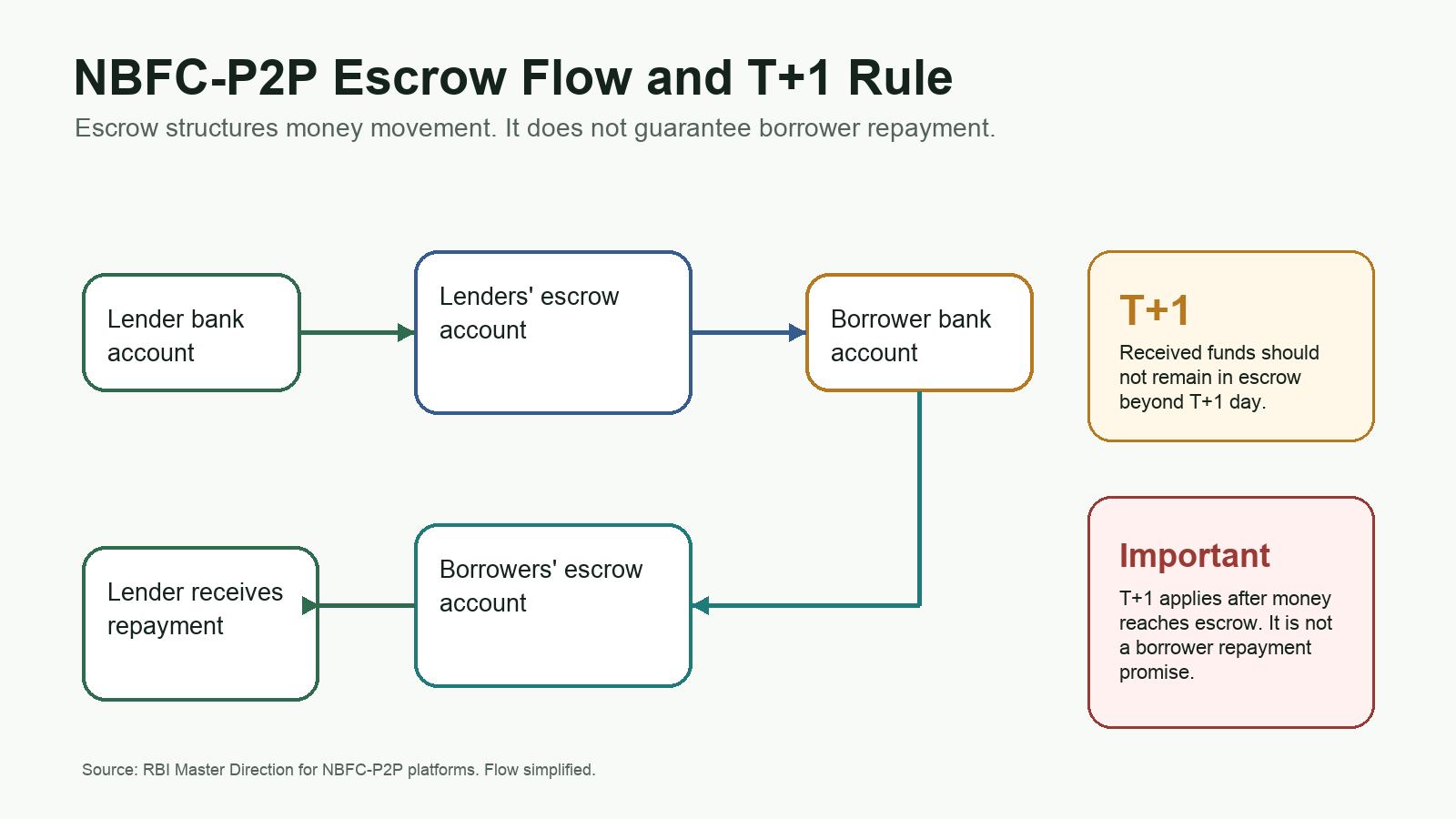
Escrow is one of the most visible parts of the RBI NBFC-P2P rules because it controls how money moves.
RBI requires fund transfer between participants on a P2P platform to happen through escrow account mechanisms operated by a bank-promoted trustee. This helps separate participant money from the platform's own operating funds.
Escrow is useful process infrastructure. It is not principal protection.
Lenders' Escrow and Borrowers' Escrow Accounts
The RBI framework requires at least two escrow accounts.
The lenders' escrow account is used for money received from lenders and pending disbursal to specific borrowers. The borrowers' escrow account is used for borrower repayment collections pending transfer to respective lenders.
The two flows must not be mixed. Funds from the lenders' escrow account should not be used for borrower repayments. Funds from the borrowers' escrow account should not be used for loan disbursals. All transfers must be through bank accounts; cash transactions are prohibited.
For a step-by-step fund-flow explanation, read IndiaP2P's guide to escrow accounts in P2P lending.
T+1 Rule in P2P Lending Is Settlement Timing, Not Liquidity
Under the updated NBFC-P2P framework, funds transferred into the lenders' escrow account or borrowers' escrow account must not remain in those escrow accounts beyond T+1 day, where T is the date the funds are received in the escrow account.
This rule is about settlement discipline after money reaches escrow. It should not be misunderstood as a borrower repayment guarantee.
If a borrower has not paid an EMI, there is no borrower repayment in escrow to settle. T+1 does not create liquidity before borrower money is received. It only controls how long received funds may remain in the escrow structure.
That is why a lender should distinguish between expected repayments and received repayments. The dashboard may show a schedule, but scheduled cash is not the same as received cash.
P2P Lending Disclosure Requirements Under RBI Rules
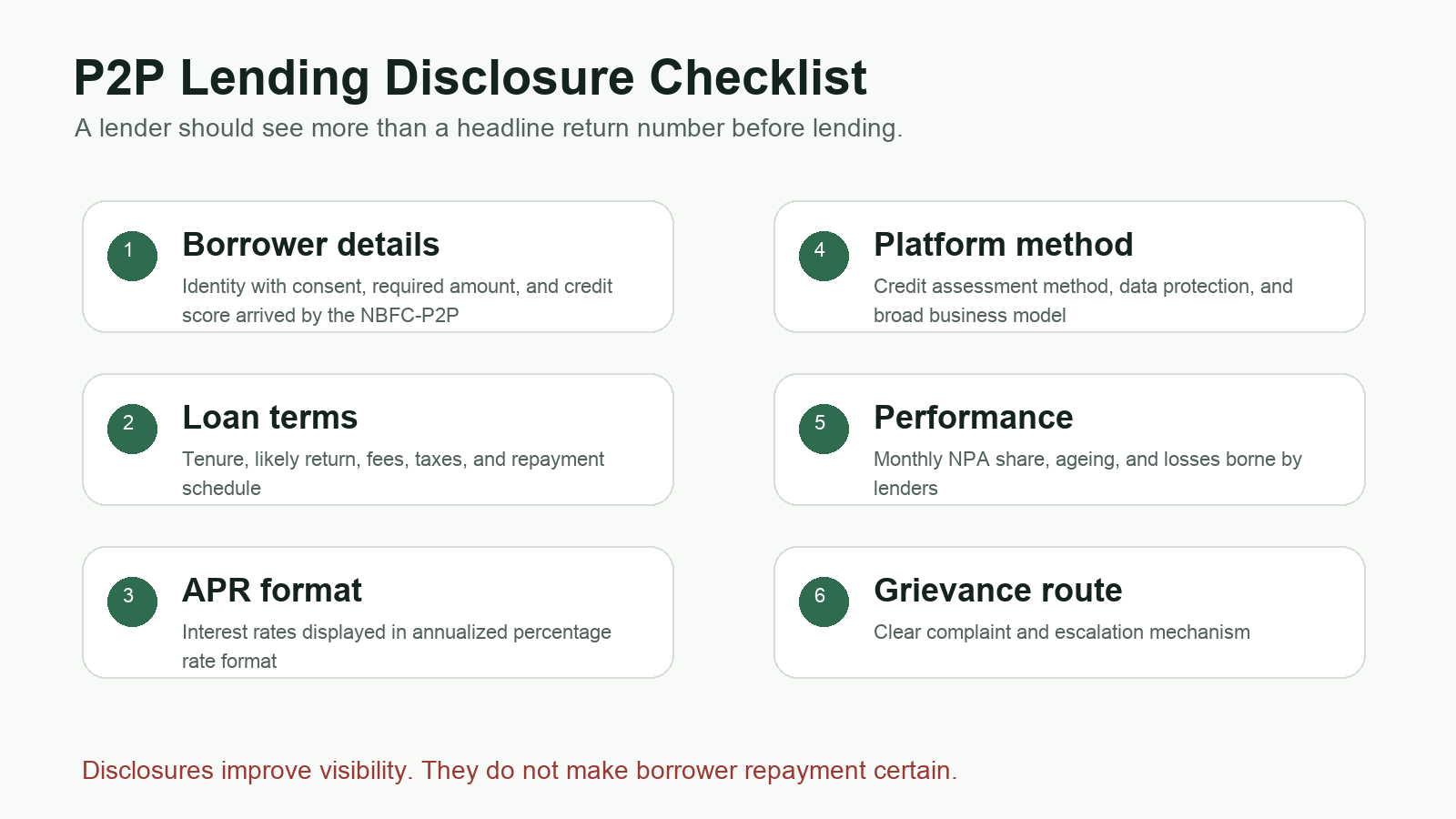
The RBI framework requires NBFC-P2P platforms to make important disclosures to lenders, borrowers, and the public. These disclosures help participants understand the transaction before entering it.
Disclosures do not remove lending risk. They make the risk more visible.
Borrower Details, Credit Assessment and APR Disclosure
Before lending, a lender should receive borrower and loan information. RBI's framework refers to borrower details, required amount, interest rate sought, credit score as arrived by the NBFC-P2P, and loan terms including likely return, fees, and taxes.
Interest rates displayed on the platform must be shown in Annualized Percentage Rate (APR) format.
For a lender, this means the pre-lending screen should not be a return number alone. It should help answer: who is the borrower segment, what is the loan amount, what is the tenure, what fees apply, what repayment schedule is expected, and what risk information is visible?
Monthly NPA and Loss Disclosure on Platform Websites
RBI's disclosure requirements also include public website-level information. NBFC-P2P platforms are expected to disclose an overview of credit assessment or score methodology, data usage and protection disclosures, grievance redressal mechanism, broad business model, and portfolio performance including the share of non-performing assets.
Importantly, performance disclosure should include losses borne by lenders on principal, interest, or both.
This is where serious lender education differs from return-first marketing. A lender should not only ask, "What return is shown?" The better question is, "What does the platform disclose about risk, overdue loans, losses, fees, and borrower assessment?"
Borrower Default Risk Under RBI P2P Lending Guidelines
RBI P2P lending guidelines reduce ambiguity around platform conduct. They do not remove borrower default risk.
Borrower default risk is the possibility that a borrower pays late, pays partly, or does not repay. This can reduce interest received, delay expected monthly cash flow, or affect principal recovery.
The platform may support assessment, documentation, reporting, servicing, and recovery. It may also publish risk disclosures and portfolio-level performance. But it cannot guarantee that every borrower will repay.
Why Diversification Reduces Concentration Risk Only
Diversification is useful because it reduces dependence on one borrower or a small group of borrowers. If a lender spreads funds across many borrower loans, one delay may have a smaller effect than it would in a concentrated exposure.
But diversification is not a guarantee. It does not convert risky loans into protected principal. It only changes the distribution of exposure.
What Happens When Borrowers Delay or Default
When a borrower delays, the lender may receive cash later than expected. When a borrower defaults, the lender may lose interest, principal, or both. Recovery efforts may continue, but recovery timing and amount are uncertain.
This is why P2P lending should be considered only with surplus money. Funds needed for emergency expenses, rent, tax payments, school fees, payroll, or near-term medical needs should not be lent through P2P.
Before lending, read IndiaP2P's P2P lending risk disclosure guide.
RBI Registered P2P Lending Platform Checklist for Lenders
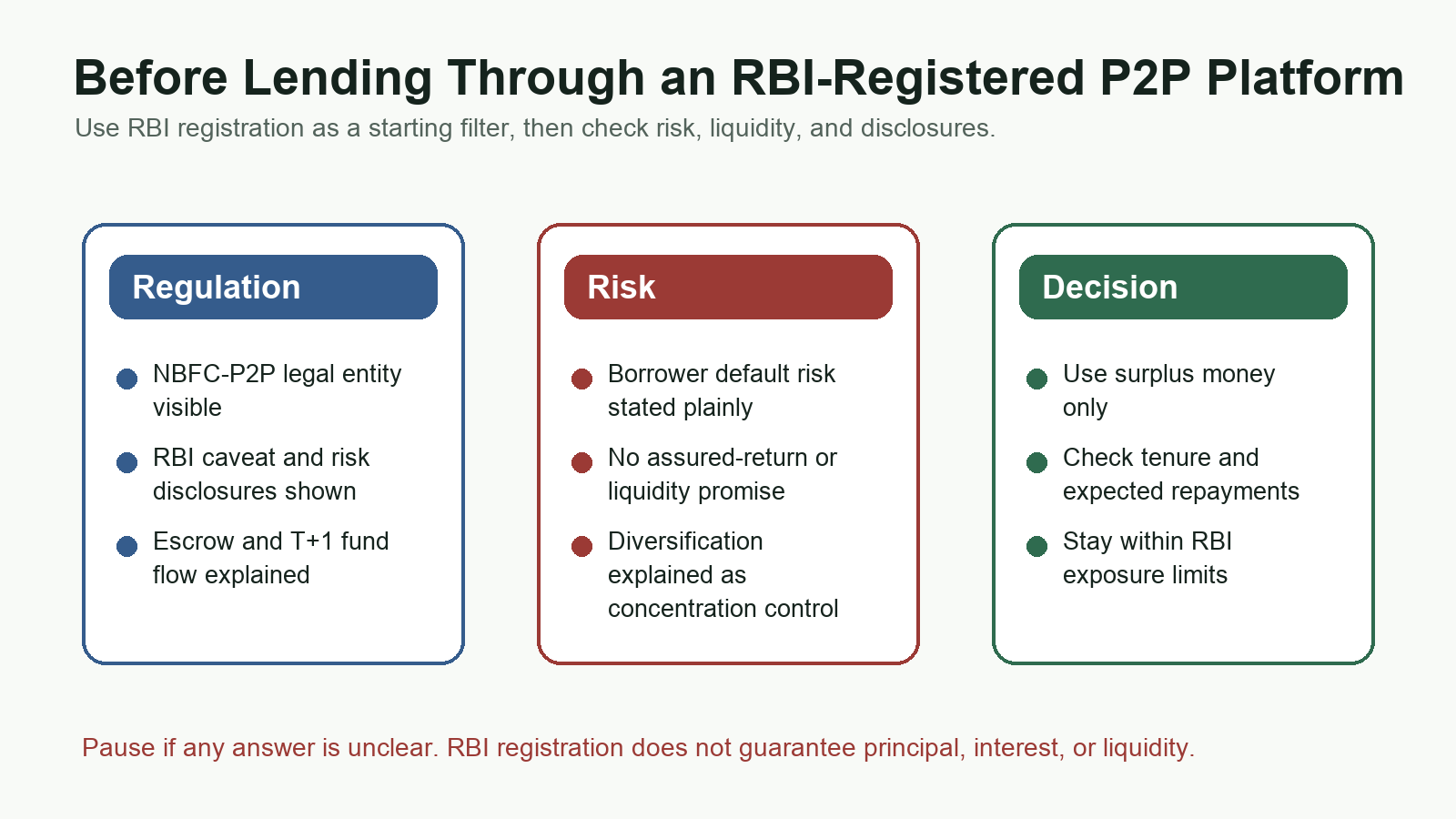
An RBI-registered P2P lending platform should be the starting filter, not the final decision.
Use this checklist before lending:
Question | Why it matters |
|---|---|
Is the legal entity registered as an NBFC-P2P? | Confirms the platform sits inside the RBI P2P framework. |
Does the platform avoid assured-return language? | Shows whether risk is being presented honestly. |
Are lender and borrower fund flows explained clearly? | Helps you understand escrow movement and T+1 timing. | |
Are borrower details and loan terms shown before lending? | Supports informed lender consent. |
Are fees, taxes, likely return and APR visible? | Helps evaluate net outcome instead of headline return. |
Are overdue, NPA and loss disclosures available? | Helps you judge risk visibility. |
Is diversification explained without guarantee language? | Prevents false comfort. |
Is the grievance route easy to find? | Shows operational accountability. |
Can your money stay exposed for the loan tenure? | Helps avoid liquidity mismatch. |
Questions to Ask Before Lending Through an NBFC-P2P Platform
Before lending, ask yourself:
Am I using surplus money?
Do I understand that RBI registration is not repayment assurance?
Do I know the expected tenure and repayment pattern?
Do I understand the borrower default risk?
Do I know whether my total P2P exposure is within RBI limits?
Do I understand that up to 18% p.a. is indicative return potential, not a guaranteed outcome?
Can I tolerate delayed repayments without needing immediate withdrawal?
If the answer to any of these is unclear, pause before lending.
IndiaP2P and RBI NBFC-P2P Rules: A Risk-Aware Summary
IndiaP2P enables eligible lenders to lend to verified borrowers through an RBI-registered NBFC-P2P platform. The platform supports onboarding, borrower assessment, lending workflow, fund-flow processes, repayment tracking, and disclosures.
IndiaP2P may show indicative return potential of up to 18% p.a., but the outcome depends on borrower repayment performance, fees, timing, diversification, and risk. The return figure should never be read without the risk sentence beside it: borrower default can reduce or delay principal and interest recovery.
The right way to read RBI P2P lending guidelines in 2026 is practical, not promotional.
They tell you that the platform must operate within a defined framework. They tell you that money should move through prescribed escrow structures. They tell you that exposure limits apply. They tell you that borrower and platform disclosures matter. They tell you that P2P lending must not be sold as an assured-return product.
They also tell you where the risk remains.
Borrower repayment risk remains with the lender. RBI registration does not guarantee returns, liquidity, or principal. Escrow improves the money-movement process, but it does not make every borrower repay. Diversification can reduce concentration risk, but it cannot eliminate default risk.
That is the useful reading of the RBI NBFC-P2P rules: they create structure, transparency, and boundaries. The lending decision still requires risk awareness.