If you want to start lending on IndiaP2P, the first step is not choosing a return number. It is understanding what P2P lending is, how your money moves, what risk you take, and what IndiaP2P can and cannot do as an RBI-registered NBFC-P2P platform.
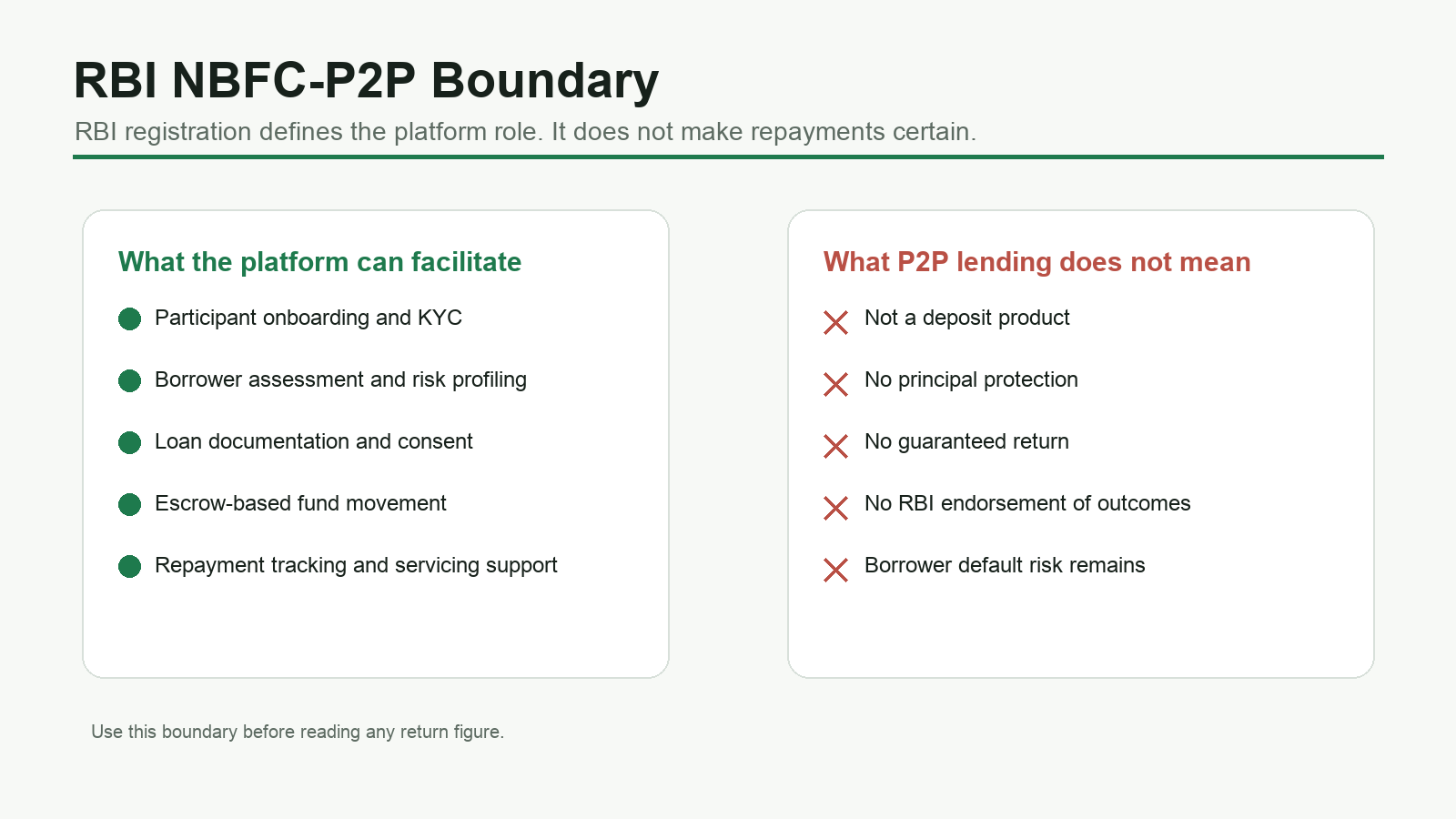
IndiaP2P, legally Trickle Flood Technologies Pvt Ltd, enables eligible lenders to lend to borrowers through a peer-to-peer lending platform. The platform facilitates onboarding, borrower assessment, documentation, fund movement and repayment tracking. It does not take deposits, protect principal, or guarantee borrower repayments.
This guide walks through the practical sequence: eligibility, KYC, account setup, adding funds, choosing a lending plan, borrower allocation, escrow flow and repayment tracking. Use it as a pre-lending checklist before you create or fund your IndiaP2P lender account.
IndiaP2P lending eligibility and KYC documents
Before you start lending on IndiaP2P, keep the basic onboarding items ready. A regulated P2P lending platform must identify participants, verify bank details, collect required declarations and maintain platform records. The exact screen flow may change over time, but the lender should expect identity, bank and consent checks before funds are lent.
What to check | Why it matters before P2P lending |
|---|---|
PAN and identity details | Needed for lender verification and platform records |
Aadhaar or approved identity route | Supports KYC verification where applicable |
Active bank account | Used for permitted fund movement and repayment receipts |
Mobile and email access | Needed for OTPs, account communication and servicing updates |
Surplus-money fit | P2P lending carries borrower default risk and should not use emergency funds |
Risk disclosure review | Principal and interest are not guaranteed |
Who can become a P2P lender in India
P2P lending eligibility in India depends on platform policy and applicable law. At a practical level, a lender should have valid identity records, a bank account, PAN details and the ability to complete the platform's KYC process. The lender should also understand that P2P lending is a borrower-linked loan exposure, not a savings account or deposit product.
For a broader first-time overview, IndiaP2P's P2P lending beginner guide is a useful starting point before you move into account setup.
PAN, Aadhaar and bank account checks for IndiaP2P onboarding
The IndiaP2P KYC process is designed to confirm the lender's identity, contact details and bank account route. Keep your PAN, identity details, mobile number, email and bank account information ready. If an additional declaration or consent is requested during onboarding, read it before accepting. A few extra minutes at this stage can prevent later confusion about fund movement, repayment schedules, fees or risk.
RBI-registered NBFC-P2P rules before lending
IndiaP2P is registered with the Reserve Bank of India as an NBFC-P2P. This is a regulatory fact, not a return endorsement. RBI's NBFC-P2P framework defines the platform as an intermediary that provides loan facilitation between participants. It also states that an NBFC-P2P should not raise deposits, lend on its own, provide credit guarantees or assume credit risk from loans on the platform.
That distinction matters because the lender takes borrower repayment risk. IndiaP2P can facilitate process, assessment, documentation, matching or mapping, repayment assistance and disclosures. It cannot make a borrower repayment certain.
P2P lending is not a deposit product
P2P lending is not a bank deposit, fixed deposit or money-back product. When you lend through a P2P platform, your money is linked to borrower loans. Repayments depend on borrowers paying as scheduled. If borrowers delay or default, your receipts can be delayed, reduced or impaired.
For a deeper distinction, read IndiaP2P's guide on why P2P lending is not a deposit.
RBI P2P exposure limits for lenders
The RBI framework caps a lender's total exposure across all P2P platforms at Rs 50 lakh. It also caps exposure from a single lender to the same borrower across all P2P platforms at Rs 50,000. If a lender's total amount lent across P2P platforms exceeds Rs 10 lakh, the framework requires a net-worth certificate from a practicing Chartered Accountant certifying minimum net worth of Rs 50 lakh.
These limits are not targets. They are maximum regulatory boundaries. A first-time lender should usually think in terms of personal risk comfort, surplus money, liquidity needs and ability to tolerate delayed repayments.
Borrower default risk and returns are not guaranteed
Borrower default risk is central to P2P lending. IndiaP2P can assess borrowers and support recovery processes, but assessment does not remove risk. There is no guarantee of return of principal or interest. Any return figure, including IndiaP2P's "up to 18% p.a." communication, should be read with this risk context beside it.
IndiaP2P onboarding steps: account, KYC, bank and e-sign
Once you understand the risk and regulatory boundary, the practical onboarding sequence is straightforward. The goal is to create a verified IndiaP2P lender account, connect the correct bank route, review terms, and only then lend through the platform.
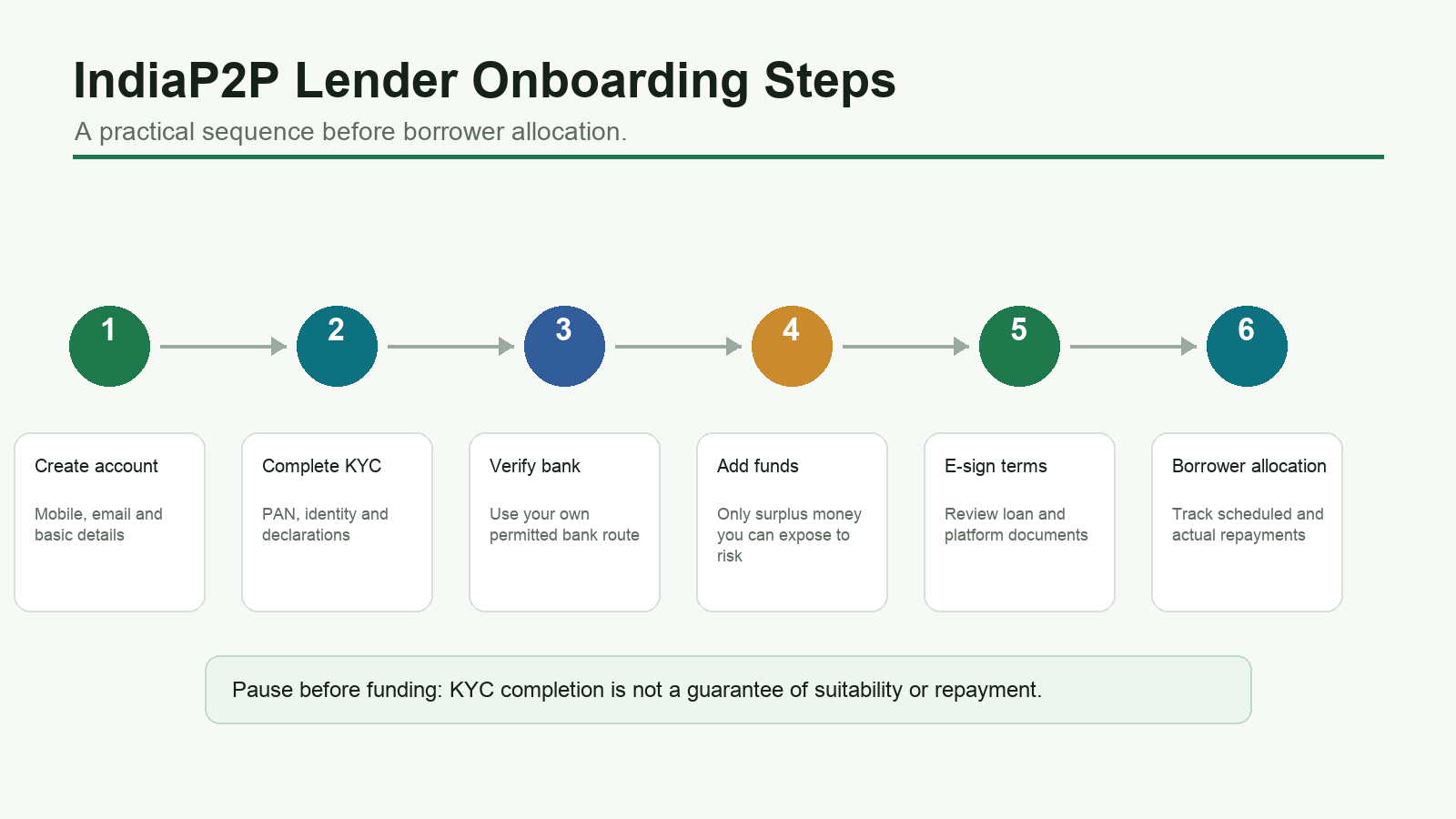
Create your IndiaP2P lender account
Start from the official IndiaP2P website or app route. Use your own mobile number, email and identity details. Avoid creating an account for someone else unless the platform specifically supports that route and the required consent/documentation is in place.
The account should be treated as a regulated lending account, not a casual wallet. The details you enter can affect KYC checks, bank verification and servicing communication.
Complete KYC verification and lender declaration
KYC verification confirms that the lender is identifiable and eligible under the platform's onboarding policy. You may also need to accept platform terms, risk disclosures and lender declarations. Read these carefully, especially anything related to borrower risk, fees, repayment timing, reporting and recovery support.
Do not treat KYC completion as product suitability approval. It confirms onboarding status; it does not mean P2P lending is suitable for every rupee of your surplus.
Add funds through permitted payment routes
After account verification, funds should be added only through platform-permitted payment routes. Under the RBI framework, fund movement in P2P lending must happen through bank accounts and prescribed escrow mechanisms. Cash transactions are not permitted.
Before adding funds, decide the amount you are comfortable exposing to borrower default risk. If the money is needed for rent, school fees, medical reserves or near-term commitments, it may not belong in P2P lending.
E-sign terms before borrower allocation
Before money is lent, the relevant loan documentation and platform terms must be completed. The RBI framework requires appropriate agreements between participants and the NBFC-P2P. Do not rush this step. Check what you are accepting, whether borrower allocation is manual or automated, how fees are shown, and how repayment information will be visible later.
Choosing an IndiaP2P lending plan and amount
The right amount is not the largest amount allowed by regulation. It is the amount that fits your surplus money, time horizon, repayment uncertainty and ability to tolerate borrower default. Start with a number that lets you learn the process without depending on perfect repayments.
Decision point | Better first-lender question |
|---|---|
Lending amount | Can I tolerate delayed or reduced repayments on this amount? |
Plan choice | Do I want expected monthly repayments or a different repayment pattern? |
Return figure | Is the return shown with default-risk context? |
Tenure | Can I leave money exposed for the loan period? |
Borrower spread | Is my money diversified across borrower loans? |
Exit need | What happens if I need cash before repayments arrive? |
Monthly Income Plan Plus for expected monthly repayments
IndiaP2P's Monthly Income Plan Plus is built around expected monthly repayments from borrower loans. The word "expected" matters. Monthly receipts depend on borrower repayments and may vary if borrowers delay or default.
Before choosing the plan, review the Monthly Income Plan checklist before lending. It helps keep the decision anchored in repayment mechanics instead of only headline return potential.
Minimum lending amount and surplus-money fit
Do not start by asking, "What is the maximum I can lend?" Start with, "What amount can I expose without affecting my essential cash needs?" P2P lending should usually sit after emergency reserves, near-term commitments and household liquidity are already protected elsewhere.
IndiaP2P's guide on how much to allocate to P2P lending can help frame the decision.
Up to 18% p.a. indicative returns with repayment risk
IndiaP2P may communicate return potential as up to 18% p.a. This should be read as an upper return communication, not a guaranteed lender outcome. Actual receipts depend on borrower repayments, defaults, fees, timing and tax treatment. Keep the risk context in the same mental frame as the number.
If you want to understand pre-tax and post-tax outcomes, review IndiaP2P's return and tax explainers before lending.
How IndiaP2P assesses borrowers before lending
At a high level, borrower assessment can include KYC checks, credit bureau review, income or bank-data review where applicable, obligation checks, fraud screens, policy filters and risk categorisation. IndiaP2P's detailed explainer on the borrower selection and credit process is the better internal page for that topic.
The important compliance point is simple: borrower assessment improves process quality, but it does not guarantee repayment.
Lender diversification across borrower loans
Diversification means spreading lender exposure across multiple borrower loans rather than concentrating it in one or a few borrowers. It can reduce concentration risk because one delayed borrower has a smaller impact on the overall lending amount. It does not remove borrower default risk.
Think of diversification as a risk-management practice, not as protection. If several borrowers delay or default, repayments can still be affected.
What borrower risk grades and loan tenure mean
Borrower risk grades and loan tenure help a lender understand the nature of the exposure. A longer tenure may mean a longer period before principal is fully received back. A borrower risk category may indicate relative borrower assessment, but it is not a promise that the borrower will pay.
Before lending, check whether the repayment schedule, borrower spread and tenure fit your cash-flow plan.
Escrow account and fund flow in P2P lending
Money movement in regulated P2P lending does not work like sending cash directly to a borrower. RBI's framework requires fund transfer through escrow account mechanisms operated by a bank-promoted trustee. It also requires separate escrow accounts for funds received from lenders pending disbursal and collections received from borrowers.
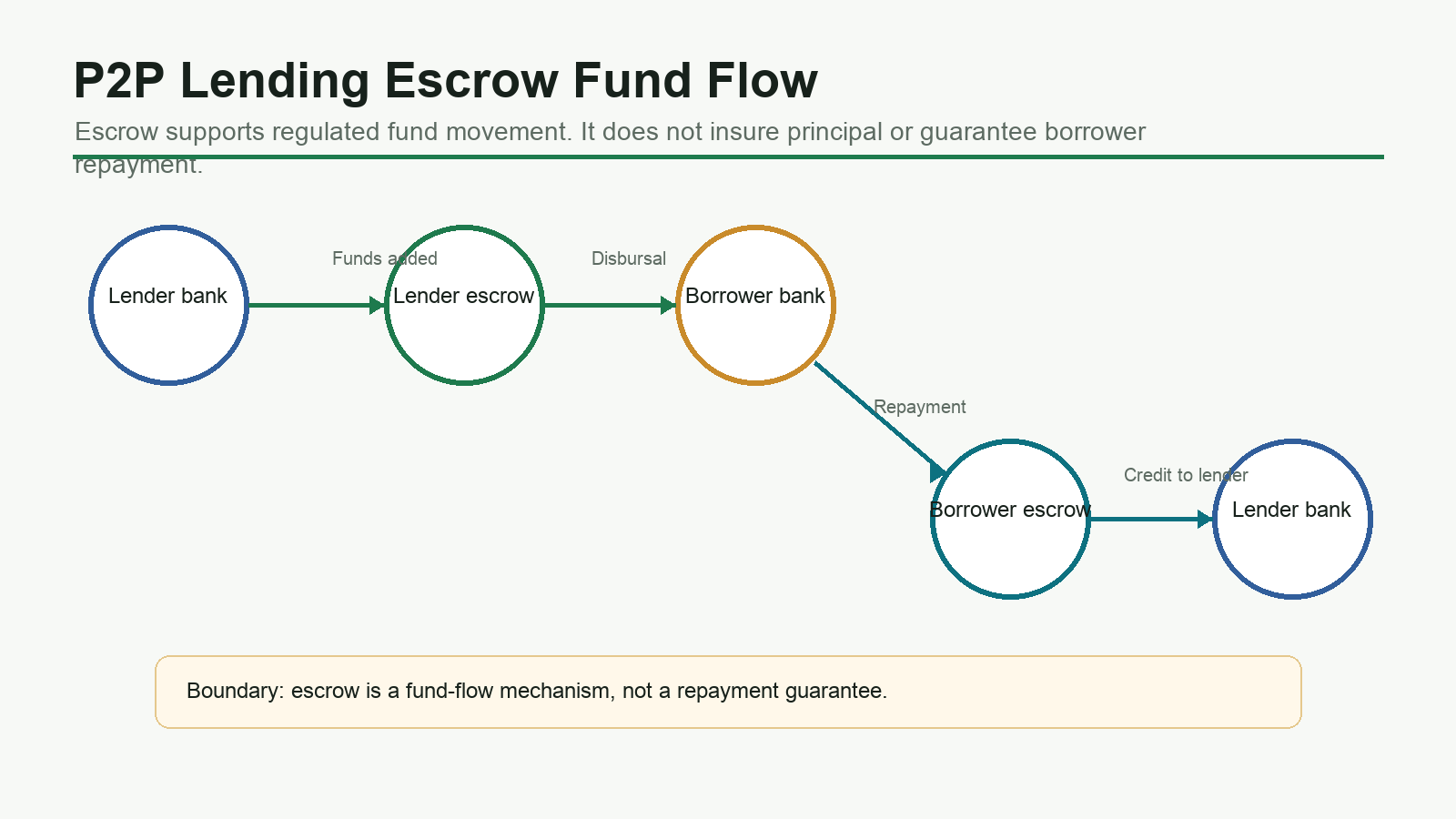
Lender escrow account to borrower bank account
Funds move from the lender's bank account to the lender escrow account, and then to the specific borrower's bank account after required conditions are met. This structure supports process integrity and helps separate platform funds from participant fund flow.
For more detail, read IndiaP2P's guide to the P2P lending escrow account.
Borrower repayments to lender bank account
When borrowers repay, funds move from the borrower's bank account to the borrower escrow account and then to the lender's bank account. Repayments may include principal and interest components depending on the loan schedule and borrower payment status.
The expected schedule is useful for planning, but actual receipts depend on borrower payment behaviour.
What escrow does not protect against
Escrow does not insure your money. It does not guarantee that a borrower will repay. It does not convert P2P lending into a deposit. Escrow is a fund-flow mechanism; borrower default risk remains with the lender.
This distinction should be visible in any article about how to start P2P lending in India, because fund-flow safety and credit risk are different things.
Repayment tracking after you start lending
Starting is only the first part. After lending, the lender should track scheduled repayments, actual receipts, delays and future choices. This is where P2P lending becomes a cash-flow discipline rather than a one-time action.
Dashboard item | What to check | Why it matters |
|---|---|---|
Scheduled repayment | Expected date and amount | Helps plan cash flow |
Received repayment | Actual amount credited | Shows borrower payment status |
Delayed EMI | Missed or late borrower payment | Signals repayment risk |
Principal outstanding | Amount still exposed | Shows remaining borrower-linked exposure |
Interest received | Interest component received | Useful for tax and return tracking |
Next action | Re-lend, withdraw or pause | Helps avoid automatic overexposure |
Expected monthly repayments vs actual receipts
If you choose a plan built around monthly repayments, distinguish expected repayments from actual receipts. Expected repayments are based on loan schedules. Actual receipts depend on borrower payment. A careful lender tracks both.
This is also why P2P lending should not be used for expenses that require certainty on a specific date.
Delayed EMI and borrower default follow-up
A delayed EMI does not always mean permanent loss, but it does mean repayment uncertainty. The platform may support servicing, reminders, collections workflows and reporting, but recovery cannot be promised. A default may affect principal, interest or both.
Read the risk disclosure before you lend, not only after something goes wrong.
Re-lend, withdraw or pause after repayments
As repayments arrive, a lender may have choices: re-lend, withdraw or pause. Re-lending keeps money exposed to borrower risk. Withdrawing reduces exposure. Pausing gives you time to review your experience before adding more.
This decision should be active, not automatic. Ask whether your original reason for lending still holds.
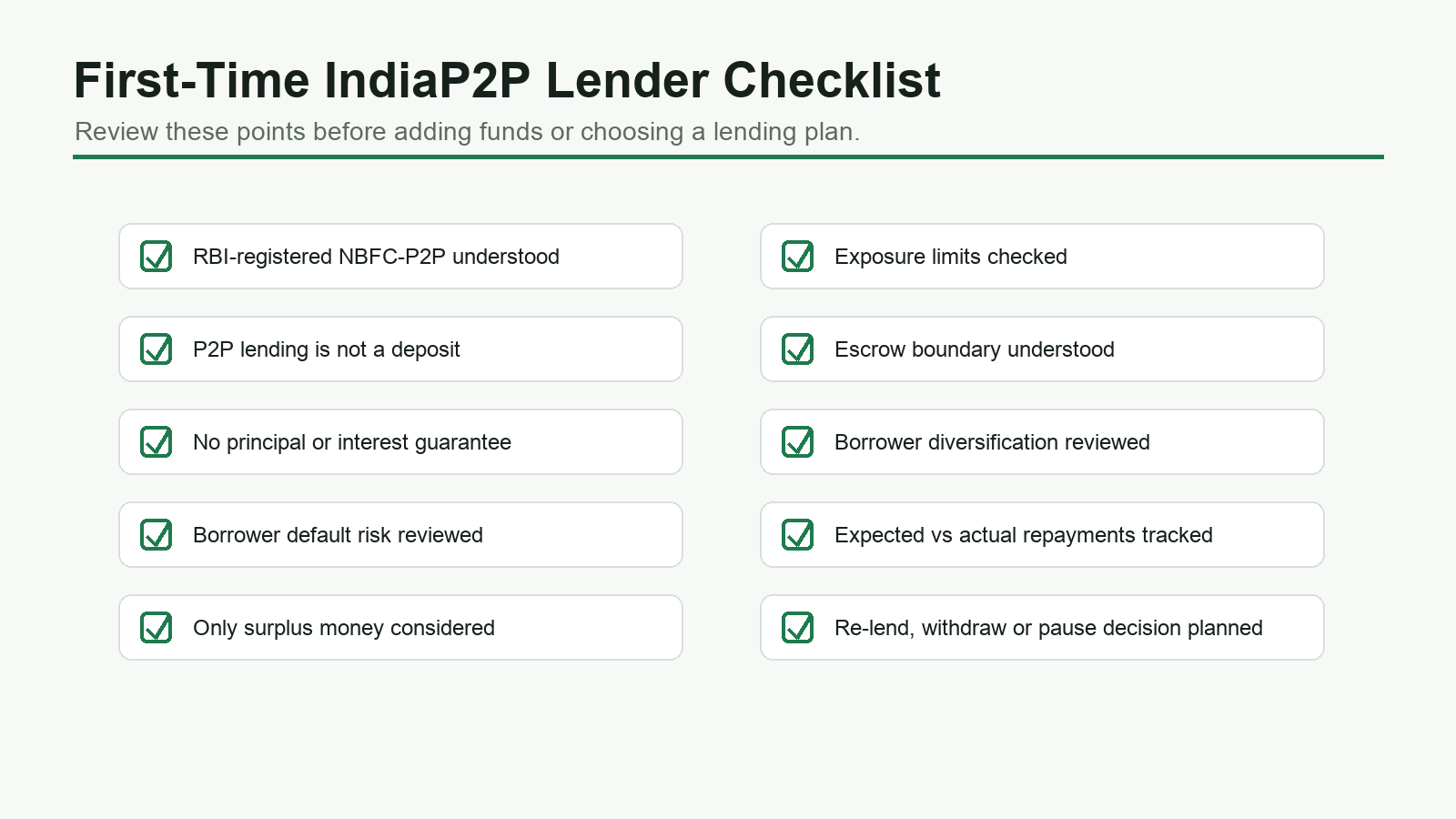
Pre-lending checklist for first-time IndiaP2P lenders
Before you start lending on IndiaP2P, run through this checklist:
Start lending with risk clarity, not only return potential
The cleanest way to start lending on IndiaP2P is to move in this order: understand the product boundary, complete KYC, add only surplus funds, review the plan, understand borrower allocation, check escrow fund flow, track repayments and revisit your decision after the first repayment cycle.
Return potential can be part of the decision, but it should not lead the decision. IndiaP2P's up to 18% p.a. communication must be read with borrower default risk, no principal protection, repayment timing uncertainty and tax treatment in mind.
If the risk framework is clear and the amount fits your surplus-money plan, you can explore IndiaP2P Monthly Income Plan Plus or start from the IndiaP2P website.