When people ask, "is P2P lending safe?", they are usually asking more than one question at once.
They may be asking whether the platform is regulated. They may be asking whether their money is held separately. They may be asking whether borrower repayments are guaranteed. They may also be asking whether the experience is closer to a bank deposit, a loan marketplace, or something else entirely.
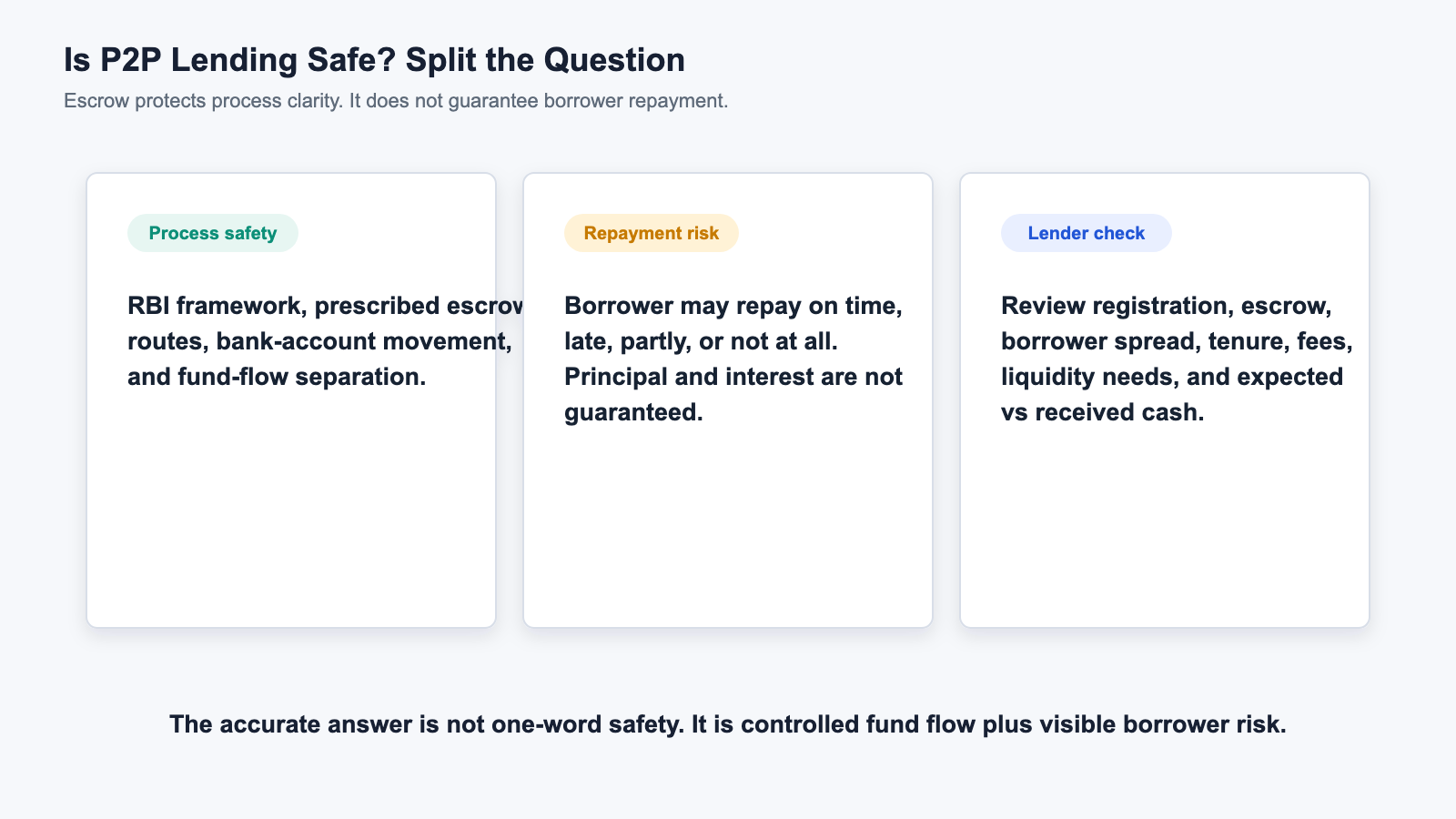
The short answer is this: P2P lending in India operates under RBI's NBFC-P2P framework, and escrow accounts are an important part of how money movement is controlled. But escrow does not make P2P lending risk-free. It does not protect principal. It does not guarantee interest. It does not make a borrower repay.
At IndiaP2P, the right way to understand safety is to separate process protection from repayment risk. Escrow helps protect the fund-transfer process. Borrower default risk still remains with the lender.
Is Peer-to-Peer Lending Safe in India? The Short Answer
Peer-to-peer lending is regulated in India, but it is not a deposit product and should not be read as principal-protected.
An RBI-registered NBFC-P2P platform acts as an intermediary. It connects lenders and borrowers, facilitates loan documentation, routes funds through prescribed banking and escrow arrangements, and provides information to participants. It does not take deposits. It does not lend its own money through the platform. It does not guarantee that a borrower will repay.
So when someone asks, "is peer to peer lending safe?", the more precise answer is:
Safety question | Practical answer in P2P lending |
|---|---|
Is the platform under a regulatory framework? | Yes, NBFC-P2P platforms operate under RBI's framework. |
Is lender money supposed to sit in the platform's own operating account? | No, fund movement should happen through prescribed escrow routes. |
Is borrower repayment guaranteed? | No. Borrowers may repay on time, late, partly, or not at all. |
Is principal protected? | No. Principal and interest are not guaranteed. |
Does diversification remove risk? | No. It may reduce concentration risk, but default risk remains. |
This distinction matters because the word safe can be misleading if it is used without context. Escrow can make fund movement more disciplined and traceable. It cannot turn lending into a guaranteed outcome.
For a related product-boundary explanation, see IndiaP2P's guide on why P2P lending is not a fixed deposit.
How Safe is P2P Lending Under RBI’s NBFC-P2P Framework?
RBI's NBFC-P2P framework is designed to define what a P2P platform can and cannot do. That framework is one reason a lender should prefer a registered platform over an unregulated arrangement.
But regulation should be understood correctly. RBI registration is not a repayment promise. It does not mean RBI has approved any return, endorsed a platform's claims, or insured lender money.
Under the RBI Master Directions for NBFC-P2P platforms, a P2P platform is an intermediary providing an online marketplace or platform to participants involved in peer-to-peer lending. The directions set boundaries around fund flow, disclosures, exposure caps, data handling, escrow, and platform conduct.
Some of the most important boundaries are:
the platform must not raise deposits
the platform must not lend on its own
the platform must not provide or arrange credit enhancement or credit guarantee
the platform must not hold participant funds on its own balance sheet
funds must move through specified escrow account mechanisms
cash transactions are not permitted
losses arising from borrower default are borne by lenders
These rules are important because they define the platform's role. IndiaP2P facilitates lending; it is not a bank, not a deposit-taker, and not a guarantor of borrower repayment.
RBI-Registered NBFC-P2P Does Not Mean RBI-Guaranteed Repayment
RBI-registered NBFC-P2P is a regulatory fact. It means the platform is registered under the applicable RBI framework for peer-to-peer lending platforms.
It does not mean the RBI guarantees principal, interest, liquidity, borrower quality, or platform performance. It also does not mean every loan on the platform has the same risk.
For lenders, the better question is not just "is the platform registered?" It is also: what does the platform disclose, how does money move, how are borrowers assessed, how is exposure diversified, and how clearly can I track repayments?
For more on the registration point, see IndiaP2P's explainer on what RBI registration means for P2P lenders.
P2P Lending Is Not a Deposit Product
P2P lending should not be compared casually with a bank deposit. A bank deposit is a relationship with a bank. P2P lending is a loan exposure to one or more borrowers through a platform that facilitates the transaction.
In P2P lending, your return depends on borrower repayments. If borrowers delay or default, your cash flow and final outcome may be affected.
That is why the right framing is not "is P2P lending safe like a deposit?" It is "what process controls exist, and what credit risk still remains?"
Escrow helps answer the first part. Borrower due diligence, diversification, allocation size, tenure, liquidity planning, and repayment tracking help answer the second.
P2P Lending Escrow Account India: What It Protects
An escrow account in P2P lending is a controlled account used to route money between lenders and borrowers. It is part of the money-movement infrastructure of an NBFC-P2P platform.
Escrow does not make the loan safer from a borrower-credit perspective. Instead, it helps keep participant money separate from the platform's own operating funds and supports a clearer trail for disbursals and repayments.
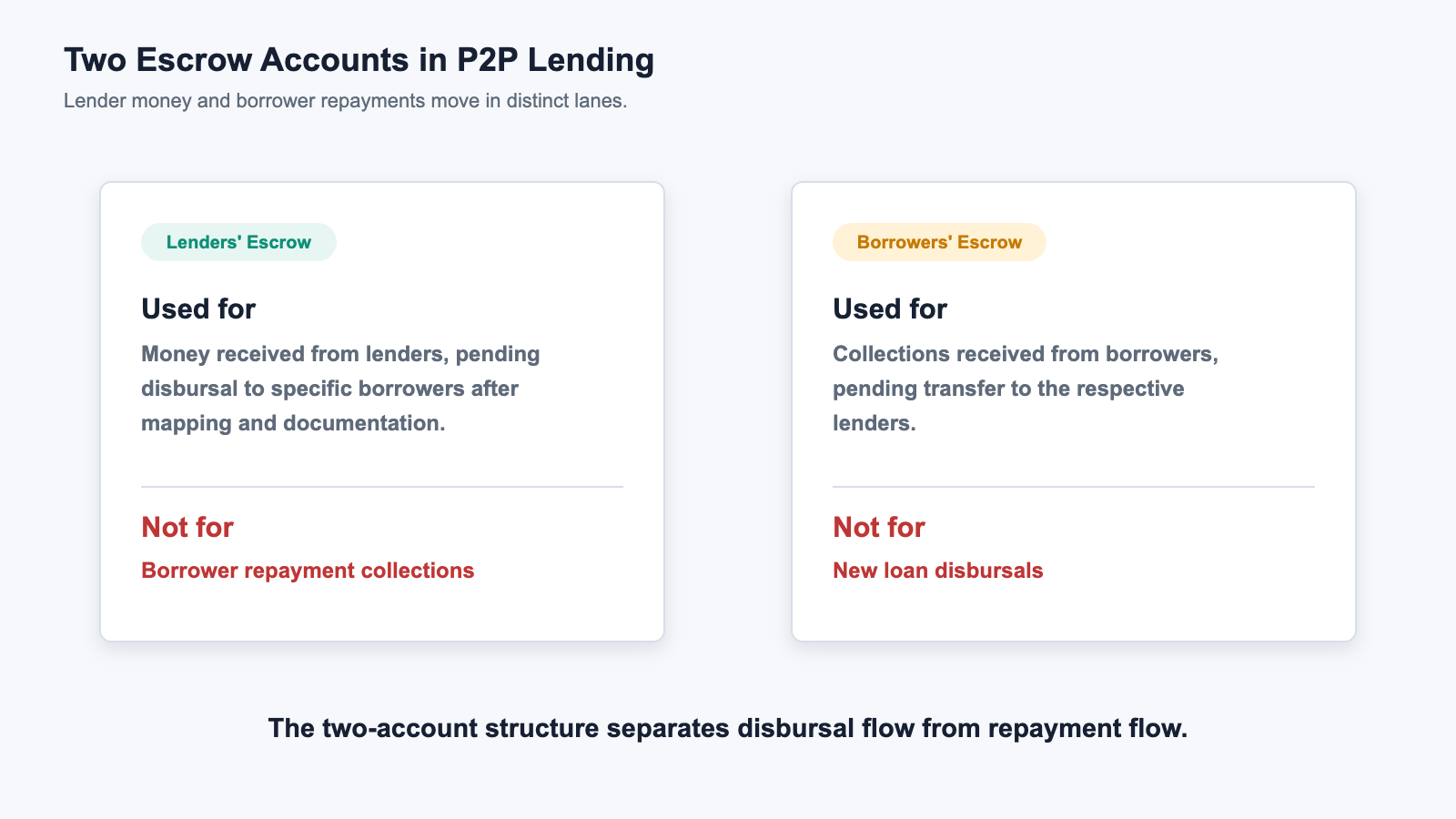
Under RBI's framework, fund transfers between participants on a P2P platform must happen through escrow account mechanisms operated by a bank-promoted trustee. The directions also require at least two escrow accounts: one for funds received from lenders and pending disbursal, and one for collections received from borrowers.
That two-account structure is one of the core escrow pieces inside IndiaP2P's fund-flow explanation.
Lenders' Escrow Account: Money Pending Loan Disbursal
The lenders' escrow account is used for money received from lenders and pending disbursal to borrowers.
In plain language, this is the lane used when money is moving toward borrowers after matching, documentation, and platform process checks. It should not be treated as the platform's own money. It should not be used casually for other platform purposes.
This matters because it reduces commingling risk. It helps create a cleaner distinction between participant money and platform operating money.
Borrowers' Escrow Account: Repayments Pending Transfer
The borrowers' escrow account is used for borrower collections pending transfer to respective lenders.
This is the return lane. When borrowers repay, collections move through the borrowers' escrow route before being transferred to the relevant lenders according to the repayment allocation.
This structure helps separate disbursal money from repayment money. It also helps lenders understand an important dashboard distinction: expected repayments and received repayments are not the same thing.
Escrow Mechanism in P2P Lending: Step-By-Step Fund Transfer
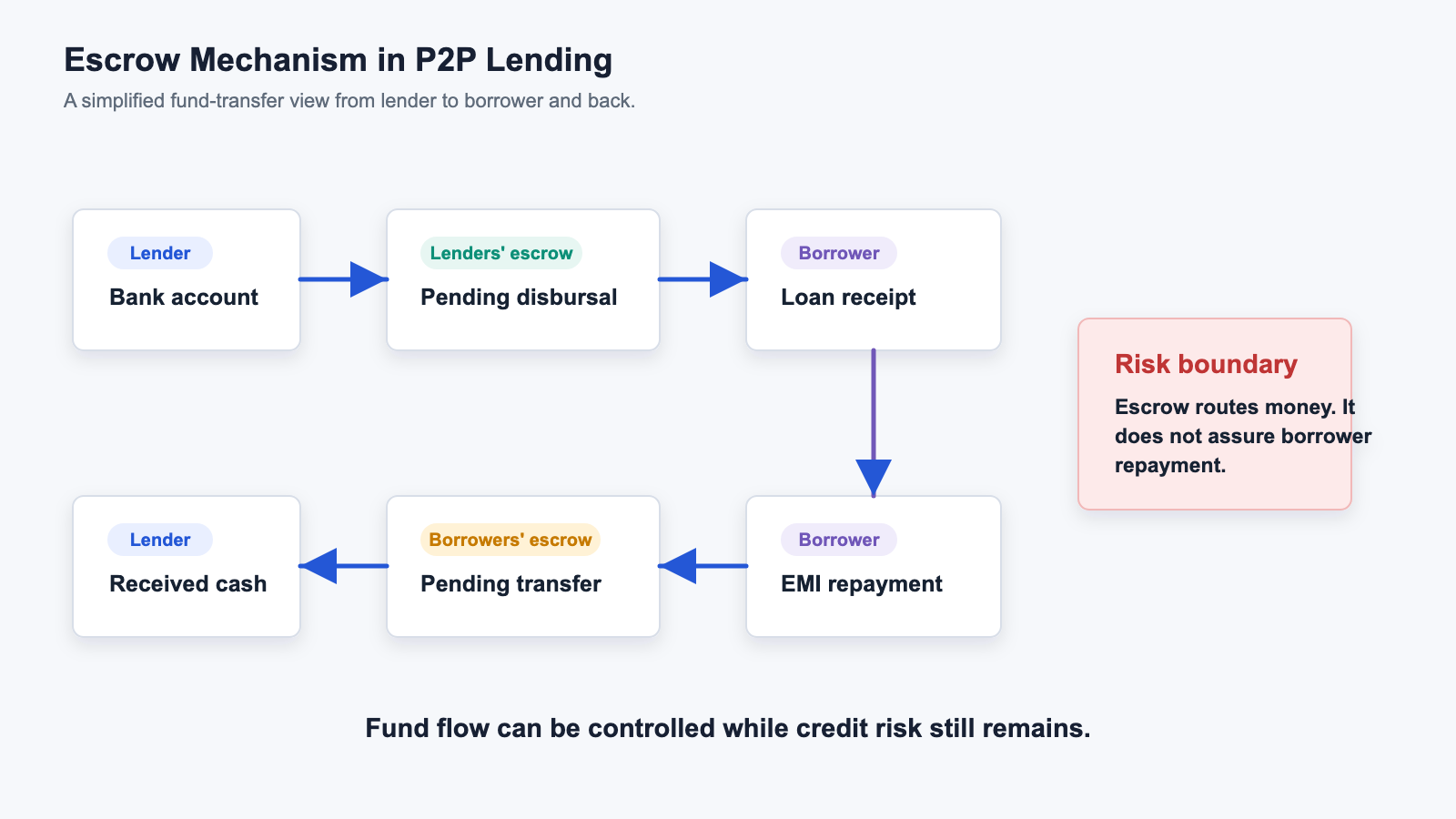
The escrow mechanism in P2P lending can be understood through five steps.
The lender transfers money from a registered bank account into the lenders' escrow route.
The platform maps lender money to borrower loans under its process and policies.
After matching, approvals, and documentation, money is disbursed to the specific borrower's bank account.
The borrower repays from the borrower's bank account into the borrowers' escrow route.
Repayments are transferred from the borrowers' escrow route to the respective lender's bank account.
The platform facilitates the workflow, loan documentation, reporting, servicing, and lender dashboard. The escrow mechanism supports the transfer of money through the prescribed structure. The borrower remains responsible for repayment.
This is the central safety distinction. Escrow can reduce operational uncertainty around where money moves. It cannot make a weak borrower strong. It cannot make a delayed EMI arrive. It cannot make principal protected.
For the wider repayment journey, see IndiaP2P's guide to P2P lending repayment flow.
Bank-Promoted Trustee and Bank-Account-Only Transfers
RBI's escrow framework refers to escrow account mechanisms operated by a bank-promoted trustee. This matters because it prevents the P2P platform from becoming the place where participant funds are held as if they belonged to the platform.
The framework also prohibits cash transactions. For a lender, that is an important process signal: legitimate P2P fund movement should be bank-account based, documented, and traceable.
This does not remove borrower risk. It does, however, create a clearer fund-transfer perimeter.
T+1 Rule in P2P Lending: Settlement Timing, Not Repayment Certainty
The T+1 rule is often misunderstood.
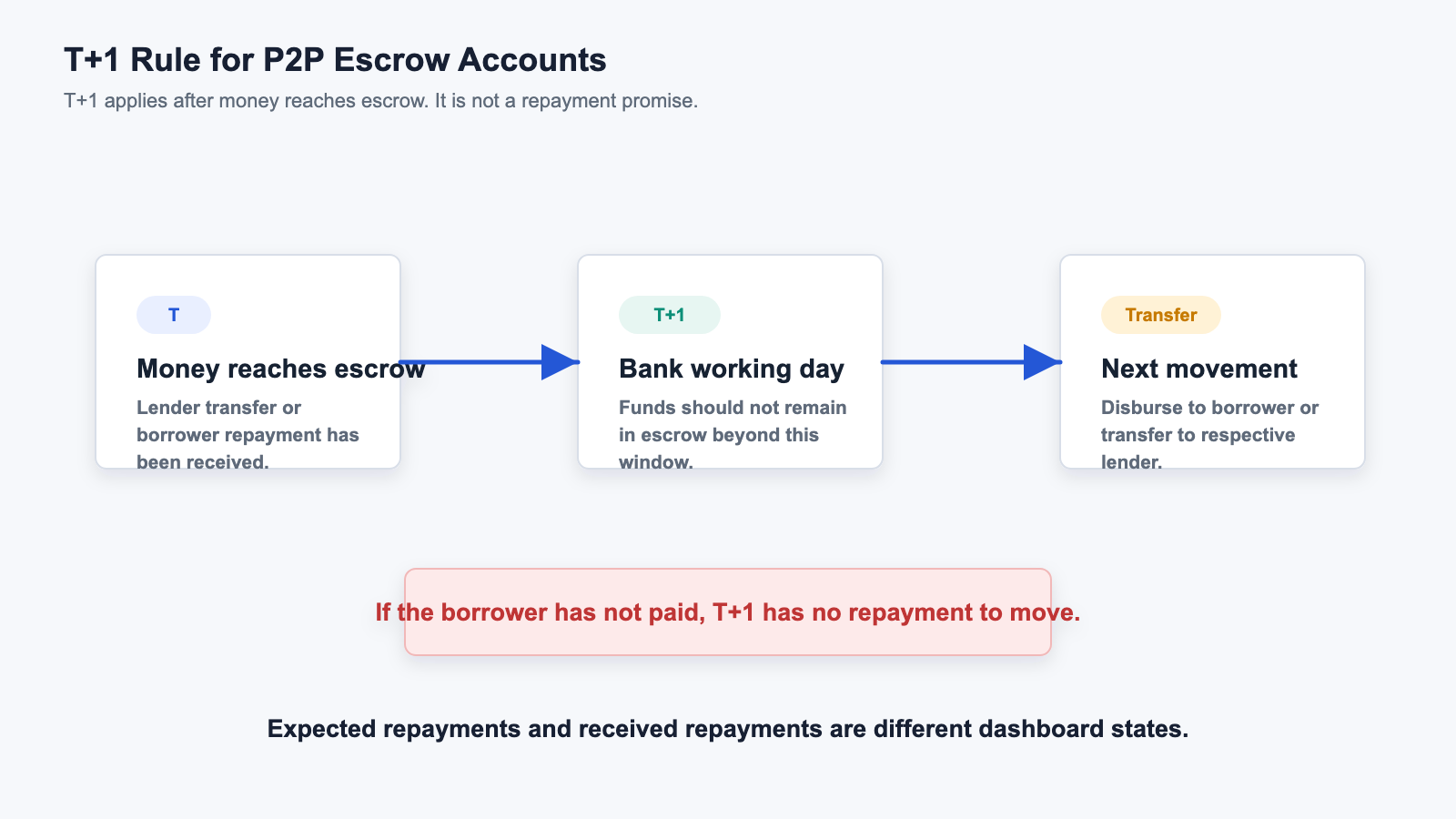
RBI's updated NBFC-P2P guidance clarifies that funds in the escrow accounts should not remain there beyond T+1, and that T+1 refers to a bank working day. In simple terms, once money has reached the applicable escrow account, it should not sit there indefinitely.
For lenders, this is useful because it limits escrow from becoming a long-stay holding area.
But T+1 does not mean a borrower will pay on schedule. If a borrower has not made the EMI payment, there is no repayment sitting in escrow to transfer. T+1 applies after money is received into escrow. It does not guarantee that scheduled money will arrive.
This is why dashboards should be read carefully. A scheduled repayment is expected cash. A received repayment is actual cash. The two can differ because borrowers may delay, partly repay, or default.
How Risky Is P2P Lending After Escrow Controls?
Escrow controls reduce some operational risks. They do not remove the core risk of P2P lending: borrower default risk.
That is why asking "how risky is P2P lending?" is more useful than asking whether it is safe in a general way. Risk depends on borrower quality, diversification, tenure, allocation size, collections experience, fees, liquidity needs, and the lender's ability to tolerate delayed or lower-than-expected repayments.
The most important boundary is simple:
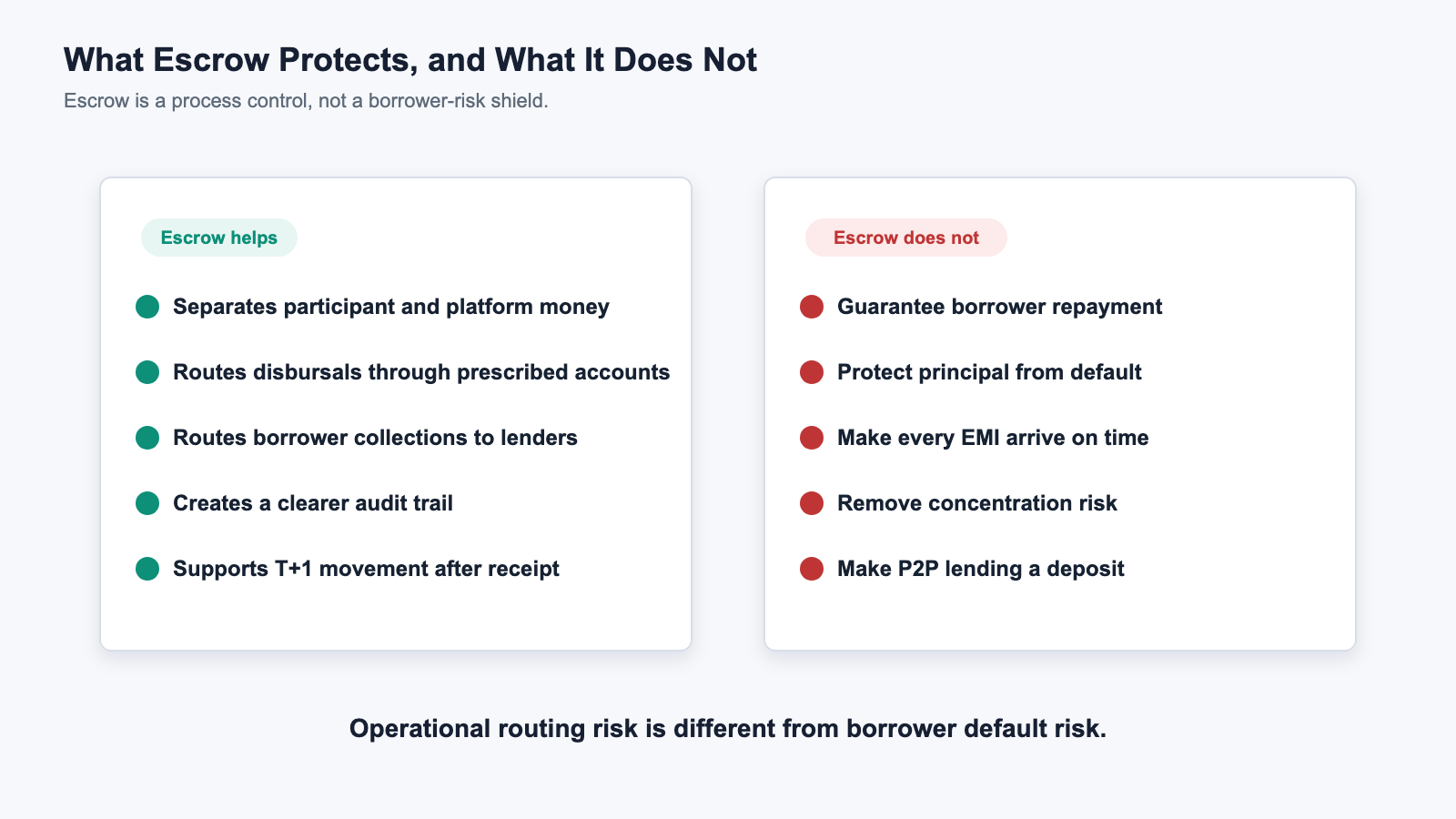
Escrow helps with | Escrow does not help with |
|---|---|
separating participant money from platform operating money | guaranteeing borrower repayment |
routing disbursals through prescribed accounts | protecting principal from default |
routing borrower collections to lenders | making every EMI arrive on time |
creating a clearer audit trail | removing credit risk |
supporting T+1 movement after receipt | making P2P lending a deposit product |
Escrow is therefore a necessary process control, not a full risk shield.
Borrower Default Risk in P2P Lending Remains With the Lender
Borrower default risk means a borrower may fail to repay as scheduled. This can affect principal, interest, cash-flow timing, and final outcome.
In P2P lending, the lender bears this risk. The platform may perform borrower assessment, facilitate documentation, route repayments, support collections, and provide reporting, but it does not guarantee borrower performance.
This is also why a lender should avoid reading any return figure in isolation. If a platform mentions returns of up to 18% p.a., that figure must be understood as indicative and subject to borrower repayment performance, fees, timing, defaults, and risk. It is not a guaranteed or standard outcome for every lender.
Concentration Risk and Lender Diversification
Concentration risk appears when too much exposure depends on one borrower, a small group of borrowers, one risk band, one tenure bucket, or one repayment pattern.
Diversification can help reduce dependence on any one borrower. It does not eliminate default risk. If some borrowers delay or default, diversification may reduce the impact compared with a highly concentrated exposure, but it cannot make repayments certain.
For this reason, lenders should look beyond the headline allocation and ask: how many borrowers am I exposed to, what is the exposure per borrower, what tenures am I taking, what risk categories am I accepting, and how will delayed repayments affect my cash-flow plan?
Liquidity Risk and Expected vs Received Repayments
P2P lending also carries liquidity risk. Once money is lent to borrowers, it is expected to come back through repayments over time. It should not be treated as instantly available cash.
A lender dashboard should ideally help separate:
money added for lending
money mapped to borrower loans
expected repayments
repayments actually received
overdue repayments
available balance
money withdrawn or lent again
This distinction protects the lender from a common planning error: treating expected EMI dates as guaranteed cash-flow dates.
For a practical dashboard-reading framework, see IndiaP2P's guide on how to read a P2P loan portfolio before lending.
How Safe Is P2P Lending When You Read the Lender Dashboard?
A lender dashboard should not be treated as a comfort screen. It should be treated as a risk-reading tool.
The useful question is not only whether the platform shows a number. It is whether the dashboard helps you understand what that number represents. A clean dashboard should make it easier to distinguish money that is still waiting to be lent, money that has already been mapped to borrowers, repayments that are scheduled, repayments that have actually been received, and repayments that are delayed.
This matters because many P2P lending misunderstandings begin with cash-flow language. A repayment schedule can look predictable on paper. Borrower behaviour may not match that schedule exactly. Escrow can help move money once it is received, but it cannot convert expected cash into received cash.
A lender should therefore read dashboard information in layers:
Dashboard item | What it tells you | What it does not tell you |
|---|---|---|
Available balance | Money not currently lent or waiting to be withdrawn | Future borrower repayment quality |
Money mapped to loans | Exposure that has moved into borrower loans | Whether every borrower will repay |
Expected repayments | Contracted repayment schedule | Whether cash has arrived |
Receieved repayments | Actual cash received through repayment flow | Whether future EMIs will be on time |
Delayed repayments | Early warning of cash-flow variance | Final recovery outcome |
Borrower spread | Concentration across borrowers | Elimination of default risk |
This is especially important for lenders using P2P lending as part of a planned cash-flow approach. A plan built only on expected dates can become fragile if delayed repayments are ignored. A better plan uses expected repayments for visibility, received repayments for actual decisions, and overdue data for risk review.
P2P Lending Safety Checks Before You Add More Money
If you are already lending through a P2P platform, safety review should not stop after onboarding. It should continue each time you add money, lend again, or change your allocation size.
Before adding more money, check:
whether your current repayments are arriving broadly in line with your expectations
whether delayed repayments are concentrated in a few borrowers or spread across many
whether your exposure to any one borrower remains within regulatory and personal comfort limits
whether your tenure mix still matches your liquidity needs
whether your available balance is being lent again automatically or intentionally
whether you understand fees and net cash received
whether you have a rule for withdrawing, holding, or lending received repayments again
This is not about avoiding P2P lending altogether. It is about avoiding blind scaling. If a lender increases exposure only because the dashboard looks busy or because expected repayments appear regular, the lender may miss the actual risk signal: received cash, overdue status, borrower concentration, and liquidity need.
RBI Exposure Limits and Personal Allocation Limits Are Different
RBI sets outer exposure limits for P2P lending. A lender's total exposure across all P2P platforms is capped at ₹50 lakh, and exposure to a single borrower is capped at ₹50,000. If a lender's aggregate lending across P2P platforms exceeds ₹10 lakh, a practising Chartered Accountant certificate certifying minimum net worth of ₹50 lakh is required.
These are regulatory caps. They are not suitability recommendations.
In other words, the fact that the framework permits exposure up to a certain limit does not mean every lender should lend up to that limit. A personal allocation limit should be based on income stability, emergency reserves, existing obligations, risk comfort, liquidity needs, and ability to absorb delayed or lower-than-expected repayments.
This is another place where safety needs precision. Regulation defines the permissible boundary. Personal risk planning defines the sensible boundary.
How Safe Is Peer-to-Peer Lending If a Platform Cannot Hold Your Money?
One of the useful parts of the NBFC-P2P framework is that the platform is not supposed to hold participant money on its own balance sheet. Fund movement is routed through prescribed escrow account mechanisms.
This improves process discipline. It limits the platform's role in money handling. It helps make the lender-to-borrower and borrower-to-lender route more traceable.
But this point should not be stretched into a repayment-safety claim.
What Platform Fund Separation Reduces
Platform fund separation can reduce:
confusion between participant money and platform operating money
risk of disbursal and repayment flows being mixed
opacity around where money sits during transfer
avoidable delays after money has reached escrow
weak audit trails around fund movement
These are meaningful process protections.
What Platform Fund Separation Does Not Reduce
Platform fund separation does not reduce:
borrower credit risk
delayed EMIs
borrower default
concentration risk
the lender's need to assess allocation size
liquidity planning risk
tax or cash-flow planning requirements
This is the practical answer to the question "how safe is peer to peer lending?" The fund flow can be structured. The lending outcome remains subject to borrower performance.
Is It Safe to Lend Through P2P Lending Platforms? A Pre-Lending Checklist
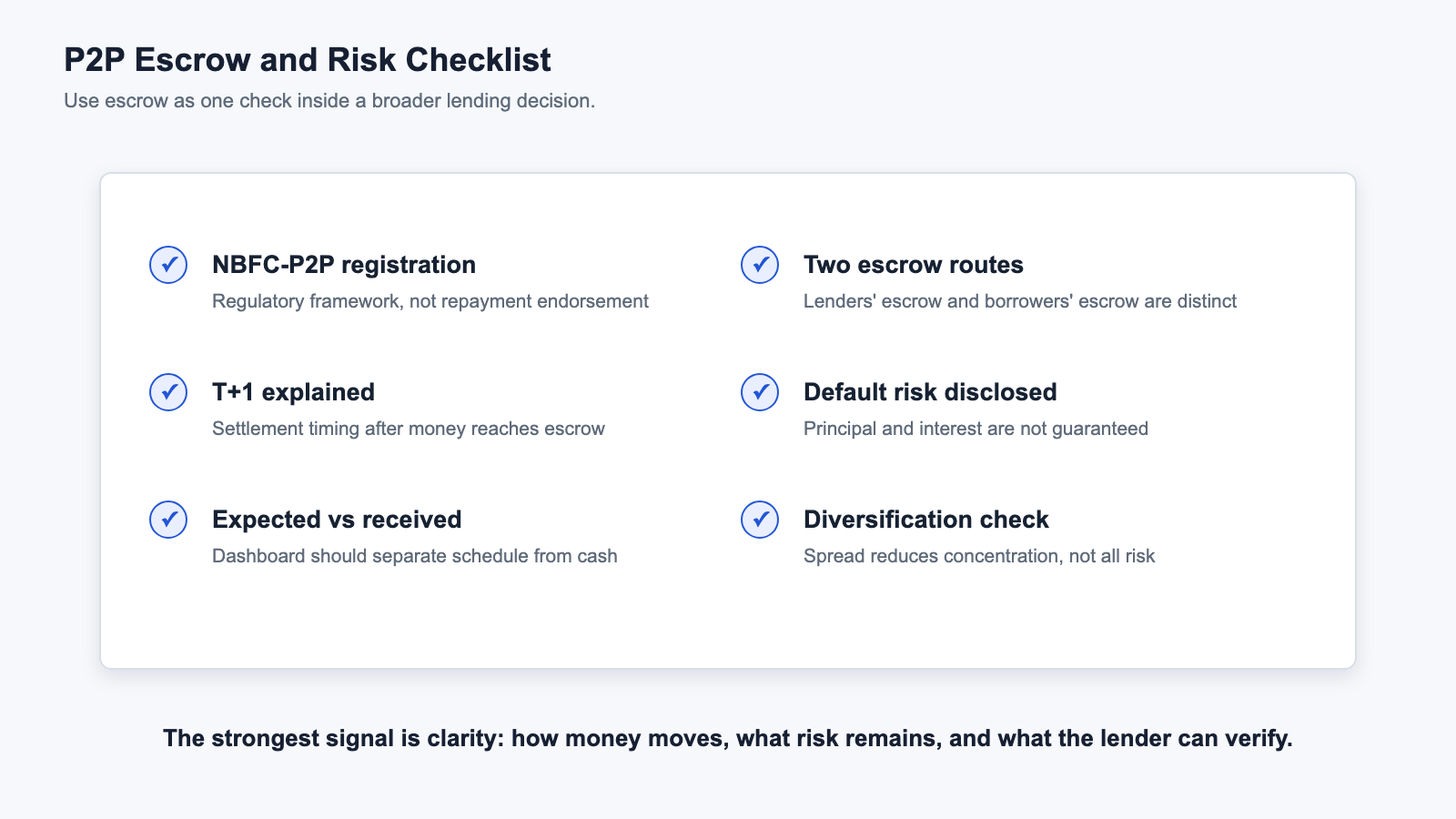
Before lending through any P2P platform, use this checklist. It keeps the safety question grounded in verifiable controls rather than broad claims.
Is the platform registered with RBI as an NBFC-P2P?
Does the platform explain that RBI registration is not RBI endorsement or repayment guarantee?
Does money move through prescribed escrow account mechanisms?
Does the platform distinguish lenders' escrow from borrowers' escrow?
Does it explain T+1 settlement without implying repayment certainty?
Does it clearly state that principal and interest are not guaranteed?
Does it avoid
risk-free,safe returns,assured returns, and similar claims?Does it disclose borrower default risk before lending, not only at the end?
Does it show borrower or loan-pool information in a way that supports lender review?
Does it help you see expected repayments separately from received repayments?
Does it explain fees, tenure, repayment schedule, and withdrawal process?
Does it show how diversification works and what it cannot protect?
Does it provide a fair-practices code and grievance redressal route?
Does your own allocation fit your risk comfort and liquidity needs?
If the answer to these questions is unclear, pause before lending.
IndiaP2P Escrow Protection: The Bottom Line for Lenders
The cleanest way to answer "is P2P lending safe?" is to avoid a one-word answer.
IndiaP2P operates under RBI's NBFC-P2P framework and uses escrow-based fund-flow structures to support regulated money movement between lenders and borrowers. That is meaningful because it separates participant money from the platform's own operating money and creates a clearer transfer route.
But escrow is not a guarantee. Borrower default risk remains. Principal is not protected. Interest is not guaranteed. Scheduled repayments may differ from received repayments.
So the practical answer is:
P2P lending can be approached with better process clarity when escrow, RBI registration, borrower assessment, diversification, and dashboard transparency are understood together. It should still be treated as lending with borrower risk, not as a deposit or guaranteed-return product.
Eligible lenders who understand these risks can review IndiaP2P's Monthly Income Plan+. Any return figure, including up to 18% p.a., should be read as indicative and subject to borrower repayment performance, fees, timing, defaults, and risk.