P2P lending vs fixed deposit is a useful comparison only if the first distinction is clear: P2P lending is not a deposit.
It may have an expected repayment schedule. It may show an indicative annual return. It may create monthly cash-flow visibility. But the underlying transaction is different. In a fixed deposit, a depositor places money with a bank or deposit-taking institution. In P2P lending, a lender funds borrower loans through a regulated peer-to-peer lending platform.
IndiaP2P enables eligible lenders to target up to 18% p.a. indicative returns through P2P lending. That number should always be read with the other half of the sentence: returns depend on borrower repayments, and borrower delays or defaults can affect both interest received and principal recovery.
That is why this distinction matters. If P2P lending is mistaken for a deposit, the lender may misunderstand risk, liquidity, insurance, and who ultimately bears loss when a borrower does not repay.
P2P Lending is not a Deposit: The Short Answer
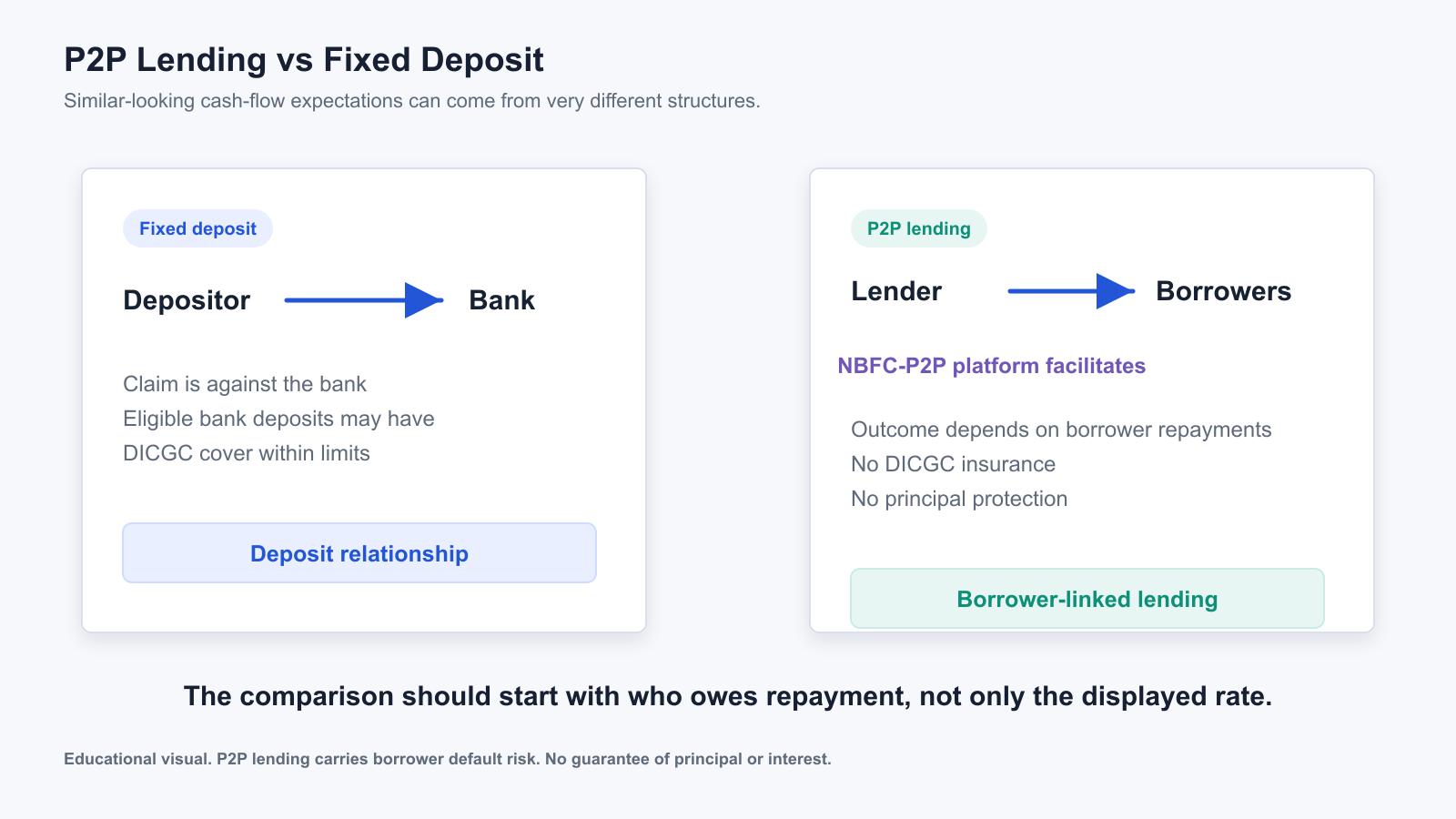
A fixed deposit is a deposit relationship. The bank or deposit-taking institution owes money to the depositor according to the deposit terms. Bank fixed deposits also sit inside a separate deposit-insurance framework, subject to applicable limits and conditions.
P2P lending is a loan facilitation relationship. The lender lends to one or more borrower loans through an NBFC-P2P platform. The platform facilitates onboarding, borrower assessment, loan documentation, money movement, repayment tracking, and servicing. It does not become a bank. It does not take deposits. It does not guarantee borrower repayment.
This is the simplest way to read the difference:
In a fixed deposit, the depositor's claim is against the deposit-taking institution.
In P2P lending, the lender's outcome depends on borrower repayment.
In a fixed deposit, deposit insurance may apply to eligible bank deposits within the DICGC limit.
In P2P lending, there is no DICGC insurance or principal protection.
The RBI framework makes this distinction explicit. Under the RBI Master Direction for NBFC-P2P platforms, an NBFC-P2P acts as an intermediary for peer-to-peer lending. It is not allowed to raise deposits, lend on its own, provide credit enhancement, or provide a credit guarantee.
P2P Lending vs Fixed Deposit: The Core Differences
The comparison is not just about return. It is about structure.
Feature | Bank fixed deposit | P2P lending through an NBFC-P2P platform | Why it matters |
|---|---|---|---|
Legal nature | Deposit placed with a bank | Lending to borrowers through a platform | P2P is borrower-linked lending, not a deposit |
Who owes repayment | The bank, subject to deposit terms | Borrowers, subject to loan repayment behaviour | Borrower default can affect P2P outcomes |
Platform role | Bank accepts deposit and lends through its own balance sheet | NBFC-P2P facilitates loans between lenders and borrowers | The platform is an intermediary |
Return language | FD interest rate as per deposit terms | Indicative return potential, subject to borrower repayment | P2P returns are not guaranteed |
Principal exposure | Depends on bank/deposit structure and insurance limits | Principal is exposed to borrower default risk | P2P does not carry capital protection |
Deposit insurance | Eligible bank deposits are insured by DICGC up to applicable limits | Not insured by DICGC | P2P is not a bank deposit |
Liquidity | As per maturity and premature-withdrawal rules | Funds generally return through borrower repayments | Expected repayments are not the same as withdrawal |
Regulation | Banking/deposit rules apply to banks | RBI NBFC-P2P framework applies to platforms | RBI registration is not RBI return approval |
Risk bearer | Depositor bears bank/deposit-related risk beyond applicable protections | Lender bears borrower repayment risk | Loss of principal or interest, if any, is borne by lenders |
The DICGC states that each depositor in a bank is insured up to ₹5,00,000 for principal and interest held in the same right and capacity, subject to its rules and trigger events. That framework applies to eligible bank deposits, not P2P lending. See the DICGC guide to deposit insurance.
This is why "P2P lending vs fixed deposit" should not be reduced to a single number. A higher indicative return can come with borrower risk, delayed repayment risk, liquidity risk, and principal exposure.
What RBI Registration Means and Does Not Mean for P2P Lending
IndiaP2P, legally Trickle Flood Technologies Pvt Ltd, is registered with the Reserve Bank of India as an NBFC-P2P.
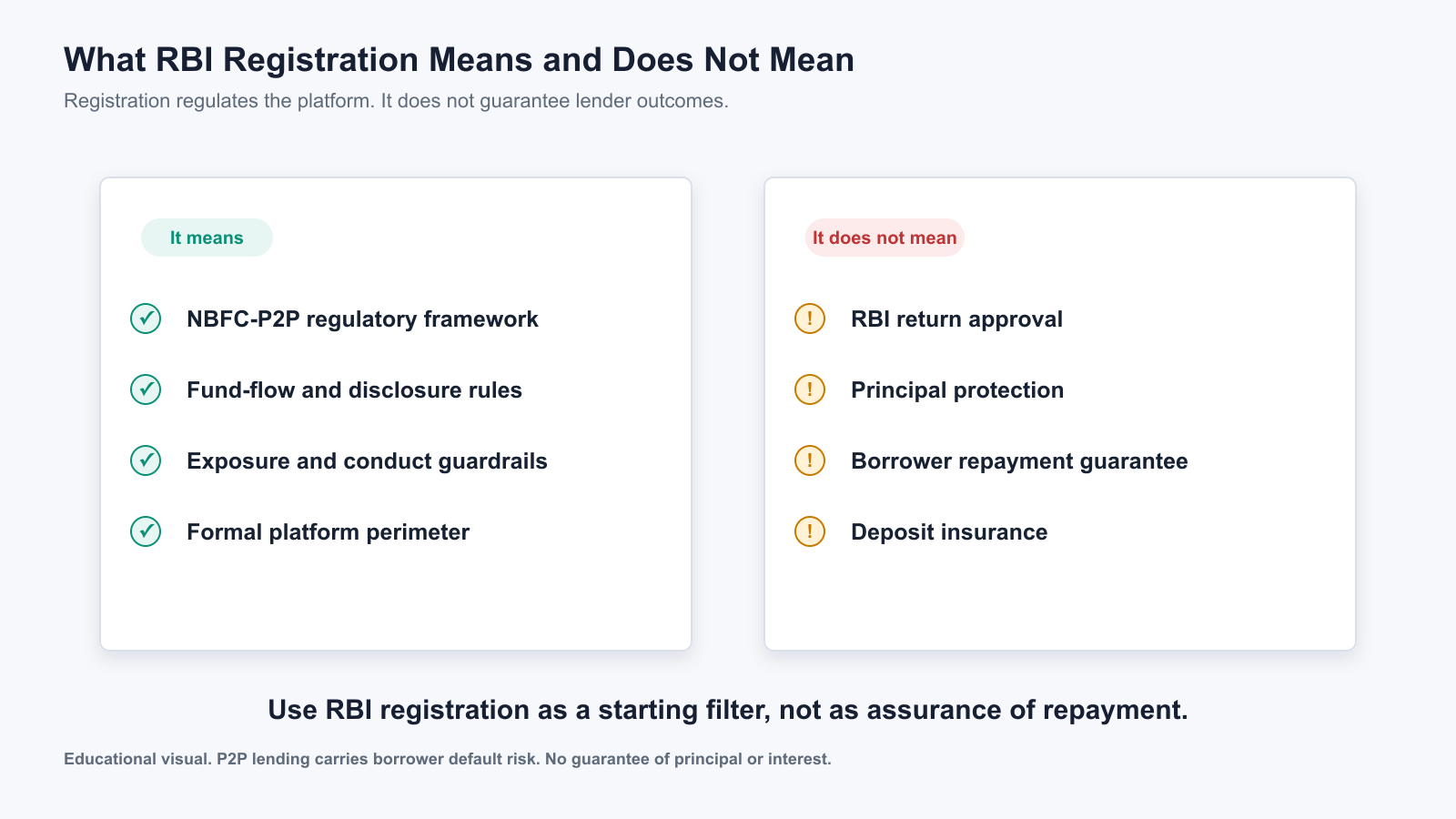
That registration matters. It means the platform operates inside RBI's peer-to-peer lending framework, with rules on platform conduct, disclosures, money movement, exposure limits, and participant information.
It does not mean RBI guarantees repayment.
IndiaP2P Is Registered With RBI as an NBFC-P2P
The RBI framework defines a peer-to-peer lending platform as an intermediary providing loan facilitation services to participants. In practice, this means the platform can help lenders and borrowers meet inside a regulated structure.
For a lender, this is a useful starting filter. A registered NBFC-P2P is not the same as an informal private lending group or an unregulated online arrangement. Registration creates a defined operating perimeter.
For more detail, read IndiaP2P's guide on what RBI registration means for P2P lenders.
RBI Registration Is Not Return Approval or Principal Protection
RBI registration should not be read as approval of any return number shown by a platform. It also should not be read as protection against borrower default.
The RBI Master Direction states that NBFC-P2P platforms must not raise deposits, must not lend on their own, and must not provide or arrange credit enhancement or credit guarantee. It also states that the entire loss of principal or interest, if any, from funds lent by lenders to borrowers on the platform is borne by lenders.
That is the central point. RBI registration regulates the platform. It does not convert P2P lending into a fixed deposit.
Who Bears the Risk if Borrowers Do Not Repay?
In P2P lending, borrower repayment risk remains with the lender.
A borrower may repay on schedule. A borrower may pay late. A borrower may partly repay. A borrower may default. These outcomes can affect the lender's received interest, principal recovery, and actual return.
This does not mean every delay has the same effect. A recent delayed EMI, a partial recovery, and a long unresolved overdue amount are different states. The lender should be able to see these differences in repayment reporting.
Borrower Default Risk in P2P Lending
Borrower default risk is the risk that a borrower does not meet repayment obligations. This is the core risk in P2P lending.
Credit assessment, borrower screening, documentation, repayment follow-up, and recovery processes can help make lending more disciplined. They cannot make borrower repayment certain.
This is why return language needs restraint. A phrase such as "up to 18% p.a. indicative returns" is only meaningful when the lender also understands borrower default risk, platform fees, loan tenure, and delayed repayment behaviour.
Diversification Helps, But It Does Not Guarantee Repayment
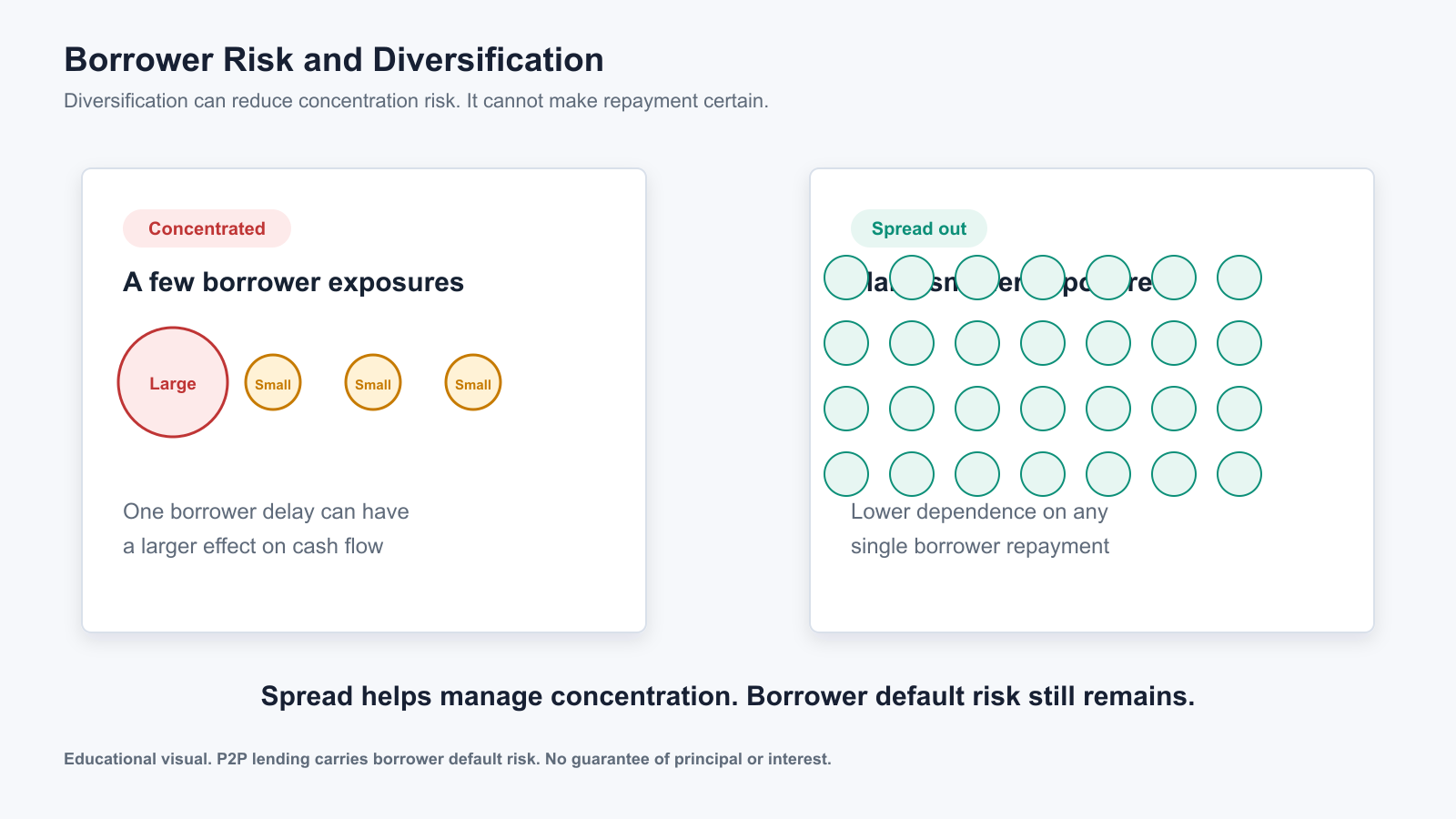
Diversification means spreading lending exposure across multiple borrowers rather than depending heavily on one borrower or a small group.
This can reduce concentration risk. If one borrower delays repayment, the effect may be smaller when the total lending amount is spread across many borrower exposures.
But diversification does not make every borrower repay. It is a risk-management practice, not a guarantee.
For a practical allocation lens, read IndiaP2P's guide on how much to allocate to P2P lending.
Why Escrow Does Not Make P2P a Deposit
Escrow is important in P2P lending, but it is often misunderstood.
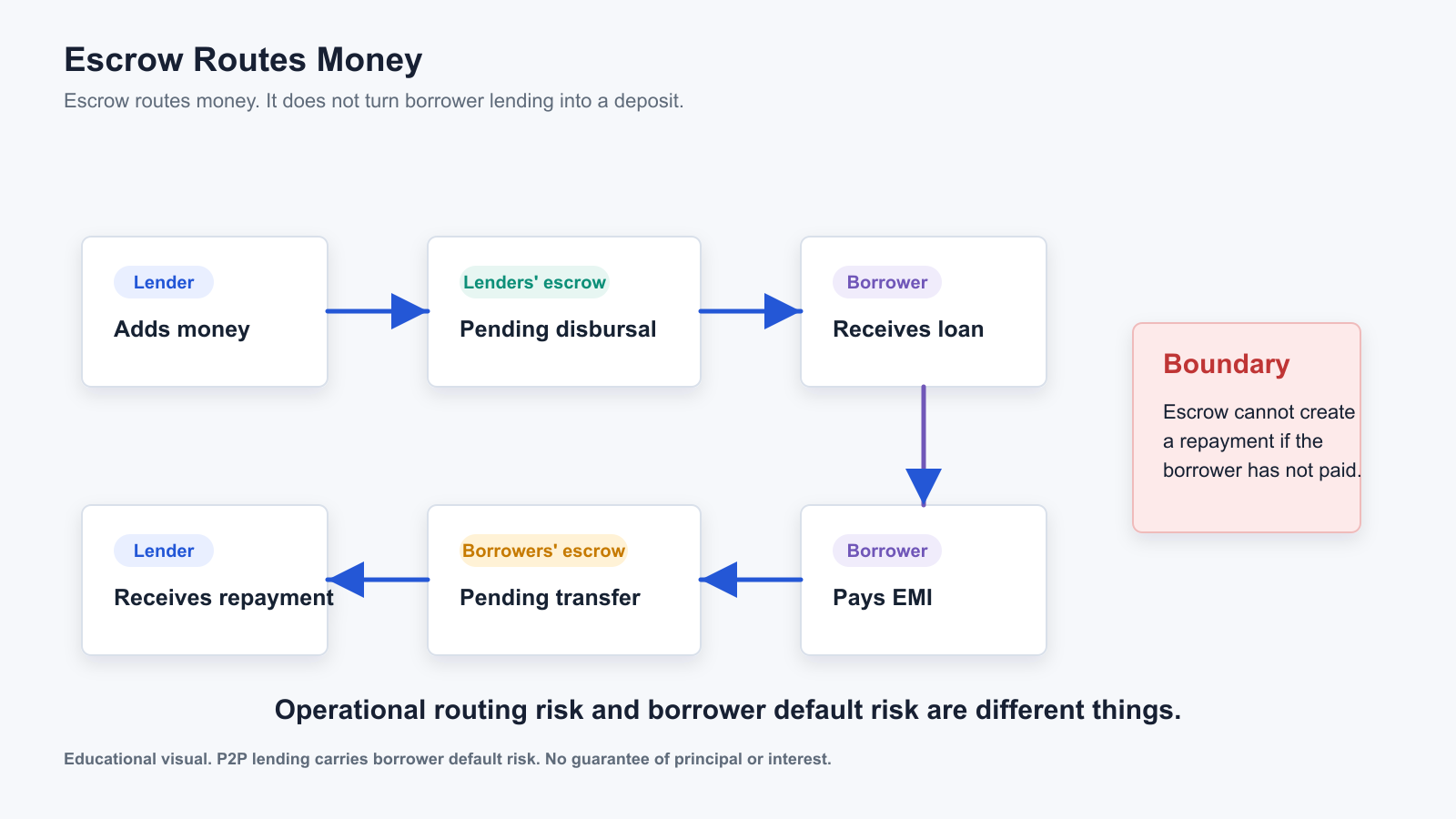
Under the RBI money-transfer mechanism, money movement between P2P participants happens through escrow account structures operated by a bank-promoted trustee. There are separate routes for money received from lenders and borrower repayment collections.
This improves money-flow discipline. It helps separate participant money from platform operating money. It creates a cleaner route between lenders and borrowers.
It does not protect the lender from borrower default.
If a borrower has not paid an EMI, escrow cannot create that repayment. Escrow governs how money moves once it is received into the relevant account structure. It does not make a scheduled borrower payment certain.
That is why escrow should be read as process infrastructure, not as principal protection.
For a deeper explanation, see IndiaP2P's guide on how escrow accounts work in P2P lending.
Liquidity: Why Scheduled Repayments Are Not the Same as Withdrawal
P2P lending can create expected repayment visibility. That does not make it an on-demand withdrawal product.
When a lender funds borrower loans, money generally comes back through borrower repayments over the loan tenure. The lender may see an expected EMI schedule. But expected cash flow and received cash flow are not the same thing.
If borrowers pay on time, repayments may arrive as expected. If borrowers delay, cash flow may shift. If borrowers default, recovery may take time and may be incomplete.
This is different from a fixed deposit, where maturity and premature-withdrawal terms are defined by the deposit product. Even there, early withdrawal may carry conditions or penalties. But the structure is still a deposit structure.
In P2P lending, the liquidity question is linked to borrower repayments and loan tenure. A lender should not use money that may be needed for rent, medical needs, taxes, payroll, school fees, or near-term obligations.
For repayment mechanics, read IndiaP2P's P2P lending repayment process.
When P2P Lending May Fit, and When It Should Not
P2P lending may fit a lender who understands borrower credit risk, can use surplus money, can wait through loan tenures, and can review repayments with patience.
It may not fit a person who wants capital protection, deposit insurance, fixed outcomes, or immediate liquidity.
Consider P2P Lending Only With Surplus Money
Surplus money means money that is not needed for essential expenses, near-term goals, or emergency needs.
This framing is not conservative for the sake of sounding cautious. It follows from the structure of P2P lending itself. Funds are linked to borrower loans. Repayments depend on borrower behaviour. Delays can happen.
If a lender cannot tolerate repayment variation, the displayed return should not decide the allocation.
Avoid Treating P2P Like Emergency Savings
Emergency money should be liquid and dependable. P2P lending is not designed for that role.
Before lending, a person should have a separate emergency buffer, a clear view of upcoming expenses, and a comfortable understanding of how much can remain lent for the selected tenure.
First-time lenders can start with IndiaP2P's first-time P2P lender guide before deciding whether the category fits.
A Lender Checklist Before Comparing P2P With Deposits
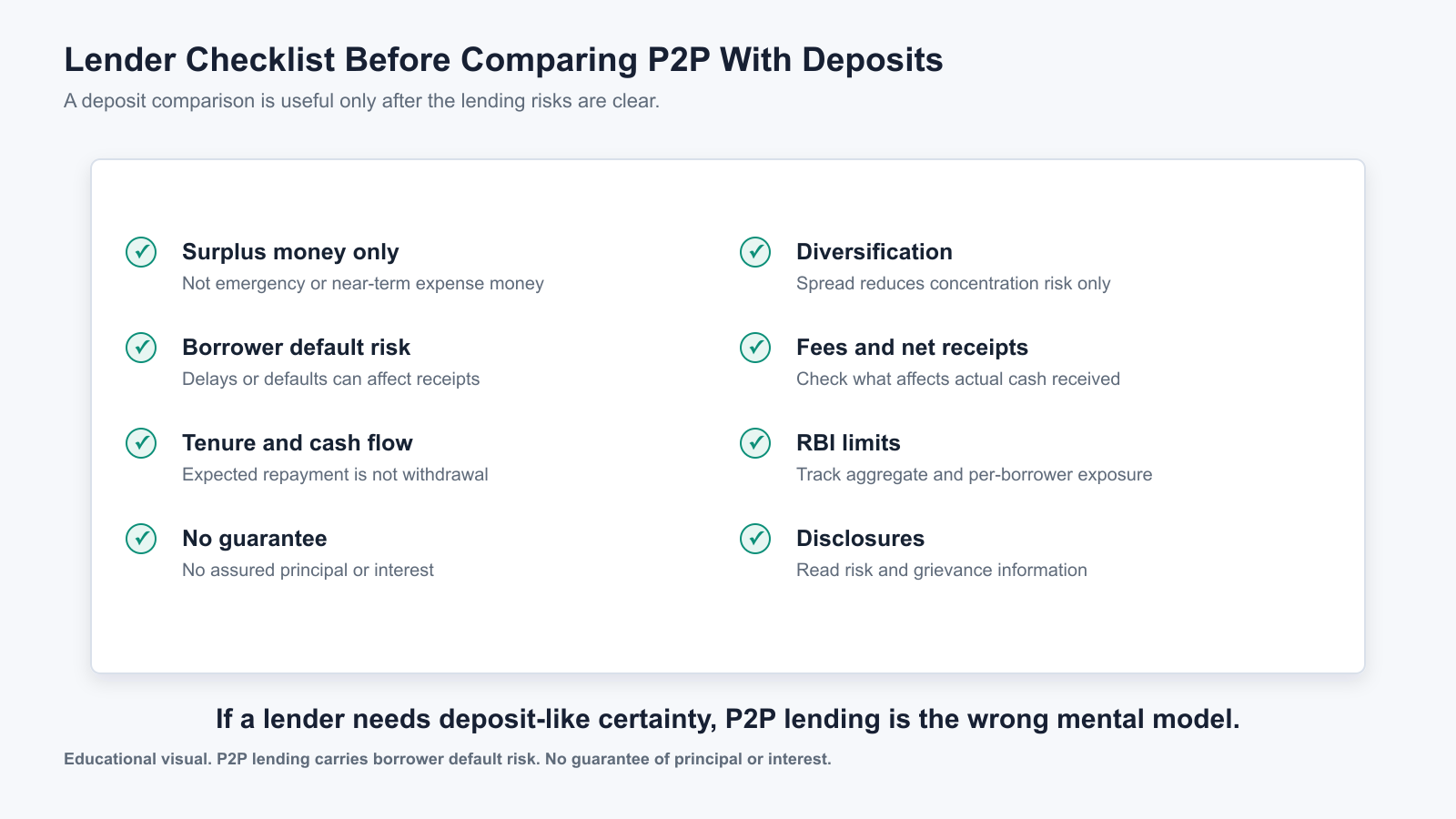
Before comparing P2P lending with a fixed deposit, ask these questions:
Am I using surplus money, not emergency money?
Do I understand that P2P lending is not a deposit?
Do I understand borrower default risk?
Do I know the loan tenure and expected repayment schedule?
Do I understand that returns and principal are not guaranteed?
Is my lending exposure spread across borrowers?
Do I understand that diversification does not eliminate default risk?
Have I checked platform fees and how net receipts are shown?
Do I know how delayed EMIs are reported?
Am I within RBI exposure limits across P2P platforms?
Have I read the platform's risk disclosure and grievance route?
This checklist is more useful than asking whether P2P is "better" than an FD. The two have different structures. A fixed deposit may fit stability and deposit-style planning. P2P lending may fit a measured lending allocation for someone who understands borrower risk.
The Bottom Line: Read P2P as Lending, Not as a Deposit
The right way to compare P2P lending vs fixed deposit is to start with the structure, not the return.
A fixed deposit is a deposit. P2P lending is lending to borrowers through a regulated NBFC-P2P platform. RBI registration creates a platform framework. It does not approve returns, guarantee repayment, or protect principal. Escrow creates a regulated money-flow route. It does not make borrower repayment certain. Diversification can reduce concentration risk. It does not remove borrower default risk.
IndiaP2P can be explored by eligible lenders who understand these distinctions and are using surplus money. Start with the risk, repayment, and liquidity questions first. Then decide whether P2P lending has a measured role in your broader money plan.
Explore IndiaP2P Monthly Income Plan Plus after reading the product terms, risk disclosures, and repayment mechanics.