Many people use market-style language when they first search for P2P lending. On IndiaP2P, the more accurate word is lender.
That distinction matters. Peer-to-peer lending is not a deposit or a pooled market product. A lender is lending money to borrowers through an RBI-registered NBFC-P2P platform. The platform facilitates the process, but the borrower still has to repay.
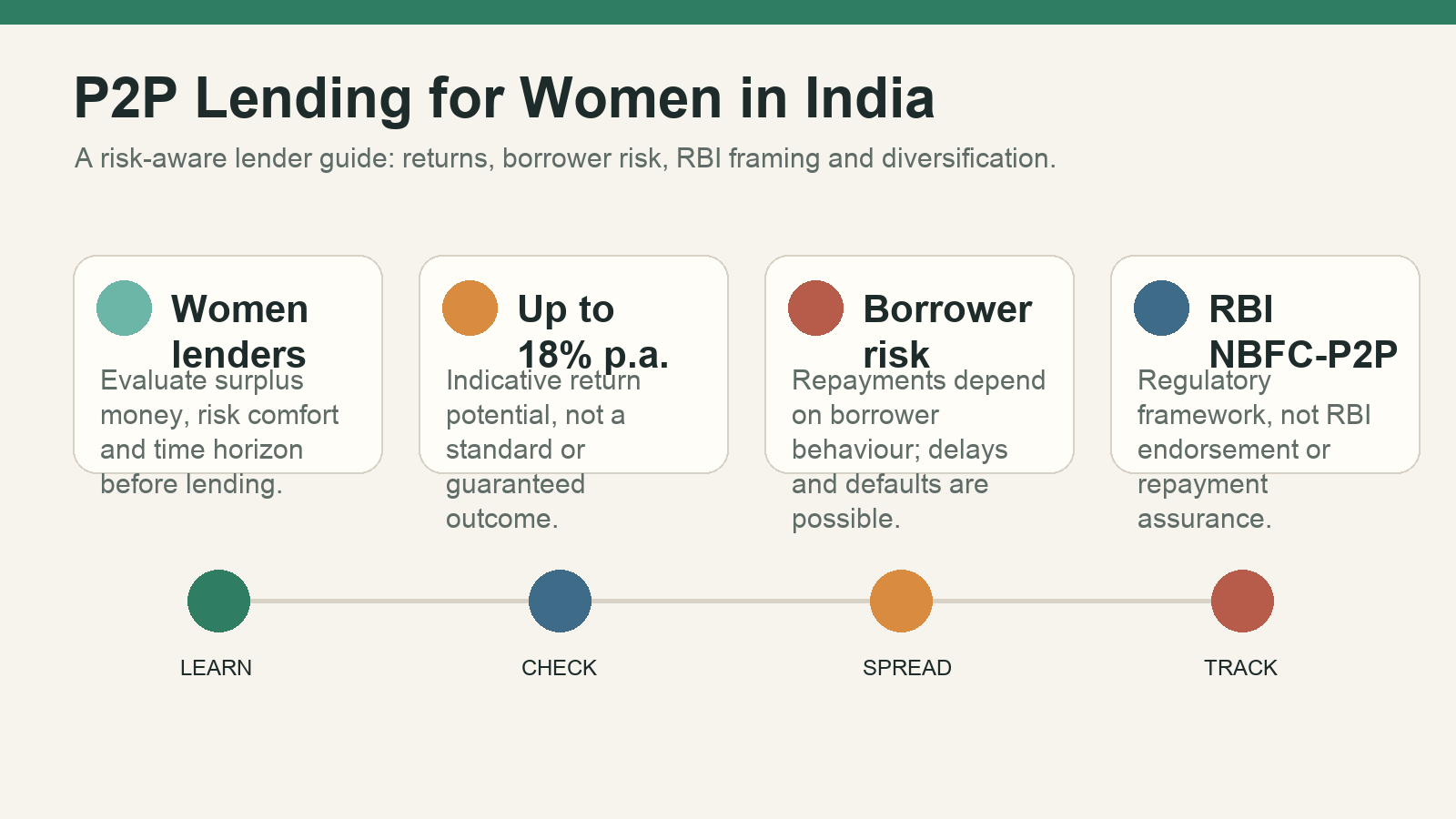
IndiaP2P enables eligible lenders to target up to 18% p.a. indicative returns through P2P lending. That figure must be read with the risk beside it: returns depend on borrower repayments, borrower delays or defaults, fees, tax treatment, platform terms, and the lending spread selected. Principal is not protected, and returns are not guaranteed.
For women lenders in India, P2P lending can be worth studying for three reasons: it is digital, it can create scheduled repayment visibility, and it can connect lender capital to borrower credit needs, including women entrepreneurs and small business owners. But it should not be approached as a simple high-return product. The better question is not, "What rate can I get?" It is, "What risk am I taking, and does this fit my money plan?"
This guide explains how P2P lending for women in India works, what women lenders should check, how IndiaP2P's women-borrower context should be understood, and why RBI registration is important but not a repayment guarantee.
Why Women Lenders in India Are Looking at P2P Lending
Women lenders in India are not a single group. A salaried professional in Bengaluru, a self-employed consultant in Pune, a homemaker managing household surplus in Jaipur, and a founder parking business-owner surplus for defined periods may all look at P2P lending for different reasons.
Some are trying to diversify beyond familiar products. Some want digital access without branch-led processes. Some are interested in monthly repayment visibility. Some are drawn to the idea that their lending amount may support borrowers who are building small businesses, including women borrowers.
Those are valid reasons to learn about peer-to-peer lending in India. They are not, by themselves, reasons to lend.
The first filter should be suitability. P2P lending carries borrower default risk. It is not designed for emergency money, school-fee money, rent money, medical contingency money, or funds that must be available on demand. It is more suitable for surplus money that can remain lent through the selected tenure, with the understanding that actual repayments may differ from expected repayments.
A careful woman lender should therefore evaluate P2P lending in the same disciplined way she would evaluate any financial decision:
Question | Why it matters |
|---|---|
Is this money surplus? | P2P lending is not an emergency liquidity product. |
Do I understand borrower default risk? | Borrowers can delay, partly repay, or default. |
Is my exposure spread across borrowers? | Diversification reduces concentration risk, but not default risk. |
Do I understand the tenure? | Funds may remain lent until repayments come in. |
Am I reading “up to” correctly? | Up to 18% p.a. indicative returns are not a standard or guaranteed outcome. |
This is the tone in which P2P lending for women in India should be discussed: practical, independent, and risk-aware.
Peer-to-Peer Lending in India: How the Lender-Borrower Model Works
Peer-to-peer lending in India is a regulated form of loan facilitation. A P2P platform connects lenders and borrowers through an online marketplace. Borrowers apply for loans. The platform conducts due diligence and credit assessment, facilitates documentation, routes funds through prescribed structures, and supports repayment servicing.
The lender's role is to lend money to borrowers, either by selecting opportunities directly where available or through a platform allocation process. The borrower's role is to repay principal and interest according to the loan terms.
The platform's role is important, but limited. It can assess, facilitate, document, route, service, disclose, and assist. It cannot guarantee that every borrower will repay on time.
The RBI Master Direction for NBFC-P2P platforms defines a peer-to-peer lending platform as an intermediary providing loan facilitation services to participants. It also says an NBFC-P2P must not raise deposits, must not lend on its own, must not provide or arrange credit enhancement or credit guarantee, and must not assume credit risk. If there is any loss of principal or interest on funds lent by lenders to borrowers through the platform, that loss is borne by the lenders.
That is the core structure:
A borrower applies for a loan.
The platform checks borrower details and risk profile.
A lender lends through the platform.
Funds move through prescribed bank and escrow arrangements.
The borrower repays through scheduled EMIs.
The lender receives repayment as principal plus interest, subject to borrower payment, platform terms, and applicable deductions.
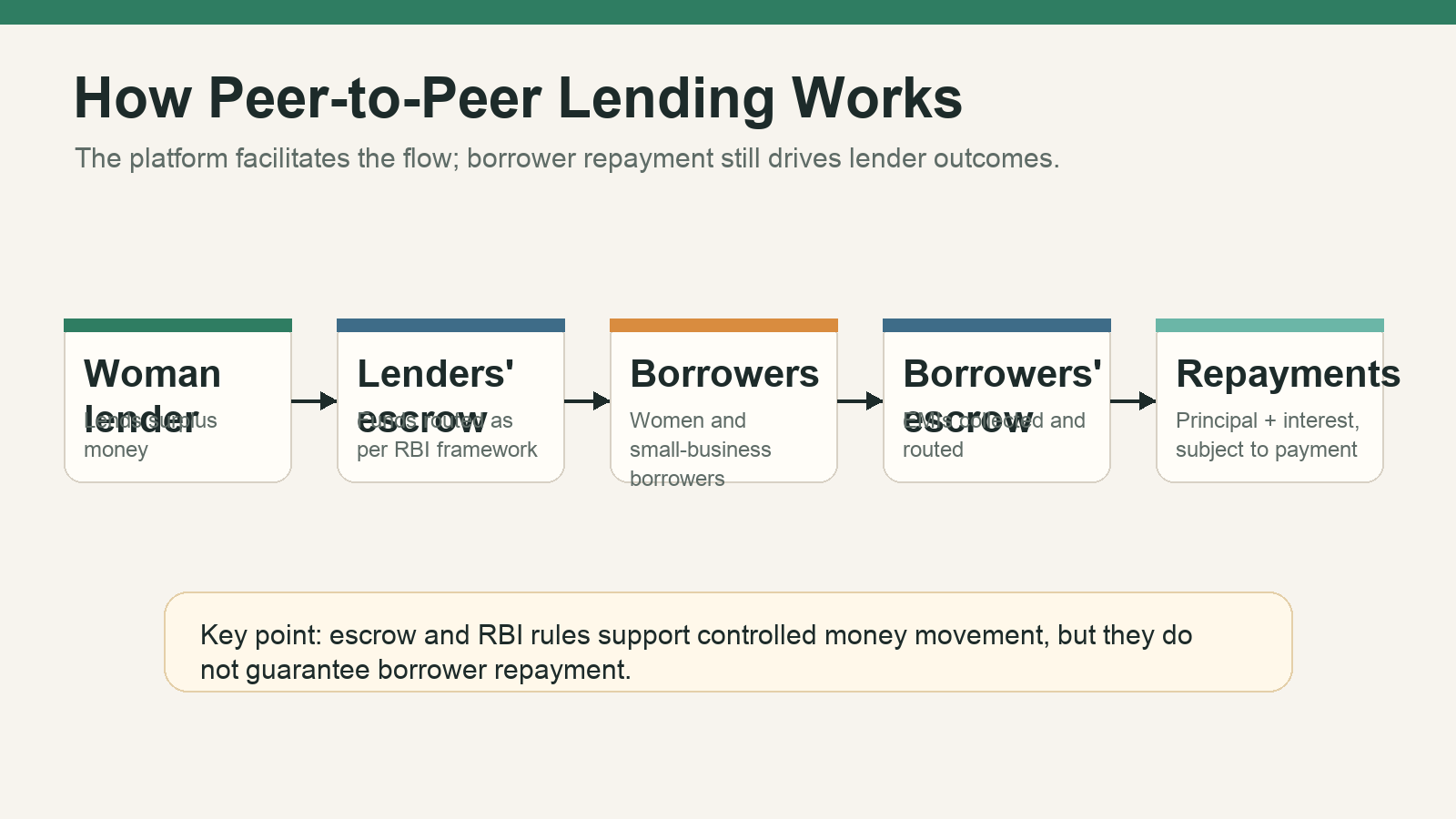
This model can be useful because it creates a direct lending structure, but it also requires the lender to think like a credit participant, not a passive depositor.
RBI-Registered NBFC-P2P Platform Does Not Mean RBI-Guaranteed Repayment
An RBI-registered NBFC-P2P platform operates inside a regulatory framework. That is meaningful because regulation defines who can operate, what activities are permitted, how money should move, what disclosures are required, and what the platform must not claim.
But RBI registration is not RBI endorsement.
It does not mean repayment is assured by the regulator. It does not mean the RBI approves any displayed return. It does not mean principal is protected. It does not mean every borrower has the same risk.
For women lenders, the practical takeaway is simple: prefer the discipline of a regulated platform, but do not confuse regulation with insurance.
IndiaP2P is registered with the Reserve Bank of India as an NBFC-P2P. This is a regulatory fact. It should be read as a framework signal, not as a promise of repayment.
P2P Lending Returns for Lenders: Read "Up to 18% p.a." Carefully
P2P lending returns for lenders come from borrower repayments. A borrower repays principal and interest. The lender receives their share after platform processes and applicable charges.
IndiaP2P enables eligible lenders to target up to 18% p.a. indicative returns, subject to borrower repayment performance, fees, timing, defaults, tax treatment, and platform terms. The words "up to" and "indicative" are doing important work.
"Up to" means the figure is an upper-end potential. It is not the standard outcome for every lender.
"Indicative" means the actual outcome can change. Borrowers may repay on time, late, partly, or not at all. Fees and tax treatment may affect net results. Lending spread and tenure may affect the cash-flow experience. Recovery timelines, where relevant, can also change realised outcomes.
This is why return-first marketing can be misleading in P2P lending. A displayed return without borrower-risk context can make lending look simpler than it is.
A better way to read returns is to ask:
Return question | Risk-aware interpretation |
|---|---|
What is the displayed return? | Is it only the starting point? |
Is it up to, indicative, historical, or contractual? | Each phrase means something different |
What can reduce realised receipts? | Delays, defaults, fees, tax treatment and recovery timing |
Is the lending amount diversified? | Borrower spread affects concentration risk |
How long is the tenure? | Longer tenures can affect liquidity planning. |
If a woman lender is comparing P2P lending with other money choices, the comparison should not be based only on rate. It should include risk, liquidity, tax, tenure, borrower exposure, and the fact that P2P lending is not a deposit.
For a detailed explanation of the return calculation, read IndiaP2P's guide on how P2P lending returns are calculated.
P2P Lending Is Not a Deposit Product
P2P lending not a deposit is one of the most important compliance points in this article.
A deposit generally creates a different legal and risk relationship between the customer and the deposit-taking institution. P2P lending is different. In P2P lending, the lender lends to borrowers through a platform. The platform is an intermediary. It does not become a bank deposit-taker. It does not guarantee return of principal or interest.
This distinction matters most when a lender wants monthly repayments. P2P loans may have scheduled repayments. Those repayments can be useful for cash-flow planning. But scheduled does not mean guaranteed. If the borrower does not pay, there is no repayment to pass through.
Women lenders should avoid using P2P lending for money that cannot tolerate delay. That includes emergency funds, near-term obligations, and money meant for essential household or family expenses.
Borrower Default Risk in P2P Lending: What Women Lenders Should Check
Borrower default risk in P2P lending is the risk that a borrower does not repay as expected.
This can show up in several ways. A borrower may pay late. A borrower may miss one EMI. A borrower may enter recovery follow-up. A borrower may repay partly. In the worst case, a borrower may default and principal or interest may be lost.
A platform can reduce information gaps through underwriting, verification, credit assessment, borrower selection, repayment tracking, and collection support. It cannot eliminate borrower risk.
Before lending, women lenders should check:
Check | What to look for |
|---|---|
Borrower selection process | Does the platform explain how borrowers are assessed? |
Repayment behaviour | Does the platform show current, delayed, or overdue status clearly? |
Lending spread | Is exposure distributed across many borrowers? |
Tenure | How long can the money remain lent? |
Fees and deductions | What charges can affect net receipts? |
Risk disclosure | Does the platform clearly state that principal and returns are not guaranteed? |
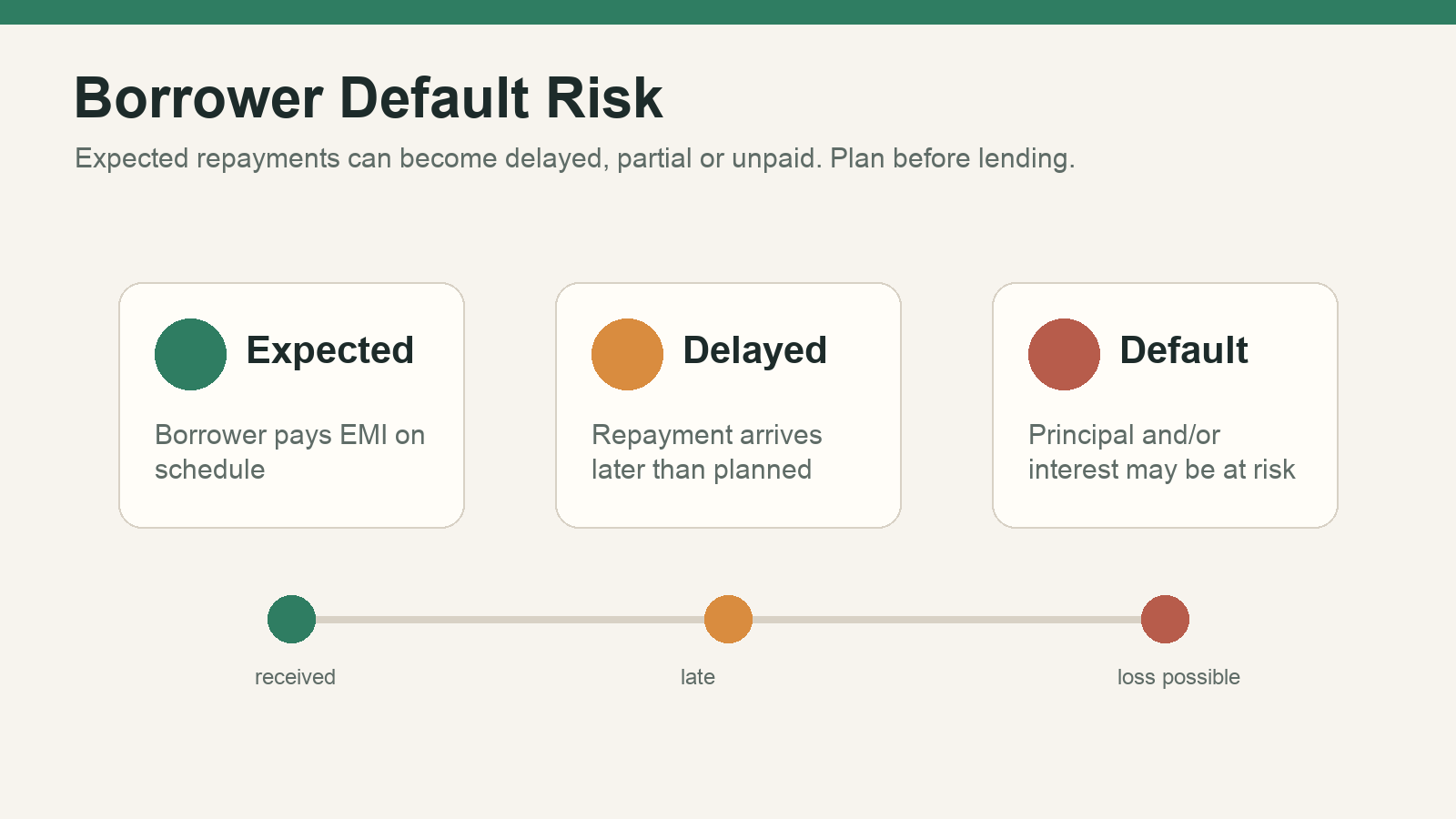
The point is not to avoid all risk. That is not possible in P2P lending. The point is to understand the risk before lending, size the lending amount accordingly, and avoid being guided only by the displayed return.
For more on borrower evaluation, read IndiaP2P's guide on how borrower selection works on IndiaP2P.
P2P Lending Risks in India: Red Flags Women Lenders Should Avoid
P2P lending risks in India are not limited to borrower default. Some risks come from how the product is described, how the lender interprets the return figure, and how much of her money plan depends on expected repayments.
The first red flag is return language that sounds too certain. A platform, article, or social post that presents P2P lending as guaranteed, assured, protected, or deposit-like should make a lender pause. A legitimate lending decision can discuss return potential, but it must also explain borrower repayment risk and the possibility of principal loss.
The second red flag is weak risk disclosure. If the risk note is hidden, overly technical, or placed far away from the return claim, the lender is not being helped to make a balanced decision. Risk disclosure should be visible before the lender commits money, not only after the return number has done all the persuasion.
The third red flag is emotional impact framing. Women-borrower stories can be meaningful, but they should not replace borrower assessment. A lender should not be asked to lend because a borrower story feels inspiring. She should be able to see how borrowers are evaluated, how repayments are tracked, and what happens if repayment is delayed.
The fourth red flag is liquidity confusion. Any suggestion that a lender can treat P2P lending like money available on demand should be read carefully. P2P loans have tenures. Repayments depend on borrower behaviour. Exit, withdrawal, and re-lending terms should be understood before lending.
The fifth red flag is over-allocation. Even when a platform is regulated and the lender understands the product, lending too much too soon can create stress. A first allocation should be sized so that delayed repayments do not disturb household cash flow, emergency reserves, tax payments, business working capital, or family commitments.
For women lenders managing multiple financial roles, these red flags are practical. They help turn P2P lending from a rate-led decision into a structured credit decision.
Women Borrowers and P2P Lending: Impact Without Ignoring Risk
One reason P2P lending for women in India is an interesting topic is that the women's angle exists on both sides: women as lenders and women as borrowers.
IndiaP2P has historically focused on women borrowers and small business borrowers. IndiaP2P's Social Impact Performance Report 2024 states that 88% of loans were to women borrowers, 72.13% of loans were to grow small businesses, and 99% of credit flow went to underserved rural and semi-urban areas. Its 2023 report stated that 94.12% of portfolio allocation was to women borrowers.
This is useful context, but it must be handled carefully.
Lending to women borrowers can have social and economic meaning. Women entrepreneurs may use credit for working capital, stock purchase, home-business expansion, education-linked productivity, or other household/business needs. Credit access can support enterprise activity in communities where formal credit may be harder to access.
But impact is not a repayment guarantee.
A borrower being a woman, an entrepreneur, or a small business owner does not remove credit risk. Each loan still depends on borrower cash flow, repayment capacity, documentation, collection discipline, and wider economic conditions.
This distinction protects both sides. It respects women borrowers as credit participants, not charity cases. It also respects women lenders by not asking them to lend based on sentiment.
The responsible framing is:
Impact-aware but risky framing | Responsible framing |
|---|---|
“Lend to women because they always repay.” | "Review borrower assessment and repayment risk before lending." |
“Impact lending is safer.” | "Review borrower assessment and repayment risk before lending." |
“Women borrowers guarantee better outcomes.” | "Borrower performance must be evaluated through data and process." |
“Supports a cause and earn returns.” | "Understand both social context and credit risk." |
For the source data, see IndiaP2P's Social Impact Performance Report 2024 and Social Impact Performance Report 2023.
Women Entrepreneurs as Borrowers Need Credit Access, Not Sentimental Lending
Women entrepreneurs in India often face credit-access friction. Some may run informal or semi-formal businesses. Some may have limited collateral. Some may have strong repayment discipline but insufficient access to traditional credit channels. Digital lending and P2P structures can help bridge parts of that gap when operated responsibly.
However, lenders should avoid turning women-borrower stories into a reason to skip risk checks.
The healthier lens is credit dignity. A borrower should be assessed on repayment ability, documents, income behaviour, credit history where available, loan purpose, and the platform's risk framework. A lender should lend only after understanding those factors.
This is where women lenders can be both empathetic and disciplined. They can care about access to credit while still asking rigorous questions about default risk, repayment flow, and suitability.
P2P Lending Diversification: Spread Exposure Without Pretending Risk Disappears
P2P lending diversification means spreading lending exposure across multiple borrowers instead of concentrating too much with one borrower or a small set of borrowers.
Diversification can reduce concentration risk. If one borrower delays, a well-spread lending amount may be less affected than a concentrated one. But diversification does not eliminate borrower default risk. If several borrowers delay during a stressed period, repayments can still be affected.
This is why diversification should be described precisely.
What diversification can do | What diversification cannot do |
|---|---|
Reduce dependence on one borrower | Guarantee repayment |
Smooth the effect of isolated delays | Remove borrower default risk |
Help distribute exposure across borrowers | Make P2P lending a deposit |
Support more disciplined lending | Protect principal in all outcomes |
RBI also sets a regulatory maximum for same-borrower exposure. A single lender's exposure to the same borrower across all P2P platforms cannot exceed ₹50,000. This is a regulatory cap, not a recommended comfort level. Many lenders may prefer a much lower per-borrower exposure depending on their risk comfort and total lending amount.
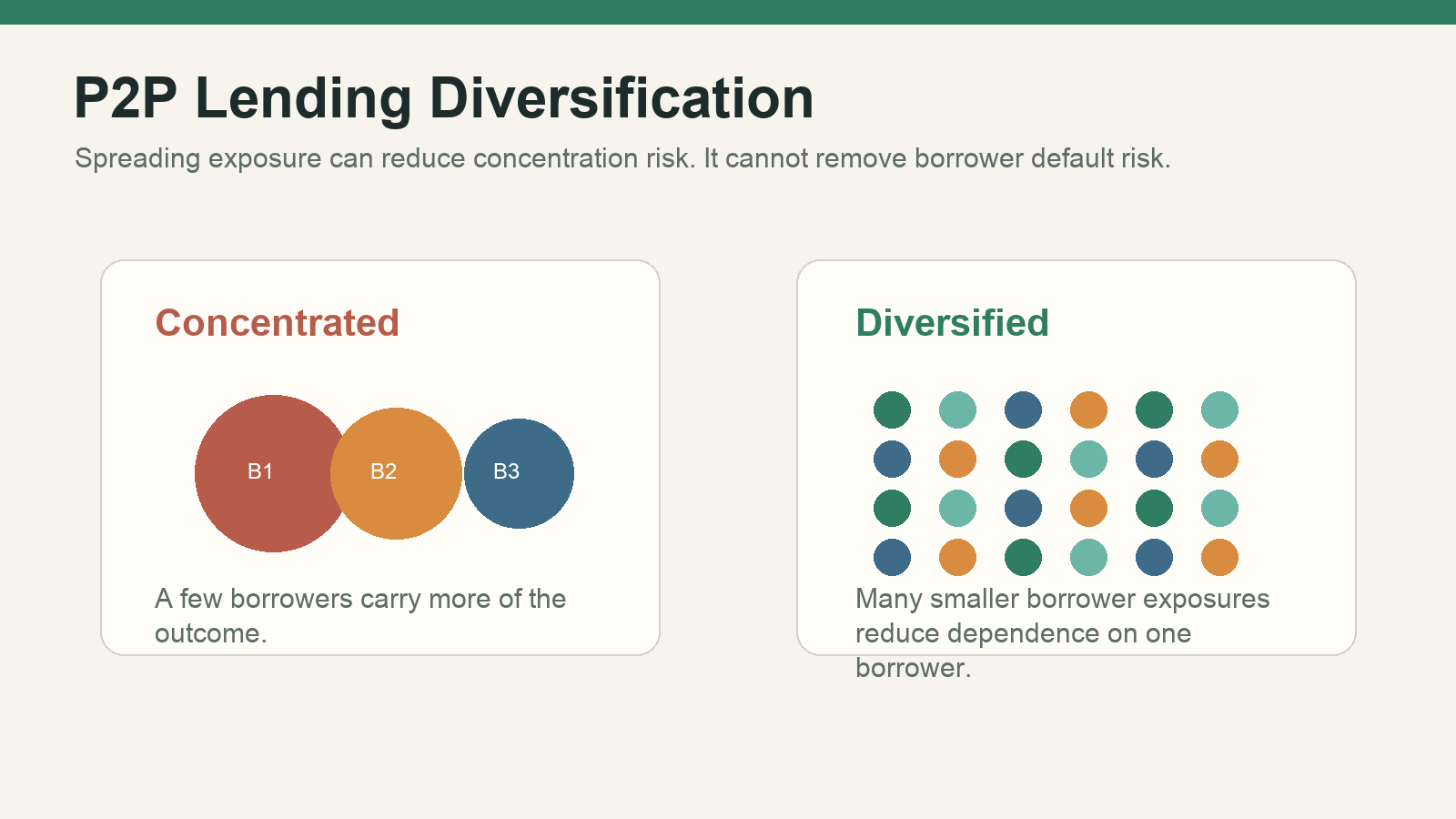
Women lenders should think in terms of borrower spread, not just total amount. For example, lending ₹1,00,000 across many borrowers is a different risk experience from lending the same amount across only a few borrowers. The amount is the same. The concentration risk is not.
For a deeper allocation framework, read IndiaP2P's guide on how much to allocate to P2P lending.
Monthly Repayments in P2P Lending: Useful, But Not Guaranteed Cash Flow
Monthly repayments in P2P lending can be appealing because they create visibility. A lender may see scheduled repayments of principal and interest over the loan tenure. This can help with tracking and planning.
But monthly repayment visibility should not be confused with guaranteed monthly income.
The scheduled date is the date on which repayment is expected. The received date depends on whether the borrower pays and how the platform and banking process handle the transfer. If a borrower delays, the expected repayment may not arrive on schedule.
Women lenders who manage household budgets, family goals, self-employment income, or business surplus should be especially careful here. P2P lending can be one part of a broader money plan, but it should not be used to fund obligations that require certainty.
A practical way to think about repayments:
Planning item | Risk-aware approach |
|---|---|
Expected EMI | Useful for projection, not certainty |
Received repayment | Count only after it is actually received |
Delayed borrower | Expect tracking, follow-up, and possible variation |
Re-lending | Decide whether to re-lend received amounts or withdraw them |
Liquidity needs | Keep urgent money outside P2P lending |
For more on repayment movement, read IndiaP2P's guide to the P2P lending repayment lifecycle.
P2P Lending for Women Lenders: A First-Allocation Framework
P2P lending for women lenders should begin with allocation discipline. The first question is not how much the RBI permits. It is how much the lender can lend without weakening the rest of her financial plan.
A practical first-allocation framework has four layers.
The first layer is emergency money. Keep emergency reserves outside P2P lending. This is the money that protects rent, medical needs, family support, children's expenses, business continuity, and unexpected gaps in income. P2P lending should not compete with this layer.
The second layer is near-term obligations. If money is needed in the next few months for a planned payment, it should usually remain in a more liquid place. P2P lending is better evaluated with money that can stay lent through the selected tenure and tolerate repayment variation.
The third layer is learning capital. A new lender may prefer to start with a smaller amount, observe dashboard reporting, see how expected and received repayments differ, understand re-lending choices, and build comfort gradually. This is especially useful for women lenders who are new to credit-risk products.
The fourth layer is review discipline. After one or more repayment cycles, review borrower spread, delayed repayments, received cash, tax records, and whether the experience feels understandable. Increasing exposure before this review can turn a learning decision into an emotional one.
This framework also keeps the up to 18% p.a. indicative returns figure in its proper place. Return potential can be attractive, but allocation should be driven by risk capacity first. If a smaller allocation is the right fit, it is not a timid decision. It is disciplined lending.
P2P Lending Exposure Limits India: RBI Caps Every Lender Should Know
P2P lending exposure limits in India are set by the RBI framework for NBFC-P2P platforms.
The main limits are:
RBI exposure limit | Current rule |
|---|---|
Aggregate lender exposure | Up to ₹50 lakh across all P2P platforms, consistent with net worth. |
CA certificate trigger | If lending exceeds ₹10 lakh across P2P platforms, the lender must provide a practising Chartered Accountant certificate certifying minimum net worth of ₹50 lakh. |
Same-borrower exposure | A single lender cannot have more than ₹50,000 exposure to the same borrower across all P2P platforms. |
Borrower aggregate loans | A borrower's aggregate loans across P2P platforms are capped at ₹10 lakh. |
Maximum maturity | P2P loan maturity cannot exceed 36 months. |
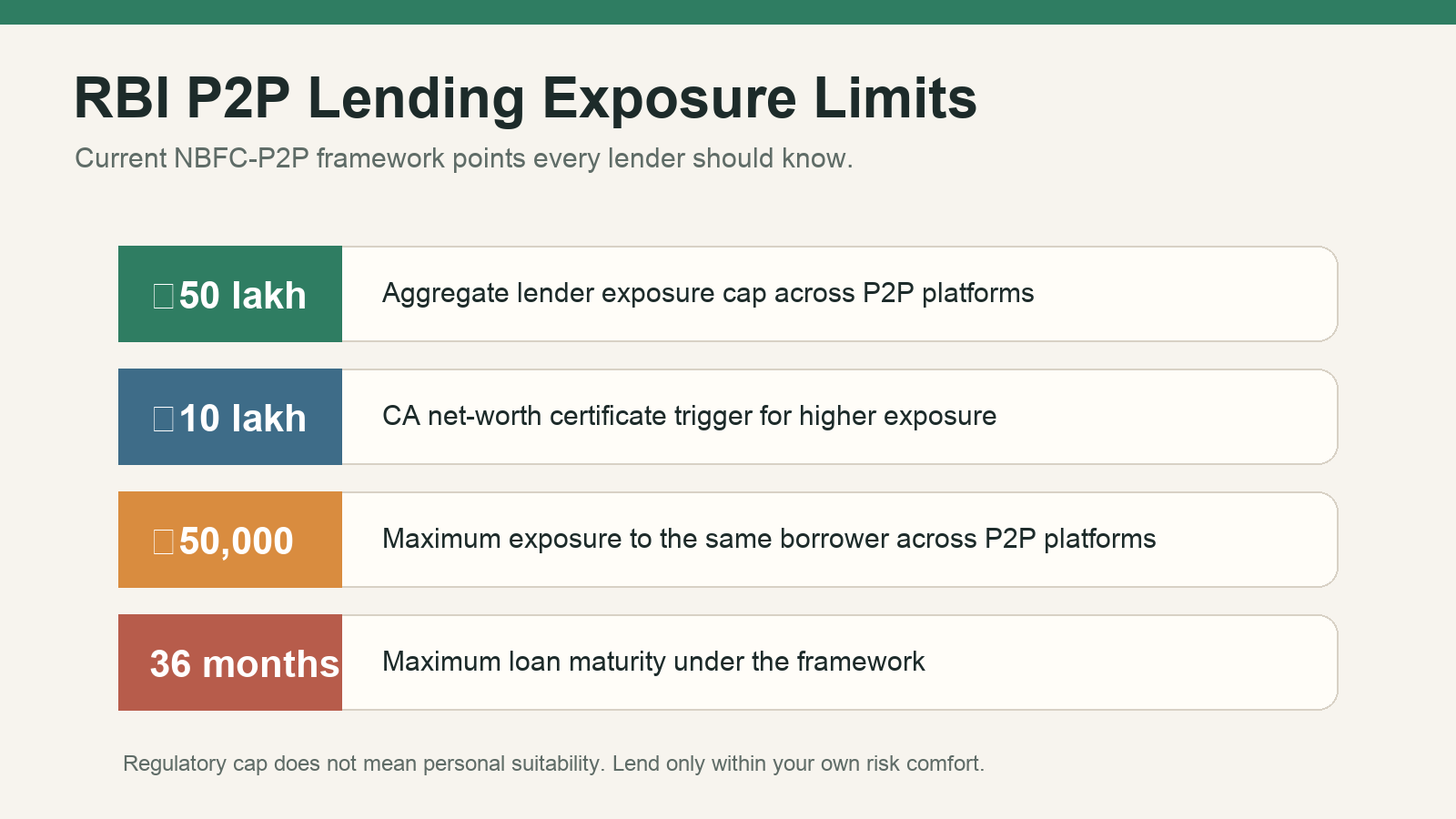
These are regulatory boundaries. They are not suggestions that every lender should lend up to the maximum.
A woman lender may decide that her personal limit is much lower than the RBI cap. That can be entirely sensible. Personal allocation should depend on income stability, emergency reserves, existing debt, family responsibilities, tax position, time horizon, and risk comfort.
The RBI framework sets the outer wall. Your personal money plan decides how close to that wall you should stand.
How Women Lenders Can Evaluate IndiaP2P Before Lending
Women lenders evaluating IndiaP2P should combine platform checks with personal suitability checks.
Start with the platform:
Is the platform registered with RBI as an NBFC-P2P?
Does it explain that RBI registration is not a repayment guarantee?
Does it describe borrower risk clearly?
Does it avoid presenting P2P lending as a deposit or assured-return product?
Does it show how borrower selection and credit assessment work?
Does it explain diversification and repayment tracking?
Does it disclose fees, tenure, and platform terms?
Then check yourself:
Is this money surplus?
Can I tolerate delayed repayments?
Am I comfortable with possible principal loss?
Have I avoided over-concentration?
Do I understand the tenure?
Am I reading up to 18% p.a. indicative returns as potential, not certainty?
Am I lending because the structure fits, not because the return number looks attractive?
IndiaP2P can be evaluated as an RBI-registered NBFC-P2P platform that enables eligible lenders to target up to 18% p.a. indicative returns, subject to borrower repayment performance and other risks. It also has a women-borrower and small-business context that may matter to lenders who care about credit access.
But the final decision should remain risk-first.
Women lenders should start only with amounts that fit their comfort level. They should observe repayment cycles, understand dashboard reporting, and build familiarity before increasing exposure.
When ready, explore IndiaP2P's Monthly Income Plan+ only after reading the risk disclosures, platform terms, borrower-risk information, and suitability considerations.
Summary: Choose P2P Lending With Risk Awareness, Not Return-Only Thinking
P2P lending for women in India should not be reduced to a high-return headline or an impact story.
It is a lending decision.
That decision may include up to 18% p.a. indicative returns for eligible lenders, but the return number is only useful when read beside borrower default risk, repayment variation, diversification, tenure, fees, tax treatment, and RBI NBFC-P2P rules.
The women-specific opportunity is not that women lenders should lend differently because they are women. It is that more women can now access, evaluate, and question digital lending options directly.
That independence deserves accurate language. You are not simply "investing in P2P." You are lending to borrowers through a regulated platform. You should understand who carries the risk, how repayments work, what diversification can and cannot do, and why RBI registration is a framework, not a guarantee.
If the structure fits your surplus money, risk comfort, and time horizon, P2P lending may be worth evaluating. If you need certainty, protection, or immediate liquidity, it is better to pause.
The strongest lending decision is not the one with the loudest return number. It is the one you can understand even when repayments do not go exactly as planned.