P2P lending returns calculation is not just a matter of multiplying the amount lent by a headline rate. In peer-to-peer lending, the return journey starts with borrower repayments and ends with the cash actually received by the lender after timing, fees, tax, delays, defaults and any re-lending decisions.
IndiaP2P enables eligible lenders to target up to 18% p.a. indicative returns through P2P lending, subject to borrower repayment performance, fees, timing, defaults, tax treatment and platform terms. This is not a deposit product. Principal is not protected, and returns are not guaranteed.
That is why a careful lender should ask a better question than "What is the rate?"
The better question is: "How is this return calculated, and what can reduce the amount I actually receive?"
If you are new to the category, start with IndiaP2P's guide to P2P lending for first-time lenders before comparing return numbers.
P2P Lending Returns Calculation: The Short Answer
At a practical level, P2P lending returns are calculated by comparing the lender's cash outflows with the lender's cash inflows over time.
The outflow is the amount lent through the platform. The inflows may include interest received from borrowers, principal repayments, late-payment recoveries where applicable, and any cash withdrawn or re-lent. From this, a lender must account for platform fees, tax, delayed repayments, defaults, idle cash and the timing of each cash flow.
A simplified way to think about it is:
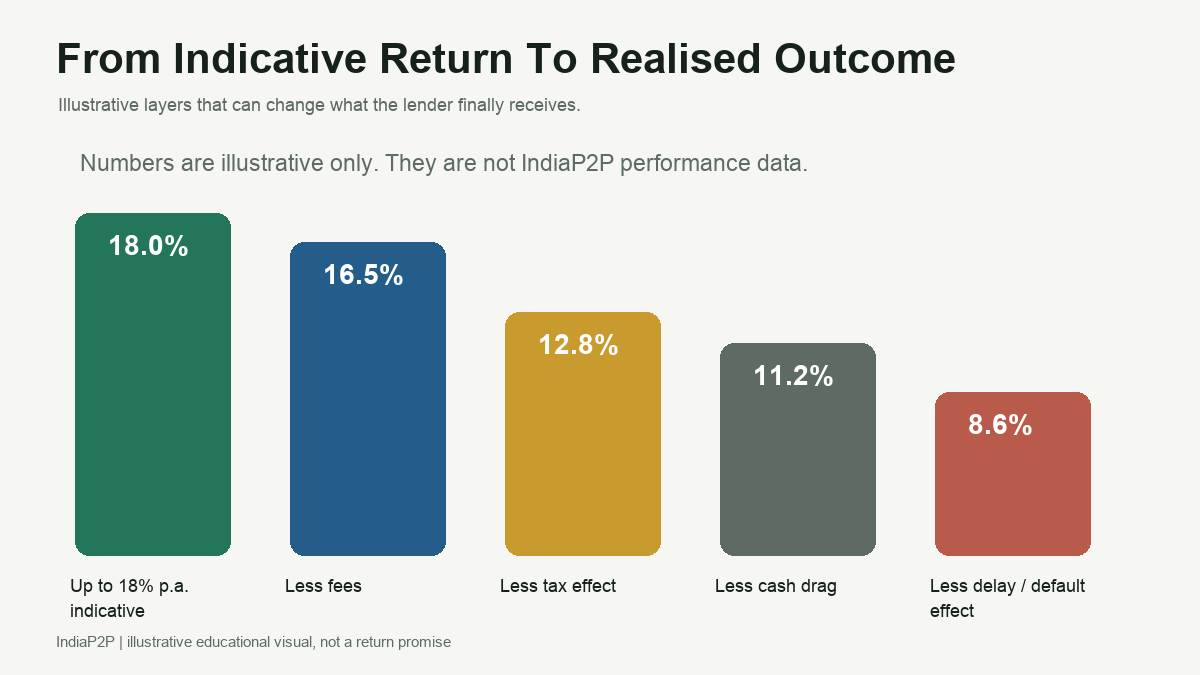
Realised P2P lending outcome = borrower interest received - fees - losses from delayed/defaulted loans - tax impact - cash drag, adjusted for timing
This is different from a displayed or target return. A displayed return may assume that borrowers repay as scheduled, cash is deployed efficiently, fees are applied as expected, and no material delay or default changes the pattern. Real life can be different.
This is why IndiaP2P uses the upper-end indicative figure with risk context. The figure is a potential outcome, not a standard result for every lender.
P2P Loan Interest Calculation Starts With Borrower EMIs
In most P2P lending structures, borrowers repay through scheduled instalments. Each instalment may contain two parts: interest and principal.
The interest component is the return source for the lender. The principal component is the lender's own capital coming back. Mixing the two can make returns look higher than they are.
For example, if a lender receives ₹5,000 in a month, that entire amount is not return. Part may be interest. Part may be principal repayment. A good return calculation separates the two.
Cash-flow item | What it means for the lender | How it affects return |
|---|---|---|
Principal lent | Amount deployed to borrower loans | Starting capital at risk |
Interest received | Borrower interest paid to lender | Adds to return |
Principal received | Capital rapid by borrower | Returns capital, but is not income |
Platform fee | Fee charged as per platform terms | Reduces net outcome |
Delayed EMI | Scheduled cash not received on time | Reduces or delays realised return |
Default / loss | Principal or interest not recovered | Can reduce return and capital |
EMI Interest Component vs Principal Repayment in P2P Lending
The distinction between interest and principal is central to the return calculation.
If a borrower repays ₹10,000 in total, and ₹1,200 of that is interest while ₹8,800 is principal, the return is linked to the ₹1,200 interest component. The ₹8,800 principal repayment matters for liquidity and capital recovery, but it should not be counted as earnings.
This is also why the timing of repayments matters. Early repayments may contain a different mix of principal and interest than later repayments, depending on the loan structure.
P2P APR vs Lender Return: Why The Same Loan Can Show Different Numbers
APR, or annual percentage rate, is usually a borrower-side way to express the cost of a loan annually. A lender's realised return is different.
The lender's return depends on what the borrower pays, when the borrower pays, how much fee applies, whether any borrower delays or defaults, how received cash is treated, and how tax applies to the lender.
So a borrower loan rate and a lender's realised outcome should not be treated as the same number.
P2P Lending XIRR and Net Annualized Return Explained
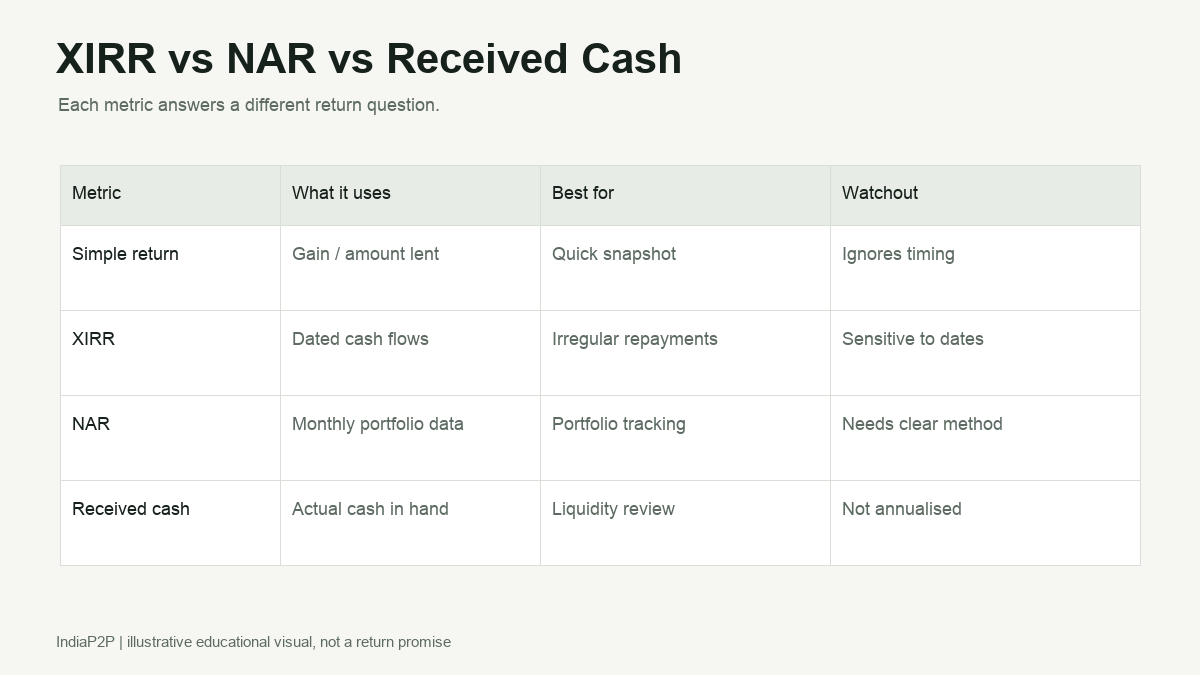
Two common ways to understand P2P lending performance are XIRR and net annualized return, often shortened to NAR.
XIRR is useful when cash flows happen on different dates. This matters in P2P lending because money may be lent on one date, repayments may arrive monthly, some cash may be withdrawn, some may be re-lent, and some repayments may be delayed.
NAR is more of a portfolio-tracking measure. It can help estimate annualised performance after considering income, fees and losses over a period. But it depends heavily on what the calculation includes and excludes.
Metric | What it measures | Useful when | Limitation |
|---|---|---|---|
Simple return | Gain or loss divided by amount lent | Quick snapshot | Ignores timing |
XIRR | Annualised return using dated cash flows | Cash flows happen on different dates | Sensitive to assumptions and dates |
NAR | Annualised portfolio return after income, fees and losses | Tracking portfolio performance | Methodology must be understood |
Received cash | Actual cash received by lender | Checking liquidity | Not the same as annualised return |
When XIRR is Useful for P2P Lending Cash Flows
XIRR is useful when a lender wants to account for timing. A rupee received after one month is not the same as a rupee received after twelve months. A delayed EMI changes the return experience because cash arrives later than scheduled.
XIRR also helps where the lender adds more funds, withdraws repayments, or re-lends received cash. In those cases, the calculation needs dates, not only amounts.
When NAR Can Help Track P2P Portfolio Performance
NAR can help lenders review a portfolio at a periodic level, especially if the platform explains the methodology clearly. It should ideally account for interest received, fees, principal outstanding, and losses where applicable.
The important point is not the label. It is what the calculation includes. A return metric that ignores delayed or defaulted loans may look cleaner than the lender's actual experience.
P2P Lending Fees, Cash Drag and Tax Change Realised Returns
The displayed return is only the starting point. Realised return can change because of three practical adjustments: fees, cash drag and tax.
Fees reduce the amount retained by the lender. The specific fee structure depends on the platform terms and should be checked before lending.
Cash drag happens when money is not actively lent. For example, a borrower repayment may arrive in the lender's account, but if the lender neither withdraws it nor lends it again, it sits idle. Idle cash may reduce the annualised return compared with a scenario where cash remains deployed.
Tax can also change the post-tax outcome. Interest-like receipts from P2P lending should be reviewed in the lender's tax context. Tax treatment depends on individual circumstances and may change. Please consult a qualified tax advisor.
For lenders planning monthly repayments, IndiaP2P's guide to building a P2P cash-flow calendar for received repayments is a useful next step.
Pre-Tax vs Post-Tax P2P Lending Returns in India
Pre-tax return is the return before personal tax is considered. Post-tax return is what remains after tax applies.
If a lender sees an indicative pre-tax number, that does not automatically mean the lender keeps the same number after tax. A lender in a higher tax bracket may have a different post-tax outcome from a lender in a lower tax bracket, even if both receive the same pre-tax interest amount.
The tax section should not be read as personal tax advice. It is a reminder that return calculation is incomplete unless the lender considers tax.
Cash Drag in P2P Lending After Repayments Arrive
Cash drag is easy to miss because it does not look like a loss. The money is still there, but it is not earning through borrower loans.
This can happen when repayments arrive between lending cycles, when suitable borrower matches are not available, or when the lender intentionally pauses. Sometimes holding cash is sensible for liquidity. But it should be a conscious decision, not an unnoticed return leak.
Borrower Default Risk Changes P2P Lending Returns
Borrower default risk is the most important adjustment in the return calculation.
In P2P lending, the lender's outcome depends on borrower repayment behaviour. If borrowers repay on schedule, the return experience may remain close to the expected cash-flow pattern, subject to fees, tax and timing. If borrowers delay, partially repay, or default, the realised return can fall. In some cases, the lender may lose principal or interest.
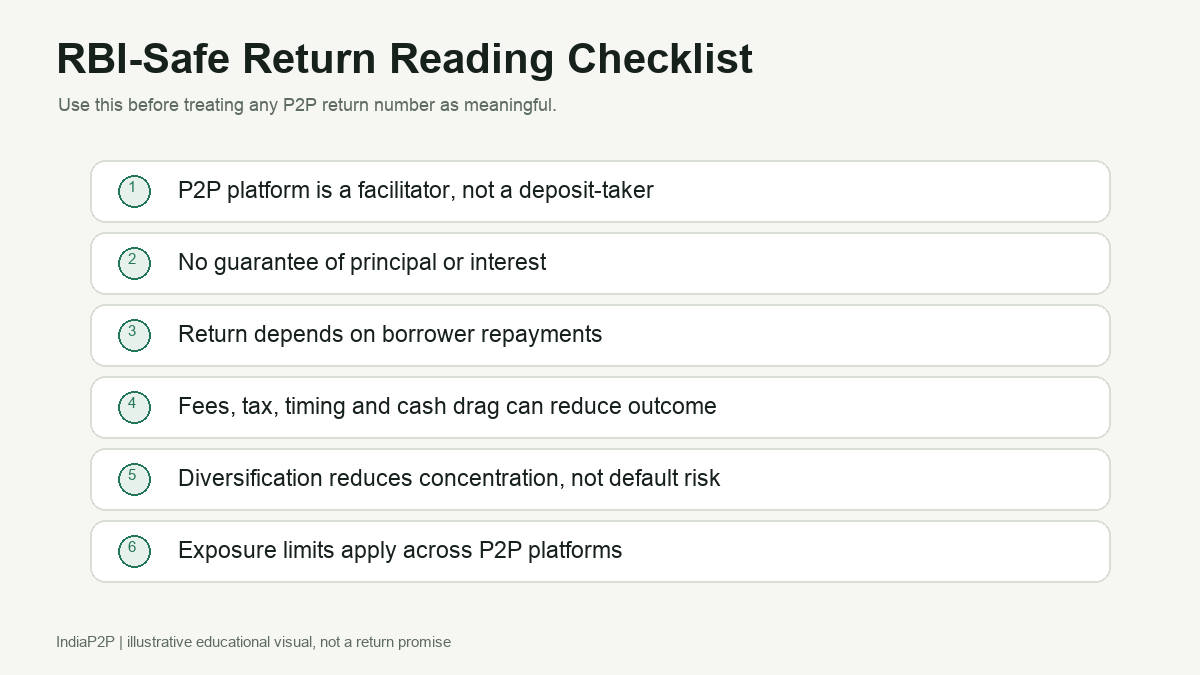
This is why P2P lending is not a deposit product. IndiaP2P is registered with the Reserve Bank of India as an NBFC-P2P, but RBI registration does not mean RBI approves returns, assures repayment, or protects principal.
For a deeper view of this risk lens, see IndiaP2P's P2P lending risks and returns guide.
Delayed EMIs, Partial Recovery and P2P Return Impact
A delayed EMI affects return in two ways.
First, the lender does not receive expected cash on time. Second, delayed cash may not be available for withdrawal or re-lending. If the delay becomes a default, the lender may also face loss of interest, principal, or both.
This is why scheduled return and realised return must be kept separate. Scheduled cash is a plan. Received cash is the fact.
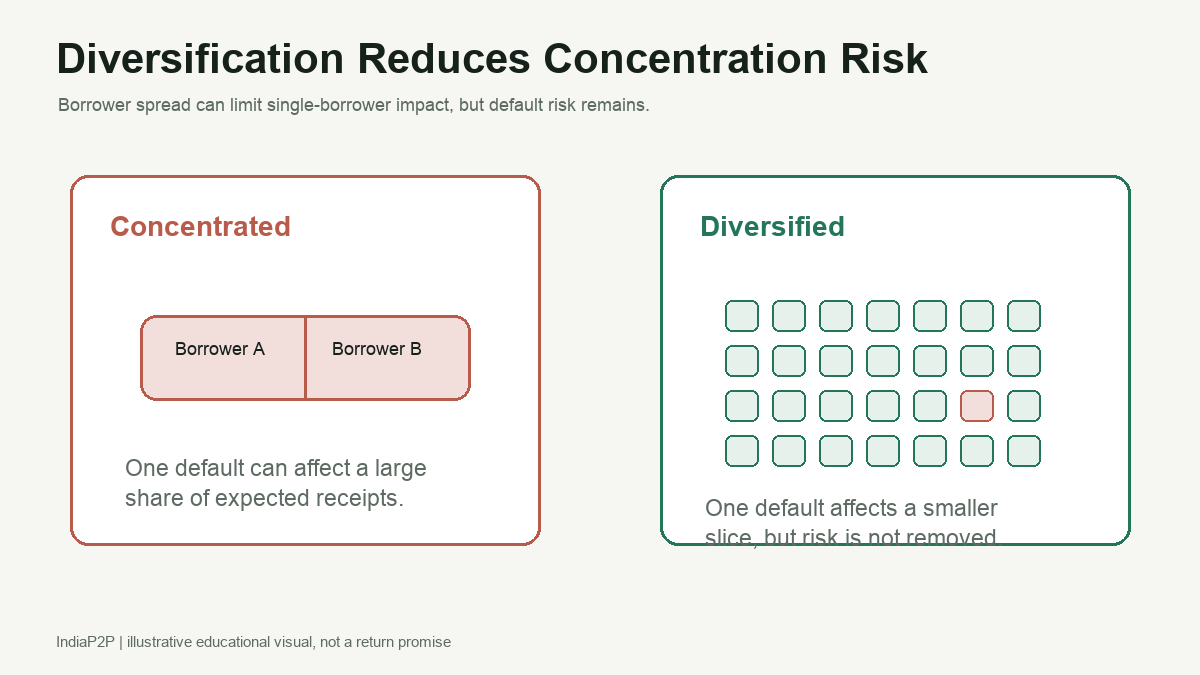
P2P Lending Diversification Reduces Concentration Risk, Not Default Risk
Diversification can reduce dependence on one borrower. If a lender's money is spread across many borrowers, one delayed EMI may affect a smaller share of the overall portfolio than it would in a concentrated exposure.
But diversification does not remove default risk. Several borrowers can still delay or default. A diversified portfolio can still deliver a lower realised return than the displayed figure.
Before increasing exposure, use IndiaP2P's risk-aware P2P lending allocation framework to decide how much money should be exposed to borrower repayment risk.
RBI NBFC-P2P Rules That Affect Return Calculations
The RBI framework matters because it defines what an NBFC-P2P platform is and is not.
Under the RBI Master Direction for NBFC-P2P platforms, a platform acts as an intermediary that facilitates lending between participants. It does not raise deposits, does not lend on its own, and cannot provide or arrange credit enhancement or credit guarantee. The RBI framework also requires disclosure of loan terms, likely return, fees and taxes to lenders.
This matters for returns because the platform is not promising the outcome. The borrower repayment behaviour remains central.
IndiaP2P's RBI NBFC-P2P rules for lenders guide explains these rules in more detail.
Escrow Account Timing and P2P Repayment Visibility
RBI's framework requires fund transfers through escrow account mechanisms. Broadly, lender funds and borrower collections move through separate escrow accounts, with transfers routed between the relevant bank accounts.
For the lender, this matters because return calculation should be based on actual received cash, not only scheduled repayments.
Exposure Limits and P2P Portfolio Return Assumptions
RBI caps a lender's aggregate exposure across all P2P platforms at ₹50 lakh. Exposure from one lender to the same borrower across all P2P platforms is capped at ₹50,000. If total exposure across P2P platforms exceeds ₹10 lakh, the lender must provide a practicing Chartered Accountant certificate confirming minimum net worth of ₹50 lakh.
These are regulatory limits, not recommended allocation targets. A lender's actual allocation should still depend on liquidity needs, borrower spread, tenure, repayment behaviour and risk comfort.
Illustrative P2P Return Calculation for a Lender
Here is a simplified example. These numbers are illustrative only. They are not IndiaP2P performance data and should not be treated as an expected or assured outcome.
Assume a lender lends ₹1,00,000 across multiple borrower loans. Also assume the dashboard initially shows upper-end indicative return potential, subject to borrower repayment performance, fees, timing, defaults, tax treatment and platform terms.
Step | Illustrative amount / effect | What it means |
|---|---|---|
Amount lent | ₹1,00,000 | Starting amount exposed to borrower repayment risk |
Scheduled annual interest | ₹18,000 | Illustrative interest potential before risk effects |
Platform fee effect | Lower net amount | Fee terms reduce lender outcome |
Delayed EMI effect | Cash received later | Timing can reduce annualised return |
Default / short recovery | Lower cash received | Principal or interest may be lost |
Tax effect | Depends on lender | Post-tax outcome differs by person |
Idle cash effect | Lower deployment | Cash drag can reduce annualised return |
The point of the table is not to predict a number. It is to show the calculation path.
A lender should read every return number with the question: "What assumptions does this number depend on?"
IndiaP2P's guide on how to read a P2P loan portfolio before lending can help lenders connect this calculation to dashboard fields such as borrower count, exposure per borrower, tenure, repayment dates, delayed EMIs and net returns.
Scheduled Return vs Realised P2P Lending Outcome
Scheduled return is based on expected borrower payments. Realised outcome is based on what actually arrives.
The gap between the two can come from delayed EMIs, defaults, fees, tax, idle cash, early closures, late recoveries or re-lending choices. This is why a serious return review should include both the earning side and the risk side.
How To Read IndiaP2P Indicative Returns
On IndiaP2P, eligible lenders may review up to 18% p.a. indicative returns on IndiaP2P Monthly Income Plan+, subject to borrower repayment performance, fees, timing, defaults, tax treatment and platform terms.
"Up to" matters. It means the figure is an upper-end potential, not the standard result for every lender.
"Indicative" also matters. It means the number depends on assumptions. The lender's realised outcome can be lower if borrowers delay, default, repay differently from schedule, or if cash remains idle between lending cycles.
Review IndiaP2P Monthly Income Plan+ only after assessing borrower repayment risk, fees, timing, liquidity needs and suitability for your financial plan.
P2P Lending Returns Checklist Before You Lend
Before lending through a P2P platform, use this checklist:
Is the return number indicative, pre-tax, post-tax, gross or net of fees?
What borrower repayment behaviour is assumed?
How many borrowers will my money be spread across?
What is my largest exposure to one borrower?
What happens if an EMI is delayed?
How are defaults and recoveries reflected in the dashboard?
What platform fees apply?
What tax treatment should I check?
Will received repayments be withdrawn, re-lent or held as idle cash?
Am I within RBI's aggregate and single-borrower exposure limits?
Is this surplus money that can tolerate repayment delays?
The calculation becomes clearer when the lender stops reading the return figure in isolation. The return number is only one layer. Under it sit borrower repayments, timing, fees, tax, cash drag, diversification and default risk.
IndiaP2P enables eligible lenders to review indicative return potential, but the decision to lend should begin with risk awareness. Read the calculation. Check the assumptions. Then decide whether the lending exposure fits your plan.