P2P lending tax in India is usually understood through a simple starting point: interest received by a lender is reviewed as taxable income, while principal repayment is not the same as income. The harder part is not the headline rule. It is knowing what to report, what documents to keep, how TDS may appear, and how tax interacts with borrower repayment risk.
IndiaP2P is registered with the Reserve Bank of India as an NBFC-P2P. That is a regulatory fact, not a statement that RBI approves returns, assures repayment, or protects principal. P2P lending is not a deposit product. It carries borrower default risk, and returns are not guaranteed.
This guide explains the tax mechanics for Indian P2P lenders in 2026, using cautious educational framing. It is not tax advice. Tax treatment depends on individual circumstances and may change. Please consult a qualified tax advisor.
Is P2P Lending Taxable in India?
Yes, P2P lending income should be reviewed for tax reporting in India. In most lender situations, the interest component received through P2P lending is treated as taxable income and included in the lender's total income. The principal component is different because it represents return of the amount lent, not income earned.
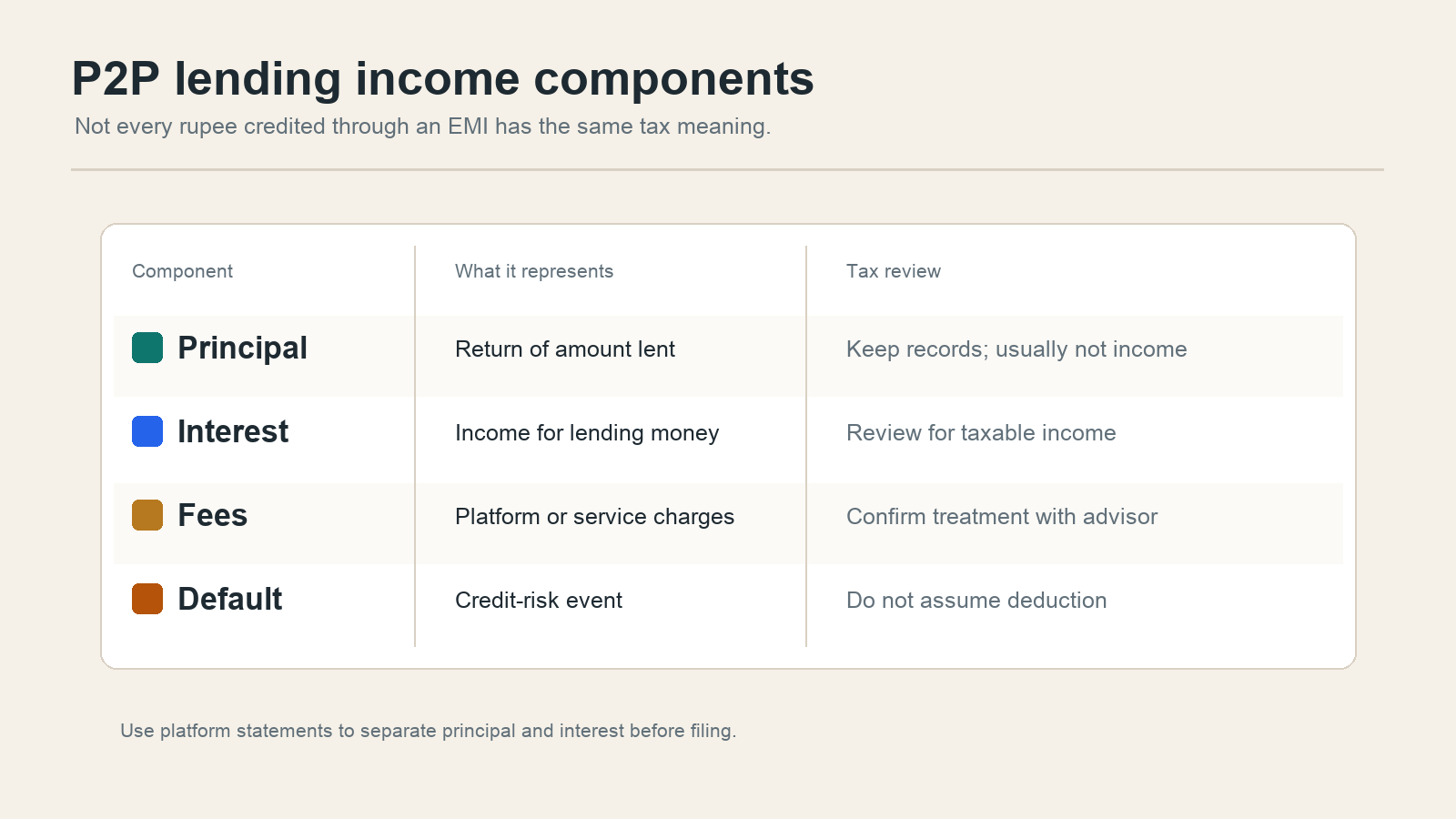
That distinction matters because a P2P loan repayment may include both principal and interest. A lender should not look only at the total EMI received. The tax review should separate:
Component | What it usually represents | Tax review |
|---|---|---|
Principal repayment | Return of the amount originally lent | Usually not income, but maintain records |
Interest component | Compensation for lending money | Generally reviewed as taxable income |
Fees or charges | Platform or transaction costs, if any | Treatment depends on facts and tax advice |
Delayed or defaulted amounts | Repayment risk event | Do not assume tax deduction without advice |
The cleanest habit is to rely on platform statements, bank records, AIS/Form 26AS where relevant, and a tax advisor's review. Do not estimate from memory, especially if repayments are monthly and spread across many borrowers.
How P2P Lending Income Tax India Works for Lenders
P2P lending income tax in India starts with the lender's actual receipts or accrued interest, depending on the facts and the method followed for tax reporting. A P2P platform may provide statements showing principal, interest, fees, repayments, and overdue amounts. The lender should use those records to separate income from capital movement.
For a P2P lender, there are four practical layers:
The amount lent to borrowers through the platform.
Borrower repayments received over time.
The interest component included in those repayments.
The lender's tax treatment for that interest.
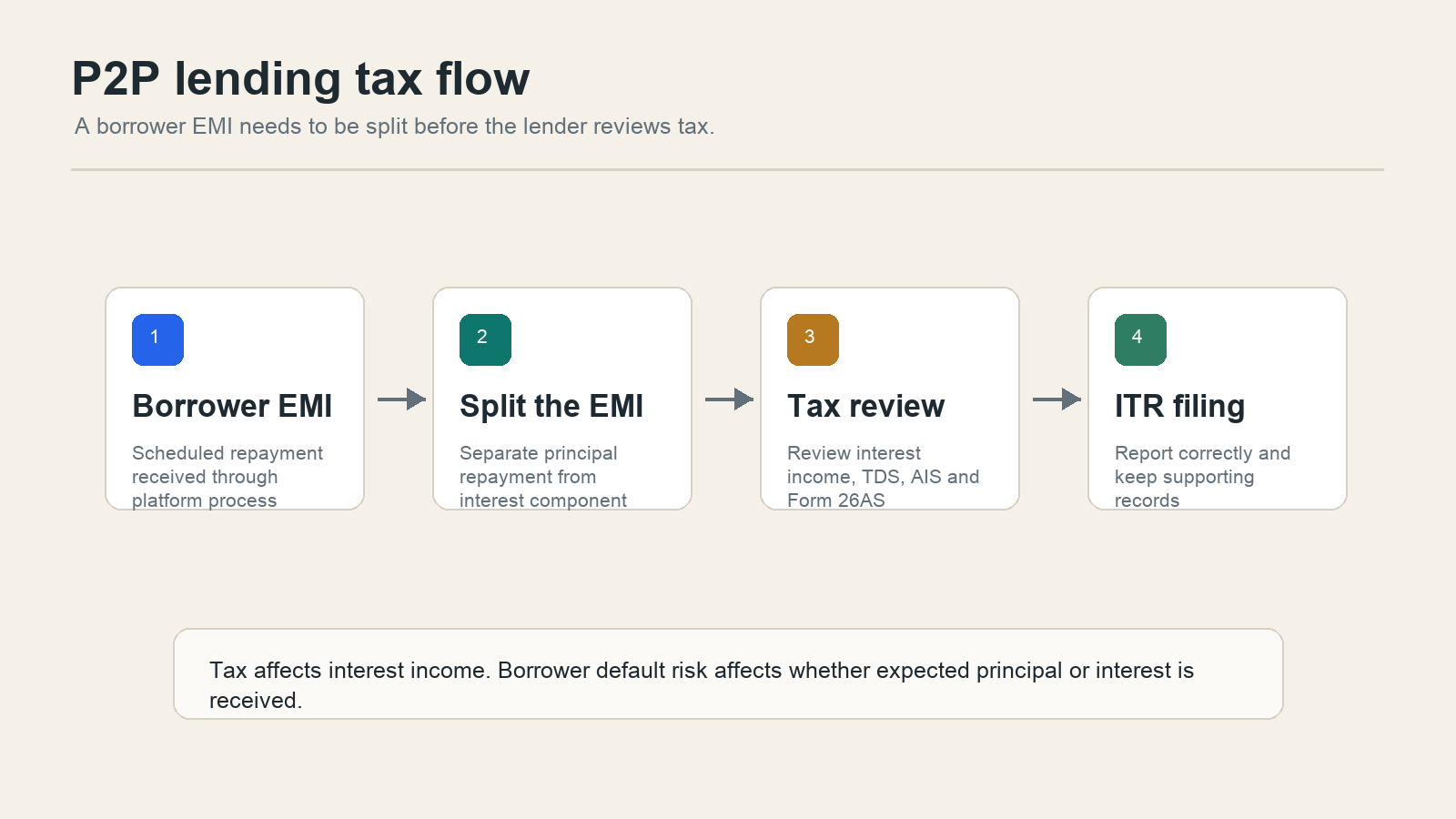
This is also why post-tax return is not the same as realised lending outcome. Tax affects what remains from taxable income. Borrower delay or default affects whether the expected principal or interest is received at all.
IndiaP2P enables eligible lenders to target up to 18% p.a. indicative returns through P2P lending, subject to borrower repayment performance, platform terms, fees, timing, tax treatment, and risk. This figure should not be read as assured, fixed, or principal-protected.
P2P Lending Interest Income Tax vs Principal Repayment
The interest component is the main tax focus for most individual lenders. The principal component is the lender's own money coming back.
For example, if a borrower EMI credited to a lender includes ₹800 principal and ₹200 interest, the tax question is usually about the ₹200 interest component, not the full ₹1,000 EMI. Over a year, those interest components may add up across many loans and should be reconciled with the platform statement.
This distinction also helps avoid over-reporting or under-reporting. Reporting total repayments as income can overstate taxable income. Ignoring small monthly interest credits can understate taxable income.
Tax on Peer-to-Peer Lending Returns and Borrower Purpose
A borrower's purpose does not automatically change the lender's tax treatment. If a borrower uses a loan for personal needs, business working capital, education, or another permitted purpose, the lender is still receiving interest for lending money.
Borrower-side tax treatment may vary depending on the borrower and use of funds. That is a separate matter. The lender should focus on the lender's own interest income, platform statement, and applicable tax position.
P2P Lending Income From Other Sources
P2P lending income from other sources is the common tax framing used for individual lenders, because interest income that is not chargeable under another income head is generally reviewed under the residual income head. Section 56 of the Income-tax Act covers "Income from other sources" for income not excluded from total income and not chargeable under other specified heads.
For most individual P2P lenders, the practical reporting question is: what interest income did I receive or accrue from P2P lending during the financial year, and where should it be disclosed in my return?
The answer depends on the taxpayer's full profile. A salaried individual with occasional P2P lending receipts may be different from a person who carries on lending as a business activity. A lender with capital gains, business income, foreign income, or other complexity may also need a different ITR form and disclosure method.
Use this as the safe working rule: keep the records, identify gross interest, check AIS/Form 26AS, and confirm the correct return form and reporting head with a qualified tax advisor.
P2P Lending TDS India: What Lenders Should Check
P2P lending TDS in India can be confusing because the platform is a facilitator and the borrower is the person paying interest. Section 194A deals with tax deduction at source on interest other than interest on securities, but its application depends on who is responsible for paying interest, the payer's status, thresholds, and other facts.
Do not assume that no TDS means no tax. Also do not assume that TDS, if deducted, completes your tax responsibility. TDS is only tax collected in advance. The final tax liability depends on the lender's total income, applicable regime, slab rate, surcharge or cess where relevant, and other tax facts.
Before filing, check:
Record | Why it matters |
|---|---|
Platform interest statement | Shows gross interest and repayment details |
Bank statement | Confirms cash movement |
AIS | May show reported interest or TDS data |
Form 26AS | Shows TDS credits where reported |
Loan-level statement | Helps reconcile principal vs interest |
Tax computation | Shows final slab impact |
If TDS appears in Form 26AS or AIS, it should be reconciled with the platform statement before filing. If TDS does not appear, the lender may still need to report the interest income and pay applicable tax.
How to Report P2P Lending Income in ITR
How to report P2P lending income in ITR depends on the lender's overall income profile. The broad process is:
Download the annual statement from the P2P platform.
Separate principal repayment, interest income, fees, overdue amounts, and defaults.
Reconcile interest income with bank credits, AIS, and Form 26AS.
Confirm the correct ITR form for your income profile.
Report the interest income under the appropriate head, commonly reviewed as Income from other sources for individual lenders.
Pay any remaining tax, including advance tax or self-assessment tax where applicable.
Keep supporting records after filing.
The ITR form point should not be guessed. ITR-1, ITR-2, ITR-3, and ITR-4 apply to different taxpayer profiles. P2P lending income may be only one part of the return. Salary, business income, capital gains, foreign assets, presumptive income, and other items can change the form.
P2P Lending Tax Documents to Keep
Keep a simple folder for the financial year. It should include:
Document | Keep because |
|---|---|
Platform annual tax or income statement | Base record for interest income |
Loan-wise repayment report | Separates principal and interest |
Bank statement | Supports actual cash movement |
AIS download | Checks income reported to tax department |
Form 26AS | Checks TDS credits |
Fee invoices, if any | Supports expense review |
Default or overdue report | Supports risk and tax-advisor review |
Tax computation | Shows slab impact and final liability |
For lenders with many small borrower exposures, the loan-wise statement matters. Small monthly interest entries can be easy to miss if the lender only reviews bank credits.
P2P Lending Returns After Tax: A Simple 2026 Example
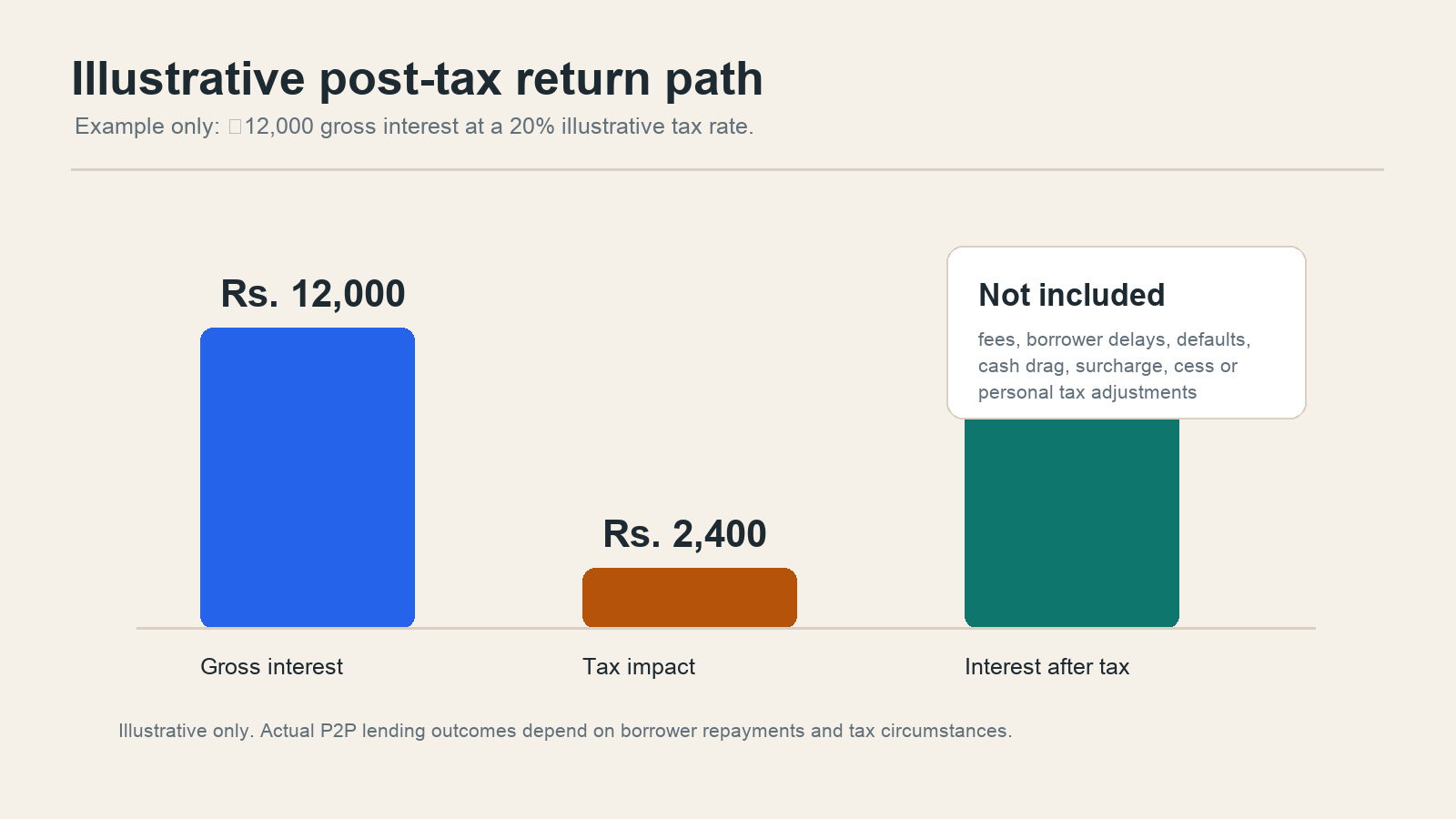
P2P lending returns after tax depend on the lender's tax rate and actual borrower repayment performance. The example below is illustrative. It is not a live IndiaP2P performance claim and not a recommendation.
Assume a lender has ₹1,00,000 deployed through P2P lending and receives ₹12,000 as gross annual interest before personal tax. Also assume there is no default impact in this simplified tax example.
Item | Illustration |
|---|---|
Amount lent | ₹1,00,000 |
Gross interest received | ₹12,000 |
Illustrative tax rate | 20% |
Tax on interest | ₹2,400 |
Interest after tax | ₹9,600 |
Approximate post-tax return before defaults/fees/cash drag | 9.6% |
Now add the P2P-specific point. If borrower repayments are delayed, the cash-flow pattern changes. If borrowers default, principal or interest may be affected. If fees apply, or if received repayments remain idle before being lent again, the realised outcome can differ from the simple post-tax calculation.
For a deeper framework, read IndiaP2P's guide on pre-tax vs post-tax returns for P2P lending.
P2P Lending Default Loss Tax: What Not to Assume
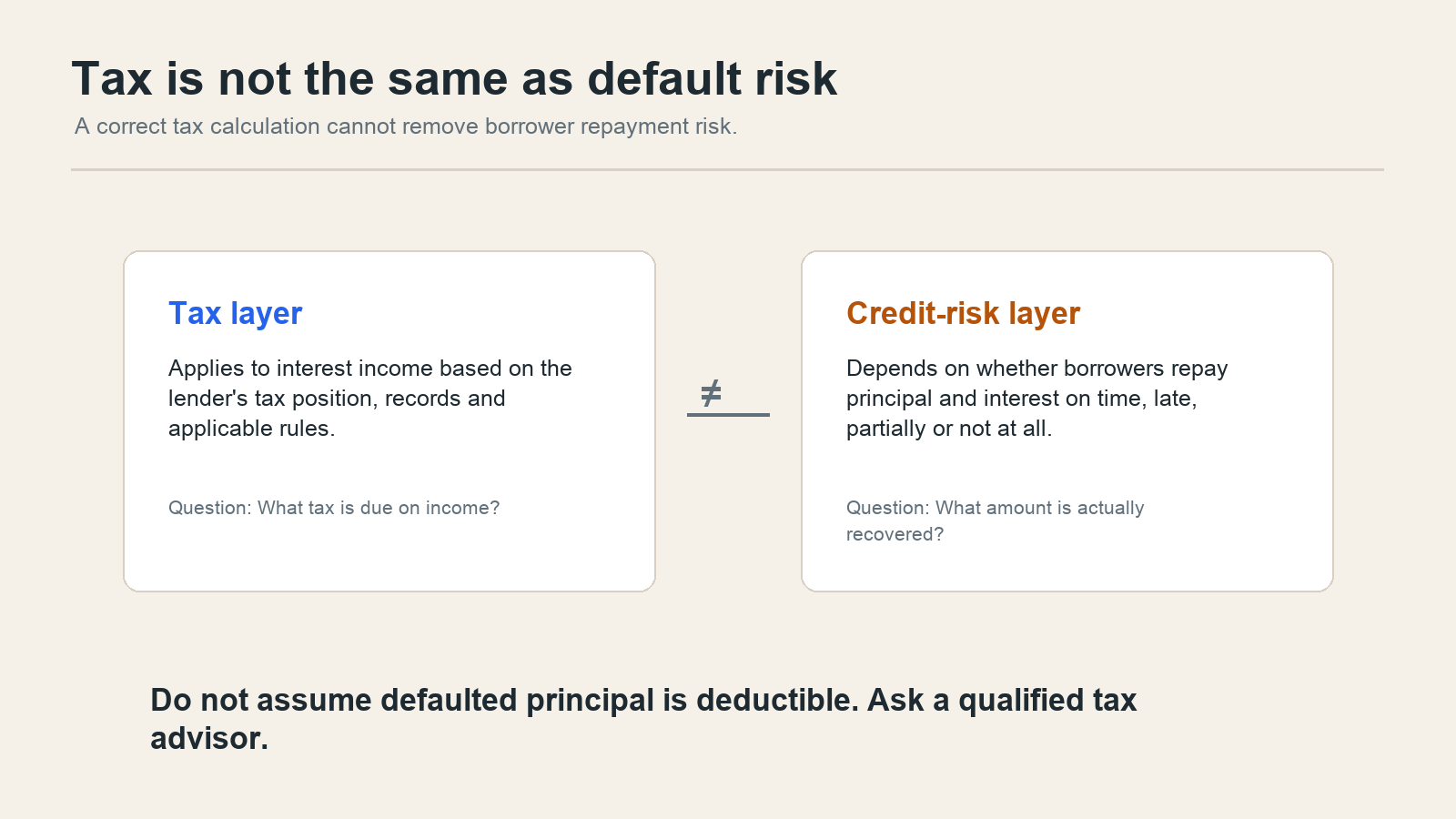
P2P lending default loss tax treatment is one of the areas where lenders should be especially cautious. A borrower default is a credit-risk event. It does not automatically become a tax deduction for every individual lender.
This is the right way to separate the two issues:
Issue | What it affects |
|---|---|
Tax on interest received | Tax liability on income earned or accrued |
Borrower default | Recovery of principal and/or interest |
Deductibility of defaulted principal | Tax-advisor question; do not assume |
Recovery after default | May require later reconciliation |
In P2P lending, diversification can reduce concentration risk by spreading exposure across borrowers. It does not eliminate borrower default risk and does not guarantee repayment.
IndiaP2P's P2P lending risk management guide explains how experienced lenders review borrower spread, overdue ageing, recovery status, and concentration risk.
NBFC-P2P Tax Treatment: What RBI Registration Changes and What it Does Not
NBFC-P2P tax treatment should not be confused with RBI registration. RBI registration defines the platform's regulatory category and operating framework. It does not create tax exemption for lenders and does not mean RBI guarantees return of principal or interest.
The RBI framework treats an NBFC-P2P as an intermediary for loan facilitation. RBI's public NBFC FAQ describes NBFC-P2P as a non-banking institution acting as an intermediary that provides loan-facilitation services through an online medium or otherwise to platform participants. RBI's default-loss-guarantee FAQ also states that default loss guarantee is not permitted on loans arranged on NBFC-P2P platforms.
For lenders, the implication is straightforward:
RBI registration means | RBI registration does not mean |
|---|---|
The platform operates within the NBFC-P2P regulatory category | RBI approves the return shown |
Fund flow and disclosure rules apply | Principal is protected |
Lender and borrower participation is structured | Interest is guaranteed |
Exposure limits and risk disclosures matter | Tax treatment becomes exempt |
For more context, read IndiaP2P's explainer on what an RBI-registered P2P lending platform means.
Escrow Account in P2P Lending and Tax Records
An escrow account in P2P lending supports controlled fund flow between lenders and borrowers. It can help maintain cleaner records of disbursals and repayments. It does not remove tax responsibility and does not protect principal from borrower default.
The lender should still keep records of:
money lent
principal received
interest received
TDS, if any
fees, if any
overdue or default status
IndiaP2P's escrow account in P2P lending guide explains what escrow protects and what it does not.
P2P Lending Tax Checklist Before Filing
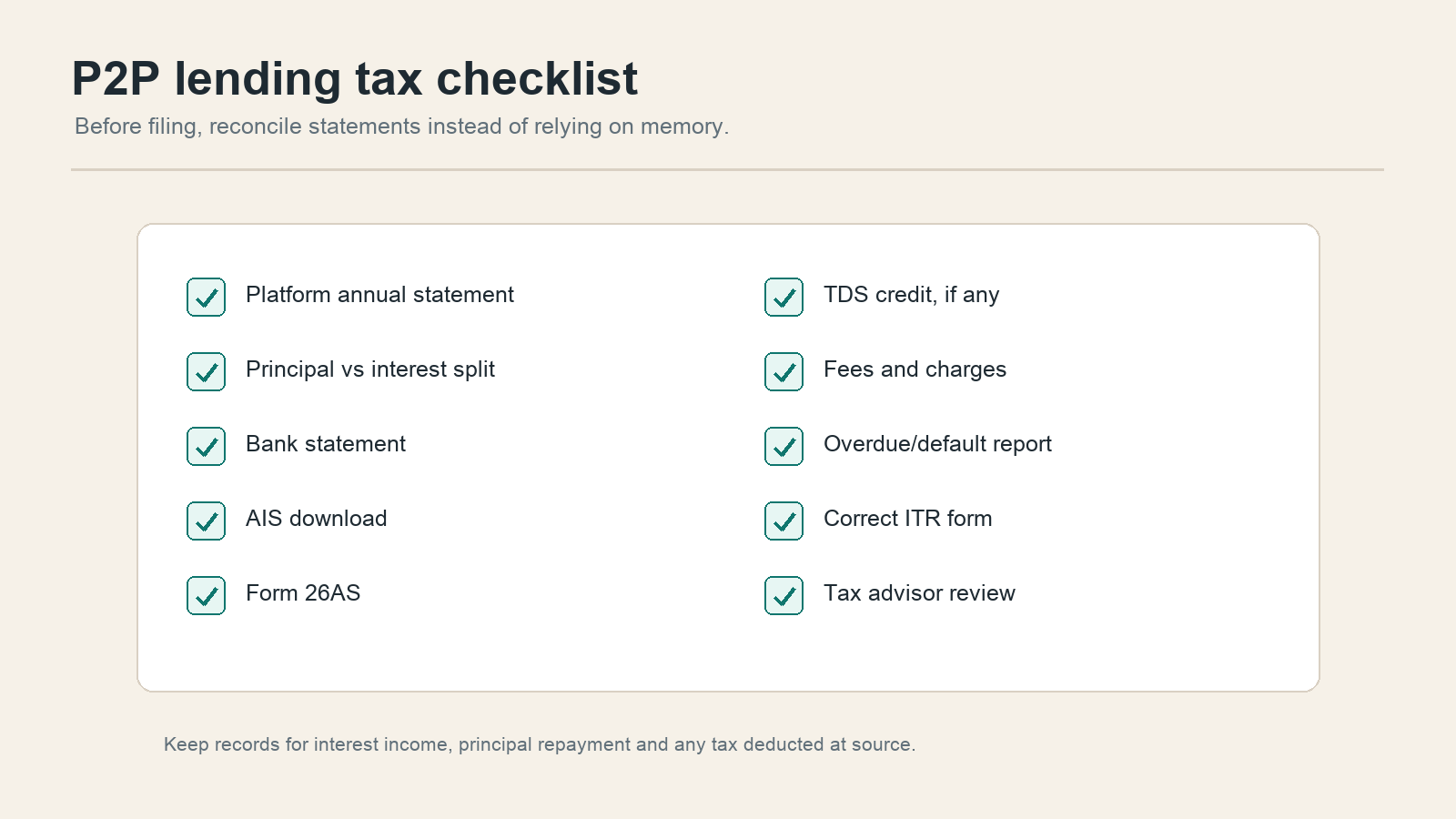
Use this P2P lending tax checklist before filing your ITR:
Check | Why it matters |
|---|---|
Download the annual platform statement | Avoids missing monthly interest credits |
Separate principal and interest | Prevents incorrect income reporting |
Check AIS and Form 26AS | Reconciles reported income and TDS |
Review TDS, if any | TDS credit must match records |
Check fees and charges | Tax treatment may need advice |
Review overdue and defaulted loans | Do not assume deduction or set-off |
Calculate post-tax return | Helps compare what remains after tax |
Keep borrower repayment risk in view | Tax is not the only adjustment |
Confirm ITR form | Depends on full income profile |
Speak to a tax advisor | Especially if amounts are material |
If your purpose is monthly cash flow, also review IndiaP2P's monthly income plan checklist before lending. Tax planning should sit beside repayment timing, borrower diversification, liquidity, and default risk.
Key Takeaway on P2P Lending Tax India
The practical answer on P2P lending tax India is this: identify the interest component, review it for tax reporting, reconcile records carefully, and do not confuse post-tax return with guaranteed outcome.
Tax can reduce what you keep from interest income. Borrower repayment risk can affect whether expected principal or interest is received. RBI registration creates a regulated NBFC-P2P framework, but it does not make P2P lending a deposit, does not protect principal, and does not guarantee returns.
IndiaP2P enables eligible lenders to target up to 18% p.a. indicative returns through P2P lending, subject to borrower repayment performance, platform terms, fees, timing, tax treatment, and risk. Before lending or filing tax, compare the full picture: interest, principal, TDS, tax slab, borrower default risk, diversification, fees, liquidity, and documentation.
To explore the product context after reviewing these risks, see IndiaP2P's Monthly Income Plan Plus.