This comparison is the wrong one if the reader wants a single winner. It becomes useful only when the question changes.
The better question is: what job should this money do?
Gold is usually bought for price-linked wealth preservation, portfolio diversification, cultural utility, or long-term holding. P2P lending is different. A lender lends money to borrowers through an RBI-registered NBFC-P2P platform and receives repayments if borrowers repay as scheduled.
IndiaP2P enables eligible lenders to target up to 18% p.a. indicative returns through P2P lending, subject to borrower repayment performance, fees, timing, defaults, tax treatment, and platform terms. That figure is not a guaranteed or standard outcome. Principal is not protected, and borrower default risk remains with the lender.
Gold does not carry borrower default risk, but it carries price risk, route risk, storage or expense drag, liquidity differences, and tax considerations. In 2026, that matters. World Gold Council data showed Indian gold prices rising sharply in Q1 2026, followed by a notable mid-year pullback. Gold can move strongly in both directions.
So the 2026 answer is not "P2P beats gold" or "gold beats P2P." P2P lending and gold fit different goals, different risks, and different holding behaviours.
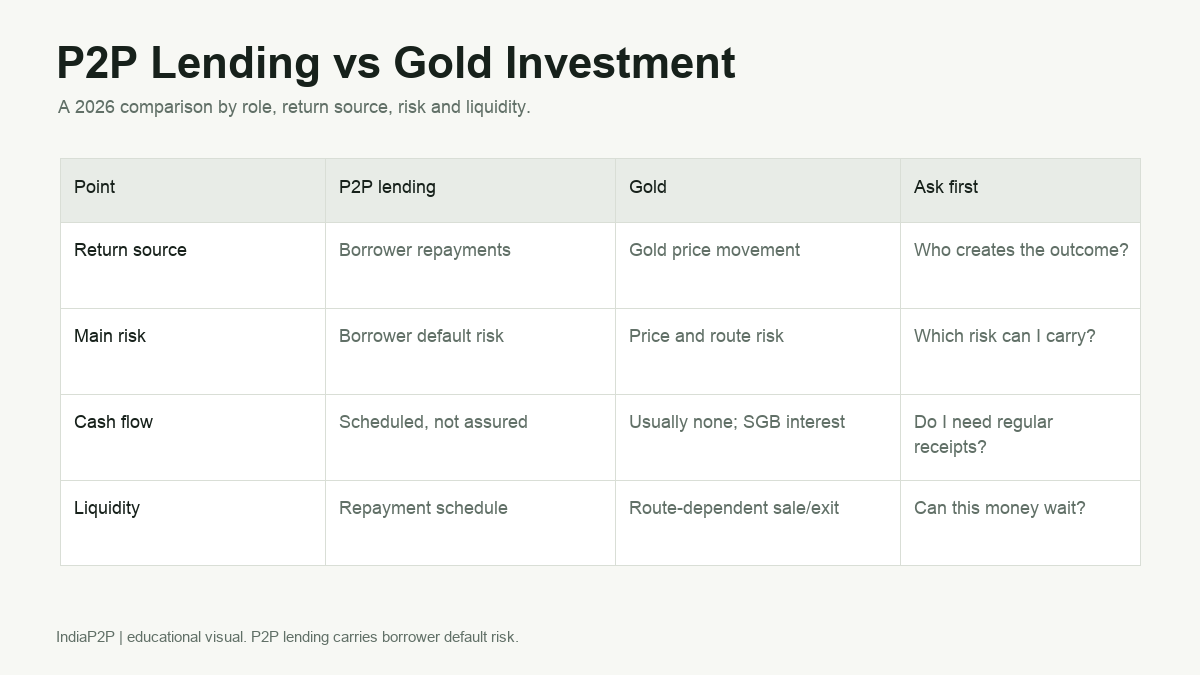
P2P Lending vs Gold: The 2026 Comparison Snapshot
P2P lending vs gold is easiest to understand when the return source is separated from the risk source.
Comparison point | P2P lending | Gold |
|---|---|---|
Primary return source | Borrower repayments of principal and interest | Movement in gold price; SGBs also pay fixed interest |
Regular cash flow | Possible through borrower repayments, but not assured | Physical gold and gold ETFs do not generate regular income; SGBs pay interest |
Main risk | Borrower delay/default, fees, tax, repayment timing | Gold price volatility, spreads, storage/route costs, tax, exit route |
Regulation | RBI NBFC-P2P framework for platforms | Route-dependent: SGBs are issued by RBI on behalf of Government of India; ETFs are market instruments; physical gold is purchase/holding route |
Principal protection | No principal protection | Gold quantity remains, but market value can fall; SGB redemption value depends on gold price formula |
Liquidity | Linked to borrower repayment schedule and platform process | Physical gold can be sold or pledged; ETFs trade on exchanges; SGB liquidity depends on maturity, early redemption or exchange sale |
Useful for | Surplus-money lending by risk-aware lenders | Diversification, long-term holding, price hedge, household gold allocation |
Should not be used for | Emergency money or money needing assured access | Short-term assured return expectation |
This table is deliberately not a ranking table. It is a structure table.
Many articles compare P2P lending returns and gold returns by placing numbers next to each other. That is incomplete. The number is only the surface. The source of that number matters more.
For a broader P2P risk-return explanation, read IndiaP2P's guide on P2P lending risks and returns.
How P2P Lending Returns Work for IndiaP2P Lenders
P2P lending returns come from borrowers repaying loans.
When a lender participates through an NBFC-P2P platform, the platform facilitates the lending process. It does not become the borrower. It does not take deposits. It does not guarantee repayment. The lender's outcome depends on borrower behaviour.
This is why "up to 18% p.a." must be read carefully. On IndiaP2P, that is indicative return potential for eligible lenders, subject to borrower repayment performance, fees, timing, defaults, tax treatment, and platform terms. A lender may receive less. A lender may face delayed repayment. A lender may lose principal or interest if borrowers default.
The P2P return path has several moving parts:
borrower selection and risk profile
loan pricing and tenure
repayment schedule
lender diversification across borrowers
platform fees and taxes
borrower delays or defaults
recovery timing, if any
whether repayments are withdrawn or lent again
A lender should therefore treat the return figure as the start of diligence, not the end of the decision.
Borrower Default Risk in P2P Lending
Borrower default risk is the central risk in P2P lending.
A borrower may pay on time. A borrower may pay late. A borrower may make a partial payment. A borrower may default. Each outcome can affect the lender's received interest, principal recovery, cash-flow timing, and realised return.
This is different from gold price risk. In gold, the risk is not that a borrower fails to pay. The risk is that the gold price may move against the holder, or the chosen route may create costs, spreads, tax friction or exit constraints.
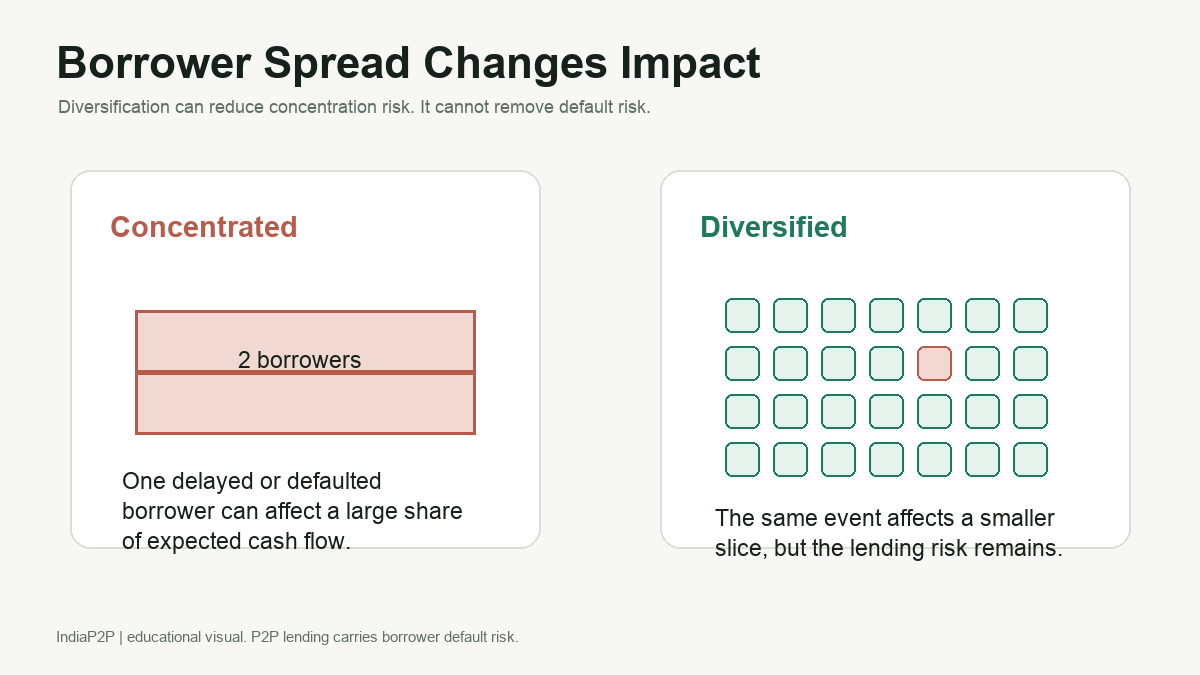
For P2P lending, diversification can reduce concentration risk. It cannot remove borrower default risk. If a lender is spread across many borrowers, one delayed borrower may have a smaller effect than it would in a concentrated exposure. But the loss possibility remains.
The practical question is not "Can diversification eliminate risk?" It cannot.
The practical question is: "Is the lender spread across enough borrowers, within RBI limits, and comfortable with delayed or lower-than-expected cash flow?"
For pre-lending review, see IndiaP2P's guide on how to read a P2P loan portfolio before lending.
RBI-Registered NBFC-P2P Does Not Mean RBI-Guaranteed
IndiaP2P is registered with the Reserve Bank of India as an NBFC-P2P. This is a regulatory fact, not a return endorsement.
Under the RBI Master Directions for NBFC-P2P platforms, an NBFC-P2P acts as an intermediary providing an online marketplace or platform for participants involved in peer-to-peer lending. The framework says an NBFC-P2P must not raise deposits, must not lend on its own, and must not provide or arrange credit enhancement or credit guarantee.
The RBI framework also states that the entire loss of principal or interest, if any, for funds lent by lenders to borrowers on the platform is borne by the lenders.
That point belongs near every P2P return comparison. RBI registration defines the operating perimeter. It does not protect principal. It does not assure repayment. It does not make P2P lending a deposit product.
RBI also sets exposure caps. A lender's aggregate exposure across all P2P platforms is capped at Rs.50 lakh, subject to net-worth consistency. If the amount lent across P2P platforms exceeds Rs.10 lakh, the lender must produce a practising Chartered Accountant certificate certifying minimum net worth of Rs.50 lakh. Exposure from one lender to the same borrower across all P2P platforms is capped at Rs.50,000. Loan maturity is capped at 36 months.
For the complete IndiaP2P explainer, see RBI P2P lending guidelines 2026.
How Gold Returns Work in India in 2026
Gold returns come from gold price movement. Some gold routes also have additional mechanics.
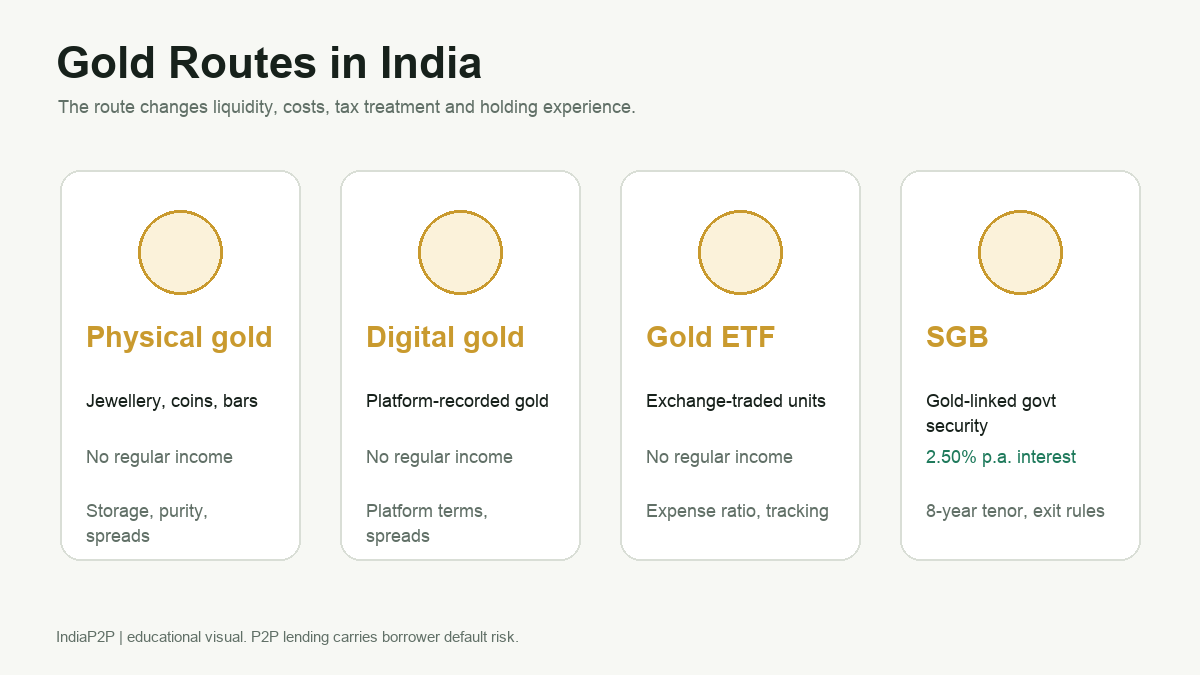
Physical gold does not generate regular income. Its outcome depends on buy price, sell price, purity, making charges if bought as jewellery, storage, insurance, and the spread between purchase and sale value.
Gold ETFs track gold prices through exchange-traded units. Their outcome depends on gold price movement, expense ratio, tracking difference, market liquidity, tax treatment, and demat/brokerage costs.
Sovereign Gold Bonds, or SGBs, are different. RBI's SGB FAQ states that the bonds bear interest at 2.50% p.a. on the amount of initial subscription, paid semi-annually. On redemption, the value is linked to the simple average closing price of gold of 999 purity for the previous three business days, as published by the India Bullion and Jewellers Association.
SGBs therefore combine gold-price-linked redemption with fixed interest. They also come with tenure and exit rules. RBI's FAQ says the tenor is eight years, with early redemption allowed after the fifth year on coupon payment dates. SGBs may be traded on exchanges if held in demat form, subject to market liquidity.
Gold's 2026 context is important. The World Gold Council reported that MCX spot gold prices rose 20% quarter-on-quarter and 81% year-on-year in Q1 2026 to a record quarterly average of INR151,108 per 10g. It later reported that domestic gold prices declined around 10% in June 2026 to near ₹141,000 per 10g, while the international gold price was nearly 7% lower year-to-date as of 14 July 2026.
That does not make gold good or bad. It simply shows that gold has price volatility. A strong past move should not be treated as a straight-line future return.
Physical Gold, Gold ETFs and Sovereign Gold Bonds Compared
Gold is not one product. The route changes the experience.
Gold route | What the holder owns | Regular income | Liquidity | Watchouts |
|---|---|---|---|---|
Physical gold | Jewellery, coins or bars | No | Can usually be sold or pledged, but value depends on purity, spreads and buyer terms | Making charges, storage, insurance, purity, emotional use |
Digital gold | Platform-recorded gold purchase | No | Depends on platform terms and redemption/sale process | Platform terms, storage backing, spreads, regulatory clarity |
Gold ETF | Exchange-traded gold-linked units | No | Exchange liquidity during market hours | Expense ratio, tracking difference, demat/brokerage costs |
Sovereign gold bond | Government security linked to gold price | Yes, 2.50% p.a. on initial subscription | Maturity, early redemption after fifth year, or exchange sale if demat | Long tenure, market price before maturity, tax treatment varies by route/event |
This matters because "gold" in a comparison may mean a family necklace, an ETF unit, a digital gold balance, or an SGB. Each behaves differently.
P2P Lending Risk vs Gold Price Risk
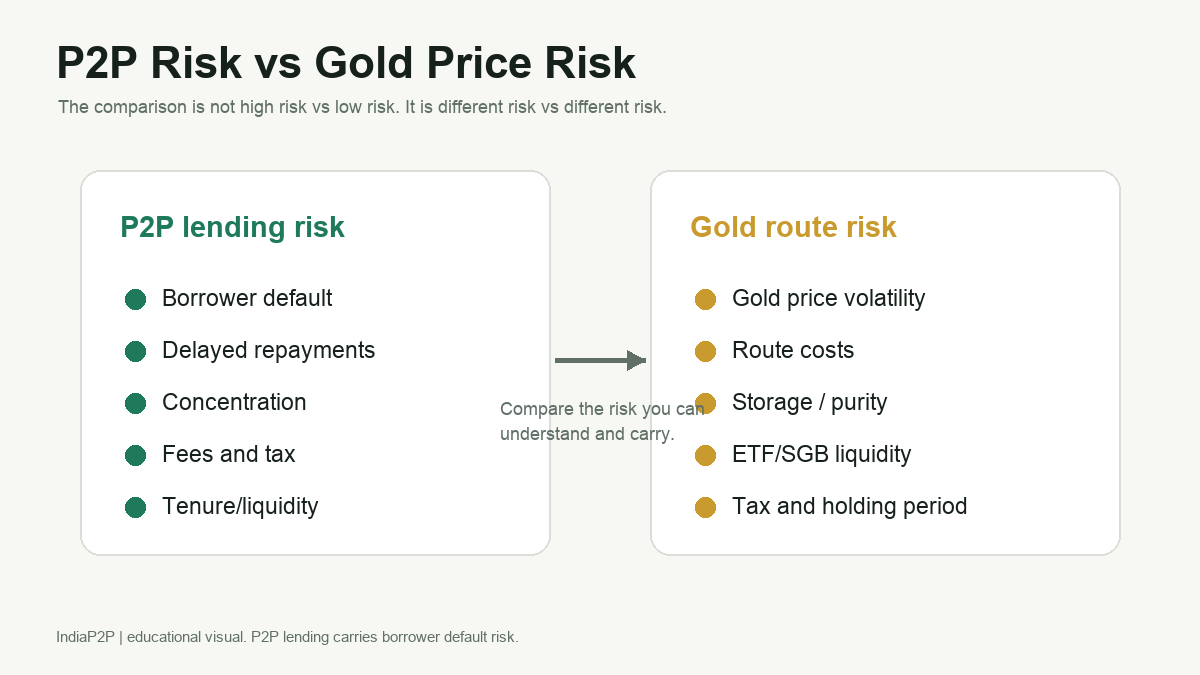
P2P lending risk vs gold price risk is the heart of the comparison.
In P2P lending, the lender's main risk is borrower repayment. The platform may assess borrowers, facilitate documentation, route funds through escrow, and support collections. But the borrower still has to repay. If the borrower delays or defaults, the lender bears the outcome.
In gold, there is no borrower repayment event. The holder's outcome depends mainly on gold price movement and the chosen gold route. If the gold price falls after purchase, the mark-to-market value falls. If the holder sells physical gold, the received amount can also be affected by purity checks, spreads, making charges not recovered, and local buyer terms.
These are different risks:
P2P lending: borrower credit risk, repayment timing risk, liquidity risk, concentration risk, platform-process understanding, tax and fee impact.
Gold: market price risk, route risk, storage/purity risk, expense drag, exchange liquidity for ETFs/SGBs, long tenure for SGBs, tax impact.
An informed reader should not ask which is "safer" in a vacuum. The more useful question is: which risk is the reader more prepared to understand and carry?
P2P Lending Liquidity vs Gold Liquidity
P2P lending liquidity is tied to borrower repayment schedules.
A lender may see expected monthly repayments, but scheduled repayments are not the same as received money. If borrowers pay late, cash flow shifts. If borrowers default, recovery may be delayed or incomplete.
Escrow and T+1 rules help discipline fund movement, but they do not make borrower repayment certain. Under the RBI framework, fund transfers happen through escrow account mechanisms operated by a bank-promoted trustee. Funds in the lenders' escrow account or borrowers' escrow account should not remain there beyond T+1 day, where T is the date funds are received in the escrow account.
This is money movement discipline, not credit protection.
Gold liquidity depends on the route. Physical gold may be easier to sell or pledge, but the realised value may be lower than the quoted gold price because of purity, spreads, or making-charge loss. Gold ETFs trade on exchanges, subject to market liquidity. SGBs have an eight-year tenor, early redemption after the fifth year on coupon dates, and exchange trading if held in demat form, but market liquidity and price can vary.
For P2P lending tenure planning, see IndiaP2P's guide on how to choose P2P lending tenure. For fund movement, see escrow account in P2P lending.
Tax on P2P Lending and Gold Returns in India
Tax should not be an afterthought in a P2P lending and gold comparison.
P2P lending interest generally needs to be considered as income in the lender's tax position. The exact treatment can depend on facts, reporting, and individual circumstances. Fees, defaults, recovery, and timing may also affect how a person thinks about the net outcome. Lenders should consult a qualified tax advisor.
Gold taxation depends on the route and holding period. Physical gold, digital gold and gold ETFs can have capital-gains implications based on applicable tax rules. SGBs have additional treatment: RBI's FAQ states that interest on SGBs is taxable as per the Income-tax Act, while capital gains arising on redemption of SGBs to an individual have been exempted. Tax treatment may change and should be checked for the specific transaction.
The main point is simple: compare post-tax outcomes, not only headline return potential or gold price appreciation.
When P2P Lending May Fit Better Than Gold
P2P lending may fit better than gold when the money is true surplus, the lender understands borrower default risk, and the goal is to receive scheduled repayments rather than hold a price-linked asset.
It may fit a lender who:
understands that P2P lending is not a deposit
accepts that principal and interest are not guaranteed
can tolerate delayed or lower-than-expected cash flow
is willing to review borrower spread, loan tenure and repayment reporting
does not need immediate liquidity
wants the possibility of monthly borrower repayments
stays within RBI exposure limits
This is a suitability frame, not a recommendation. P2P lending should not be used for emergency funds, school fees due soon, medical reserves, tax payments, payroll, rent, or money where principal protection is required.
Eligible lenders who understand these risks can review IndiaP2P Monthly Income Plan Plus after reading the risk disclosure and product terms.
When Gold May Fit Better Than P2P Lending
Gold may fit better when the reader wants gold-price exposure, long-term diversification, cultural utility, or an asset that is not linked to borrower repayments.
Gold may fit a person who:
wants exposure to gold price movement
is comfortable with price volatility
prefers a physical, ETF or SGB route
does not need monthly borrower repayments
wants a long-term diversifier rather than a lending allocation
understands route-specific costs, liquidity and tax treatment
Gold is not automatically low-risk. It can fall in price. Physical gold can carry making charges and storage concerns. ETFs can have expenses and tracking difference. SGBs have tenure and liquidity considerations. But the nature of the risk is different from borrower default risk.
A Practical 2026 Decision Framework for P2P Lending vs Gold
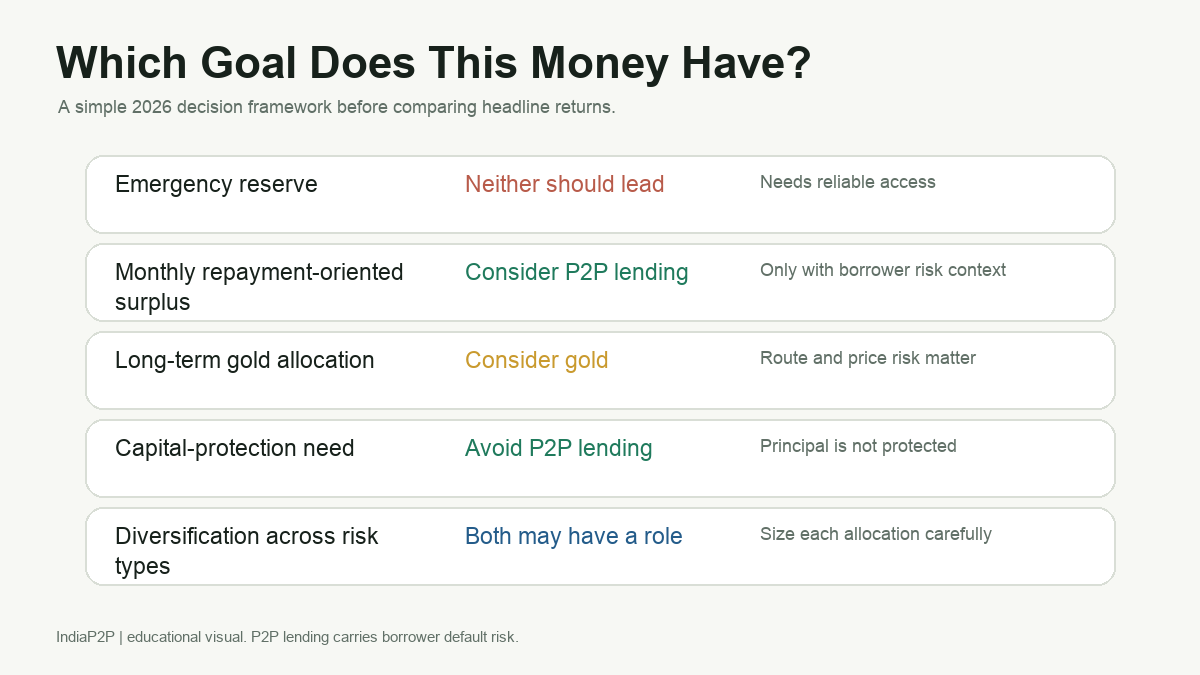
Use this decision framework before comparing the two.
If the money is for… | P2P lending may fit? | Gold may fit? | Reason |
|---|---|---|---|
Emergency reserve | No | Usually not ideal for short-notice certainty either | Emergency money needs immediate, reliable access |
Monthly repayment-oriented surplus | May fit, if borrower risk is understood | Usually no regular income unless SGB interest is the goal | P2P can create scheduled repayments, but not assured cash flow |
Long-term gold allocation | No | May fit | Gold gives price-linked exposure |
Very short-term return chasing | Np | No | Both can disappoint if used for short-term certainty |
Diversification across risk types | May fit as a measured lending allocation | May fit as a gold allocation | Different risks can play different roles |
Capital-protection need | No | Route-dependent, but gold price can fall | P2P principal is not protected |
The most disciplined approach is to decide the role first.
If the role is "lend surplus money and accept borrower repayment risk," P2P lending can be evaluated. If the role is "hold gold exposure," gold can be evaluated. If the role is "keep money certainly available," neither comparison should distract from liquidity and capital protection.
Final Takeaway: Which Wins in 2026?
P2P lending wins only for the specific job of risk-aware lending with surplus money where the lender understands borrower default risk and accepts that outcomes may vary.
Gold wins only for the specific job of gold exposure, route-specific liquidity, and long-term diversification where the holder accepts price volatility and tax/route costs.
Neither wins as a universal answer.
For IndiaP2P, the responsible comparison is this: P2P lending can offer eligible lenders indicative return potential of up to 18% p.a., subject to borrower repayment performance, fees, timing, defaults, tax treatment, and platform terms. Gold can deliver strong price-linked gains in some periods and sharp drawdowns in others. Both need risk-aware sizing.
Before lending, read the P2P lending risks and returns guide, check how much to allocate to P2P lending, and review product terms carefully.