P2P lending vs FD returns is a useful comparison only when the return number is not read alone.
A fixed deposit return comes from a deposit contract with a bank or issuer. P2P lending return potential comes from borrowers repaying loans through a regulated peer-to-peer lending platform. The two can both show annual percentages, but the mechanics behind those percentages are different.
IndiaP2P enables eligible lenders to target up to 18% p.a. indicative returns through P2P lending, subject to borrower repayment performance, fees, timing, defaults, tax treatment, and platform terms. That figure should never be read as a standard outcome for every lender or as a principal-protected return.
If you are comparing P2P lending returns with FD returns in 2026, compare four things together: return source, risk bearer, tax/fees, and liquidity. The existing IndiaP2P guide on why P2P lending is not a fixed deposit explains the structure. This article focuses on the return comparison.
P2P Lending Returns vs FD Returns: The Short Answer
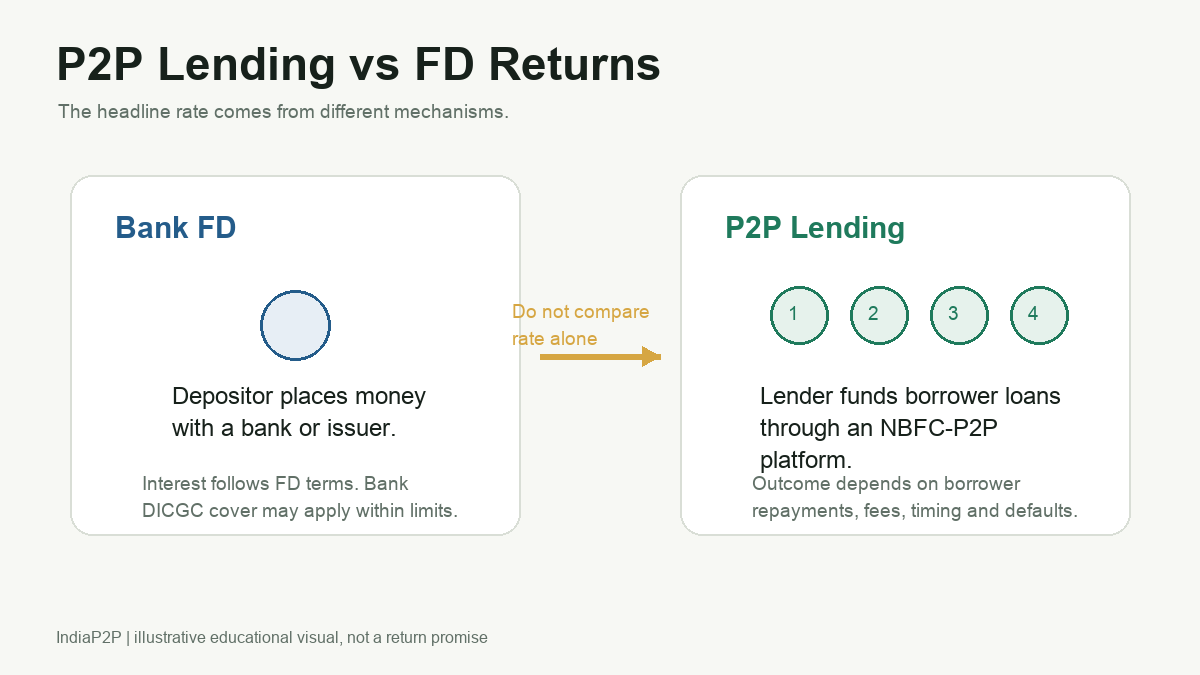
FD returns and P2P lending returns should not be compared as if they are the same kind of number.
In a bank fixed deposit, the depositor places money with a bank for a selected tenure. The bank pays interest as per the FD terms. The depositor's claim is against the bank, subject to product terms, premature withdrawal rules, tax treatment, and applicable deposit insurance limits.
In P2P lending, a lender lends money to one or more borrowers through an NBFC-P2P platform. The lender's received outcome depends on borrower repayments. If borrowers repay on schedule, the lending outcome may align with the expected schedule. If borrowers delay, pay partly, or default, the realised return may change.
This is why a headline comparison such as "FD at X% p.a. vs P2P at up to 18% p.a." is incomplete. The P2P figure must be read with borrower default risk, fees, tax, repayment timing, and liquidity. The FD figure must be read with issuer type, tenure, tax, premature withdrawal terms, and DICGC eligibility where relevant.
The better question is not: "Which return is higher?"
The better question is: "What has to happen for this return to be received, and what can interrupt it?"
FD Returns India 2026: What the Headline Rate Shows
FD returns India 2026 vary by bank, issuer type, tenure, depositor category, callable or non-callable terms, and tax slab.
As a public-sector bank reference point, SBI's official retail domestic term deposit page showed, on its latest listed update, public card rates of 6.25% p.a. for 1 year to less than 2 years and 6.40% p.a. for 2 years to less than 3 years. Senior citizen rates were higher for those tenures. These are useful examples, not a market-wide FD rate table.
FD interest can feel simpler because the rate is stated upfront. But the received post-tax outcome can still differ across people. Interest from FDs is generally taxable as per the person's applicable tax slab. Premature withdrawal may also reduce the effective return if the depositor exits before maturity.
There is also an important distinction between bank FDs and corporate or NBFC FDs. Bank fixed deposits sit inside a deposit insurance framework. Corporate or NBFC FDs do not have the same DICGC protection. So even within the word "FD", the risk picture is not identical.
For a fair P2P lending vs FD returns comparison, use FD rates as the low-complexity baseline, but do not ignore tax, issuer type, and withdrawal terms.
DICGC Insurance Fixed Deposit Limits and Return Certainty
DICGC insurance fixed deposit coverage applies to eligible bank deposits, within the prescribed limit. The DICGC official guide states that each depositor in a bank is insured up to Rs.5,00,000 for principal and interest held in the same right and same capacity, subject to the applicable rules and trigger events.
This matters because many savers read bank FD returns with the comfort of that framework. That comfort should not be transferred to P2P lending.
P2P lending is not a deposit product. It does not carry DICGC insurance. Principal is not protected. Returns are not guaranteed. The lender's outcome depends on borrower repayment behaviour.
This does not make every FD and every P2P lending allocation automatically right or wrong. It simply means the return number is not doing the same job in both products.
P2P Lending Returns India: Why Up to 18% p.a. Is Not a Promise
P2P lending returns India searches often focus on the highest number shown by a platform. That is understandable, but incomplete.
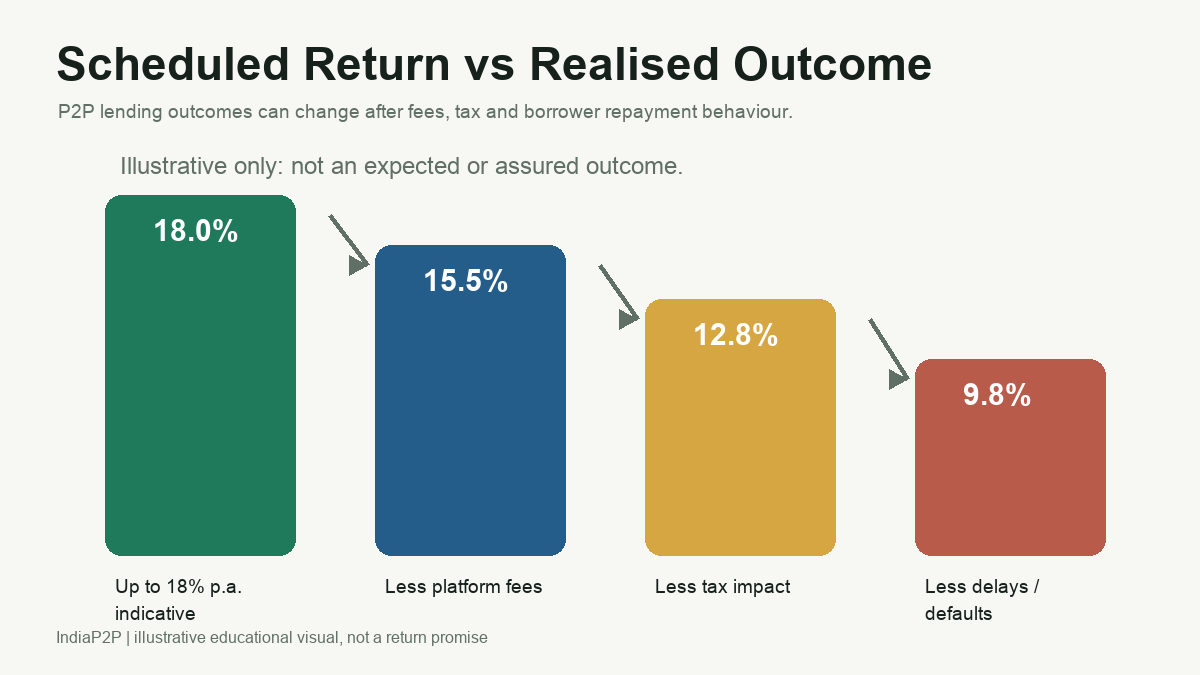
On IndiaP2P, eligible lenders may see up to 18% p.a. communicated as indicative return potential, subject to borrower repayment performance, fees, timing, defaults, tax treatment, and platform terms. "Up to" is doing important work in that sentence. It means the displayed figure is an upper-end potential, not a guaranteed outcome and not the standard result for every lender.
The P2P lending return path has more moving parts than a bank FD:
borrower selection and loan pricing
loan tenure
repayment schedule
platform fees
borrower delays or defaults
recovery timing, if any
tax on interest received or accrued, depending on the facts
whether repayments are withdrawn or lent again
A lender should therefore read the P2P return figure as a starting point for diligence, not as the end of the decision.
The IndiaP2P Monthly Income Plan Plus page can be reviewed for product context after reading the risk disclosure and repayment mechanics.
Borrower Default Risk Can Change Realised P2P Lending Returns
Borrower default risk is the central risk in P2P lending returns.
A borrower can repay on time. A borrower can pay late. A borrower can make a partial repayment. A borrower can default. Each outcome can affect the lender's cash received, interest received, and principal recovery.
This is why P2P lending returns are not only about the interest rate attached to a borrower loan. The timing of repayment matters. The amount recovered matters. The number of borrowers in the lender's exposure matters. Fees and tax also matter.
A delayed EMI may reduce near-term cash flow. A default may reduce interest, principal, or both. Recovery efforts may continue, but recovery timing and amount are uncertain.
That is the return comparison point many short articles miss: P2P lending return potential can be higher than many bank FD card rates, but the lender is taking borrower repayment risk to access that potential.
P2P Lending Fees and Tax Can Change the Net Outcome
P2P lending fees and tax can change the number a lender finally experiences.
The borrower interest rate is not automatically the lender's received return. A platform may charge fees as per its terms. Borrowers may pay on time or late. Some loans may become overdue. Interest income may be taxable as per the lender's applicable tax position.
FD interest also has a tax layer. A person in a higher tax slab may see a meaningfully lower post-tax FD return than the headline rate. P2P lending interest also needs post-tax thinking, but the P2P calculation has additional uncertainty because borrower repayment behaviour can change the base amount received.
For a deeper IndiaP2P-specific explanation, read the guide on P2P lending tax in India. Tax treatment depends on individual circumstances and may change. Please consult a qualified tax advisor.
RBI NBFC-P2P Framework: What It Regulates in a Return Comparison
The RBI NBFC-P2P framework is important because it defines what a P2P platform can and cannot do.
Under the RBI Master Direction for NBFC-P2P platforms, an NBFC-P2P acts as an intermediary providing an online marketplace or platform for participants involved in peer-to-peer lending. The framework states that an NBFC-P2P must not raise deposits, must not lend on its own, and must not provide or arrange credit enhancement or credit guarantee.
Most importantly for return comparison, the RBI framework states that the entire loss of principal or interest, if any, in respect of funds lent by lenders to borrowers on the platform is borne by the lenders.
That single rule changes how P2P lending returns should be read. RBI registration gives a regulatory perimeter for the platform. It does not make the return comparable to a bank FD return. It does not turn the platform into a deposit-taker. It does not make borrower repayment certain.
RBI rules also include exposure limits. A lender's aggregate exposure across all P2P platforms is capped at Rs.50 lakh, subject to net-worth consistency. Exposure from a single lender to the same borrower across all P2P platforms is capped at Rs.50,000. Loan maturity is capped at 36 months.
These rules are useful guardrails. They are not return guarantees.
RBI Registered P2P Lending Platform Does Not Mean RBI-Guaranteed Returns
An RBI registered P2P lending platform has permission to operate within the NBFC-P2P framework. IndiaP2P is registered with the Reserve Bank of India as an NBFC-P2P.
That statement should be read plainly. It is a regulatory fact.
It should not be rewritten in the reader's mind as "RBI-approved returns", "RBI-backed principal", or "RBI-certified outcome." Those are not accurate interpretations.
For more detail, read IndiaP2P's guide on what RBI registration means for P2P lenders.
P2P Lending Liquidity vs FD Withdrawal: Scheduled Repayments Are Different
P2P lending liquidity is different from FD withdrawal.
An FD has a maturity date. It may also have premature withdrawal terms, sometimes with a penalty or reduced interest. The exact rules depend on the bank or issuer and the deposit product.
P2P lending generally returns money through borrower repayments over the loan tenure. A lender may see an expected repayment schedule, but scheduled cash flow is not the same as cash received. If borrowers delay, monthly cash flow can shift. If borrowers default, recovery may be incomplete or delayed.
Escrow and T+1 settlement should also be understood correctly. Under the RBI framework, P2P money movement happens through escrow account mechanisms operated by a bank-promoted trustee. Funds transferred into the lenders' escrow account or borrowers' escrow account should not remain there beyond T+1 day, where T is the date the funds are received in the escrow account.
That is settlement discipline. It is not a guarantee that a borrower will pay on time.
For fund-flow detail, read how escrow accounts work in P2P lending and the P2P lending repayment process.
P2P Lending Diversification: How Borrower Spread Affects Return Outcomes
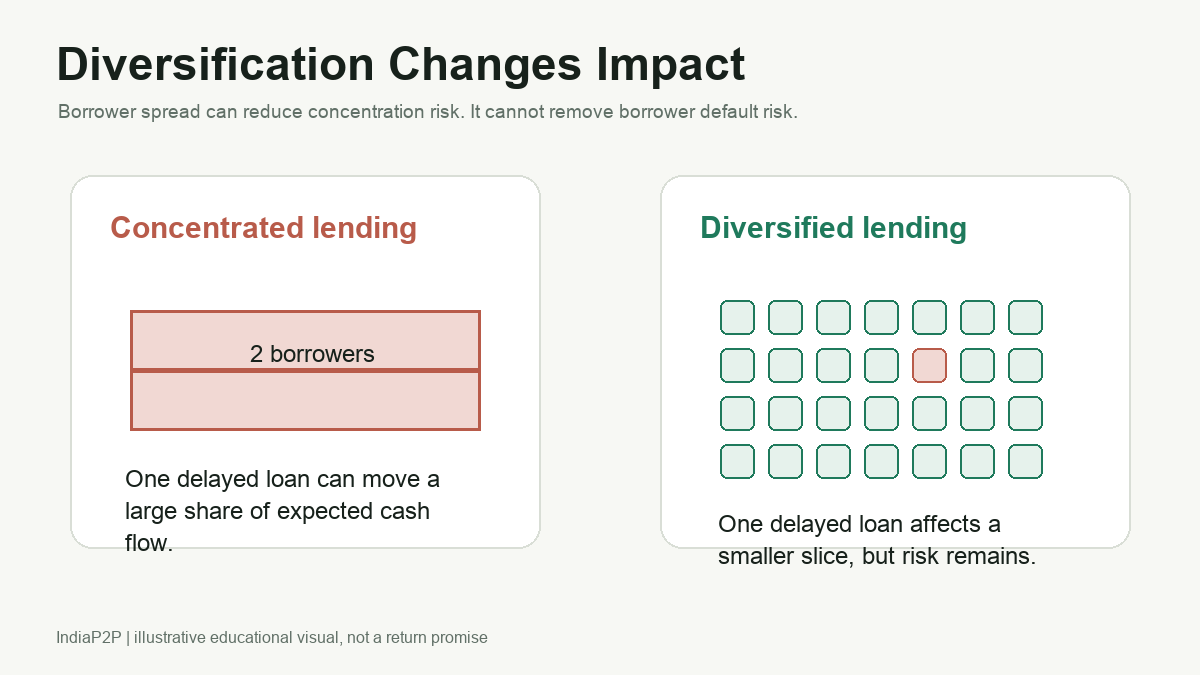
P2P lending diversification can reduce concentration risk, but it cannot remove borrower default risk.
If a lender's money is concentrated in a small number of borrowers, one delayed or defaulted loan can have a large effect on the expected cash flow. If lending is spread across many borrowers, the effect of one borrower delay may be smaller.
That is a useful risk-management principle. It is not a guarantee.
Diversification does not make every borrower repay. It does not create principal protection. It only changes how dependent the lender is on any single borrower or small group of borrowers.
This is why a return comparison should include borrower spread. A lender comparing FD returns with P2P lending return potential should ask:
How many borrowers will my lending exposure be spread across?
What is the exposure to any one borrower?
What borrower information is available before lending?
How are overdue EMIs reported?
What happens when a borrower pays late?
What recovery process applies after default?
For allocation context, see IndiaP2P's guide on how much to allocate to P2P lending.
P2P Lending vs FD Returns 2026: A Risk-Aware Comparison Table
The table below is a practical way to compare P2P lending vs FD returns in 2026.
Comparison point | Bank FD return | P2P lending return potential | What the lender should check |
|---|---|---|---|
Return source | Bank or issuer pays interest as per FD terms | Borrowers repay principal and interest through the platform | Who is actually paying? |
Headline number | Rate depends on bank, tenure, depositor type, and product terms | IndiaP2P may show up to 18% p.a. indicative return potential, subject to borrower repayment performance, fees, timing, defaults, tax treatment, and platform terms | What assumptions sit behind the number? |
Principal protection | Eligible bank deposits have DICGC cover within limits | No principal protection; borrower default risk remains | What happens if the payer fails? |
Insurance | DICGC may apply to eligible bank FDs up to Rs.5 lakh per depositor per bank | No DICGC deposit insurance | Is there statutory deposit insurance? |
Liquidity | Maturity and premature withdrawal terms apply | Funds return through borrower repayments over loan tenure | Can this money wait? |
Tax | FD interest is generally taxable as per slab | P2P interest also needs tax reporting; actual receipts can vary | What is the post-tax picture? |
Fees | Usually embedded in product terms; penalty may apply on early withdrawal | Platform fees can affect realised outcome | What is the net received amount? |
Risk management | Bank/issuer selection and deposit limit planning matter | Borrower diversification, credit assessment, and repayment tracking matter | Is the risk being actively reviewed? |
Best use | Deposit-style planning where FD terms fit | Measured lending allocation for surplus money and risk-aware lenders | Does the product match the job? |
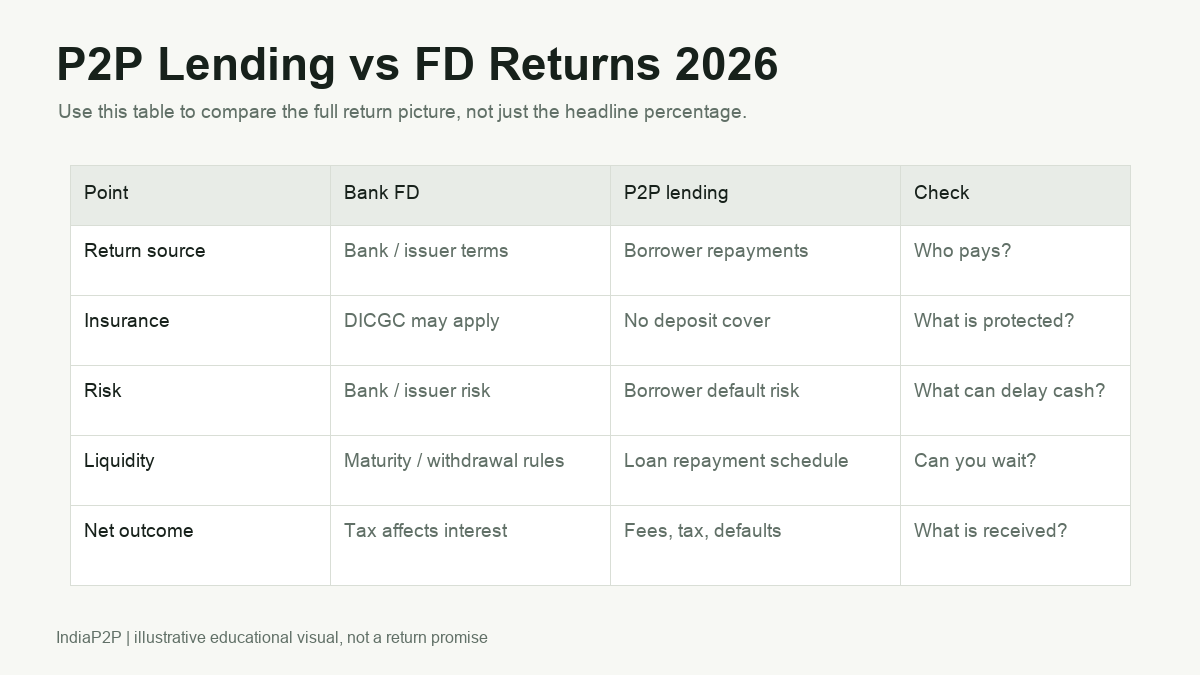
This table is not a recommendation to choose one over the other. It is a reminder that the return number is only one layer.
FDs are often easier to understand because the rate, maturity, and withdrawal terms are visible upfront. P2P lending needs a more active reading: borrower risk, diversification, fees, tax, repayment schedule, and overdue reporting all affect the realised outcome.
When P2P Lending Return Potential May Fit, and When FD-Like Certainty Matters More
P2P lending return potential may fit a lender who is using surplus money, understands borrower risk, can wait through loan tenures, and is willing to review repayment behaviour.
It may not fit money needed for rent, medical needs, school fees, taxes, payroll, emergency reserves, or near-term commitments. If the money needs capital protection, deposit insurance, or fixed deposit-like certainty, P2P lending should not be treated as a substitute.
The return difference exists for a reason. A lender seeking up to 18% p.a. indicative return potential on IndiaP2P is accepting that outcomes depend on borrower repayment performance, fees, timing, defaults, tax treatment, and platform terms. That is different from reading an FD card rate.
The calm approach is to give each product a different job. FD-style products may serve capital-preservation and planned-maturity needs. P2P lending may serve a measured surplus-money allocation for lenders who understand borrower repayment risk.
How to Compare P2P Lending Returns and FD Returns Before You Lend
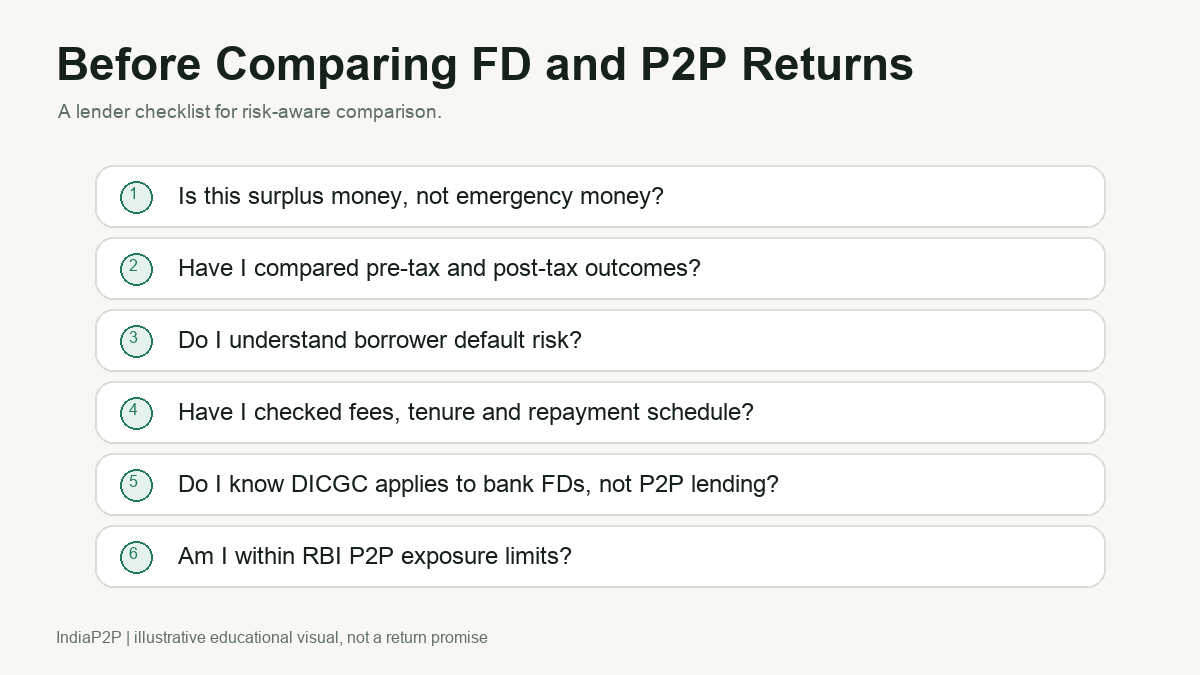
Use this checklist before comparing P2P lending returns and FD returns:
Is this surplus money, not emergency money?
Am I comparing pre-tax and post-tax outcomes?
Do I know whether the FD is a bank FD or a corporate/NBFC FD?
Do I understand DICGC insurance applies to eligible bank deposits, not P2P lending?
Do I understand borrower default risk in P2P lending?
Have I checked P2P fees, loan tenure, repayment schedule, and delayed EMI reporting?
Is my lending exposure spread across borrowers?
Am I within RBI P2P exposure limits?
Have I read the platform's risk disclosure and product terms?
P2P lending vs FD returns should be a return-quality comparison, not only a return-size comparison.
IndiaP2P can be explored by eligible lenders who understand that P2P lending is not a deposit, principal is not protected, and returns depend on borrower repayments. Review IndiaP2P Monthly Income Plan Plus only after reading the risk disclosure, borrower-risk explanation, repayment mechanics, and product terms.