A salary gives structure. It arrives on a known date, supports monthly expenses, and makes planning possible. But many salaried professionals eventually ask a second question: can surplus money create an additional income layer without taking on another job?
That is where the search for passive income for salaried employees in India usually begins. The phrase is useful, but it can also mislead. Most income sources are not completely passive. They either need capital, time, skill, risk review, tax reporting, or periodic monitoring.
P2P lending is one such option. Through a peer-to-peer lending platform, a lender lends to borrowers and receives repayments based on borrower performance. IndiaP2P enables eligible lenders to target indicative returns of up to 18% p.a., but this is not assured. Returns depend on borrower repayments, fees, timing, defaults, recovery outcomes, tax treatment, and platform terms.
This guide explains how P2P lending can be evaluated as a second-income layer for salaried employees, where it may fit, and where caution is non-negotiable.
Second Income for Salaried Employees: What Passive Really Means
Second income for salaried employees is income that comes in addition to salary. It may be active, semi-passive, or passive.
Active side income needs regular work. Freelancing, consulting, weekend teaching, part-time services, and creator work can create meaningful cash flow, but they use time and energy. If the work stops, the income usually stops.
Semi-passive income needs effort upfront and lighter maintenance later. Digital products, affiliate content, online courses, and rental assets can fall into this bucket. They can work, but they still need setup, distribution, maintenance, and tax discipline.
Capital-led income uses money rather than time as the main input. Examples include interest-bearing products, dividends, rental income, REIT distributions, systematic withdrawals, bonds, and P2P lending. This is where many salaried professionals look first because it does not compete directly with office hours.
P2P lending sits in the capital-led category, but it is not effortless. A lender should understand borrower risk, repayment schedules, platform disclosures, liquidity limits, tax treatment, and diversification before lending.
The useful question is not: "Which option gives passive income without effort?"
The better question is: "Which second-income layer fits my surplus, time horizon, risk comfort, and need for liquidity?"
For salaried employees, that framing matters because salary already has fixed commitments attached to it: rent or EMI, household expenses, insurance premiums, tax planning, family obligations, travel, and emergency needs. Any second-income plan should protect those first.
A practical order is:
Step | What to check before building second income |
|---|---|
1 | Monthly essentials are covered by salary |
2 | Emergency buffer is held outside P2P lending |
3 | Insurance premiums and near-term obligations are planned |
4 | High-cost debt is reviewed separately |
5 | Only surplus money is considered for lending |
6 | Repayments are tracked as received cash, not promised cash |
This is especially important with P2P lending. Scheduled borrower repayments may help with monthly cash-flow planning, but borrower delays or defaults can affect both timing and amount received. A salary earner should not rely on P2P lending for rent, school fees due next month, medical reserves, or any unavoidable near-term payment.
Passive Income Ideas for Salaried Employees: Where P2P Lending Fits
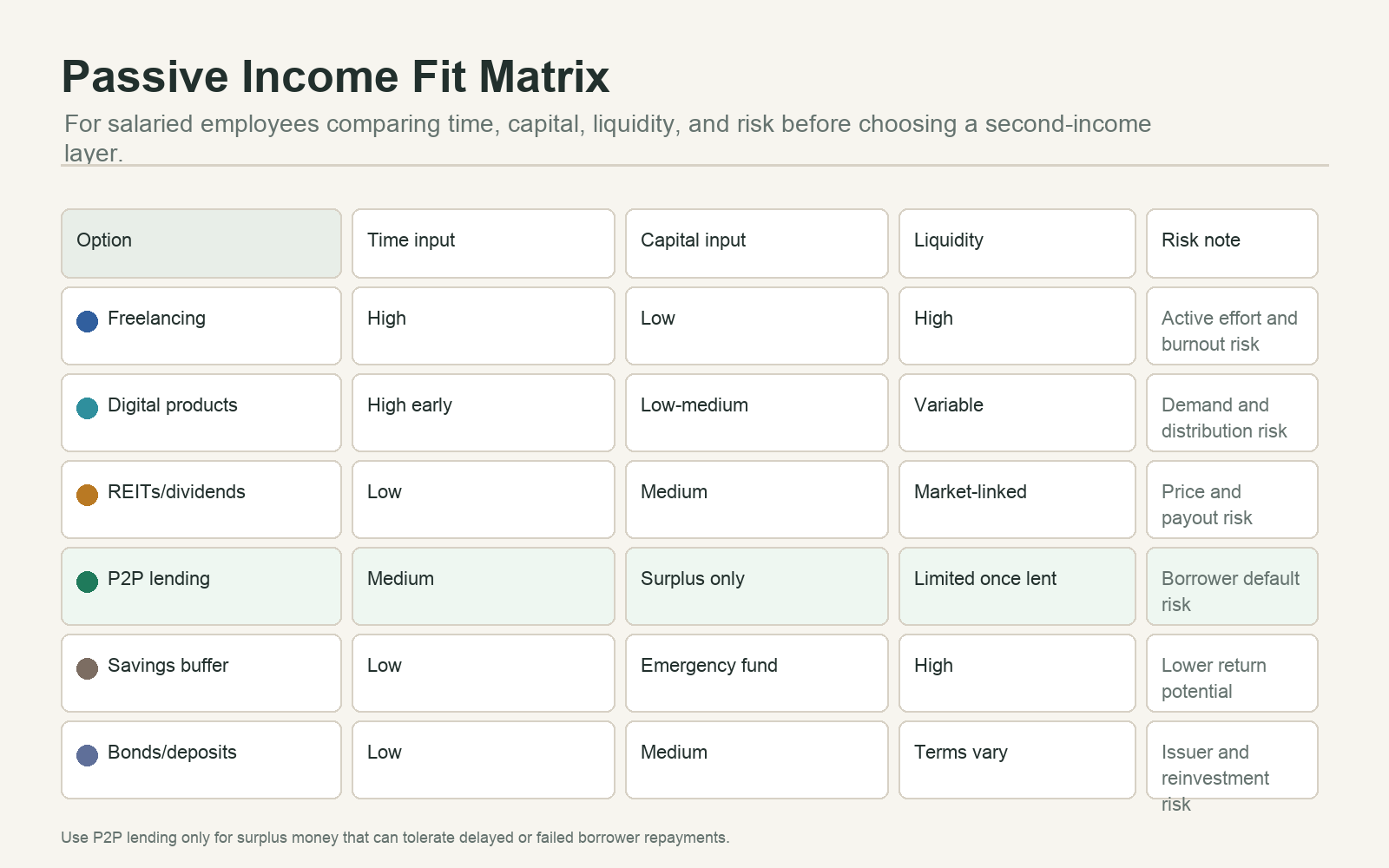
Most passive income ideas for salaried employees fall into one of four groups: work-led, asset-led, market-linked, or lending-led.
The choice depends on what the salaried professional has more of: time, skill, capital, risk tolerance, or patience.
Option | Main input | Income from | Monitoring need | Key risk |
|---|---|---|---|---|
Freelancing or consulting | Time and skill | Project fees | High | Time pressure and burnout |
Digital products or content | Time, skill, distribution | Sales, royalties, affiliate income | Medium | Uneven demand |
REITs or InvITs | Capital | Distributions and market-linked value | Medium | Market and asset risk |
Dividend stocks | Capital and market knowledge | Dividends | Medium | Dividend cuts and price volatility |
Systematic withdrawal plans | Existing corpus | Periodic withdrawals | Medium | Market and sequence risk |
Bonds or deposits | Capital | Interest/coupon flows | Low to medium | Issuer, rate, liquidity, or reinvestment risk |
P2P lending | Surplus capital | Borrower repayments | Medium | Borrower default and liquidity risk |
P2P lending for salaried employees may fit when the lender wants a repayment-linked income layer and is comfortable with borrower default risk. It may not fit when the money is needed soon, when principal protection is required, or when the person does not want to monitor repayments and risk disclosures.
This distinction is important because P2P lending is not a deposit product. A deposit creates a claim on a bank or issuer under specific terms. P2P lending creates exposure to borrower repayment behaviour through a regulated facilitation platform. IndiaP2P is registered with the Reserve Bank of India as an NBFC-P2P, but RBI registration should be read as regulatory status, not an endorsement or repayment assurance.
Salaried employees should also separate "side income" from "side business." Some second-income ideas create operational duties: client calls, invoices, GST questions, employer conflict checks, weekend delivery, customer support, and ongoing content production. These can be worthwhile, but they are not passive. P2P lending is different because it does not ask the salaried employee to sell services after office hours. The trade-off is that the main input is capital, and that capital is exposed to borrower repayment risk.
Before choosing any option, check whether it conflicts with employment terms. Many employment contracts restrict outside work, directorships, advisory roles, paid consulting, competing business activity, or use of employer resources. Capital-led income sources generally create fewer time conflicts, but the employee should still keep personal finances, bank accounts, tax records, and employer systems separate.
Among passive income sources in India, P2P lending is best understood as a planned surplus-lending layer. It should not be described as easy money, guaranteed income, or a substitute for emergency savings.
For a salaried employee, the decision can be simplified:
If your priority is… | P2P lending may be… | But check… |
|---|---|---|
Monthly repayment visibility | Worth evaluating | Repayments may be delayed |
Higher indicative return potential | Worth evaluating | Higher potential comes with borrower risk |
Principal safety | Poor fit | No principal protection |
Money needed in 1-3 months | Poor fit | Liquidity can be limited after lending |
Diversified surplus lending | Possible fit | Diversification reduces concentration, not default risk |
Fully hands-off income | Poor fit | Monitoring is still needed |
This is the gap most generic passive-income lists miss. They compare ideas as if every income stream is interchangeable. A salaried professional needs to compare effort, risk, tax, liquidity, and timing together.
P2P Lending for Passive Income: How Borrower Repayments Work
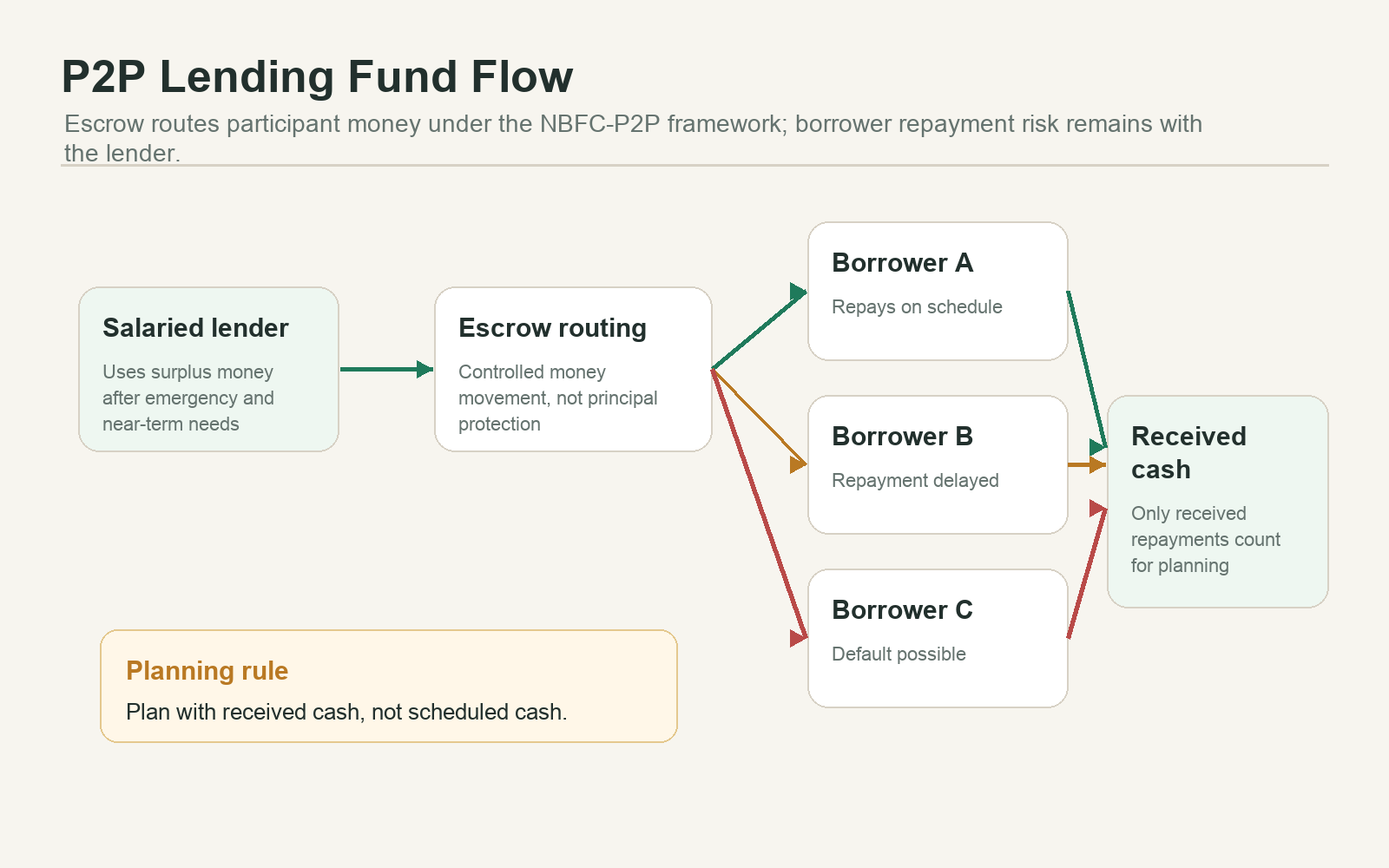
P2P lending for passive income works through borrower repayments, not through platform-guaranteed payouts.
In a simplified flow:
A lender completes onboarding and KYC.
The lender reviews platform information, risk disclosures, and plan terms.
Funds are routed through the permitted fund-flow mechanism, including escrow structures as applicable under the NBFC-P2P framework.
The platform facilitates matching or mapping between lenders and borrowers as per its policies.
Borrowers repay according to their repayment schedule.
The lender receives repayments based on actual borrower performance, after applicable fees and terms.
The keyword is "actual." A repayment schedule is not the same as received cash. Borrowers can repay on time, repay late, prepay, settle, or default. The lender's experience depends on the mix of borrower outcomes.
This is why P2P lending should be explained as lending, not as an income product with fixed payouts. A platform can facilitate onboarding, documentation, risk assessment, repayment routing, collections workflows, and disclosures. It cannot remove borrower default risk.
For a deeper operational explanation, see IndiaP2P's guide to escrow account in P2P lending. Escrow helps route participant money under the applicable structure; it does not protect the lender from borrower default.
Monthly Income from P2P Lending and Repayment Timing
Monthly income from P2P lending is better described as monthly repayment-linked cash flow. It may include principal and interest components, depending on the loan structure and repayment schedule.
For a salaried employee, this can be useful because salary and expenses are often monthly. If borrower repayments are received monthly, the lender can track them against goals such as:
Goal | How repayments may be used |
|---|---|
Re-lending | Received amounts are lent again, subject to platform terms and risk comfort |
Cash-flow support | Received cash is assigned to planned non-essential expenses |
Goal bucket | Received repayments are moved to a separate savings bucket |
Review trigger | Missed or delayed repayments prompt a risk review |
But planning must use received cash, not expected cash. If a repayment is scheduled for a month but not received on time, the lender should not treat it as available.
IndiaP2P's guide on monthly income from P2P lending explains this difference between cash flow and returns in more detail.
For salaried employees, a conservative rule is useful: use P2P repayments for flexible goals first. Avoid using them for essentials with hard due dates.
There is also a behavioural benefit to keeping P2P repayments separate from salary. Salary should pay for the household operating system. P2P repayments, if received, can be assigned to a clearly named purpose: re-lending, discretionary spending, a travel bucket, annual subscriptions, or a non-essential goal. This reduces the chance of building fixed expenses around uncertain repayments.
One simple method is to review repayments once a month after salary budgeting is complete. The lender can record what was scheduled, what was received, what was delayed, what was re-lent, and what was withdrawn. Over time, this habit creates a realistic view of P2P lending as experienced cash flow, not just a return figure shown at the start.
RBI Registered P2P Lending Platform: What It Means and Does Not Mean
An RBI registered P2P lending platform operates under RBI's NBFC-P2P framework. The RBI Master Directions define the operating framework for NBFC-P2P platforms, including registration, scope of activity, fund-transfer mechanisms, disclosures, and exposure limits.
For lenders, the regulatory framing matters for two reasons.
First, it clarifies the platform's role. An NBFC-P2P platform is a facilitator. It is not a deposit-taker. It does not lend its own balance sheet to protect the lender. It connects lenders and borrowers under a regulated framework.
Second, it clarifies the boundary of protection. RBI registration does not mean RBI guarantees repayment. It does not mean returns are approved by RBI. It does not mean principal is protected.
IndiaP2P is registered with the Reserve Bank of India as an NBFC-P2P. That is a regulatory fact. It should be read plainly, not as a promotional claim.
For a deeper explanation, read IndiaP2P's guide to RBI registered P2P lending platform meaning.
The RBI framework also sets exposure limits. A lender's aggregate exposure across all P2P platforms is capped at ₹50 lakh, and exposure to a single borrower is capped at ₹50,000. These are regulatory ceilings, not suggested amounts. A salaried employee should decide how much to lend based on surplus, risk comfort, liquidity needs, and ability to absorb repayment delays or defaults.
P2P Lending Risk India: What Salaried Lenders Must Check
P2P lending risk India searches often focus on a single question: is P2P lending safe?
That question is too broad. The more useful question is: what risks remain with the lender after the platform's role is understood?
The core risk is borrower default risk. If borrowers do not repay, the lender's principal and interest outcome can be affected. There is no guarantee of return of principal or interest.
Other risks also matter:
Risk | What it means for a salaried lender |
|---|---|
Borrower default risk | Some borrowers may delay, settle, or fail to repay |
Concentration risk | Too much exposure to one borrower or borrower type can magnify loss |
Liquidity risk | Money may not be freely withdrawable once lent |
Cash-drag risk | Unlent or delayed deployment amounts may not earn |
Fee impact | Platform fees can affect net outcome |
Tax impact | Interest-like receipts may be taxable based on the lender's circumstances |
Behavior risk | Chasing headline return figures can lead to poor allocation decisions |
This is also where the phrase "up to 18% p.a." needs discipline. The figure can describe indicative return potential for eligible lenders, but it should never stand alone. It should always sit near the risk context: borrower repayment performance, defaults, fees, tax, timing, and platform terms.
A salaried employee should also read the platform's risk disclosures before lending. A risk-disclosure review should happen before any return figure is treated as meaningful.
Lender Diversification in P2P Lending Across Borrowers
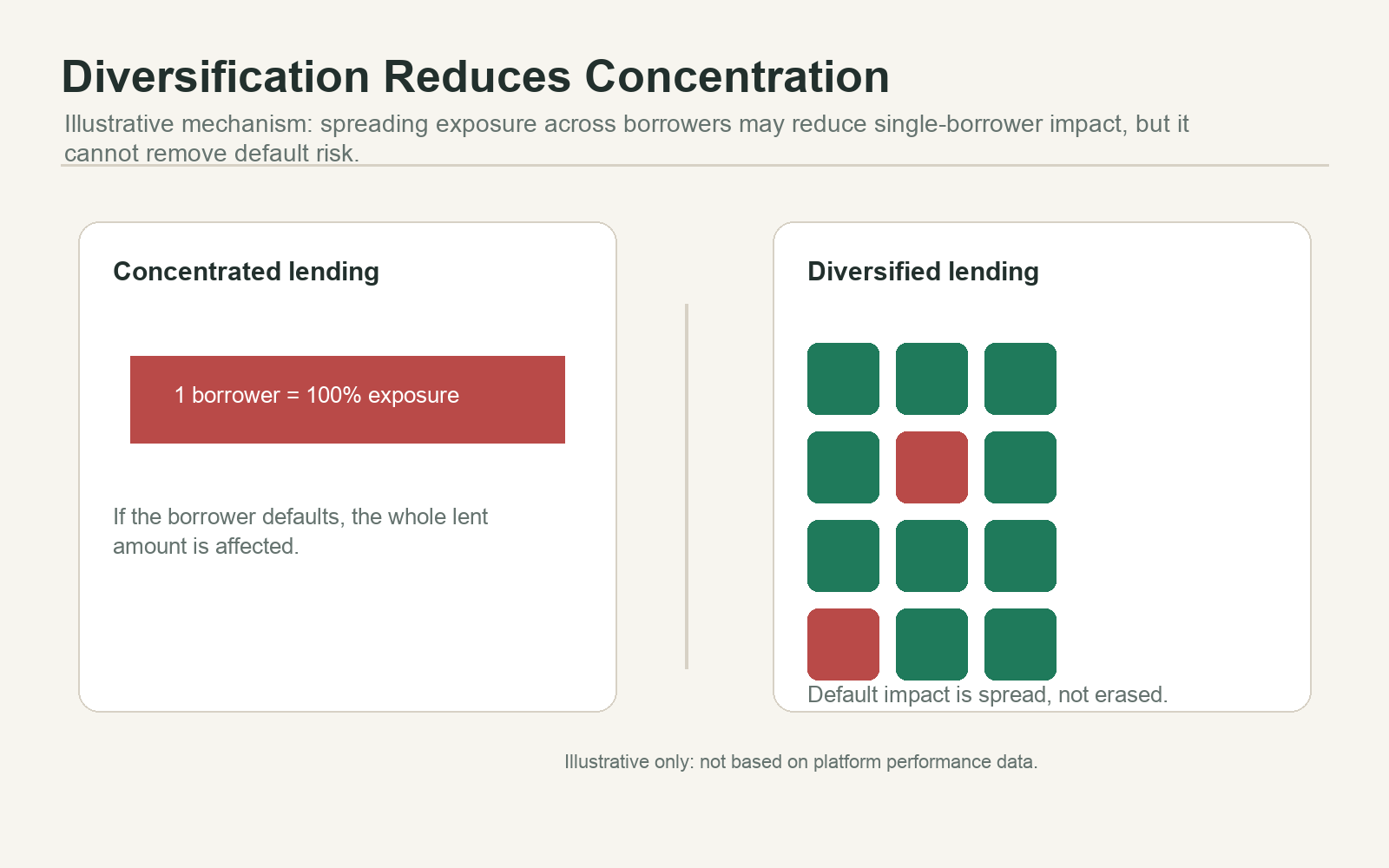
Lender diversification in P2P lending means spreading lending exposure across multiple borrowers rather than depending on one borrower.
Diversification can reduce concentration risk. If one borrower delays repayment, the entire lending amount is not dependent on that borrower alone.
But diversification does not eliminate risk. If borrower performance weakens across a segment, or if several borrowers delay at once, repayments can still be affected. The benefit is risk spreading, not risk removal.
For salaried employees, diversification should be reviewed at three levels:
Diversification level | What to check |
|---|---|
Borrower count | Is the amount spread across enough borrowers? |
Borrower type | Is exposure concentrated in similar borrower profiles? |
Repayment timing | Are repayments staggered or clustered? |
If the platform provides automated diversification, the lender should still understand the logic at a high level and read all disclosures. Automation can reduce manual effort, but it does not transfer borrower risk away from the lender.
Borrower Default Risk and No Principal Protection
Borrower default risk is the central risk in P2P lending. It means the borrower may not repay as agreed.
A salaried employee should assume three things before lending:
Some repayments may arrive late.
Some repayments may not arrive in full.
Principal is not protected.
This does not mean every lender will experience the same outcome. It means the plan should be built to withstand adverse outcomes.
A practical approach is to separate money into three buckets before lending:
Bucket | Should it go to P2P lending | Why |
|---|---|---|
Emergency money | No | Needs immediate access |
Near-term obligations | Usually no | Hard due dates need certainty |
Surplus money | Maybe | Can tolerate timing and default risk |
The phrase "surplus money" should be taken seriously. It means money that can remain exposed to repayment uncertainty without disrupting the household budget.
P2P Lending Tax India: What Salaried Employees Should Plan For
P2P lending tax India questions matter because second income does not sit outside tax reporting simply because it is separate from salary.
Salaried employees should track:
Item | Why it matters |
|---|---|
Amount lent | Establishes principal exposure |
Principal received | Separates capital return from income component |
Interest-like receipts | May need tax reporting |
Fees | Affects net outcome review |
Delays/defaults | Affects realised outcome |
Tax statements | Helps with ITR preparation |
Tax treatment depends on individual circumstances and may change. Please consult a qualified tax advisor.
For many salaried employees, the practical challenge is not only tax rate. It is recordkeeping. Salary income is usually captured through Form 16, payroll TDS, AIS, and Form 26AS. P2P-related receipts may need separate review so they are not missed during ITR filing.
This is another reason to avoid chasing a headline return number. A pre-tax return figure does not tell the salaried lender what remains after tax, fees, delays, defaults, and cash drag.
For a fuller treatment, see IndiaP2P's guide to P2P lending tax India.
Salaried employees can make tax season easier by maintaining a simple monthly ledger. It does not need to be complex. A spreadsheet with date, amount lent, principal received, interest-like receipt, fee, delayed amount, and closing exposure is usually more useful than trying to reconstruct the year at filing time.
This also helps with household decision-making. If the lender sees that receipts are irregular, the plan can be adjusted before the amount becomes too large. If cash remains idle before being lent, the lender can factor cash drag into the realised outcome. If tax reduces the effective receipt, the lender can compare the net result with the original expectation. None of these checks remove risk, but they make the risk visible.
The tax point is especially important for employees in higher slabs. A second-income layer may look attractive before tax, but the post-tax outcome can differ. Tax treatment depends on individual circumstances and may change. Please consult a qualified tax advisor.
Extra Income While Working Full Time: A Practical Allocation Framework
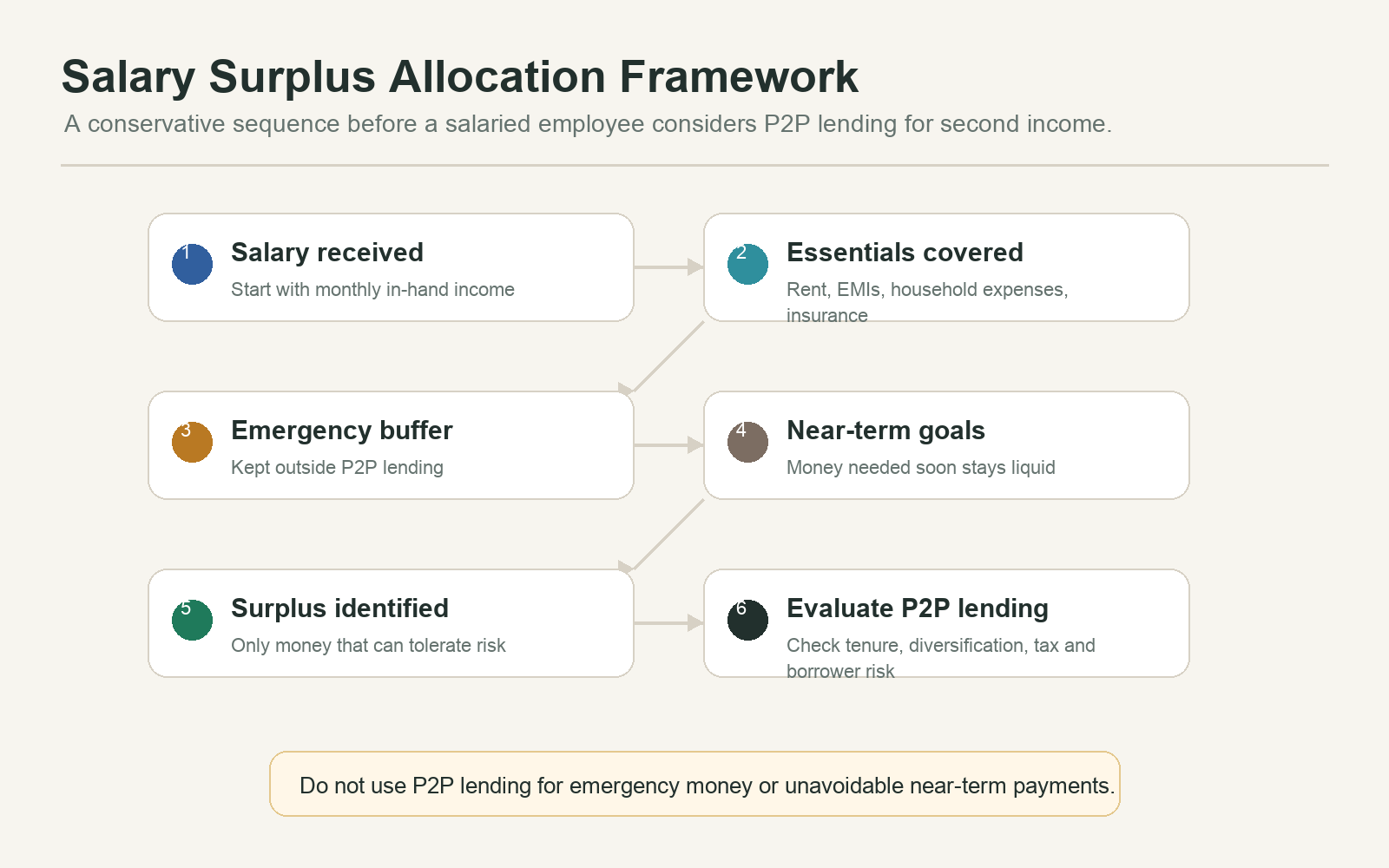
Extra income while working full time should not create extra financial stress. A simple allocation framework can help salaried employees decide whether P2P lending belongs in the plan.
Start with monthly salary inflow. Then deduct:
Essential monthly expenses.
EMIs and debt obligations.
Insurance premiums.
Tax-related outflows.
Emergency buffer contributions.
Near-term goal savings.
Only after these are handled should a salaried employee identify surplus money for lending.
The next question is time horizon. If the money may be needed soon, P2P lending may not fit. If the money can stay allocated for the relevant lending tenure and tolerate repayment uncertainty, it may be evaluated.
Tenure matters because P2P lending involves borrower repayment schedules. A longer tenure may affect liquidity. A shorter tenure may affect the repayment pattern and deployment options. The lender should match tenure to liquidity needs before lending.
A basic salary-surplus framework can look like this:
Question | Conservative answer before lending |
|---|---|
Do I have an emergency fund? | Yes, held outside P2P lending |
Do I need this money in the next few months? | No |
Can I tolerate delayed repayments? | Yes |
Can I tolerate some loss of principal? | Yes |
Do I understand the fee and tax treatment? | Yes, reviewed |
Do I know how repayments will be tracked? | Yes |
Is the amount diversified? | Yes, across borrowers as applicable |
If any answer is "no", the lender should pause or reduce the amount.
P2P Lending for Salaried Employees: The First 90 Days
P2P lending for salaried employees should begin with observation, not urgency. The first 90 days can be treated as a learning period.
In the first month, the lender should understand onboarding, risk disclosures, fund movement, repayment schedules, fees, tax reports, and platform communication. No return figure should be reviewed without the risk note beside it.
In the second month, the lender should monitor whether scheduled repayments and received repayments match. This is not only a performance check. It is a planning check. If a salaried employee mentally spends repayments before they arrive, even a small delay can create stress.
In the third month, the lender should review whether the amount lent still fits the household budget. Salary changes, bonuses, annual expenses, insurance renewals, school fees, travel, medical needs, and tax payments can all change the surplus picture. The right allocation is not fixed forever.
A first-90-days checklist can look like this:
Month | Review question | Action |
|---|---|---|
Month 1 | Do I understand how lending, escrow routing, fees and repayments work? | Read disclosures before adding more money |
Month 2 | Are scheduled repayments being treated separately from received cash? | Track both columns |
Month 3 | Does the amount still fit my surplus and risk comfort? | Re-lend, pause, reduce or withdraw based on experience |
This routine keeps the salaried lender from turning a new income idea into an automatic habit too quickly.
How Much to Lend Through P2P as a Salaried Employee
The question "how much to lend through P2P" cannot be answered by regulatory limits alone.
RBI caps total exposure across all P2P platforms at ₹50 lakh per lender and exposure to a single borrower at ₹50,000. These caps are maximum limits. They are not recommendations, allocation targets, or suitability guidance.
For salaried employees, the amount should be based on household resilience. A person with stable cash flow, adequate emergency funds, low debt, and long time horizon may evaluate a different amount from someone with high EMIs, dependents, or near-term expenses.
A more useful approach is staged lending:
Stage | Purpose |
|---|---|
Observe | Read risk disclosures, understand platform flow, check tax reporting needs |
Start small | Use an amount whose delay or loss will not affect household obligations |
Track | Monitor scheduled vs received repayments |
Review | Compare actual experience with expectations |
Adjust | Re-lend, pause, withdraw, or reduce exposure based on risk comfort |
IndiaP2P's Monthly Income Plan checklist before lending is useful at this stage because it focuses on pre-lending checks rather than only return potential.
How to Create Second Income in India Without Chasing Returns
How to create second income in India is often presented as a list of ideas. For salaried employees, the better approach is a sequence.
First, protect the primary income system. Keep emergency money outside P2P lending. Avoid overcommitting to any income source that can disturb job performance or household stability.
Second, match the income idea to your constraint. If you have time and skills, active side work may help. If you have surplus capital but limited time, capital-led income sources may be more realistic. If you want repayment-linked cash flow and understand borrower risk, P2P lending may be evaluated as one layer.
Third, avoid return chasing. A higher quoted return potential is not a complete decision. The relevant review includes risk, liquidity, tax, fees, repayment timing, and what happens when things do not go as scheduled.
Fourth, document the plan. Salaried employees are used to salary slips, Form 16, monthly budgets, and payroll deductions. A second-income layer needs similar discipline:
Record | Why it helps |
|---|---|
Amount lent | Tracks exposure |
Borrower spread | Tracks concentration |
Expected repayments | Sets planning baseline |
Received repayments | Shows real cash flow |
Fees and taxes | Shows net outcome |
Delays/defaults | Shows risk experience |
Re-lending decisions | Prevents automatic overexposure |
If the goal is monthly repayment-linked cash flow, review IndiaP2P's Monthly Income Plan Plus after reading the risk disclosures, tax guide, and tenure framework. The right lending decision is not the one with the largest headline figure. It is the one the salaried lender understands clearly enough to live with during delayed repayments.
Passive Income Sources in India Need Risk Discipline
Passive income for salaried employees in India is possible only when the word "passive" is used carefully. A second-income layer should reduce dependence on salary over time, not create hidden stress.
P2P lending can be evaluated by salaried professionals who have surplus money, understand borrower repayment risk, and want a repayment-linked cash-flow layer. IndiaP2P enables eligible lenders to target indicative returns of up to 18% p.a., but actual outcomes depend on borrower repayments, fees, defaults, timing, tax treatment, and platform terms.
The disciplined path is simple: protect liquidity first, lend only surplus money, diversify across borrowers where applicable, track received repayments, and never treat scheduled cash flow as assured income.